จำนวน Repository ( 12 )

Development of a hydrogen gas purifier for improving the quality of biogas in fermentation process
Hydrogen sulfide (H25 cheap materials activated carbon scraped iron sand cement and rice husks applied to the small scale biogas production at 30 ppm within 6 hours. The filter materials with highest to lowest H48.18 percent respectively. In the medium scale biogas production (20 L) at 30 ppm. Scraped iron and sand mixed with activated carbon filter had the best H(200 L) production of the biogas fermentation (30 ppm biogas product) sand mixed with activated carbon filter at the ratio 60:40 displayed the best performances in removing H2(3 day). It is the most environmental friendliness as well as cost-effective filter for biogas fermentation at scale up sizes at least 20 L. S) is found to be one major serious contaminant to biogas production system. In this research the team aimed to develop a high efficient filter for removing H2S from the biogas reaction. From all 2S absorptivity were activated carbon sand scraped iron and rice husks those accounted for 88.02 76.06 55 50 and 2S absorptivity (100 percent) and sand showed its H2S removal efficiency lower at 65 percent respectively. In larger scale S after incubated for 4.5 hours while scraped iron filter as well as activated carbon filter functioned in H2S removal longer time (2 and 3 days respectively). In order to be able to practically apply for continuous filtering H2S from the continuous biogas production sand mixed with activated carbon filter exhibited long last filtration
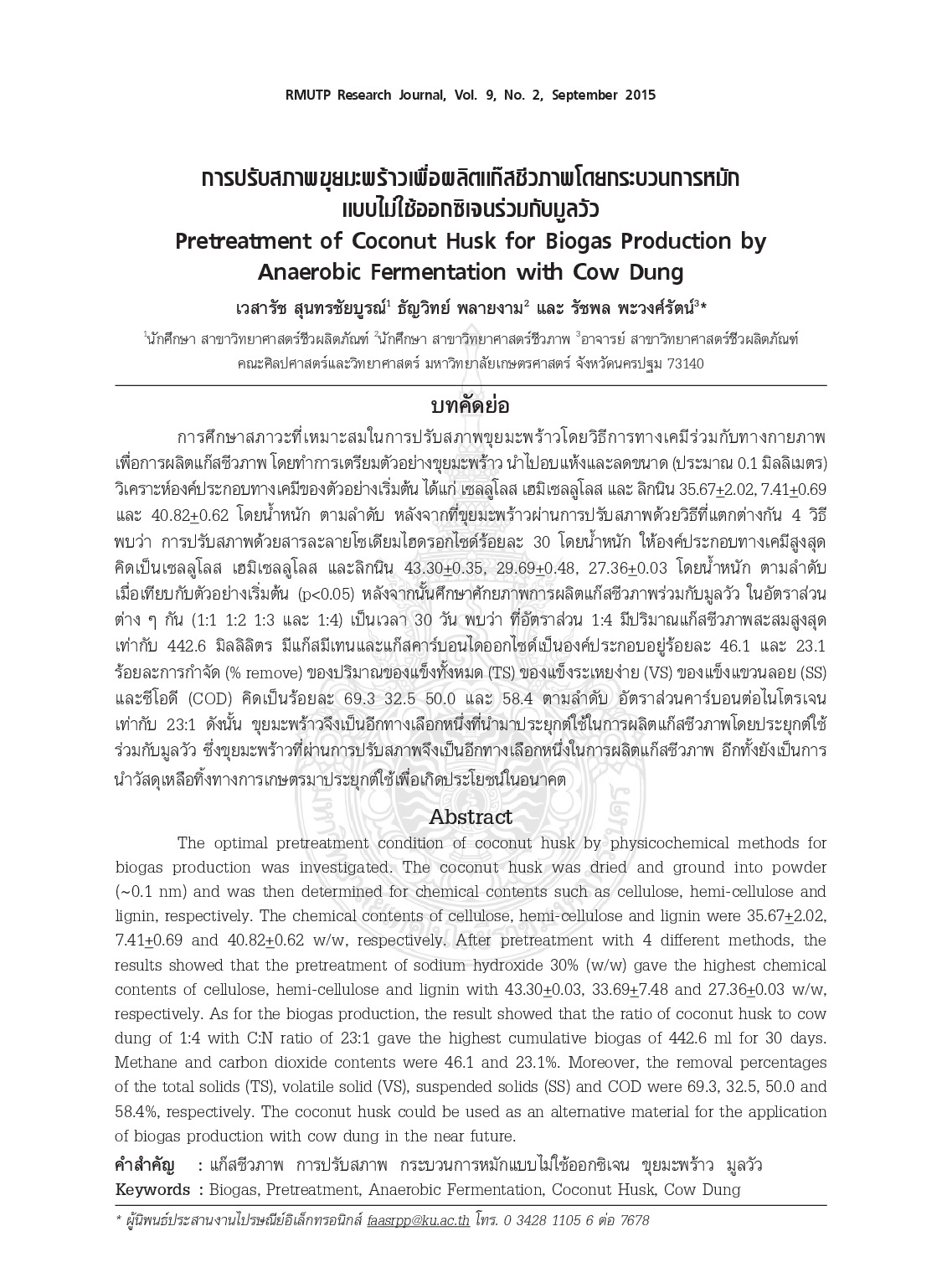
การปรับสภาพขุยมะพร้าวเพื่อผลิตแก๊สชีวภาพโดยกระบวนการหมักแบบไม่ใช้ออกซิเจนร่วมกับมูลวัว
The optimal pretreatment condition of coconut husk by physicochemical methods for biogas production was investigated. The coconut husk was dried and ground into powder (~0.1 nm) and was then determined for chemical contents such as cellulose hemi-cellulose and lignin respectively. The chemical contents of cellulose hemi-cellulose and lignin were 35.67±2.02 7.41±0.69 and 40.82±0.62 w/w respectively. After pretreatment with 4 different methods the results showed that the pretreatment of sodium hydroxide 30 % (w/w) gave the highest chemical contents of cellulose hemi-cellulose and lignin with 43.30±0.03 33.69±7.48 and 27.36±0.03 w/w respectively. As for the biogas production the result showed that the ratio of coconut husk to cow dung of 1:4 with C:N ratio of 23:1 gave the highest cumulative biogas of 442.6 ml for 30 days. Methane and carbon dioxide contents were 46.1 and 23.1 %. Moreover the removal percentages of the total solids (TS) volatile solid (VS) suspended solids (SS) and COD were 69.3 32.5 50.0 and 58.4 % respectively. The coconut husk could be used as an alternative material for the application of biogas production with cow dung in the near future.
Biogasification from rice straw
The research is to present the biogas production from rice straws with anaerobic digester. Firstly three digester tanks contain dry rice straw 3 kg slice with length 1-2 inch and water 60 lite. Digester A was a control sample. Digester B was designed for minimum performance (add the morass 2 lite) while the digester C was designed for Carbon/Nitrogen control (add urea 1 kg.). The biogas was operated for 30 days and measured which highest percent of Lower Explosive Limit was 93%. This studied show the simple methods to producing the biogas from the rice straw.
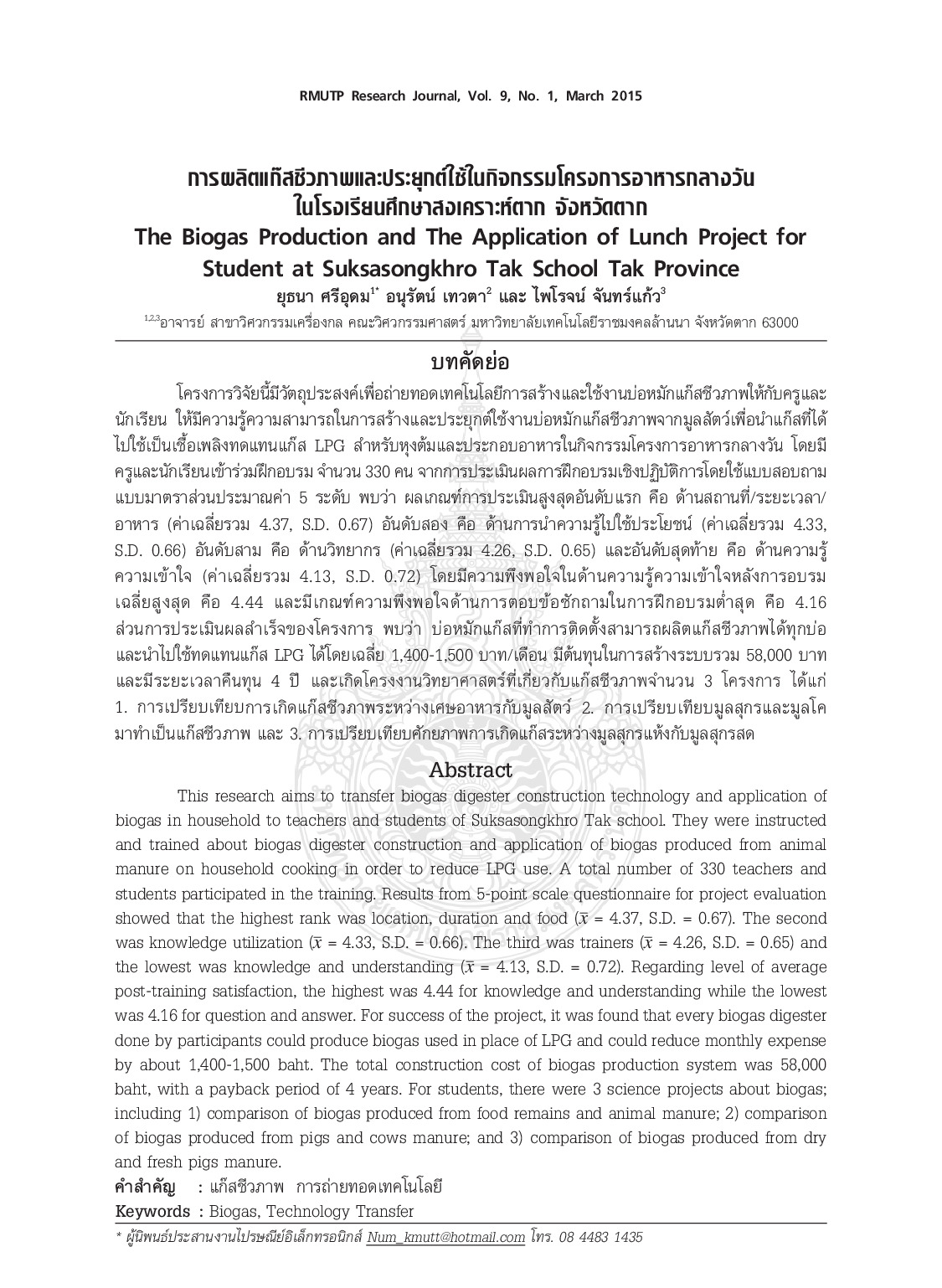
The biogas production and the application of lunch project for student at suksasongkhro tak school tak province
This research aims to transfer biogas digester construction technology and application of biogas in household to teachers and students of Suksasongkhro Tak school. They were instructed and trained about biogas digester construction and application of biogas produced from animal manure on household cooking in order to reduce LPG use. A total number of 330 teachers and students participated in the training. Results from 5-point scale questionnaire for project evaluation showed that the highest rank was location duration and food ( = 4.37 SD = 0.67). The second was knowledge utilization ( = 4.33 SD = 0.66). The third was trainers ( = 4.26 SD = 0.65) and the lowest was knowledge and understanding ( = 4.13 SD = 0.72). Regarding level of average post-training satisfaction the highest was 4.44 for knowledge and understanding while the lowest was 4.16 for question and answer. For success of the project it was found that every biogas digester done by participants could produce biogas used in place of LPG and could reduce monthly expense by about 1400 – 1500 baht. The total construction cost of biogas production system was 58000 baht with a payback period of 4 years. For students there were 3 science projects about biogas; including 1) comparison of biogas produced from food remains and animal manure; 2) comparison of biogas produced from pigs and cows manure; and 3) comparison of biogas produced from dry and fresh pigs manure.
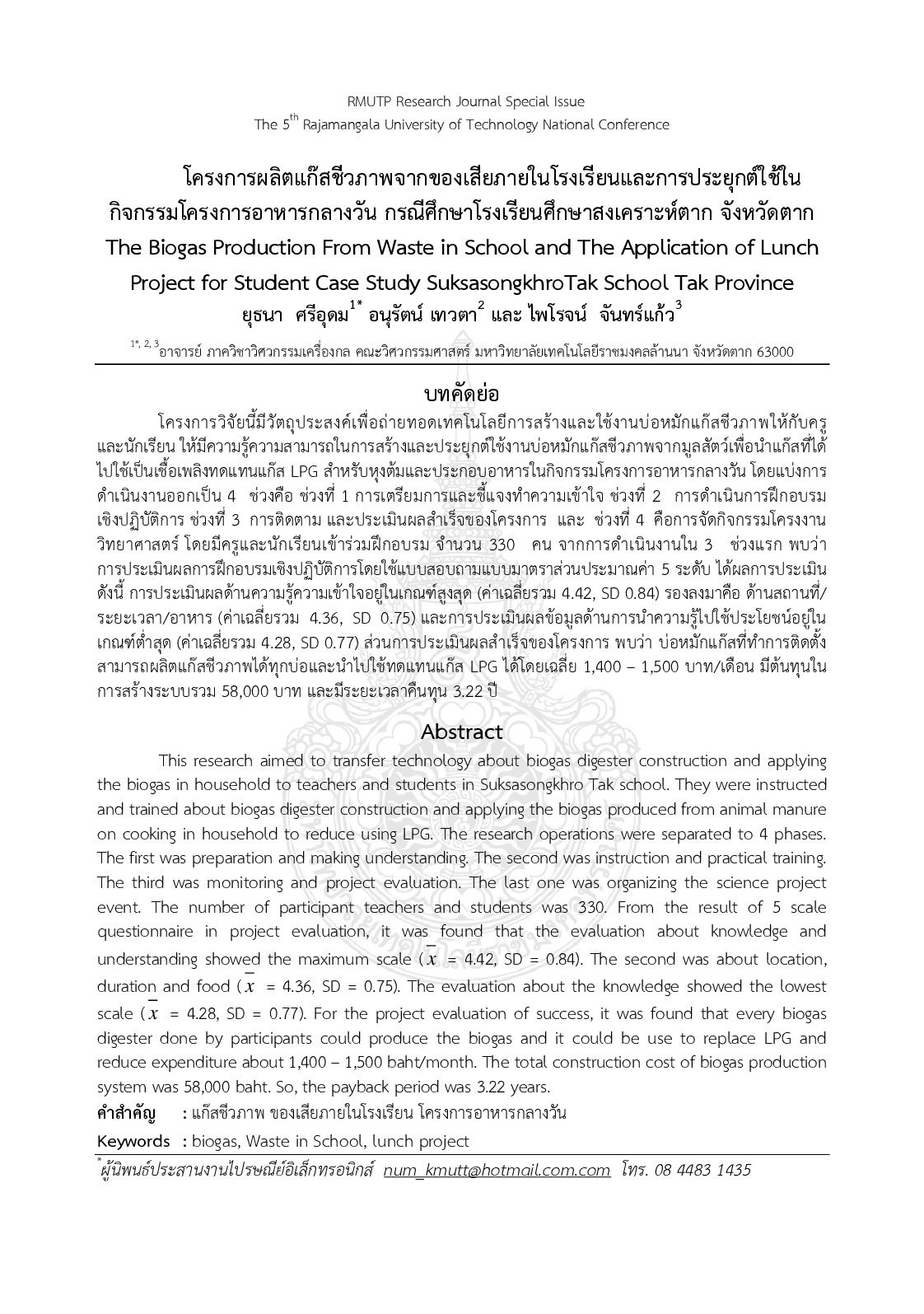
The biogas production from waste in school and the application of lunch project for student case study suksasongkhro tak school tak province
This research aimed to transfer technology about biogas digester construction and applying the biogas in household to teachers and students in Suksasongkhro Tak school. They were instructed and trained about biogas digester construction and applying the biogas produced from animal manure on cooking in household to reduce using LPG. The research operations were separated to 4 phases. The first was preparation and making understanding. The second was instruction and practical training. The third was monitoring and project evaluation. The last one was organizing the science project event. The number of participant teachers and students was 330. From the result of 5 scale questionnaire in project evaluation it was found that the evaluation about knowledge and understanding showed the maximum scale ( = 4.42 SD = 0.84). The second was about location duration and food ( = 4.36 SD = 0.75). The evaluation about the knowledge showed the lowest scale ( = 4.28 SD = 0.77). For the project evaluation of success it was found that every biogas digester done by participants could produce the biogas and it could be use to replace LPG and reduce expenditure about 1400 – 1500 baht/month. The total construction cost of biogas production system was 58000 baht. So the payback period was 3.22 years.