จำนวน Repository ( 13 )

Particle swarm optimization based NBTI modeling for finFET circuits
Fin Field Effect Transistor (FinFET) technology has increasingly been adopted for use within integrated circuits thanks to its superior electrical integrity and scalability. However a steady increase in vulnerability of FinFET circuits to negative bias temperature instability (NBTI) has recently become one of the major lifetime reliability problems. In this paper we propose a simulation framework to address NBTI in combinational circuits implemented with 14-nm tri-gate FinFET predictive technology. Particle swarm optimization (PSO) algorithm is applied to construct an accurate long-term NBTI degradation model from cycle-by-cycle data history. The proposed simulation methodology provides accurate results with high efficacy in computation time compared to reference models. From the proposed framework the average delay degradation for all experimental circuits under normal operation after 10-year NBTI stress is approximately 6% yet temperature variation in the circuit strongly influences NBTI degradation.
Design of cmos voltage reference circuit
This paper presents a CMOS voltage reference design which is widely used in electronic circuits both analog and digital circuits. In the conventional a CMOS voltage reference circuit design composed of several MOS transistors and complicated circuits the output voltage cannot be adjusted to any levels. Therefore in this paper proposed the CMOS voltage reference circuit design technique based on a new current combination circuit which it was reduced number of MOS transistors and the proposed circuit is able to operate without complex startup circuit. The performance of the proposed circuit is confirmed through PSPICE simulation results the circuit can be operated with supply voltage varies from 2V to 4V the output voltage reference is about 231 2mV at wide temperature range of -80 to 120 it has very low temperature coefficient of about 37.65 ppm/ and a total power dissipation of 7.37 W
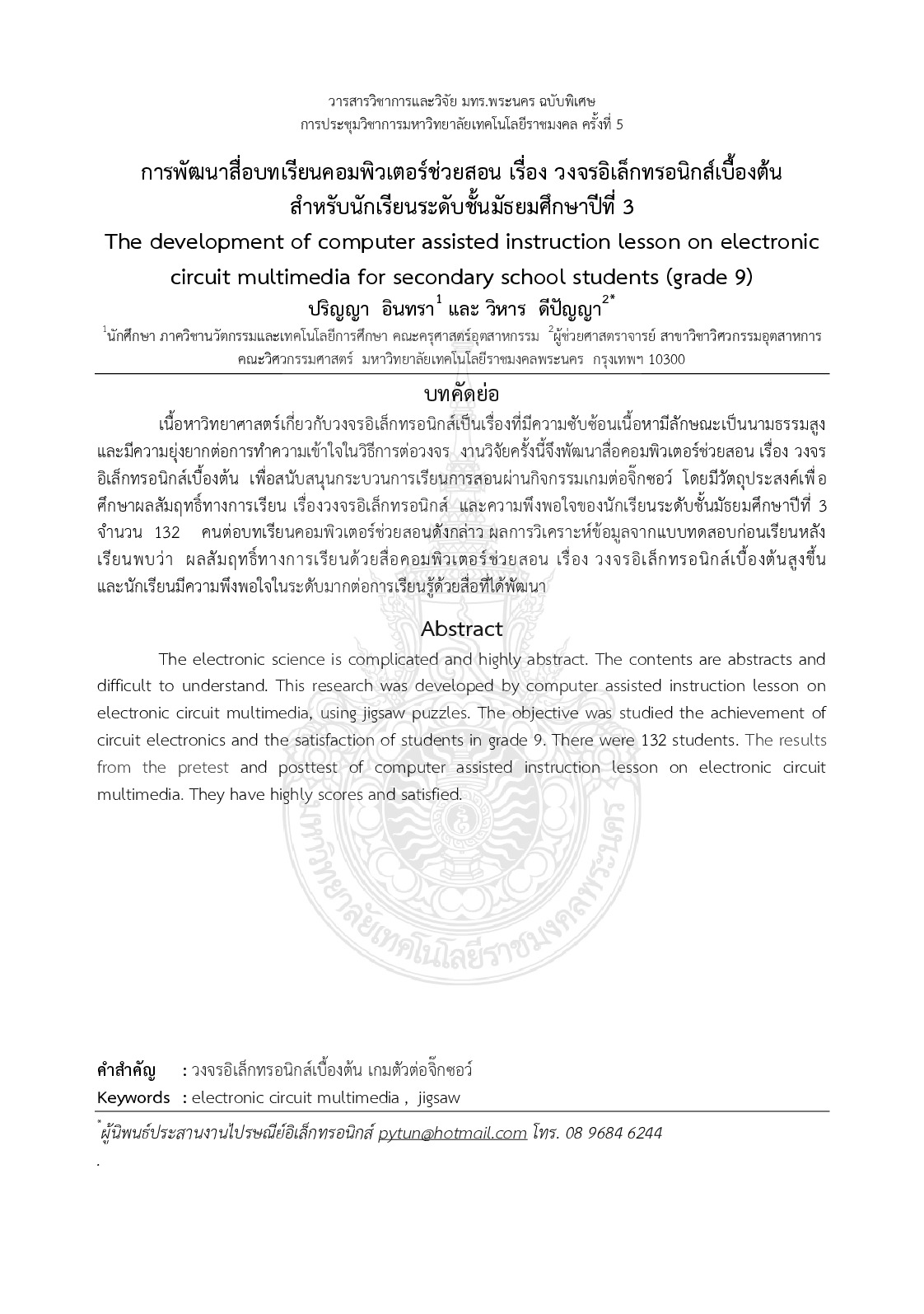
The development of computer assisted instruction lesson on electronic circuit multimedia for secondary school students (grade 9)
The electronic science is complicated and highly abstract. The contents are abstracts and difficult to understand. This research was developed by computer assisted instruction lesson on electronic circuit multimedia using jigsaw puzzles. The objective was studied the achievement of circuit electronics and the satisfaction of students in grade 9. There were 132 students. The results from the pretest and posttest of computer assisted instruction lesson on electronic circuit multimedia. They have highly scores and satisfied.
การสร้างและหาประสิทธิภาพบทเรียนคอมพิวเตอร์ช่วยสอนเรื่อง วงจรอิเล็กทรอนิกส์เบื้องต้น สำหรับนักเรียนระดับชั้นมัธยมศึกษาปีที่ 3
The purpose of this research were to create and determine the efficiency of computer assisted instruction lesson on electronic circuit multimedia for secondary school students (grade 9) Triamudomsuksanomklaononthaburi school. The research sample consisted of 120 students of secondary school students (grade 9) during semester 2 in the academic year of 2012. The data were analyzed using mean standard deviation level of difficulty and discrimination power. The results found as follows : The efficiency of computer assisted instruction lesson electronic circuit multimedia for secondary school students (grade 9) is 80.15/83.35 and the students’ satisfaction with the computer assisted instruction lesson electronic circuit multimedia was at highest level ( = 4.60 S.D = 0.74)
Bidirectional resonant converter using duty cycle voltage control for CCTV solar energy
This paper proposes the bidirectional resonant converter with duty cycle voltage control using for CCTV with solar energy. The converter designed at 20 KHz for 20 W with 92.85 % of efficiency is operated at zero voltage switch mode for reducing the losses of converter. The modes of operation divide in two modes for operating bidirectional current. The first part is buck mode which has 5 volt at the output voltage and second is boost mode which has 8 volt at the output voltage. The two operation modes of converter will be discussed in this paper.