จำนวน Repository ( 9 )
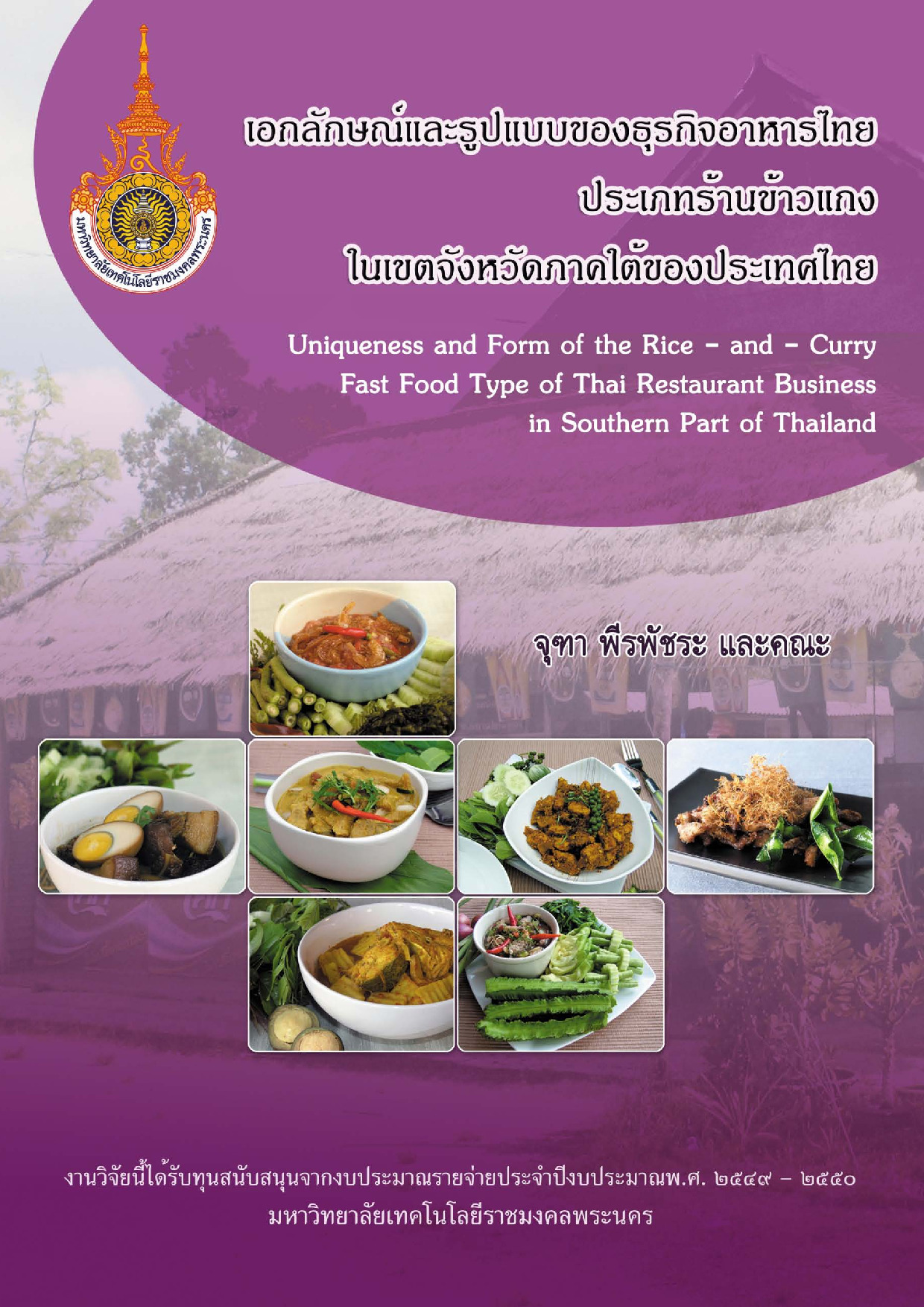
Uniqueness and Form of the Rice - and - Curry Fast Food Type of Thai Restaurant Business in Southern Part of Thailand
The research on uniqueness and form of the rice-and-curry fast-food type of Thai restaurant business in southern part of Thailand is a combined quantitative and qualitative research which aims to study the uniqueness of the rice-and-curry fast-food type of Thai restaurant business in terms of raw materials and cooking method. It has three main purposes: to study the form of the rice-and-curry fast-food type of Thai restaurant business in terms of administration decoration and sale in order to compare the uniqueness of Thai rice-and-curry fast-food in each province; to compare the form of rice-and-curry fast-food type of Thai restaurant business in each province; and to organize standard recipes for Thai rice-and-curry fast-food in southern provinces of Thailand. The sample used in this research were rice-and-curry fast-food shops from Nakhon Sri Thammarat Krabi Phang-nga Songkhla and Satun provinces - 5 shops each - with a total of 25 shops. The tool used in this study consisted of survey questionnaire food test questionnaire and record form for food recipe raw materials and equipment. Data were collected bymeans of survey and interview and were statistically analyzed for frequency and percentage together with a qualitative analysis.
การพัฒนาผลิตภัณฑ์พริกแกงสำเร็จรูปเพื่ออุตสาหกรรมการส่งออก
Development Project of instant Thai curry products for export industry aimed to conduct the process of making curry to have shelf-life extension and transfer this knowledge and technology to community entrepreneur and private organizations for industrial productivity with quality ready-to cook and tasty delicacy curry paste. It also helps adding value for the market and the export which is correspond with the policy of promoting Thailand as Kitchen ofthe World Since 2006 the research on curry paste process and developed recipe included 5 types of curry; red curry green curry Pha-naeng curry Tai PIa curry (Fish innards curry) and Thai Tom Yum curry. The result of the study was found that the overall satisfaction level of the consumer was accepted for curry powder because it lasted and was ready to cook. As for the research in 2007 it focused on the shelf-life extension of Thai instant curry and was developed by testing for its quality by physical chemical microbial and sensory evaluation. It was found that Thai instant curry lasted for more than 8 months. When developed to use in the factory the quality of curry was not different from the one produced in the laboratory except currys weight after drying which was less; however the result was accepted. In this case the quality of raw material temperature and drying period should be controlled constantly. The researcher transferred this knowledge and technology to the community and target private organization twice. The first time held on Instant Curry Course at the Faculty of Home Economics Technology between 30 June -1 July 2007. The second time was the training course for Organic community in Khon Kaen province between 21-22 July 2007. The result of the technology transfer was found that 94.6 % of the participants satisfaction was accepted and after the course was finished the target groups applied this knowledge and technology for their careers to increase communitys income. It is regarded that this project was accomplished according to its success in the goal and objectives.
Development of Thai Instant Curry Products for Export Industry
The results revealed that the methods were done by various ways. It was found that Tom Yum curry was developed into instant Thai Tom Yum curry powder by drying Tom Yum set in the hot air oven and grinding into powder. Red curry was developed by blending the ingredients together to make curry paste drying the paste and grinding into powder. Green curry was developed into dry and wet combination and curry powder. After being sterilized the dry one was dark in color and gave different taste and smell from fresh green curry paste. The latter was similar to green curry powder. Pa-naeng curry was developed by drying the curry paste in the hot air oven. It was considered as the good property of curry. Whereas Pa-naeng curry cube can be produced by combining with chemical substances and forming the cube by using the blocking machine. Tai Pla curry (Fish innards curry) was developed into powder type by blending the ingredients together to make Tai Pla curry drying the paste and grinding into powder. It was seen that all of curry powder could be kept longer and easily.

การพัฒนาผลิตภัณฑ์ขนมหม้อแกงแก่นตะวันผงเพื่อสุขภาพ
The purposes of this research were developing for health Thai custard dessert (Khanom Maw Kaeng) by using the Jerusalem artichoke powder and cereal cream instead of coconut cream. By using Jerusalem artichoke powder 3 types and 3 levels at 2 % 4 % and 6% the result of sensory evaluation from 40 nutrition experts had showed that using Jerusalem artichoke powder at 2% and 4% had been no significant difference at P<.05. The testing of custard with 4% of Jerusalem artichoke powder was receiving the result from a hundred consumers by the overall liking test using 9-point hedonic scale a hundred consumers rated the products like moderately to very and 100% of consumers accepted the product. Hardness of product was being 319.72 firmness was being 230.83 cohesiveness was being 0.17 and difficulty of crunch was being 24.85. The result of a physical attributes; the facial color was being bright at L* 37.13 the color value of green to red was being a* 8.27 and blue to yellow was being b* 12.15. But the color of product was being bright at L* 46.52 the color value of green to red at a* 5.06 and blue to yellow at b* 14.34 and the results of chemical factor were being; relative humidity was being 37.71 protein was being 14.36 fat 3.21 Ash 0.79 dietary fiber 3.23 total dissolved solid was being 33.27 carbohydrate was being 40.70 and total energy was being 249.13 respectively.