จำนวน Repository ( 34 )

การพิมพ์สีครั่งบนผ้าฝ้ายและผ้าพอลิเอสเตอร์โดยไม่ใช้การมอร์แดนท์สำหรับผู้ประกอบการรายย่อย
This research had an aim for studying the printing process of LACCIFER LACCA KERR. (LAC) on cotton and polyester fabric. The Lac dye was extracted by using Sodium hypochlorite solution Sodium hydroxide Hydrogen peroxide and diethyl ether then Acetic acid was used for dye sedimentation. Thenthe printing condition and color fastness to washing crocking and light were examined. The efficiency of solution for extraction process were found Diethyl ether > Sodium hypochlorite solution > Sodium hydroxide > Hydrogen peroxide respectively. The hot air was suitable fixation process for cotton and polyester printing. The cotton fixation was 150oC for 5 minutes it is 11.87 in color strength. And the polyester fabric was fixed at 220oC for 3 minutes the 8.27 color strength was shown. The both of cotton and polyester were printed with Lac dye had the good color fastness to crocking and light and moderate in washing fastness. This study can apply the Lac dye on cotton and polyester fabric by a printing technique without mordanting. Then it can reduce some chemicals in the textile printing industry. This process can applied and transfer for small enterprise for Lac value added appication.
การศึกษาผ้าลายอย่างโบราณสำหรับออกแบบผลิตภัณฑ์เครื่องการศึกษาผ้าลายอย่างโบราณสำหรับออกแบบผลิตภัณฑ์องค์ประกอบการแต่งกายสตรีด้วยเทคนิคการพิมพ์ระบบดิจิทัลพริ้นต์
This research aimed to (1) study pattern from ancient fabrics (2) to study design of women’s apparel by digital printing techniques and (3) study the satisfaction women’s apparel in 3 designs consisting of printed fabric with four-petaled diamond design in a trellis pattern Printed fabric with design in a puttern pattern. The population was 100 assessors within the age range 35 - 40 yearn in Phra Nakhon Bangkok. The research instrument was a questionnaire. Data were statistically analyzed for Percentage Mean and Standard Deviation. Results showed that most respondents ages 31 - 35 years being single earning from 15000 - 25000 bath. Most got bachelors degree Working private business and used to use women’s apparel by printed fabric choose to buy/use your own style purchase from the opportunity to be used motivated by personal preferences and selection issues from shapes. The satisfaction of the respondents towards womens apparel products has a high level of average in all 3 products according to the following average values: shawls with an average of 4.10 shoulder bags with an average of 4.03 and hats with an average of 3.72. The decision to buy when the product is released. Interested in choosing to order products online most. The products that are most interested in buying are shoulder bags. The pattern that is most interested in buying is diamond design in a trellis pattern. The factors that make the decision to buy the most are the pattern and colour of the product.
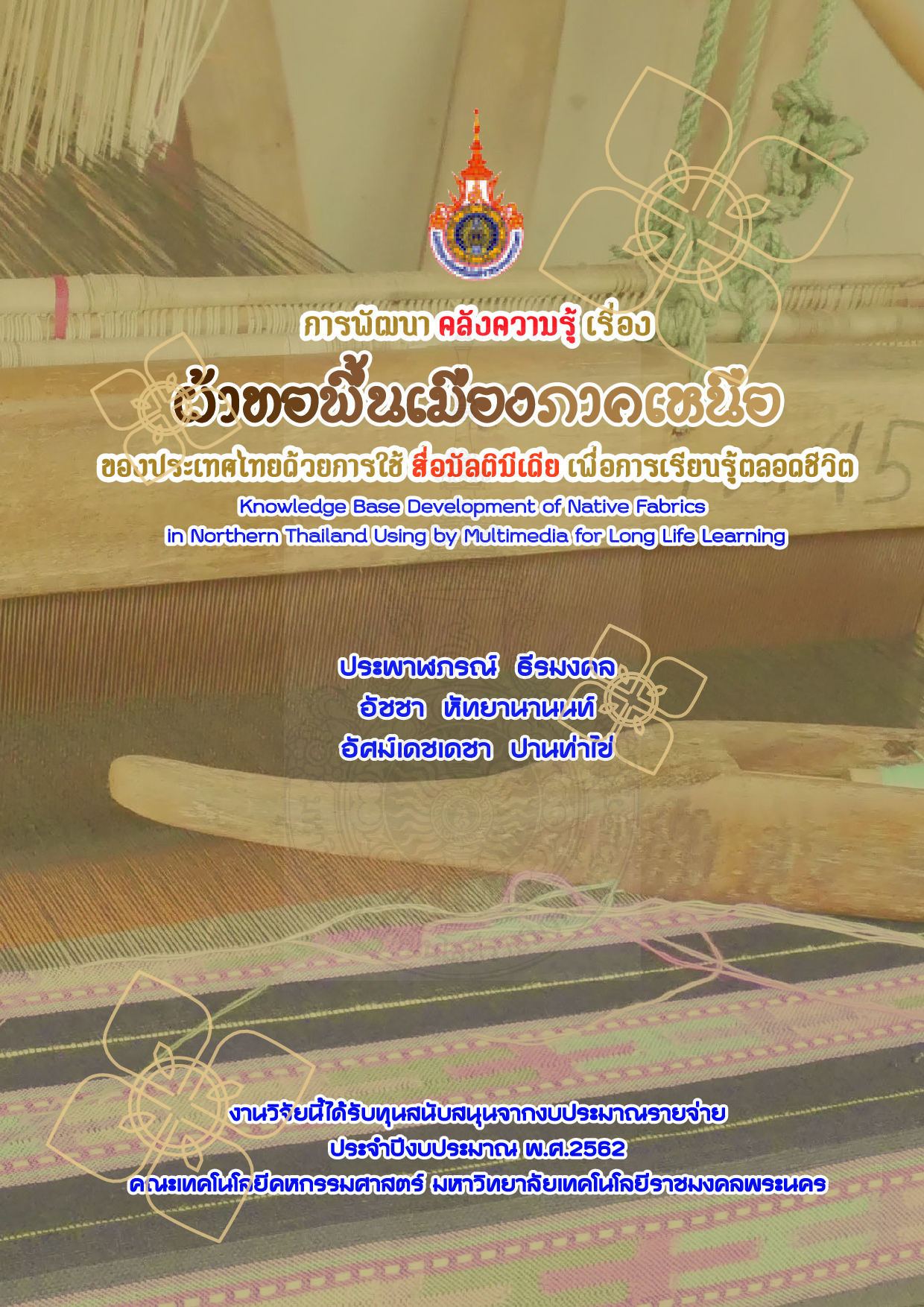
การพัฒนาคลังความรู้เรื่องผ้าทอพื้นเมืองภาคเหนือของ ประเทศไทยด้วย การใช้สื่อมัลติมีเดียเพื่อการเรียนรู้ตลอดชีวิต
This research is the development of the knowledge base on local textiles of northern Thailand by using multimedia for lifelong learning. The aim is to study compile and gather information of local cloths in northern Thailand. Develop a knowledge base by using multimedia on the local textiles of northern Thailand for lifelong learning and transferring knowledge and disseminating the knowledge base on northern Thai fabric by using multimedia for lifelong learning to the community. The research team proceeded to gather primary knowledge from the roots of the researchers who are interested in the local woven fabric. Therefore proceeding further knowledge in the upper reaches from literature reviews Including from field trips for data collection through in-depth interviews with important people Interviewing people who have knowledge about social context community local weaving characteristics weaving characteristics name of pattern type of fabric weaving technique of local textiles in northern Thailand in 9 provinces as well as studying primary data from textbooks textbooks and technical documents and in the internet. Thus the research shown that into 3 parts which are 1. Ethnic groups of Northern Thailand 2. Local woven fabric in northern Thailand and 3. Woven process and pattern. After that the knowledge library was developed by using multimedia on the local textiles of Northern Thailand for lifelong learning. This research can summarize the results in the form of a written description showing that the northern region of Thailand in the past was the Lanna Kingdom area. In the area of Xishuangbanna Before moving to the north of Thailand including the Tai Lue Tai Kheen Thai people Tai Yai people Meng (Mon) Lua people villages scattered throughout the highlands of the Lanna region such as Karen (Pak Kahen M) Mien (Yao) Hmong (Meo) Akha (Akha) Lahu (Mso) Lisu. In addition there are some groups in the Lanna fringe such as Khmu Labri (Tong Lueang). Each ethnic group has its own unique style especially Common skirt Has the same basis with the resin head the resin body and the resin tip but each part is not woven differently Have different colors Some ethnicities have a section called Lep which is the part that the weaver often weaves to keep the thread as for knowledge transfer. The research created a book Local woven cloth consists of videos from local knowledge sources and digital documents and to make the transfer of knowledge more complete Therefore held a forum and exhibition on the topic primary fabric of Lanna Kingdom as a medium for those interested in Local woven fabrics in the Lanna Kingdom of Thailand attended. Exchange ideas from various sources of knowledge from the research. While also receiving multimedia for lifelong learning from the inquiry regarding the satisfaction of the participants. The Keynote speakers are interesting and event condition caused the interest in the knowledge content that used to organize the exhibition. Overall the work is most satisfied.
การพัฒนารูปแบบเครื่องนุ่งห่ม จากผ้าทอพื้นเมือง จังหวัดพิษณุโลก
The research entitled “Development of Designed Clothing from Native Woven Fabrics of Phitsanulok” aims to 1) investigate the information of Phitsanulok’s native woven fabric patterns 2) develop designed clothing from native woven fabrics of Phitsanulok and 3) measure the consumer satisfaction for the clothing from native woven fabrics of Phitsanulok. The sample of this research comprised 398 working age women selected by using the accidental sampling technique form working age woman resided in Mueang district of Phitsanulok province. The questionnaire and clothing prototypes were used as a tool for the consumer satisfaction data collecting. The descriptive used for statistical analysis in the study were the frequency percentage arithmetic mean and standard deviation.
การพัฒนาเครื่องประกอบการแต่งกายจากผ้าย้อมคราม จังหวัดสกลนคร
This project was for the development of apparel accessories from indigo dyed fabrics in Sakon Nakhon Province. This project aims to bring indigo dyed fabrics to be developed into apparel products in UNISEX pattern so that it put on in everyday life and used all genders without restrictions. Today the sexual choices increase to introduce the concept of UNISEX pattern as an alternative. From the questionnaire the consumer needs the apparel accessories could be used in everyday life by using the principles of apparel accessories as a guide to design. Color tone used cool color (Cool Hues). 0The cool color was comfortable. The project maker chose to use indigo dyed fabric to make prototype products and also increase the value of indigo dyed fabric as well. 0 The samples used 100 people who interested in textile products at Chatuchak Market. The tools used questionnaires. The collected data were interview. The statistics used percentage. The study indicated that analysis assessed on the material shape products and the strength. Using silk indigo dyeing products were suitable in 78 percent and the material products were suitable in 42 percent. The shapes of products were suitable in the bag 64 percent and shoes 55 percent respectively. The product color was 64 percent and the durable strength for use in 52 percent.