จำนวน Repository ( 10 )

Development of a hydrogen gas purifier for improving the quality of biogas in fermentation process
Hydrogen sulfide (H25 cheap materials activated carbon scraped iron sand cement and rice husks applied to the small scale biogas production at 30 ppm within 6 hours. The filter materials with highest to lowest H48.18 percent respectively. In the medium scale biogas production (20 L) at 30 ppm. Scraped iron and sand mixed with activated carbon filter had the best H(200 L) production of the biogas fermentation (30 ppm biogas product) sand mixed with activated carbon filter at the ratio 60:40 displayed the best performances in removing H2(3 day). It is the most environmental friendliness as well as cost-effective filter for biogas fermentation at scale up sizes at least 20 L. S) is found to be one major serious contaminant to biogas production system. In this research the team aimed to develop a high efficient filter for removing H2S from the biogas reaction. From all 2S absorptivity were activated carbon sand scraped iron and rice husks those accounted for 88.02 76.06 55 50 and 2S absorptivity (100 percent) and sand showed its H2S removal efficiency lower at 65 percent respectively. In larger scale S after incubated for 4.5 hours while scraped iron filter as well as activated carbon filter functioned in H2S removal longer time (2 and 3 days respectively). In order to be able to practically apply for continuous filtering H2S from the continuous biogas production sand mixed with activated carbon filter exhibited long last filtration
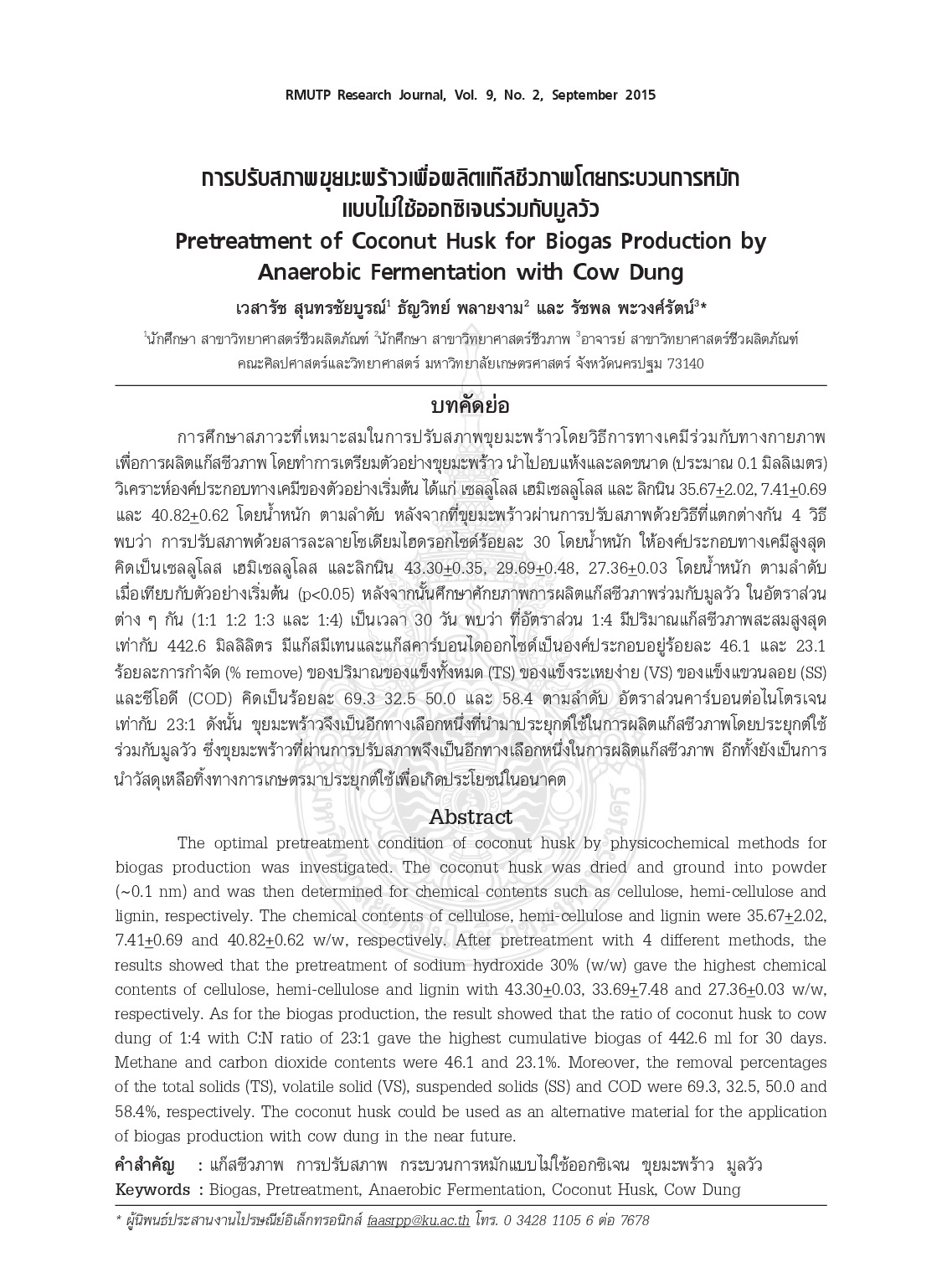
การปรับสภาพขุยมะพร้าวเพื่อผลิตแก๊สชีวภาพโดยกระบวนการหมักแบบไม่ใช้ออกซิเจนร่วมกับมูลวัว
The optimal pretreatment condition of coconut husk by physicochemical methods for biogas production was investigated. The coconut husk was dried and ground into powder (~0.1 nm) and was then determined for chemical contents such as cellulose hemi-cellulose and lignin respectively. The chemical contents of cellulose hemi-cellulose and lignin were 35.67±2.02 7.41±0.69 and 40.82±0.62 w/w respectively. After pretreatment with 4 different methods the results showed that the pretreatment of sodium hydroxide 30 % (w/w) gave the highest chemical contents of cellulose hemi-cellulose and lignin with 43.30±0.03 33.69±7.48 and 27.36±0.03 w/w respectively. As for the biogas production the result showed that the ratio of coconut husk to cow dung of 1:4 with C:N ratio of 23:1 gave the highest cumulative biogas of 442.6 ml for 30 days. Methane and carbon dioxide contents were 46.1 and 23.1 %. Moreover the removal percentages of the total solids (TS) volatile solid (VS) suspended solids (SS) and COD were 69.3 32.5 50.0 and 58.4 % respectively. The coconut husk could be used as an alternative material for the application of biogas production with cow dung in the near future.
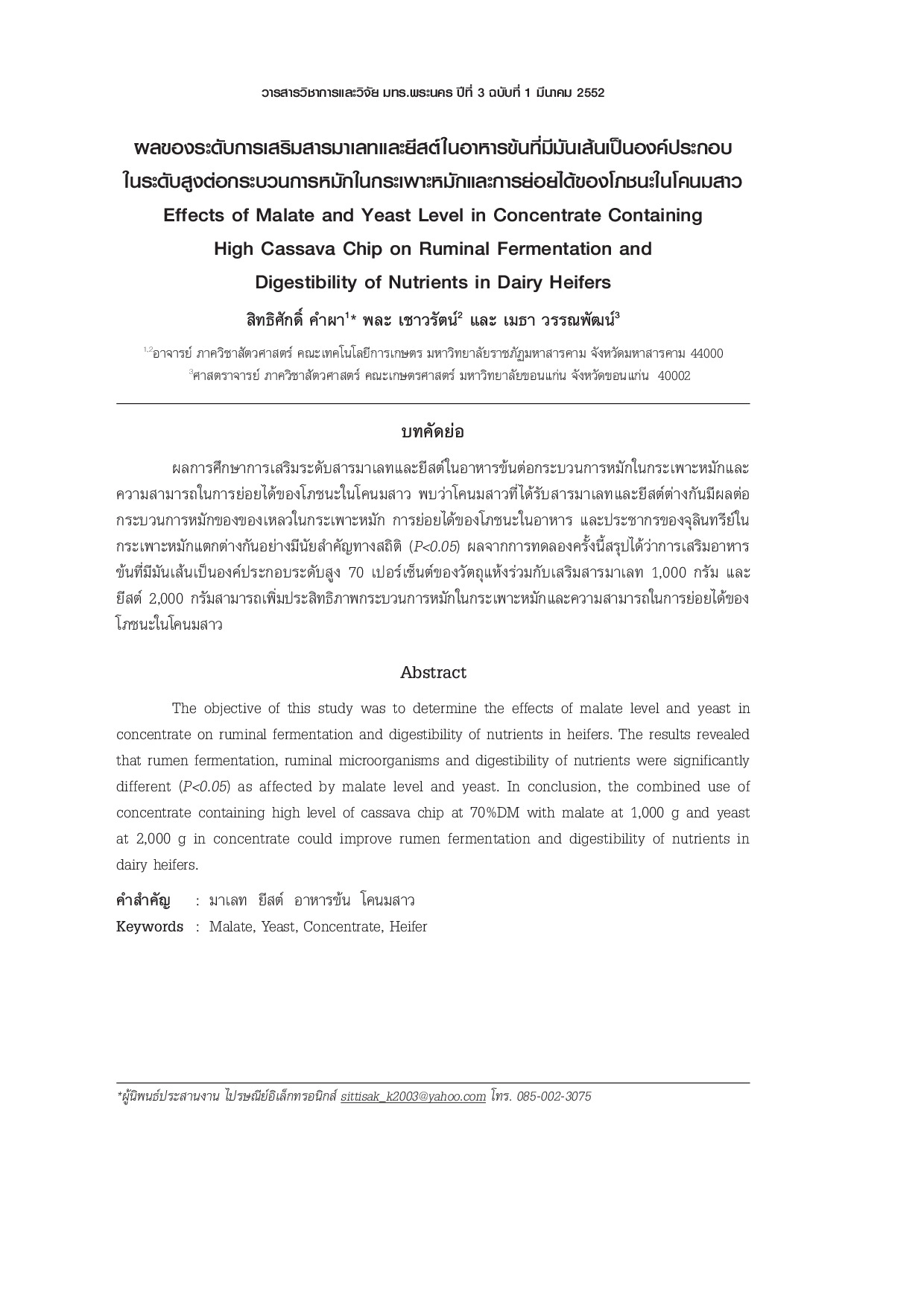
Effects of Malate and Yeast Level in Concentrate Containing High Cassava Chip on Ruminal Fermentation and Digestibility of Nutrients in Dairy Heifers
The objective of this study was to determine the effects of malate level and yeast in concentrate on ruminal fermentation and digestibility of nutrients in heifers. The results revealed that rumen fermentation ruminal microorganisms and digestibility of nutrients were significantly different (P<0.05) as affected by malate level and yeast. In conclusion the combined use of concentrate containing high level of cassava chip at 70%DM with malate at 1000 g and yeast at 2000 g in concentrate could improve rumen fermentation and digestibility of nutrients in dairy heifers.
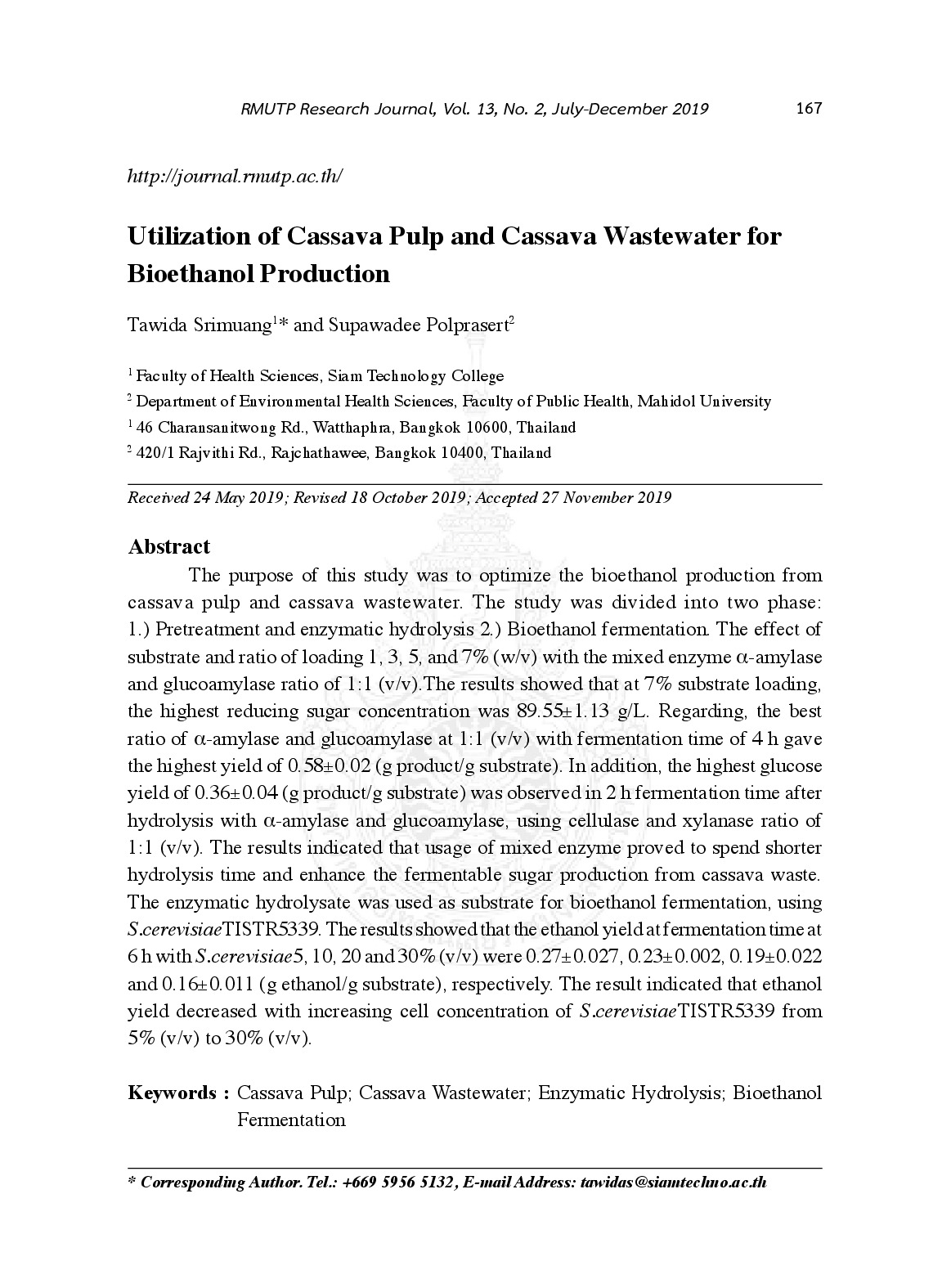
Utilization of cassava pulp and cassava wastewater for bioethanol production
The purpose of this study was to optimize the bioethanol production from cassava pulp and cassava wastewater. The study was divided into two phase: 1.) Pretreatment and enzymatic hydrolysis 2.) Bioethanol fermentation. The effect of substrate and ratio of loading 1 3 5 and 7% (w/v) with the mixed enzyme α-amylase and glucoamylase ratio of 1:1 (v/v).The results showed that at 7% substrate loading the highest reducing sugar concentration was 89.55±1.13 g/L. Regarding the best ratio of α-amylase and glucoamylase at 1:1 (v/v) with fermentation time of 4 h gave the highest yield of 0.58±0.02 (g product/g substrate). In addition the highest glucose yield of 0.36±0.04 (g product/g substrate) was observed in 2 h fermentation time after hydrolysis with α-amylase and glucoamylase using cellulase and xylanase ratio of 1:1 (v/v). The results indicated that usage of mixed enzyme proved to spend shorter hydrolysis time and enhance the fermentable sugar production from cassava waste. The enzymatic hydrolysate was used as substrate for bioethanol fermentation using S.cerevisiaeTISTR5339. The results showed that the ethanol yield at fermentation time at 6 h with S.cerevisiae5 10 20 and 30% (v/v) were 0.27±0.027 0.23±0.002 0.19±0.022 and 0.16±0.011 (g ethanol/g substrate) respectively. The result indicated that ethanol yield decreased with increasing cell concentration of S.cerevisiaeTISTR5339 from 5% (v/v) to 30% (v/v).
การย่อยสลายภายใต้สภาวะไร้อากาศของสารอินทรีย์ประเภทเศษอาหารเข้มข้นในกระบวนการผลิตแก๊สชีวภาพ
The purposes of this research were to investigate anaerobic digestion of concentrated food waste in biogas production system at mesophilic temperature (37 C). The effect of grinding and pH controlled at 6.20 and 7.00 on methane production were also studied. It was found that the ability of mix bacteria which had initial concentration of 2100 mg/l for digesting concentrated food waste with grinding was higher than that without grinding because of the increase in surface area (about 1.37 time). In this system the optimum condition for bacteria growth was found at pH 7.00. Under optimal condition the digestion efficiency in term of chemical oxygen demand (COD) removal was 18.81% higher corresponding to an increase in methane production rate (19.10%) than other conditions