จำนวน Repository ( 20 )

ความเป็นพิษร่วมกันระหว่างพอลิไซคลิกอะโรมาติกไฮโดรคาร์บอนกับไทรทรอนเอ็กซ์-100 หรือทวีน 80 ต่อการเจริญเติบโตระยะต้นกล้าของบานเย็นและกระเจี๊ยบเขียว
Use of synthetic surfactant is another choice to increase efficiency of polycyclic aromatic hydrocarbon (PAH) phytoremediation in soil. In this study the toxicity of soil contaminated with anthracene and fluoranthene at total concentration as 0 200 and 800 mg/kg in combination with 2 synthetic surfactants that were triton x-100 and tween 80 at concentration as 0 1 and 10 times of critical micelle concentration (CMC) on seedling growth of Hibiscus sabdariffa and Mirabilis jalapa. Both synthetic surfactants were watered separately on day 13 after inoculation and seedling growth were measured on day 20 after inoculation. The result shown that both H. sabdariffa and M. jalapa could grow in soil contaminated with anthracene and fluoranthene at all concentrations in combination with both synthetic surfactants. Tween 80 at 1 time of CMC were the least toxic to H. sabdariffa while toxicity of all surfactants on M. jalapa were not different. Decrease of plant growth depended on the increasing of PAH concentration in soil. With these reasons both plants were possible to use for PAH phytoremediation at total concentration 200 mg/kg in combination with synthetic surfactant
The study of nutrient components in co-composted sludge, from serm suk co.,ltd. applied on brassica chinensis growth
The study of nutrient components in co-composted sludge from Serm Suk Co. Ltd. applied on Brassica chinensis growth had the objective to reduce the amount of waste from beverage processing which the factory did not eradicate properly. This experimental research helped reducing the problem of sludge eradication by using the sludge as a fertilizer. The experiment was divided into 2 sets. 1) The dried leaves and garbage 2) The dried leaves garbage and sludge. All sets have 60 . Collect data every 5 days. The growth rate of each part was measured including the height of trunk and number of leaves. Found that in the set 2 was the best nutrients the values are as follows organic matter is 30.64% (w/w) carbon is 17:11% (w/w) the ratio of carbon : nitrogen is 22:1 total nitrogen is 0.80% total phosphorus is 0.43% and pH is 6.35. It also affected to the growth of the Brassica chinensis better than set 1 and set 3. The growth of the highest level at average at 7.7 cm and the average number of leaves at 4. This set was the best ratio for growing Brassica chinensis and reducing the waste from factory as well.
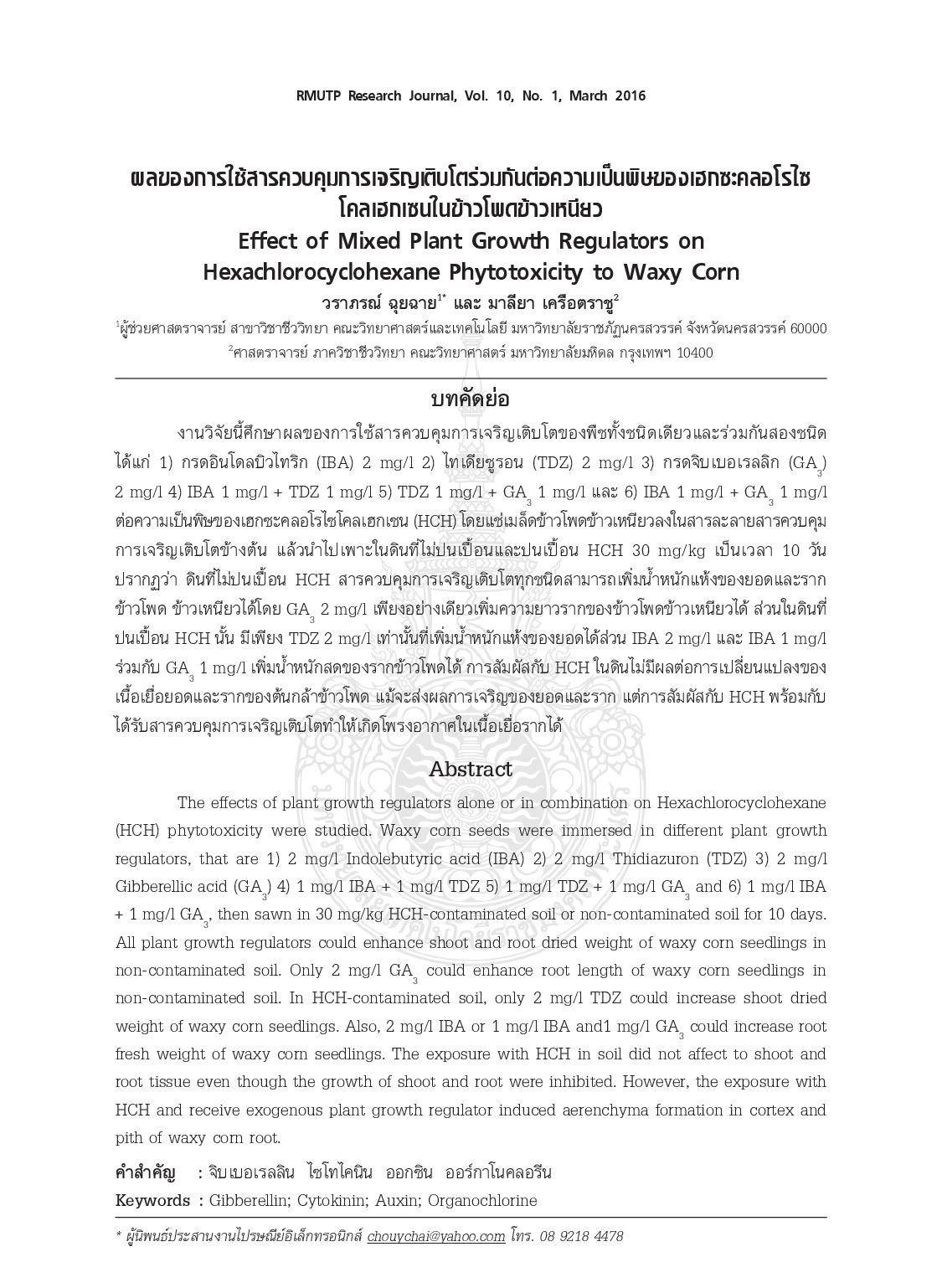
ผลของการใช้สารควบคุมการเจริญเติบโตร่วมกันต่อความเป็นพิษของเฮกซะคลอโรไซโคลเฮกเซนในข้าวโพดข้าวเหนียว
The effects of plant growth regulators alone or in combination on Hexachlorocyclohexane (HCH) phytotoxicity were studied. Waxy corn seeds were immersed in different plant growth regulators that are 1) 2 mg/l Indolebutyric acid (IBA) 2) 2 mg/l Thidiazuron (TDZ) 3) 2 mg/l Gibberellic acid (GA3) 4) 1 mg/l IBA + 1 mg/l TDZ 5) 1 mg/l TDZ + 1 mg/l GA3 and 6) 1 mg/l IBA + 1 mg/l GA3 then sawn in 30 mg/kg HCH-contaminated soil or non-contaminated soil for 10 days. All plant growth regulators could enhance shoot and root dried weight of waxy corn seedlings in non-contaminated soil. Only 2 mg/l GA3 could enhance root length of waxy corn seedlings in non-contaminated soil. In HCH-contaminated soil only 2 mg/l TDZ could increase shoot dried weight of waxy corn seedlings. Also 2 mg/l IBA or 1 mg/l IBA and1 mg/l GA3 could increase root fresh weight of waxy corn seedlings. The exposure with HCH in soil did not affect to shoot and root tissue even though the growth of shoot and root were inhibited. However the exposure with HCH and receive exogenous plant growth regulator induced aerenchyma formation in cortex and pith of waxy corn root.
Development of bone replacement material via nanohydroxyapatite crystal growth on silk fibroin fiber
The objective of this research is to propose a new way to fabricate a composite material for future bone replacement development via growing apatite crystal on silk fibroin fiber. Apatite crystallization on silk fibroin fiber was prepared by precipitation reaction between Ca(NO3)2 solution and (NH4)2HPO4 solution adjusted pH by NH4OH solution. In this work Effect of solution concentration and initial pH values was investigated on apatite crystals. Chicken eggshells were used as calcium source by heating sufficiently powdered eggshells at 1300 °C for 4 h to acquire CaO powders made Ca(NO3)2 solution by dissolving in 65% HNO3 solution. Prepared Ca(NO3)2 solutions were adjusted concentration as 3 levels and were adjusted different pH values of 7 8 and 9 respectively. For processing of apatite crystallization silk fibroin fibers were immersed in Ca(NO3)2 solutions for 30 min. After that (NH4)2HPO4 solutions were added in silk fibroin fibers immersed in Ca(NO3)2 solutions. Reaction time was fixed about 1 min before cleaning to remove impurity precipitates on surface of silk fibroin fiber. Finally apatite crystallization on silk fibroin fibers occurred. The obtained result can conclude morphologies of apatite crystals on silk fibroin fibers was sheets sphere and flower. Solution concentrations and initial pH values directly influenced on Ca/P ratio of obtained apatite crystals by Ca/P ratio increases as increased solution concentrations or increased pH values. Finally research silk fibroin fibers were woven as two patterns of plain weave and twill weave and they were investigated Young’s modulus and tensile strength. The result indicates that Young’s modulus of silk fibroin fiber sheets woven as twill weave and as plain weave were about 616 MPa and 425 Mpa and tensile strengths of them weave were about 40 Mpa and 72 Mpa respectively. The optimum condition of growing apatite crystals on silk fibroin fibers was sample of CP19. Design of silk fibroin fiber with plain weave was an optimum pattern for future biomedical applicaions.
Potential of extracts of Ficus hispida linn for controlling germination and Growth of Weed in Rice Field for Increase the value of biodiversity and its sustainable use
The potential of extracts of the Ficus hispida Linn to inhibit germination and growth of barnyardgrass (Echinochloa crus-galli) a common weed in rice. The bark leaves and fruit of F. hispida isolated by the Maceration and extracted by the polarity of the solvent (Sequential Extraction) with organic solvents such as hexane ethyl acetate and methanol when each part of the crude extract was tested the type of phytochemical tested for germinate inhibition root length inhibition stem length inhibition and dry weight inhibition of barnyardgrass and selected extracts with highest inhibition to separation using column chromatography the fractions tested repeating. The results showed that 1. Crude methanolic extracts from the bark leaves and fruit of barnyardgrass at a concentration of 3000 ppm showed highest inhibited percentage of germinate inhibition root length inhibition stem length inhibition and dry weight inhibition. 2. Fractions methanolic extracts from the bark leaves and fruit of barnyardgrass on a separate with column chromatography found that fractions extracts F5 F8 and F2 showed highest inhibited percentage of germinate inhibition root length inhibition stem length inhibition and dry weight inhibition.