จำนวน Repository ( 33 )

การวิเคราะห์และประเมินอุตสาหกรรมยานยนต์ของประเทศไทยด้วยวิธีการการวางแผนภาพวาดแห่งอนาคต
การวิจัยครั้งนี้เป็นการวิจัยเชิงคุณภาพที่เน้นศึกษาสถานการณ์ที่คาดว่าจะเกิดขึ้นในอนาคตเกี่ยวกับอุตสาหกรรมยายยนต์ไทยใช้เทคนิคการวิเคราะห์การวางแผนภาพวาดแห่งอนาคต โดยได้ทำการวิเคราะห์ข้อมูลผ่านขั้นตอนในการวิจัย 6 ขั้นตอน ได้แก่ ขั้นที่ 1 ระบุถึงความท้าทายที่จะส่งผลกระทบต่ออุตสาหกรรมยานยนต์ของประเทศไทย โดยเฉพาะอย่างยิ่งกลุ่มธุรกิจรถยนต์ ขั้นที่ 2 รวบรวมข้อมูลที่เกี่ยวกับอุตสาหกรรมยานยนต์ไทย โดยเฉพาะอย่างยิ่งกลุ่มธุรกิจรถยนต์จากการสอบถามผู้เกี่ยวข้องกับอุตสาหกรรมยานยนต์จำนวน 5 ราย และรวบรวมข้อมูลจากหนังสือพิมพ์ นิตยสารที่เกี่ยวข้อง สื่อออนไลน์ บทสัมภาษณ์ของผู้บริหารและบุคคลที่เกี่ยวข้องกับอุตสาหกรรมยานยนต์จากสื่อออนไลน์เพื่อนำมาใช้ในการวิเคราะห์ข้อมูลเพื่อ นำไปสู่การวางแผนภาพวาดแห่งอนาคตของอุตสาหกรรมยานยนต์ไทย ขั้นที่ 3 การระบุปัจจัยสภาพแวดล้อมทางธุรกิจที่ส่งผลกระทบต่อการดำเนินธุรกิจหรืออุตสาหกรรมปัจจัยสภาพแวดล้อมทางธุรกิจที่เป็นตัวขับเคลื่อน โดยใช้การวิเคราะห์ STEBNPDILE ขั้นที่ 4 กำหนดความไม่แน่นอนที่สำคัญที่อาจเกิดขึ้นในอนาคตของอุตสาหกรรมยานยนต์ไทย ขั้นที่ 5 สร้างภาพวาดแห่งอนาคตของอุตสาหกรรมยานยนต์ไทย ขั้นที่ 6 ระบุประเด็นของภาพวาดแต่ละภาพเพิ่มเติมและสร้างขอบเขตเรื่องราวที่เกี่ยวข้องกับอุตสาหกรรมยานยนต์ไทย ผลการวิจัยพบว่า ปัจจัยที่มีความสำคัญมากที่สุดในแง่ระดับความไม่แน่นอนและผลกระทบที่มีต่ออุตสาหกรรมยานยนต์ไทยได้แก่ ปัจจัยด้านเศรษฐกิจและปัจจัยด้านสภาพแวดล้อม ซึ่งนำไปสู่การกำหนดภาพวาดแห่งอนาคตของอุตสาหกรรมยานยนต์ไทย ได้ทำการกำหนดภาพวาดที่แตกต่างกันออกมา ภาพ ได้แก่ 4 ภาพวาดที่ 1 รถเพื่อชีวิต ภาพวาดที่ 2 นวัตกรรมเพื่ออนาคต ภาพวาดที่ 3 ไฟดับ และภาพวาดที่ 4 รถเพื่อการดำเนินชีวิต
ปัญหาการใช้ระบบการวางแผนทรัพยากรองค์กร (ERP)ในระบบงานบัญชี ของมหาวิทยาลัยเทคโนโลยี
The purposes of this study were to investigate problems regarding the use of enterprise resource planning (ERP) in Accounting Department of Rajamangala University of Technology Phra Nakhon and obtaine the results of the study as suggestions according to their personal data. The samples were 92 ERP users working in different departments based in Rajamangala University of Technology Phra Nakhon drawn from purposive sampling. The data were collected from a set of questionnaires and analyzed by the percentage frequency distribution percentage standard deviation (SD) t-test One-Way Analysis of Variance and the analysis of pairs applying Sheffe’s Method. The findings were revealed as follows. 1. The level of the problems regarding the use of Enterprise Resource Planning (ERP) in Accounting Department of Rajamangala University of Technology Phra Nakhon was in the average level. 2. The analysis of the problems regarding the use of Enterprise Resource Planning (ERP) in Accounting Department of Rajamangala University of Technology Phra Nakhon varied in their education levels study fields experiences using ERP the number of ERP trainings was not different at 0.05 statistical significance in the overall. 3. The analysis of the problems regarding the use of Enterprise Resource Planning (ERP) in Accounting Department of Rajamangala University of Technology Phra Nakhon varied in their experiences and job responsibilities using ERP the number of ERP trainings was different at 0.05 statistical significance in the overall.
ความสัมพันธ์ระหว่างวัฒนธรรมองค์กรกับระบบบริหารทรัพยากรองค์กร (ERP) ของมหาวิทยาลัยเทคโนโลยีราชมงคลพระนคร
The purposes of this study were to 1) compare the perception on the organization culture of the personnel with different demographic characteristics working at Rajamangala University of Technology Phra Nakhon 2) compare the effectiveness of the Enterprise Resource Planning (ERP) of the personnel with different demographic characteristics working at Rajamangala University of Technology Phra Nakhon and 3) study the relationship between the perception on the organization culture and the effectiveness of the enterprise resource planning (ERP) at Rajamangala University of Technology Phra Nakhon. The samples were 170 accounting and supply staff and administration who involved with ERP. The collected data were analyzed by the percentage distribution frequency distribution mean and standard deviation. T-test and F-test were applied to verify the hypothesis and analyzed by One-Way ANOVA and Person’s Product Moment Correlative Coefficient. The results of the study revealed that the staff with the age difference perceived the organization culture differently at the level of .05 significance. Gender marital status educational level working period faculty/department of the staff did not vary in perceiving the organization culture in the overall. In terms of the effectiveness of the Enterprise Resource Planning (ERP) it was found that the staff with the age difference differed at the level of .05 significance. Gender marital status educational level working period faculty/department of the staff did not vary in the effectiveness of the Enterprise Resource Planning (ERP) in the overall. The perception on the organization culture of RMUTP personnel positively related to the effectiveness of the Enterprise Resource Planning (ERP) at the level of .05 significance.
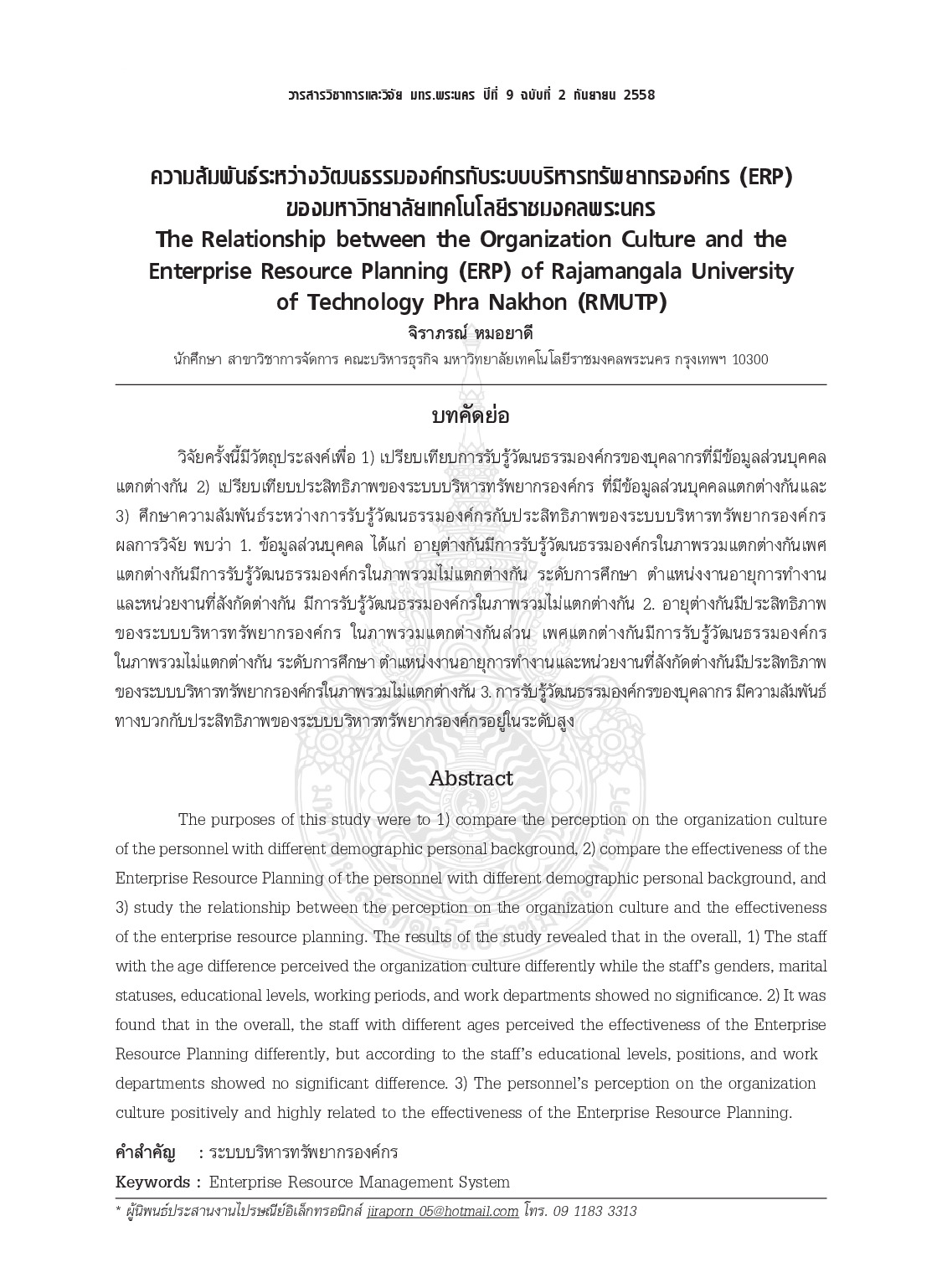
ความสัมพันธ์ระหว่างวัฒนธรรมองค์กรกับระบบบริหารทรัพยากรองค์กร (ERP) ของมหาวิทยาลัยเทคโนโลยีราชมงคลพระนคร
The purposes of this study were to 1) compare the perception on the organization culture of the personnel with different demographic personal background 2) compare the effectiveness of the Enterprise Resource Planning of the personnel with different demographic personal background and 3) study the relationship between the perception on the organization culture and the effectiveness of the enterprise resource planning.The results of the study revealed that in the overall1) The staff with the age difference perceived the organization culture differently while the staff’s genders marital statuses educational levels working periods and work departments showed no significance. 2) It was found that in the overall the staff with different ages perceived the effectiveness of the Enterprise Resource Planning differently but according to the staff’s educational levels positions and work departments showed no significant difference. 3) The personnel’s perception on the organization culture positively and highly related to the effectiveness of the Enterprise Resource Planning.
การตรวจหาเครื่องจักรที่ผลิตสินค้าบกพร่องเพื่อวางแผนป้องกันและบำรุงรักษาโดยใช้ตัวแบบฮิดเดนมาร์คอฟ: กรณีศึกษาโรงงานผลิตเครื่องดื่ม
This research proposes a hidden Markov model for detecting machines with multiple fillers producing soft drink for quality control in order to reduce defective products. The proposed model is compared with a classical generalized estimating equations model (GEE). The monthly data the number of defective products the correctness and the time spending in correction were collected from a machine in a sample factory in Pratumthanee province. The two hidden states of the fillers are workable and unworkable. The states has a logistic distribution. The results show that the correctness of the filler error occurrence does not improve the probability of being in a unworkable state neither the period of time spending on correction. The current state seems to be the same as the previous state