จำนวน Repository ( 126 )
การประยุกต์ใช้น้ำแข็งแห้งในการผลิตมูสช็อกโกแลตสำหรับการแข่งขัน ขนมหวานตะวันตกประเภทเย็น
The objectives of the research on the application of dry ice in making chocolate mousse for the cold western dessert competition were to study the appropriate time for freezing chocolate mousse and test the physical quality of frozen chocolate mousse using randomized complete block design (RCBD) method at 95% reliability. The quality of senses sight color smell taste and texture and the overall preference were evaluated. The difference of mean was compared with by Duncan New Multiple Rang Test (DMRT) using a computer program to find the appropriate time to freeze chocolate mousse. 15 testers applied the 5 – point hedonic scale to test the product. Research results showed that the testers preferred the product that was frozen for 40 minutes the most. In terms of color smell taste and overall preference the mean was 4.50 4.41 4.00 4.35 4.25 and 4.21 respectively. The physical quality test results indicated that the texture of the mousse frozen for 30 minutes had the best hardness adhesion and flexibility 27.53 3.17 0.43 and 1.21 respectively. The product frozen at 40 minutes had the highest lightness (L*) yellowness (b*) and redness (a*) 40.15 13.03 and 22.31 respectively with the statistical significance (p≤0.05).
แบบจำลองพื้นผิวตอบสนองและการหาสูตรอาหารที่เหมาะสมสำหรับการเพิ่มการผลิตกรดแกมมา-ไลโนเลนิกในมอส Physcomitrella patens โดยใช้วิธีพื้นผิวตอบสนอง
The objective of this study is to obtain a model that maximize production of γ-linolenic acid (GLA) by the moss Physcomitrella patens employing response surface methodology (RSM). The RSM with a three-variables (sucrose potassium nitrate and glutamate concentrations) and five-level (-2 -1 0 1 and 2) central composite design (CCD) including 20 experimental runs was employed to optimize the medium composition. Results showed that the experimental data could be appropriately fitted into a second-order polynomial model with a coefficient of determination (R2) more than 0 .9 5 for GLA production. Analysis of variance (ANOVA) revealed that the model was highly significant (p<0.0001) and the effects of the sucrose (20-100 g/L) and glutamate (0.5-2.5 g/L) concentrations on GLA production were significant (p<0.05). The GLA production with the optimized culture medium (sucrose concentration of 62.92 g/L potassium nitrate of 0.80 g/L and glutamate concentration of 1 .4 2 g/L) by RSM increased 4.61 folds when compared with the standard BCD medium. This experimental value (16.37 mg GLA/L) fit well with the predicted values (16.20 mg GLA/L).
การพัฒนาผลิตภัณฑ์เบเกอรี่จากหยวกกล้วยและส่วนเหลือทิ้งในการผลิตกล้วยตาก ของกลุ่มวิสาหกิจชุมชนแม่บ้านบางตาโฉม จังหวัดสิงห์บุรีสู่เชิงพาณิชย์อย่างยั่งยืน
Bakery Products Development from the Banana Pseudo-stems and Waste from Dried Banana Production at Ban Bang Ta Chom Community Enterprise Sing Buri Province for Sustainable Commerce. Research on bakery product development from paprika and bananas in Production of Dried Banana of Bang Ta Chom Housewife Community Enterprise Group Sing Buri province for sustainable commercialization in order to: 1. Develop bakery products from 4 types of Banana Pseudo-stems and Waste 2. study the formulas and production processes of bakery products from Banana Pseudo-stems and Waste 3. study the consumer test of bakery products from 4 types of Banana Pseudo-stems and Waste and 4. To transfer technology Little Bakery products from Banana Pseudo-stems and Waste then bring the shelf life in conditions ranging from 0-10 days and compare the physical properties. Chemical and microorganisms such as pH value color measurement and total number of microorganisms found that Khanom Jeen noodles stored in modified atmosphere conditions have longer shelf life than those stored. At normal atmospheric conditions and vacuum conditions. Chemical analysis results showed that the bakery products decreased their pH over time. With values between 4.31 ± 0.00 and 2.99 ± 0.01 and bakery products Stored at 100% carbon dioxide (CO2) modified atmosphere packed in a sealed nylon / PET vacuum plastic bag. Store at room temperature. Can be stored for up to 10 days and found that the total number of microbes increased when the storage life is longer But not over the standard of community products so the products are safe and not harmful to consumers. Consumer test results show that consumers like and are interested in buying bakery products that use 100 percent carbon dioxide (CO2) at 75 percent.
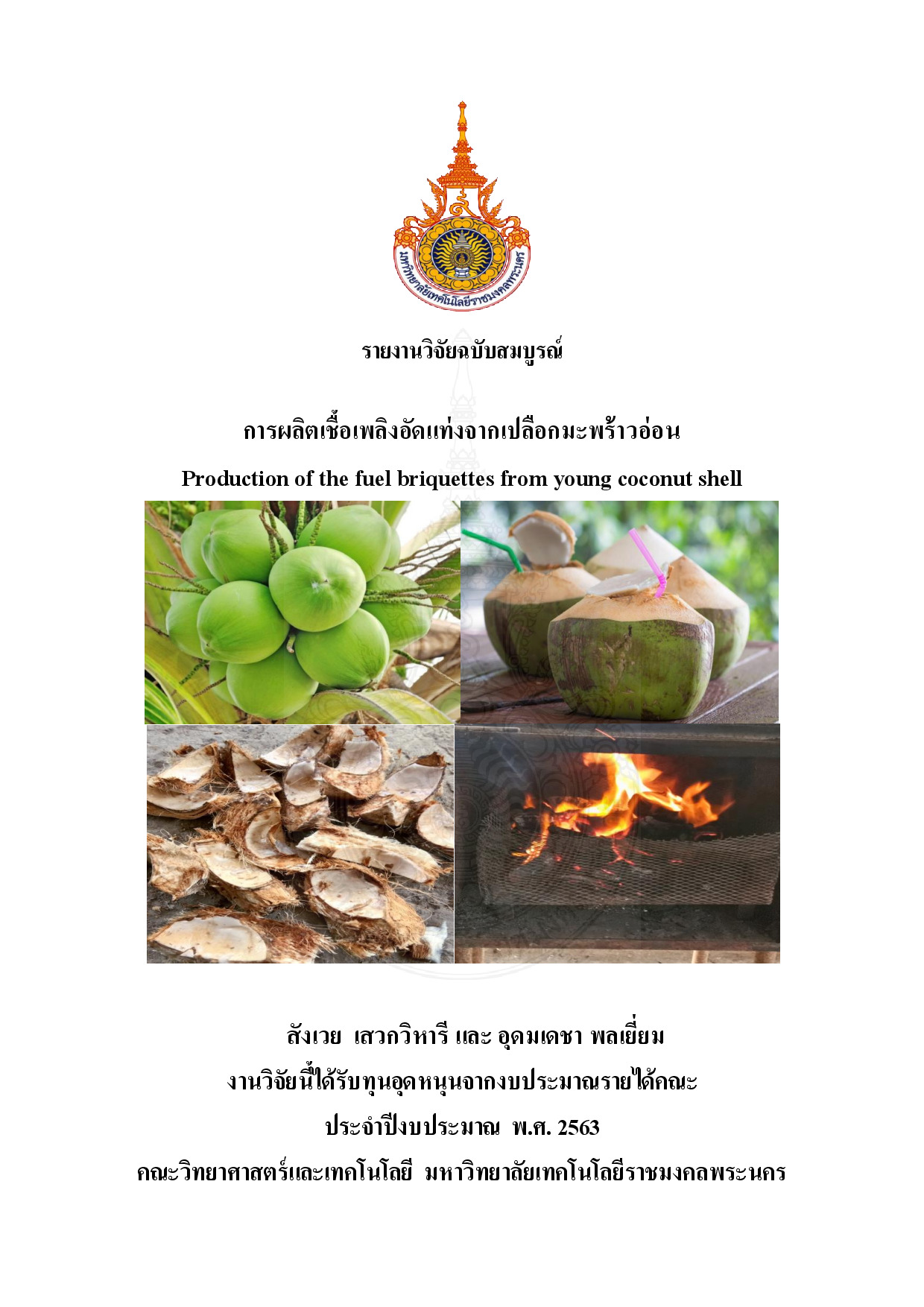
การผลิตเชื้อเพลิงอัดแท่งจากเปลือกมะพร้าวอ่อน
Young coconut shells are a byproduct after processing coconut juice which can be used to produce a solid-fuel. This fuel from the coconut shell is an alternative source instead of using firewood or charcoal made of timber in the natural forest. The solid-fuel from young coconut shells was prepared by using a wet glue powder as a binder then was compressed by using a briquette machine. The black coconut briquette was stable after exposure to the sun. The average of the briquette combustion rate was at 11.24 g /min. There is no eruption smut smoke and odor by using the young coconut shell briquette yo start a fire. To sum up a young coconut shell has a high potential as an alternative biomass material for producing a briquette especially for commercial. This solution can increase the reduction of haze weather in the sight of solid waste incineration and also global warming.
การผลิตไข่เค็มแดงชนิดเค็มน้อยด้วยเกลือและมอลโตเด็กซ์ตริน
This study demonstrates a new concept of salted yolks processing using only the yolk directly with the egg white portion being further utilized. This salting process accelerated the salting time from 4 weeks for whole egg pickling to only 5 days. The results showed that the increasing of amount of salt and maltodextrin in the salt solution (20 and 26% of salt 10 and 20% of maltodextrin) and salting time (0-5 days) resulting in a decrease in the moisture content of the yolk as well as the increase in the amount of salt and fat content in salted yolk. These caused a lower in brightness (L*) and a yellow index (b*) while a higher red index (p<0.05) of salted yolk. Moreover salted yolk has higher hardness cohesiveness gumminess and chewiness while showed lower adhesiveness and springiness which the increasing of salt solution concentration and salting time (p<0.05). Pickling of egg yolks directly in a solution of 20% of sodium chloride mixed with 20% of maltodextrin resulted in the lowest salt content. The comparison of the chemical and physical quality for salted egg yolks this new separted yolk salting generated salted yolks of similar quality to those of commercial salted egg yolks which was produced using the traditional egg-shell method but lower in salt content (p<0.05). Thus this novel salting process can be a guideline for the development of an efficient low-salt egg yolk production method.