จำนวน Repository ( 19 )
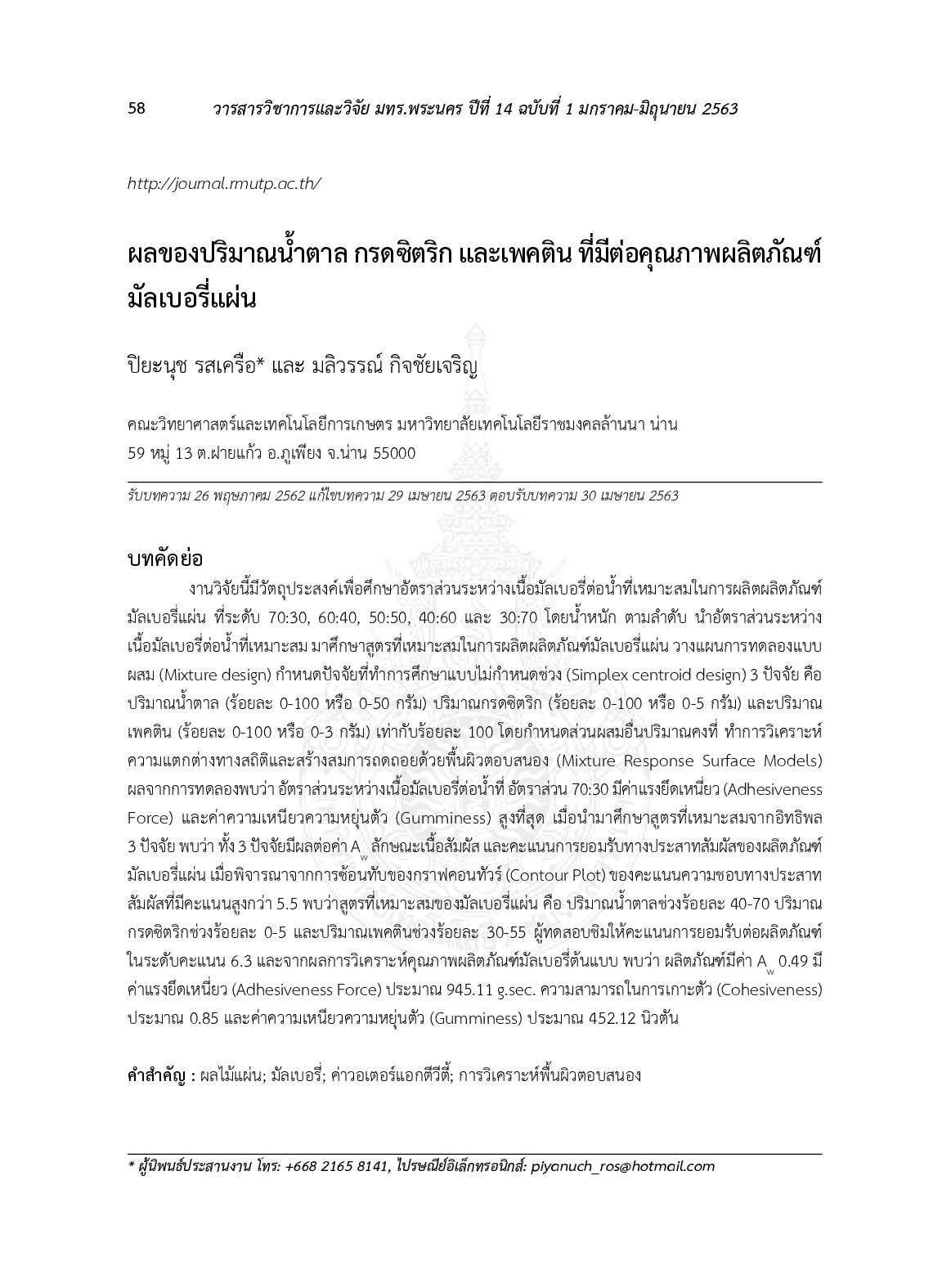
ผลของปริมาณน้ำตาล กรดซิตริก และเพคติน ที่มีต่อคุณภาพผลิตภัณฑ์มัลเบอรี่แผ่น
The objective of this study was to investigate the optimal formulation of mulberry fruit leather product when varying the weight ratio of mulberry fruit: water as 70:30 60:4050:50 40:60 and 30:70. Three factors were then determined by simplex centroid design; sugar (0-100% or 0-50 grams) citric acid (0-100% or 0-5 grams) and pectin (0-100% or 0-3 grams) which the sum of them equivalent to 100% while other ingredients remained constant. Analysis of the data was performed using ANOVA and Mixture Response Surface Models. The results indicated that the highest adhesiveness force and gumminess of mulberry fruit leather product were founded when the weight ratio of mulberry fruit to water was 70:30. The amount of sugar acid and pectin had effects on water activity (Aw) texture profile and sensory score of overall liking of product. From contour plot the predictive models were obtained by plottin g the contour line of all sensory attributes with acceptable score greater than 5.5 and thus the optimization area was selected. After overlapping contour plots an optimal formulation obtained was composed of 40-70% sugar 0-5% citric acid and 30-55% pectin. The sensory score of overall liking of product using a 9-point hedonic scale was 6.3. The water activity (Aw)adhesiveness force cohesiveness and gumminess of the prototype mulberry fruit leather product was 4.9 945.11 g. sec. 0.85 N and 452.12 N. respectively.

A study on activated carbon from bagasse and charcoal adsorption efficiency in decolorization and COD of sugar factory wastewater from rajburi sugar co., ltd
The current time activated Carbon spaciously have been used in the process of wastewater Treatment and Air Pollution Treatment because of it can absorb various materials such as colors smells and organic materials both in the wastewater or air pollution In this research the researcher interest to study the activated carbon from bagasse as become more quantity in the country to use for reducing the pollution of wastewater at Sugar Company and recycling the leaving materials. This study is the Experimental Research being divided into 2 kinds of charcoal: 1) synthesizing activated carbon from bagasse 2) charcoal. The three contents of waste water: 10 50 and 100 percent are used for analyzing and testing at three periods of time: 30 60 and 90 minutes. The example of the wastewater were analyzed the color and COD. The using activated carbon from the bagasse with the content of wastewater at 10% shown that it could not absorb the color differently at every periods of time the color remained lower than 5 Pt-Co and it could reduce more COD at the more periods of time. At the content of waste water 50% shown that the more using time for absorbing the color the quality of absorbing become lower (10 15 and 20 Pt-Co) but it became more reduce COD while the absorbing the color at the content of waste water 100% found that when used the more time quality of absorbing the color became lower (25 30 and 35) while the quality of reducing the COD became increase. The charcoal at the content of wastewater 10% its’ absorbing color was 5 Pt-Co at the all periods of time but the result of reducing the COD was increase: 4300 4000 and 3800 respectively. As the testing the content of waste water at 50% shown that the more using the time its’ quality of absorbing the color became lower while the quality of reducing the COD became decrease: 7330 6500 and 6030 respectively. As studying the content of waste water 100% found that the more using the time for treatment the waste water its’ quality became decrease but it could more reduced COD. The comparison between the activated carbon from bagasse and the charcoal shown that the activated carbon from bagasse can absorb the color better than the charcoal at 0.25 Pt-Co and could more reduce COD than the charcoal 43.5 % by average at the content of waste water 10%. While the waste water 50% the activated carbon from bagasse could more absorb the color than the charcoal at 55% and can more reduced the COD than the charcoal 19.34% averagely. For the content of waste water 100 % the activate carbon from bagasse could more absorb the color than the charcoal at 54.17% and reduced the COD 7.83% by averaging.
การใช้น้ำตาลโตนดทดแทนน้ำตาลทรายบางส่วนในผลิตภัณฑ์ขนมชั้น
The purpose of this research was the use of jaggery palm substitute partial sugar in Khanom Chan the suitable ratio of jaggery and sugar (25:50 50:50 and 75:25) were investigated and to study the suitable kneading time which varied at 5 1015 and 20 minutes. Analyze nutritional values and design the experimental by Randomized Complete Block Design (RCBD). Sensory evaluation (color flavor taste texture and overall liking) was tasted by sixty testers with 9-point hedonic scale. After that using 5-point hedonic scale for consumer acceptance test by one-hundred testers. Results showed that the suitable ratio is 50:50 and the suitable kneading time is 20 minutes had high score in every attributes from sensory test. Chemical properties protein fat ash and moisture content were increased while carbohydrate total energy and energy from fat were decrease that compared with basic recipe of Khanom Chan. The partial substitution of sugar with jaggery palm that still yielded an acceptable product for the consumers was 100%.
การใช้น้ำตาลโตนดทดแทนน้ำตาลทรายบางส่วนในผลิตภัณฑ์ขนมอาลัว
The replacement of partial sugar with jaggery palm in Khanom Ar-Lua production was further carried out for studying the suitable ratio of jaggery and sugar are 25:50 50:50 and 75:25 and studying the suitable drying time which varied period of time at 8 9 10 and 11 hours. Analyze nutritional values of Khanom Ar-Lua that sugar partially replaced with jaggery palm and Randomized Complete Block Design (RCBD) was applied. Sensory evaluation (color flavor taste texture and overall liking) was tasted by sixty panels with 9-point hedonic scale. After that using 5-point hedonic scale for consumer acceptance test by one-hundred panels. The results showed that Khanom Ar-Lua which use of jaggery palm replacement partial sugar at ratio of 25:75 had the highest score in every properties of sensory test. The suitable drying time is 10 hours. Khanom Ar-Lua that used jaggery palm to replace partial sugar had higher protein carbohydrate and total energy than basic recipe but moisture content and energy from fat are the lower. The consumer acceptance test showed that 99% acceped Khanom Ar-Lua which using jaggery palm replaced patial sugar.
การใช้น้ำตาลโตนดทดแทนน้ำตาลทรายบางส่วนในการทำผลิตภัณฑ์ไอศกรีมกะทิ
The objectives of this research are to study three standard recipes of coconut milk ice cream and to study the optimal level of jaggery palm in production coconut milk ice cream which sugar partially substituted with jaggery palm at difference levels are 50% 70% and 100% and then the experiment was analyzed with Randomized Complete Block Design (RCBD) at the confidence level was at 95%. Sensory evaluation (appearance color flavor taste texture (smoothness) and overall liking) was tasted by sixty panels with 9-point hedonic scale and the differences of the mean scores were compared with using Duncan’s New Multiple Rang Test (DMRT) in SPSS program for selection the standard recipe and optimal level of jaggery palm. Finally consumer acceptance test on the coconut milk ice cream which sugar partially substituted with jaggery palm was tasted by one-hundred consumers with 5-point hedonic scale. The result showed that the third standard recipe and the 100% of jaggery palm are the most acceptable from panels in sensory evaluation. Afterwards physical properties were analyzed found that viscosity increased up to 705.86 cps 21.56 of overrun value together with 11.26 melting rate. Average score of appearance color flavor taste texture (smoothness) and overall liking are 4.45 4.41 4.33 4.37 4.46 and 4.51 respectively and 98% of consumer accepted using jaggery palm substituted for partial sugar in coconut milk ice cream.