จำนวน Repository ( 194 )

The effect of using fishes condensate as feed containing on rearing of climbing perch (anabas testudineus bloch)
The experiment on using of different levels fishes condensate as feed contain in climbing perch (Anabas testudineus Bloch). To study on growth rate (SGR) feed conversion ratio (FCR) protein efficiency ratio (PER) and survival rate of climbing perch. The diets contained 40% protein and 3200 Kcal/Kg (DE) in all formulas with varying levels ; 0 25 50 and 75% of fishes condensate replacement of fish meal respectively and compared with pellet feed (formula 5). The diets were given for 10 weeks to fish which the initial average weight were 4.43+0.14 g. The result showed that the SGR FCR PER and survival rate of climbing perch was 25 percentage of fishes condensate (formula 2) gave highest growth performance as SGR 0.72+0.16 (%/day) and PER 1.12+0.22 were significantly different (p<0.05) with 0 75 and 50% respectively but not significantly different from the control feed (formula 5). All of the feed formulas showed no effect on survival rate (p>0.05).
Effects of water content and cooking time on chemical composition structureand properties of germinated purple rice (oryza sativa var. glutinosa) flour
The purpose of this research is to estimate the affects of water content (27 37 and 47 % wet basis) cooking time (1 3 and 5 hr) at 110oC and germinating time (24 36 and 48 hr) on chemical composition structure and properties of germinated purple rice flour. A Box-Behnken design under the response surface methodology was performed to optimize their composition. Rajamangala University of Technology Lanna Nan was research place. Results demonstrated that germinating time had no significantly effect on protein and lipid content but resulted in increasing crude fiber and decreasing carbohydrate and amylose content with increase in germinating time. Scanning electron micrographs (SEM) revealed the presence of polyhedral shape and agglomerations. Birefringence was evidenced. Pasting properties of germinated purple rice flour showed an increase in the pasting temperature but a decrease the peak viscosity breakdown final viscosity and setback (p<0.05) as germinating time increased. Modified rice flour were increase in carbohydrate and amylose content and decrease in protein lipid ash and fiber as water content and cooking time at 110oC increased. Change in birefringence of starch granule after heating at 110oC was examined by a polarized light microscope. SEM showed the presence of creak surfaces and agglomerations. The swelling power of germinated purple rice flour decreased with increase in cooking time. The solubility at 85oC of germinated purple rice flour was increased in each level of water content.
Effect of azimuth and pot color on the variation of pot surface and growing media temperature
The effect of azimuth and pot color on the variation of pot surface and growing media temperature was studied. Four pot colors that including with black brown silver and white color were used. The growing media comprised with soil : rice husk : coconut dust at 1:1:1 ratio. From the result of this study the azimuth and pot color effected the variation of pot surface temperature. The azimuth effected the variation of pot surface temperature at 8.00 10.00 14.00 and 16.00. At 8.00 and 10.00 pot surface temperature in east direction was the highest while at 14.00 and 16.00 pot surface temperature in west direction was the highest. Whereas pot color effected the variation of pot surface temperature at 8.00 10.00 and 14.00 with black color was the color that had the highest 33.3 39.1 and 46.4 C respectively. On the other hand the white color was the color that could the highest reduces the pot surface temperature when compared with the temperature of black pot color which were 4.6 3.9 and 4.3 C lower than that in a black pot respectively. Not only the effect on the variation of pot surface temperature pot color was also affected on the variation of growing media. Pot color effected the variation of growing media temperature during 8.00 to 18.00. When compare the growing media temperature among the pot color with that in black pot color which was the highest temperature white color pot was the highest efficiency to reduce the growing media temperature especially at 10.00 and 12.00. White pot color could reduce the growing media temperature about 5 C follow by silver color pot was about 3 C while the growing media temperature in brown color pot was not difference with that in black color pot
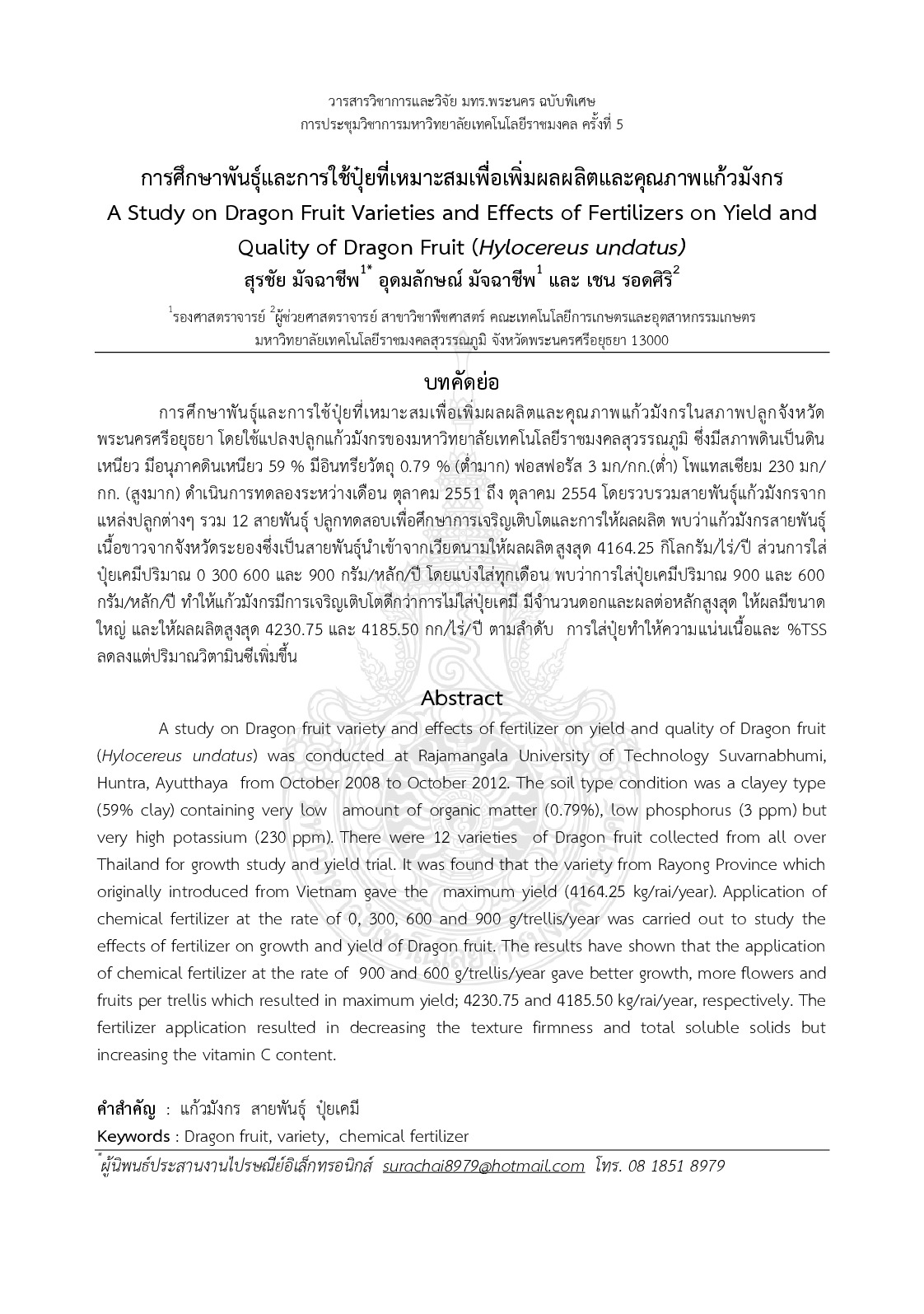
A study on dragon fruit varieties and effects of fertilizers on yield and quality of dragon fruit (hylocereus undatus)
A study on Dragon fruit variety and effects of fertilizer on yield and quality of Dragon fruit (Hylocereus undatus) was conducted at Rajamangala University of Technology Suvarnabhumi Huntra Ayutthaya from October 2008 to October 2012. The soil type condition was a clayey type (59% clay) containing very low amount of organic matter (0.79%) low phosphorus (3 ppm) but very high potassium (230 ppm). There were 12 varieties of Dragon fruit collected from all over Thailand for growth study and yield trial. It was found that the variety from Rayong Province which originally introduced from Vietnam gave the maximum yield (4164.25 kg/rai/year). Application of chemical fertilizer at the rate of 0 300 600 and 900 g/trellis/year was carried out to study the effects of fertilizer on growth and yield of Dragon fruit. The results have shown that the application of chemical fertilizer at the rate of 900 and 600 g/trellis/year gave better growth more flowers and fruits per trellis which resulted in maximum yield; 4230.75 and 4185.50 kg/rai/year respectively. The fertilizer application resulted in decreasing the texture firmness and total soluble solids but increasing the vitamin C content.
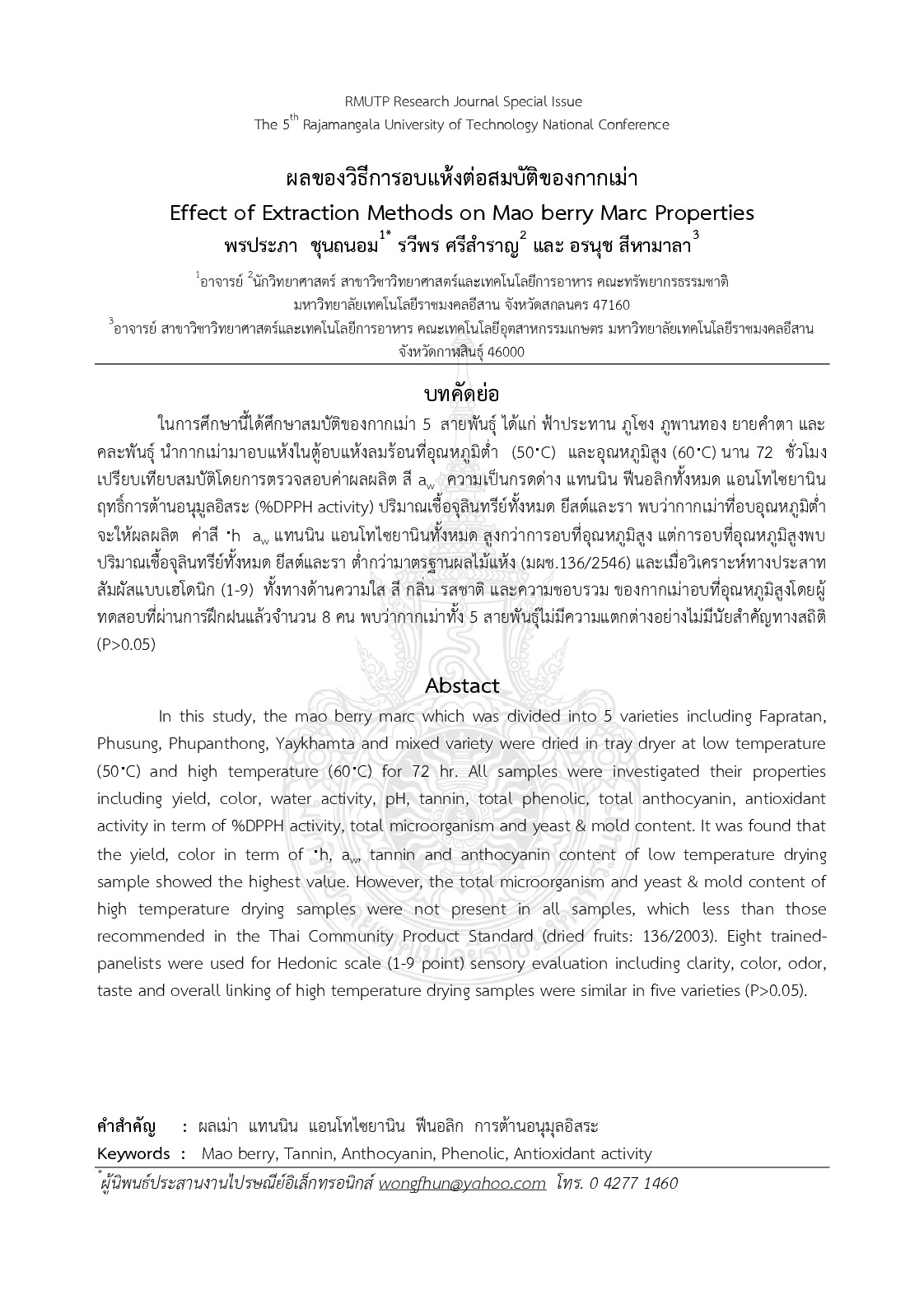
Effect of extraction methods on mao berry marc properties
In this study the mao berry marc which was divided into 5 varieties including Fapratan Phusung Phupanthong Yaykhamta and mixed variety were dried in tray dryer at low temperature (50?C) and high temperature (60?C) for 72 hr. All samples were investigated their properties including yield color water activity pH tannin total phenolic total anthocyanin antioxidant activity in term of %DPPH activity total microorganism and yeast & mold content. It was found that the yield color in term of ?h aw tannin and anthocyanin content of low temperature drying sample showed the highest value. However the total microorganism and yeast & mold content of high temperature drying samples were not present in all samples which less than those recommended in the Thai Community Product Standard (dried fruits: 136/2003). Eight trained-panelists were used for Hedonic scale (1-9 point) sensory evaluation including clarity color odor taste and overall linking of high temperature drying samples were similar in five varieties (P>0.05).