จำนวน Repository ( 1852 )
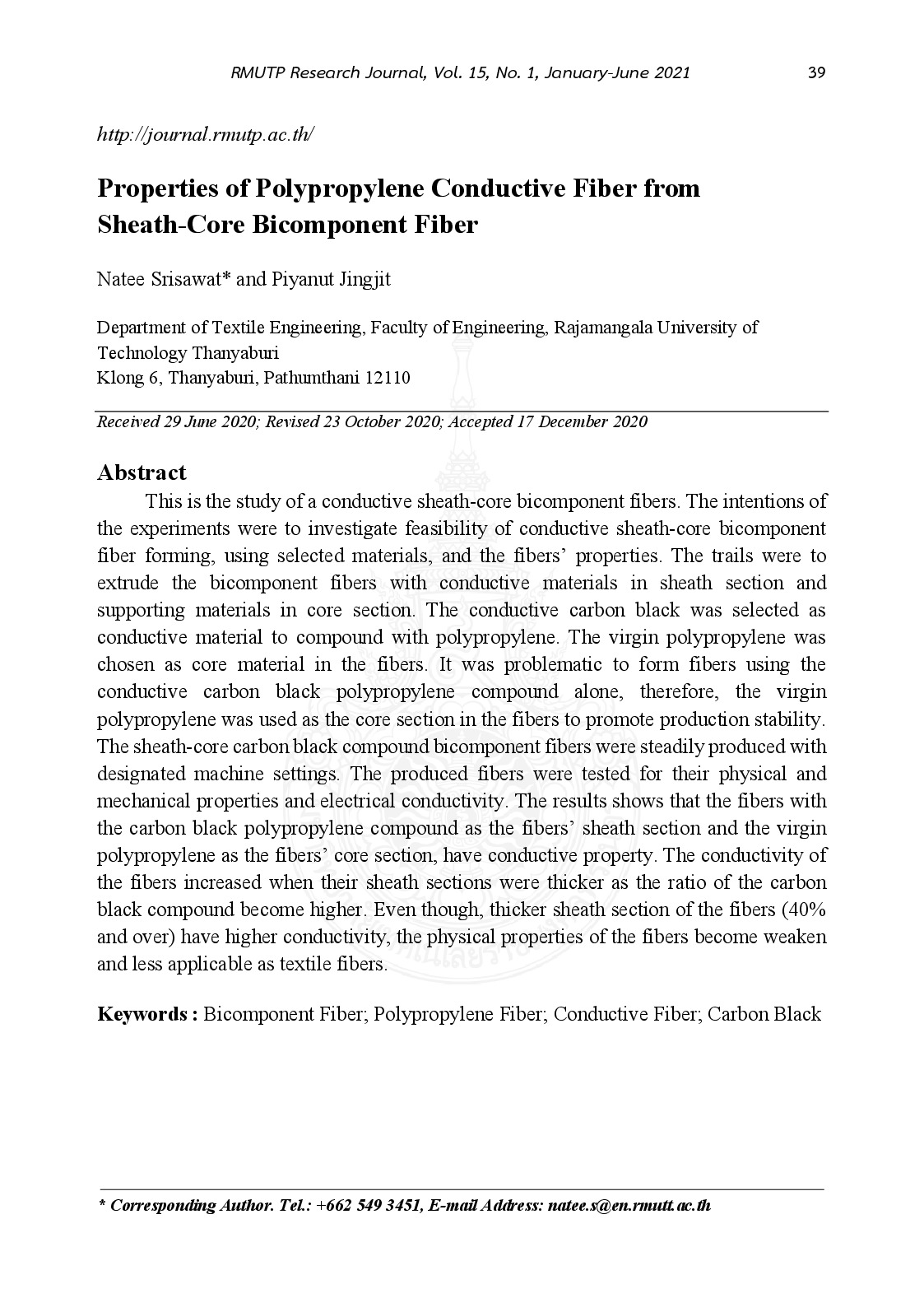
Properties of polypropylene conductive fiber from sheath-core bicomponent fiber
This is the study of a conductive sheath-core bicomponent fibers. The intentions of the experiments were to investigate feasibility of conductive sheath-core bicomponent fiber forming using selected materials and the fibers’ properties. The trails were to extrude the bicomponent fibers with conductive materials in sheath section and supporting materials in core section. The conductive carbon black was selected as conductive material to compound with polypropylene. The virgin polypropylene was chosen as core material in the fibers. It was problematic to form fibers using the conductive carbon black polypropylene compound alone therefore the virgin polypropylene was used as the core section in the fibers to promote production stability. The sheath-core carbon black compound bicomponent fibers were steadily produced with designated machine settings. The produced fibers were tested for their physical and mechanical properties and electrical conductivity. The results shows that the fibers with the carbon black polypropylene compound as the fibers’ sheath section and the virgin polypropylene as the fibers’ core section have conductive property. The conductivity of the fibers increased when their sheath sections were thicker as the ratio of the carbon black compound become higher. Even though thicker sheath section of the fibers (40% and over) have higher conductivity the physical properties of the fibers become weaken and less applicable as textile fibers.
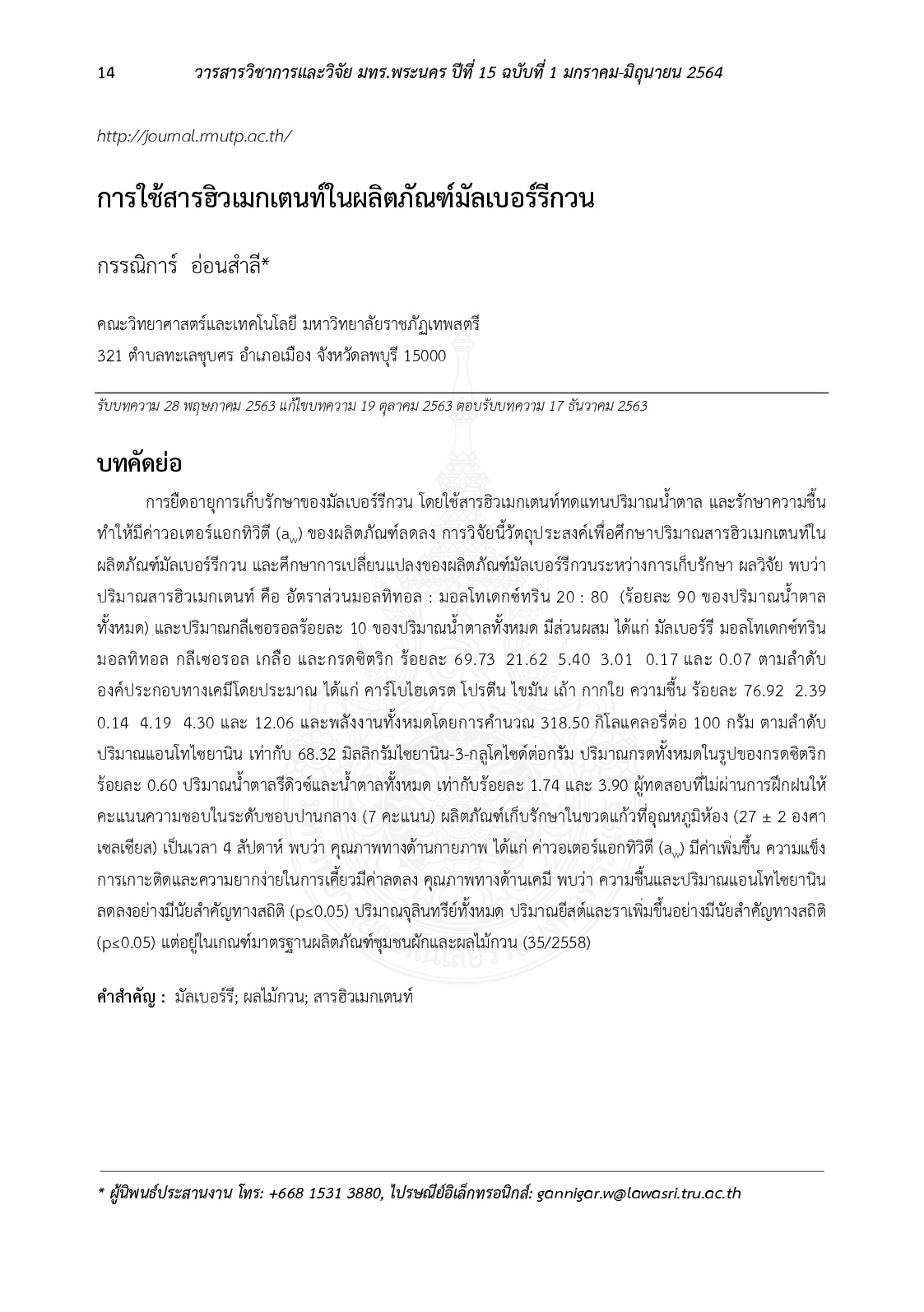
การใช้สารฮิวเมกเตนท์ในผลิตภัณฑ์มัลเบอร์รีกวน
The shelf-life extension of mulberry paste by using humectants to place sugar content could maintain the moisture while reducing the water activity (aw) of the product. The objectives of this research were to study on humectants replacement and the changes of the mulberry paste product quality during storage. The sugar content in the standard formula was replaced by 10% w/w glycerol and 90% w/w of maltitol and maltodextrin mixture (20:80 w/w). The final mulberry paste product consisted of mulberry maltodextrin maltitol glycerol salt and citric acid by 69.80% 21.62% 5.40% 3.01% 0.17% and 0.07% respectively. The chemical compositions: carbohydrates proteins fat ash fiber and moisture of the product were 76.92% 2.39% 0.14% 4.19% 4.30% 12.06% respectively. The total energy by calculation was 318.50 kcal/100 g. The anthocyanin content was 68.32 mg cyanidin- 3-glucoside/g. Total titratable acidity (citric acid equivalent) was 0.60%. The reducing sugar and total sugar values were 1.74% and 3.90% respectively. The consumer acceptance as evaluated by untrained panelists was in the level of moderately like (7 score). The product packed in glass bottle containers was stored at 27±2 ºC for 4 weeks. The aw was increased while the textural properties: hardness adhesiveness and chewiness were decreased. The chemical quality analysis showed significant decreases (p≤0.05) in the moisture and the anthocyanin contents. The microbial quality; total plate count and yeast and mold measurements were significantly increased (p≤0.05) however the values were within the acceptable range according to the Thai community product standard (35/2558).
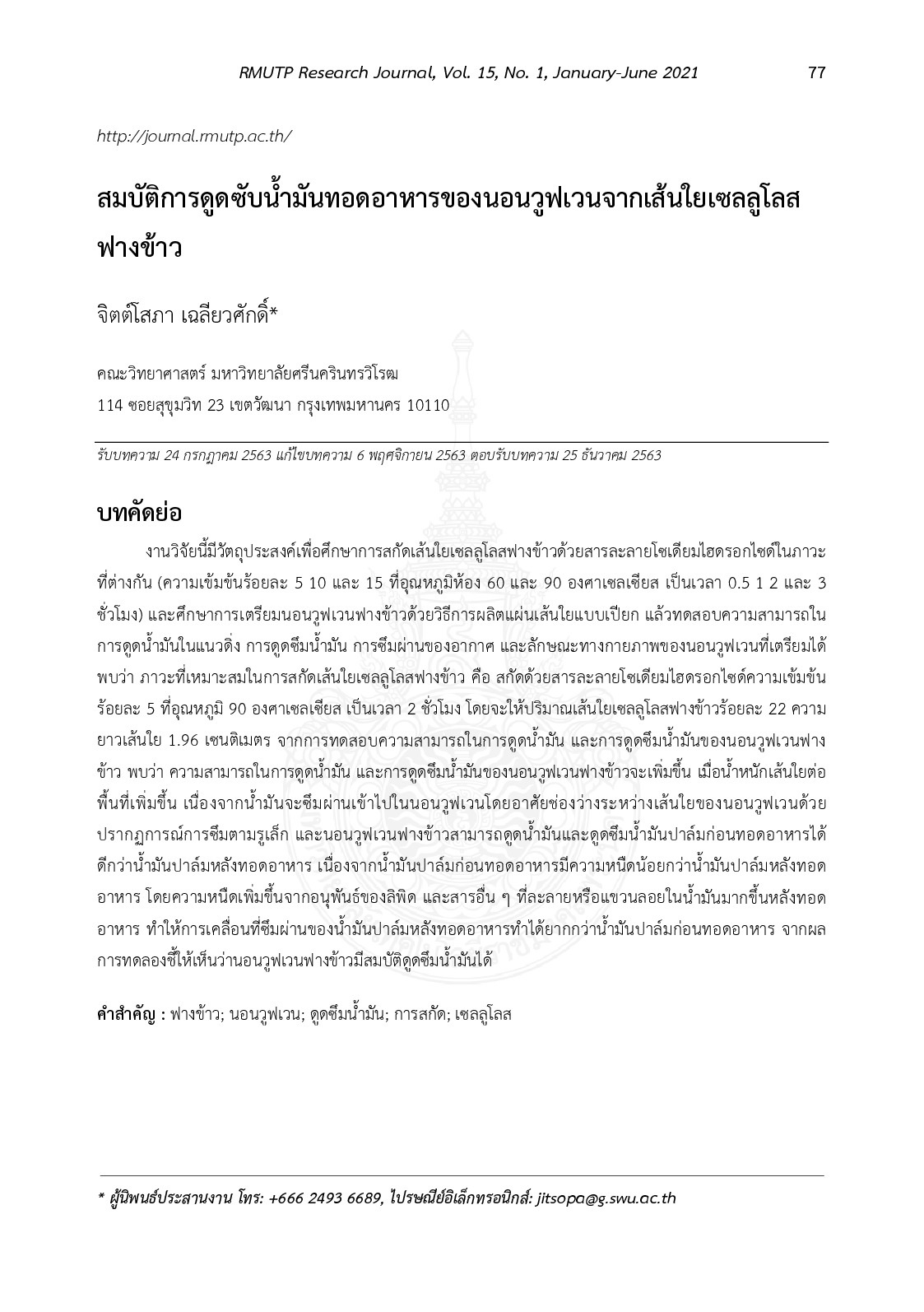
สมบัติการดูดซับน้ำมันทอดอาหารของนอนวูฟเวนจากเส้นใยเซลลูโลสฟางข้าว
The objectives of this research were to study cellulose fiber extraction from rice straw with sodium hydroxide in various conditions (with 5 1 0 and 1 0 % of sodium hydroxide at room temperature 60ºC and 90 ºC for 0.5 1 2 and 3 hours) and to study rice straw nonwovens preparation by the wet-laid process. Oil wicking ability oil absorption ability air permeability morphology and physical properties of prepared nonwovens were investigated. It was found that the optimal condition for cellulose fiber extraction from rice straw was 5% of sodium hydroxide at 90 ºC for 2 hours. At this condition the cellulose fiber yield of 2 2% and the fiber length of 1 . 9 6 cm were obtained. The oil wicking ability and oil absorption ability of rice straw nonwovens increased when weight per unit area increased. Therefore oil absorbed into gaps between fibers of the nonwovens by capillary effect. Moreover the nonwovens could wick and absorb virgin palm oil better than fried palm oil because virgin palm oil has a lower viscosity than fried palm oil. The viscosity increased from derived lipid and other substances which dissolve and disperse increasing after frying food. The results indicated that the rice straw nonwovens had oil absorption ability.
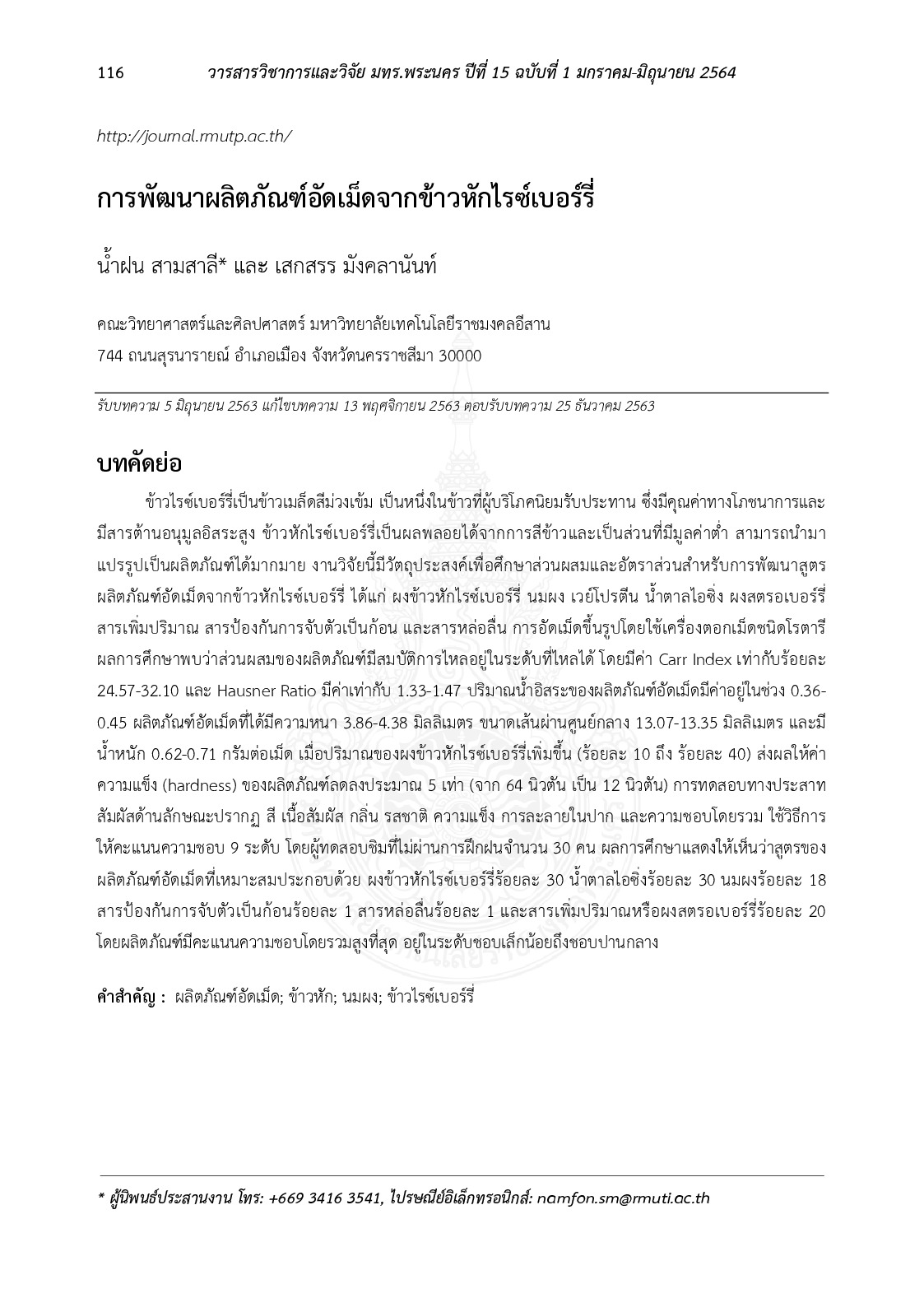
การพัฒนาผลิตภัณฑ์อัดเม็ดจากข้าวหักไรซ์เบอร์รี่
Riceberry rice is dark purple coloured grains. It is one of the most famous rice for consumers. There are nutrients and high antioxidant properties. Riceberry broken rice (RBR) is a by-product from the rice milling process and has a low value. It can be processed into various products. The purpose of this research was to study the ingredients and the ratios for tablet formulations including RBR powder milk powder whey protein icing sugar strawberry powder bulking agent anticaking agent and lubricant agent. Tabletting of powders was performed using a rotary tablet press machine. It was found that the powder products exhibited passable flow with the Carr Index of 24.57-32.10% and the Hausner Ratio value of 1.33-1.47. The water activity value of product was in the range 0.36-0.45. The tablets had thickness 3.86-4.38 mm diameter 13.07-13.35 mm and weight 0.62-0.71 g/tablet. The increase of RBR powder content (10% - 40%) decreased hardness value of tablet products about 5 times (from 64 N to 12 N). Sensory evaluation of products in appearance color texture odor flavor hardness dissolution in the mouth and overall liking were conducted using 9 - point hedonic scale with 30 untrained panelists. The results showed that the optimal tablet formulation consisted of 30% RBR powder 30% icing sugar 18% milk powder 1% anticaking agent 1% lubricant agent and 20% bulking agent or strawberry powder. They showed the highest overall liking scores in ranges of “like slightly” to “like moderately”
แบบจำลองพื้นผิวตอบสนองและการหาสูตรอาหารที่เหมาะสมสำหรับการเพิ่มการผลิตกรดแกมมา-ไลโนเลนิกในมอส Physcomitrella patens โดยใช้วิธีพื้นผิวตอบสนอง
The objective of this study is to obtain a model that maximize production of γ-linolenic acid (GLA) by the moss Physcomitrella patens employing response surface methodology (RSM). The RSM with a three-variables (sucrose potassium nitrate and glutamate concentrations) and five-level (-2 -1 0 1 and 2) central composite design (CCD) including 20 experimental runs was employed to optimize the medium composition. Results showed that the experimental data could be appropriately fitted into a second-order polynomial model with a coefficient of determination (R2) more than 0 .9 5 for GLA production. Analysis of variance (ANOVA) revealed that the model was highly significant (p<0.0001) and the effects of the sucrose (20-100 g/L) and glutamate (0.5-2.5 g/L) concentrations on GLA production were significant (p<0.05). The GLA production with the optimized culture medium (sucrose concentration of 62.92 g/L potassium nitrate of 0.80 g/L and glutamate concentration of 1 .4 2 g/L) by RSM increased 4.61 folds when compared with the standard BCD medium. This experimental value (16.37 mg GLA/L) fit well with the predicted values (16.20 mg GLA/L).