จำนวน Repository ( 131 )
การศึกษากรรมวิธีการทำเปลือกแตงโมปรุงรส
The research on “A Study of Seasoning Watermelon shell Process ” had objectives of study to develop product of Watermelon shell jam from changing the prototype recipe of pineapple jam. The researchers altered the recipe by using Watermelon shell to replace 100 per cent pineapple texture in three recipes to be put additionally into water melon texture in three different content 20 per cent 30 per cent and 40 per cent of the total weight of Watermelon shell . The researcher studied about the process of making flavored Watermelon shell in order to study three types of appropriate and different processes of Watermelon shell including diced Watermelon shell chopped Watermelon shell and ground Watermelon shell in homogenous texture. From the study it was found that study of pineapple jam recipe was in prototype recipe; altering the recipe by using Watermelon shell to replace 100% pineapple texture. Then the researchers had tasting persons taste three basic recipes and found that tasting persons accepted recipe No. 2 in the total aspects of color scent flavor texture and fondness. The scores were 7.93?0.62 8.25?0.56 7.80?0.54 7.63?0.70 and 7.68?0.57 respectively; the fondness was from moderate level to much fondness. When variance was analyzed and statistical difference was searched it was found that total features of color scent flavor texture and fondness did not have significant difference at level of 0.05. From study it was found that study of process of making flavored Watermelon shell in three types including diced watermelon shell chopped watermelon shell and ground Watermelon shell in homogenous texture it was found that tasting persons accepted recipe No. 1 (diced Watermelon shell ) in total color scent flavor texture and fondness having mean value at 8.03?0.66 8.50?0.64 8.28?0.55 7.98?0.66 and 7.93?0.35 respectively in the level of moderate fondness to much fondness. When variance was analyzed and statistical difference was searched it was found that total features of color scent flavor texture and fondness had significant difference at level of 0.05.
พฤติกรรมการใช้น้ำ และไฟฟ้า ของนักศึกษาคณะเทคโนโลยีคหกรรมศาสตร์ มหาวิทยาลัยเทคโนโลยีราชมงคลพระนคร
The purposes of this research are to study water and electricity consumption behavior of the students to study understanding of water and electricity saving and to compare the difference of water and electricity consumption behavior classified as personal characteristic of the students Faculty of Home Economics Technology Rajamangala University of Technology Phra Nakhon. This research was descriptive research. The sample group used in the research was the students Faculty of Home Economics Technology Rajamangala University of Technology Phra Nakhon. Size of the sample group was specified to be 325 people by stratified sampling. The tool used in data analysis was questionnaire divided into 3 parts including part 1: questions regarding general details of a respondent part 2: questions regarding knowledge of water and electricity saving consumption the students of Faculty of Home Economics Technology Rajamangala University of Technology Phra Nakhon and part 3: questions regarding water and electricity consumption behavior of the students Faculty of Home Economics Technology Rajamangala University of Technology Phra Nakhon. The statistics used in data analysis consisted of frequency percentage mean standard deviation and hypothesis testing using t-test and ANOVA (Analysis of Variance) for testing parallel difference by LSD method. The research result found that: 1. The level of water and electricity consumption behavior of the students Faculty of Home Economics Technology Rajamangala University of Technology Phra Nakhon was overall in the moderate level. 2. The level of understanding and knowledge regarding water and electricity saving of the students Faculty of Home Economics Technology Rajamangala University of Technology Phra Nakhon was overall in the moderate level. 3. The comparison of different behavior of water and electricity consumption specified according to personal characteristics could be summarized that the students having different gender class and major had identical water consumption behavior and the students having different gender class and major had identical electricity consumption behavior. On the other hand the students having different major had statistical significance in electricity consumption behavior at 0.05

Heavy metal adsorption of waste waters from chemical laboratory using firebrick. Case study : Faculty of Science and Technology, Rajamangala University of Technology Phra Nakhon
The purpose of this research is to study the heavy metal removal from wastewater from laboratory by using adsorption process with firebricks. Waste water was collected among three courses of laboratory such as analytical chemistry principle chemistry and chemistry for engineers. The optimized absorption efficiencies of multi-elements with stirring time volume ratio and temperature were 2 hours 10 g/100 mL and room temperature respectively. It was found that absorption efficiencies of lead (Pb) copper (Cu) zinc (Zn) chromium (Cr) were 65.1 54.8 63.4% and ND respectively.
Automatic watering system using solar PV tracking
This paper presents the design of automatic watering system using sun tracking as an energy source .The objective is to design the automatic watering system for fruits grown in both areas without electricity. The solar panel can be moved along the direction of the sun cover an altitude - azimuth dual axis as an energy source of the system. The 20 longan trees are used in the experiment. The DC motors and the solar panel is controlled and rotated by the microcontroller to the position of the maximum light intensity. The watering system section will use a technique to measure the soil moisture sensors ECHO2-20 with real time PC based monitor system by Visual Basic Studio. As for the experiment results it was found that the energy stored by the developed solar tracker increased to 17.72 percent in comparison to a solar panel fixed installation. The watering appropriate soil moisture content is 12 percent and stops at 25 percent resulting for the garden moderators to save time and labor.
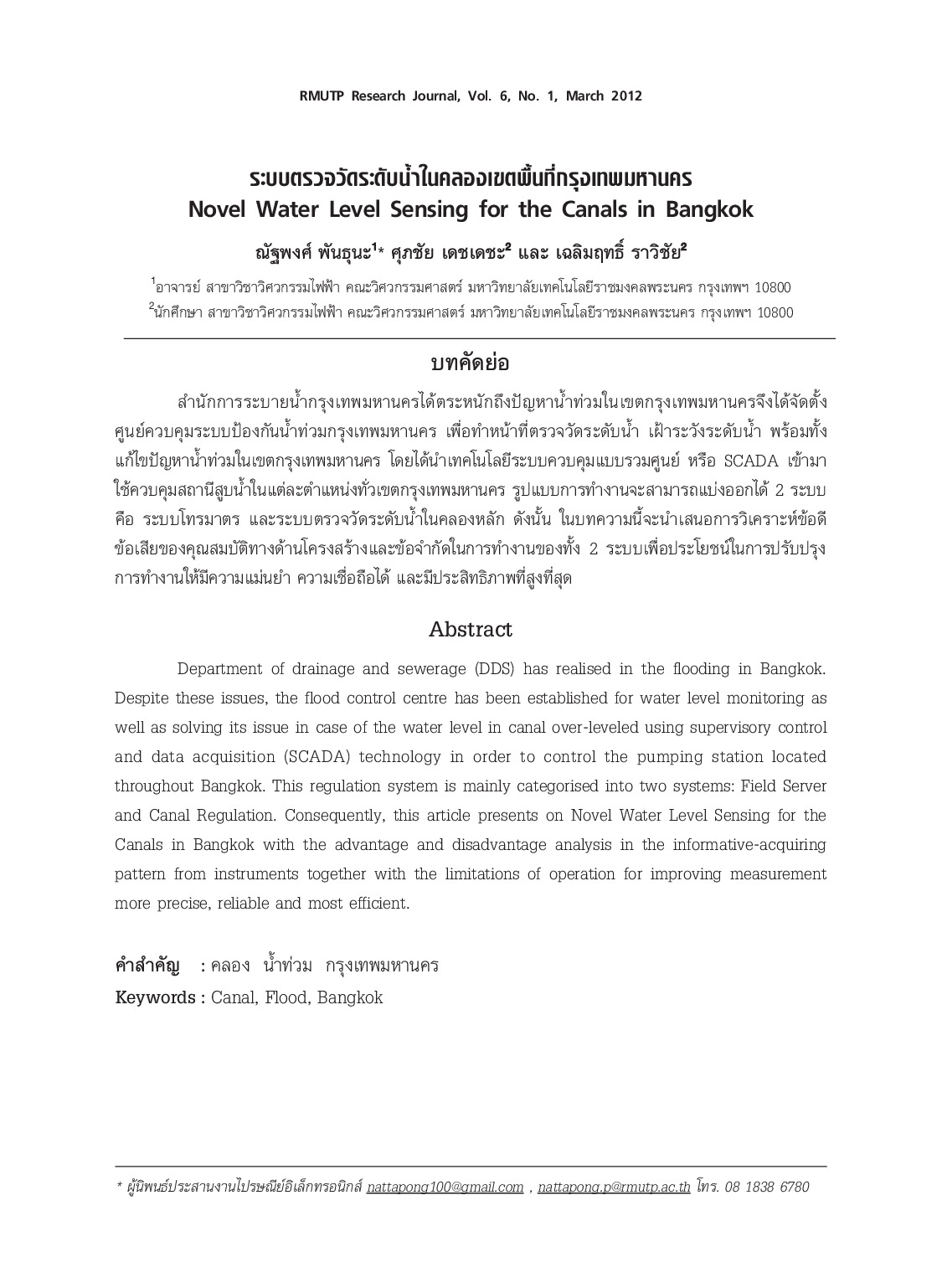
Novel water level sensing for the canals in Bangkok
Department of drainage and sewerage (DDS) has realised in the flooding in Bangkok. Despite these issues the flood control centre has been established for water level monitoring as well as solving its issue in case of the water level in canal over-leveled using supervisory control and data acquisition (SCADA) technology in order to control the pumping station located throughout Bangkok. This regulation system is mainly categorised into two systems: Field Server and Canal Regulation. Consequently this article presents on Novel Water Level Sensing for the Canals in Bangkok with the advantage and disadvantage analysis in the informative-acquiring pattern from instruments together with the limitations of operation for improving measurement more precise reliable and most efficient.