จำนวน Repository ( 137 )

Creating and evaluating the effectiveness of computer assisted instruction program subject electric power system analysis chapter 3-6.
The purposes of the research were to create and efficiency validation of computer assisted for the courses of practiced to reading. Creating and Evaluating the Effectiveness of Computer Assisted Instruction Program Subject Electric Power System Analysis Chapter 3-6 based standard and analyses the leaning achievement of the student after by using computer assisted instruction. The subjects in the study were first year diploma students enrolled in Rajamangala University of Technology Phra Nakhon . The Researcher using the experiment by let the students do until test before class And then study by using computer assisted instruction focused on practiced to basic turning. After that let students do the unit test again at the class and calculate to find out the efficiency of the computer assisted instruction and analyses the leaning achievement of students after study . The research result revealed that the efficiency of the computer assisted Instruction was efficient in standard Moreover after learning achievement At significant level of 0.05 .
Analysis of steel industries in thailand : Case study of production planning and control by determination of time limited free back orders.
The objectives of this research were to find the distribution of food demand for laying hens and to find the optimum amount of that food production which had minimum cost. The data consisted of customer purchase orders for the food of laying hens price of food for laying hens cost per unit for the food inventory cost related to food of laying hens in which the food was out of stock such as fine overtime urgent purchase for material. They were collected in 2008-2009 form a factory in Nakhonratchasima province. The collected data were analized in order to explore the distribution of the monthly food demand for the laying hens and to see the rate of inventory per unit. The results were used in the stochastic linear programming model for aggregate planning in which the optimum production minimum cost could be obtained. Programming algorithm in MATLAB and tools in Linprog software were used to get the solution. The distribution of the food demand for laying hens and the random numbers were used in the model. The study found that the distribution of food demand for laying hens every month has normal distribution (January to December). The monthly average amount of production from January to December were 10936.94 12913.74 11898.12 13096 15443.26 14916.33 10322.64 10818.21 11393.11 11700.72 9706.05 and 11702.05 respectively. The minimum total cost average for 12months was Baht 62422386.98.
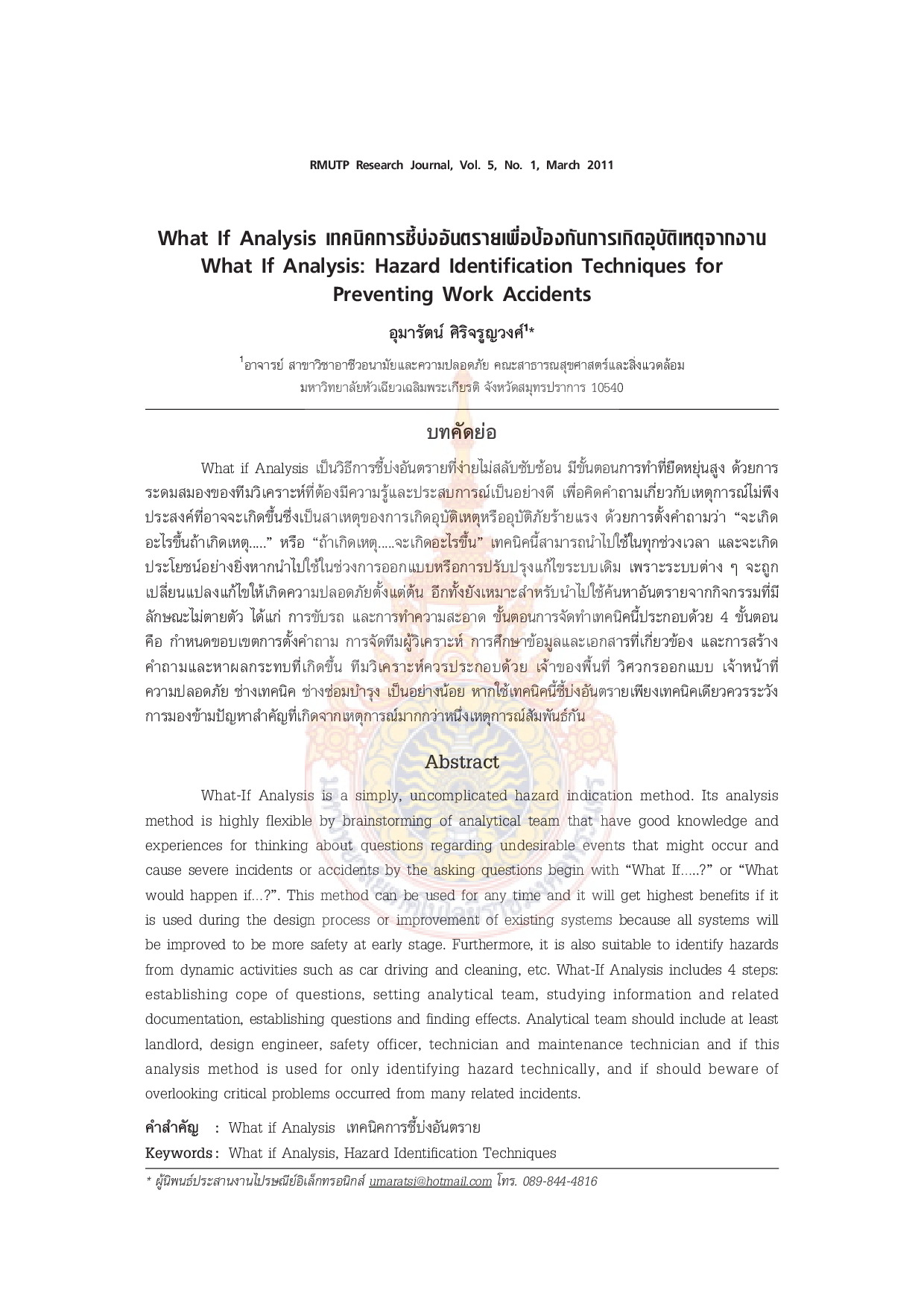
What If Analysis: Hazard Identification Techniques for Preventing Work Accidents
What-If Analysis is a simply uncomplicated hazard indication method. Its analysis method is highly flexible by brainstorming of analytical team that have good knowledge and experiences for thinking about questions regarding undesirable events that might occur and cause severe incidents or accidents by the asking questions begin with “What If…..?” or “What would happen if…?”. This method can be used for any time and it will get highest benefits if it is used during the design process or improvement of existing systems because all systems will be improved to be more safety at early stage. Furthermore it is also suitable to identify hazards from dynamic activities such as car driving and cleaning etc. What-If Analysis includes 4 steps: establishing cope of questions setting analytical team studying information and related documentation establishing questions and finding effects. Analytical team should include at least landlord design engineer safety officer technician and maintenance technician and if this analysis method is used for only identifying hazard technically and if should beware of overlooking critical problems occurred from many related incidents
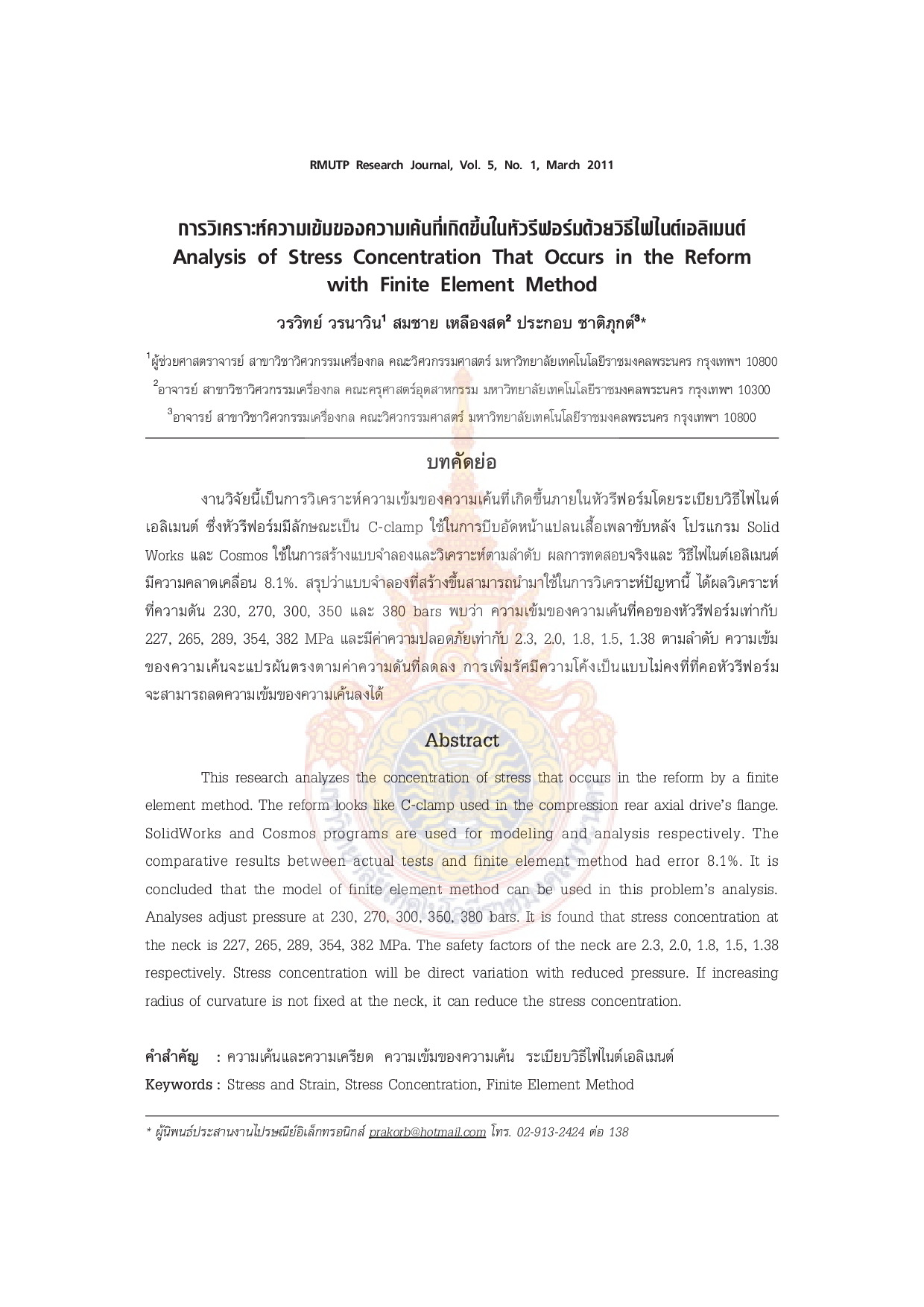
Analysis of Stress Concentration That Occurs in the Reform with Finite Element Method
This research analyzes the concentration of stress that occurs in the reform by a finite element method. The reform looks like C-clamp used in the compression rear axial drive’s flange. SolidWorks and Cosmos programs are used for modeling and analysis respectively. The comparative results between actual tests and finite element method had error 8.1%. It is concluded that the model of finite element method can be used in this problem’s analysis. Analyses adjust pressure at 230 270 300 350 380 bars. It is found that stress concentration at the neck is 227 265 289 354 382 MPa. The safety factors of the neck are 2.3 2.0 1.8 1.5 1.38 respectively. Stress concentration will be direct variation with reduced pressure. If increasing radius of curvature is not fixed at the neck it can reduce the stress concentration.