จำนวน Repository ( 179 )
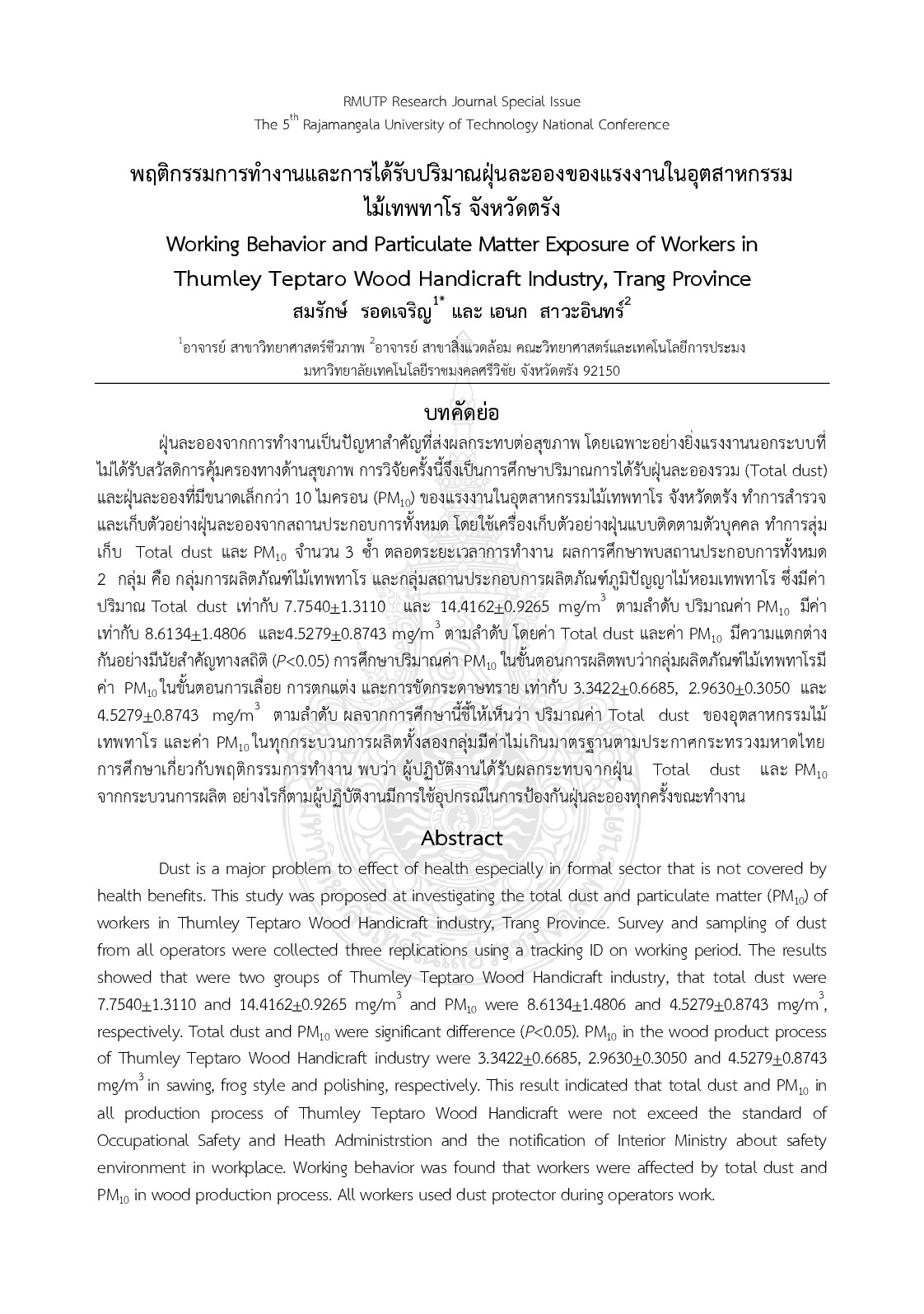
Working behavior and particulate matter exposure of workers in thumley teptaro wood handicraft industry, trang province
Dust is a major problem to effect of health especially in formal sector that is not covered by health benefits. This study was proposed at investigating the total dust and particulate matter (PM10) of workers in Thumley Teptaro Wood Handicraft industry Trang Province. Survey and sampling of dust from all operators were collected three replications using a tracking ID on working period. The results showed that were two groups of Thumley Teptaro Wood Handicraft industry that total dust were 7.7540+1.3110 and 14.4162+0.9265 mg/m3 and PM10 were 8.6134+1.4806 and 4.5279+0.8743 mg/m3 respectively. Total dust and PM10 were significant difference (P<0.05). PM10 in the wood product process of Thumley Teptaro Wood Handicraft industry were 3.3422+0.6685 2.9630+0.3050 and 4.5279+0.8743 mg/m3 in sawing frog style and polishing respectively. This result indicated that total dust and PM10 in all production process of Thumley Teptaro Wood Handicraft were not exceed the standard of Occupational Safety and Heath Administrstion and the notification of Interior Ministry about safety environment in workplace. Working behavior was found that workers were affected by total dust and PM10 in wood production process. All workers used dust protector during operators work.

พฤติกรรมการจัดกลุ่มราคาในระบบ Electronic Trading Transaction และระบบ Block Trading Transaction ในตลาดอนุพันธ์แห่งประเทศไทย: กรณีศึกษา ดัชนี SET50 Index Futures
This research studied behavior of price clustering in Electronic Trading Transaction and Block Trading Transaction in Thailand Futures Exchange market from SET50 Index Futures using daily closing price data of SET50 index Futures from April 28 2006 to June 302012 Descriptive statistics and quantitative analysis included Chi-square to test Uniform Distribution; Hirshmann Herfindal Index(HHI) to measure price density standardized Range and Excess Clustering to measure price clustering; and Multiple Regression to test behavior of price Clustering. Results showed that the behavior of price clustering in SET50 Index Futures was characterized in the same way. That is the most frequent last two digits were 00 (32.31%) and 50 (13.82%) while other last two digits had the frequency of not greater than 8%. There was more price clustering along with the trading volume. It also found that the opening price the bid-ask spread. And the volatility had positive impacts on price clustering while the closing price had negative impact. For the total retum no impact was found on price clustering at the signicant level of 0.05
Psycho-social Factors Related to Effective Teaching Behavior of Business Administration Faculty Lecturers at Rajamangala University of Technology, Bandkok Metropolitan
The objectives of this research were: 1) to study psycho-social factors related to effective teaching behavior of the lectures at Faculty of Business Administration Rajamangala university of Technology Bangkok metropolitan 2) to study social characteristics and psychological characteristics that could predict effective teaching behavior of the lectures in overall and small groups at Faculty of Business Administration Rajamangala university of Technology Bangkok metropolitan 3) to study the interaction between social characteristics and psychological characteristics affecting to effective teaching behavior of the lectures at Faculty of Business Administration Rajamangala university of Technology Bangkok metropolitan. The sample used in this study consisted of 252 lectures at Faculty of Business Administration Rajamangala university of Technology Bangkok metropolitan. There were three independent variables. One was social support and the other two were innovation acceptance and attitude towards effective teaching behavior. The dependent variable was effective teaching behavior. Statistical analysis stepwise multiple regressions Two –Way ANOVA were applied to analyze lecturers in both overall and small groups according to their biosocial factors. The results of the study are as follows. 1. Three major variables to predict the lecturers’ effective teaching behavior are variables from social characteristics and psychological characteristics. In the overall group the percentage of the predictability score is 54.40. In smaller groups the percentage of the predictability score ranges from 44.60 to 62.90. The highest score is predicted by attitude towards effective teaching innovation acceptance and social support in Rajamangala university of Technology Ratanakosin. 2. The analysis from Two –Way ANOVA shows that the lecturers who highly accepted innovation and received high social support showed highly effective teaching. However the factors of innovation acceptance as well as social support had no interaction with the lecturers’ effective teaching behavior. When looking into each independent variable it was found that the score of effective teaching behavior varied according to the innovation acceptance in overall group and smaller groups which were classified into groups of male lecturers female lecturers inexperienced lecturers experienced lecturers higher-than-bachelors degree lecturers single lecturers married lecturers and lecturers from four centers of Rajamangala university of Technology. It was also found that the score of social support varied in both overall group and smaller groups of male lecturers female lecturers younger lecturers senior lecturers experienced lecturers higher-than-bachelors degree lecturers and married lecturers. In case of lectures having attitude of effective teaching behavior and being socially supported when looking into each of the independent variables and there was no interaction between them. The score of effective teaching behavior varied in accordance with attitude of effective teaching behavior in groups of male lecturers female lecturers younger lecturers senior lecturers inexperienced lecturers experienced lecturers lecturers with higher than bachelors degree married lecturers groups of lectures from Rajamangala university of Technology Phra Nakhon Rajamangala university of Technology Ratanakosin Rajamangala University of Technology Krungthep. Finally the variations which are resulted from social support in groups of male lecturers female lecturers younger lecturers inexperienced lecturers experienced lecturers lecturers with higher than bachelors degree married lecturers groups of lectures from Rajamangala university of Technology Ratanakosin and Rajamangala University of Technology Rajamangala University of Technology Tawan-ok.
The Factors that Effects 0n Household Saving Behaviors in Koh Peah Community, Trang Province
The Factors that Effects on Household Saving Behaviour in Koh Peach Community Trang Province This study investigates effects on household saving behaviour in Koh Paech Community Trang Province. The objectives are (1) to examine the household saving behaviour (2) to analyse various factors affecting the household saving behaviour and (3) to compare household saving behaviour between general household and those which are members of the Saving Group for Production. For primary data questionnaires are employed to obtain information from a total 326 households interviewed in July 2012. These data are examined and evaluated by way of simple statistical analysis with multiple regression used to investigate the relationship between household saving and factors determining it such as the household leader’s age income expenditure and level of education. The study includes consideration of the boosting household consumption policies of the Thai government. Results of this paper indicate that most household leaders are male (70.9%) and half of them are over the age of 50 years. The majority are agriculturists (57%) and most have an elementary education (58.3%). Average number of dependents is two and the average income of households interviewed is 352904 baht/year. Average household expenditure is 186151 baht/year average assets are 2681596 baht/year average debt is 311809 baht and average household saving is 91008 baht/year. Multiple regression analysis reveals that income (0.78) and assets (0.18) both have highly significant positive relationships with household saving while for expenditure (-0.36) there is a highly significant negative relationship. An unexpected finding of no effect from interest rates on household saving may be due to a preference for convenience over returns from saving. In comparing saving behaviour the result show that households which are members of the Saving Group for Production have an average saving of 80342 baht/year. They mostly save money before spending and usually have monthly security deposits. For general households the average saving is 96274 baht/year. They mostly spend rather than save money and have infrequent security deposits.
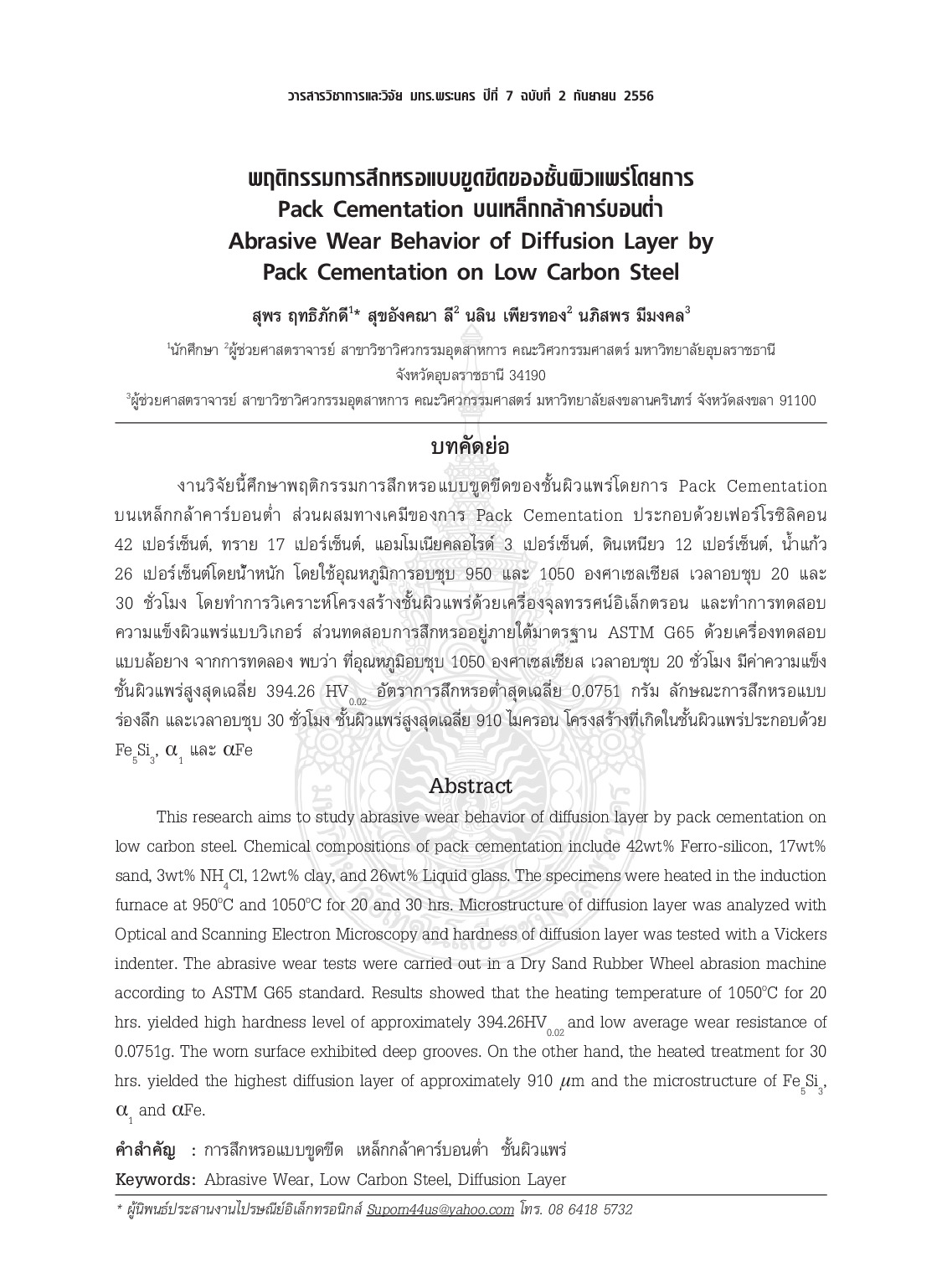
Abrasive wear behavior of diffusion layer by Pack Cementation on low carbon steel
This research aims to study abrasive wear behavior of diffusion layer by pack cementation on low carbon steel. Chemical compositions of pack cementation include 42wt% Ferro-silicon 17wt% sand 3wt% NH4Cl 12wt% clay and 26wt% Liquid glass. The specimens were heated in the induction furnace at 950?C and 1050?C for 20 and 30 hrs. Microstructure of diffusion layer was analyzed with Optical and Scanning Electron Microscopy and hardness of diffusion layer was tested with a Vickers indenter. The abrasive wear tests were carried out in a Dry Sand Rubber Wheel abrasion machine according to ASTM G65 standard. Results showed that the heating temperature of 1050?C for 20 hrs. yielded high hardness level of approximately 394.26HV0.02 and low average wear resistance of 0.0751g. The worn surface exhibited deep grooves. On the other hand the heated treatment for 30 hrs. yielded the highest diffusion layer of approximately 910?m and the microstructure of Fe5Si3 ?1 and ?Fe.