จำนวน Repository ( 143 )

Mathematical modelling for design the control system of a liquid
This paper presents a mathematical modelling for design the control system of a liquid. The system are consists of one and two tanks of a liquid. To confirm the achieved mathematical modelling is used to design P PI PD and PID controller in the frequency domain. The experimental results are indicated as the following. An one tank of a liquid controlling The controller can be control the liquid level to set point with in 100s. In the case of a disturbance occurs in the system it is perform by drain a liquid. As same as the controller it can be control the liquid level into the steady state. In the part of the liquid control this is the interaction between two tanks. The experimental results of the system operation the controller can be control the liquid into the set point both occur disturbance and without disturbance respectively
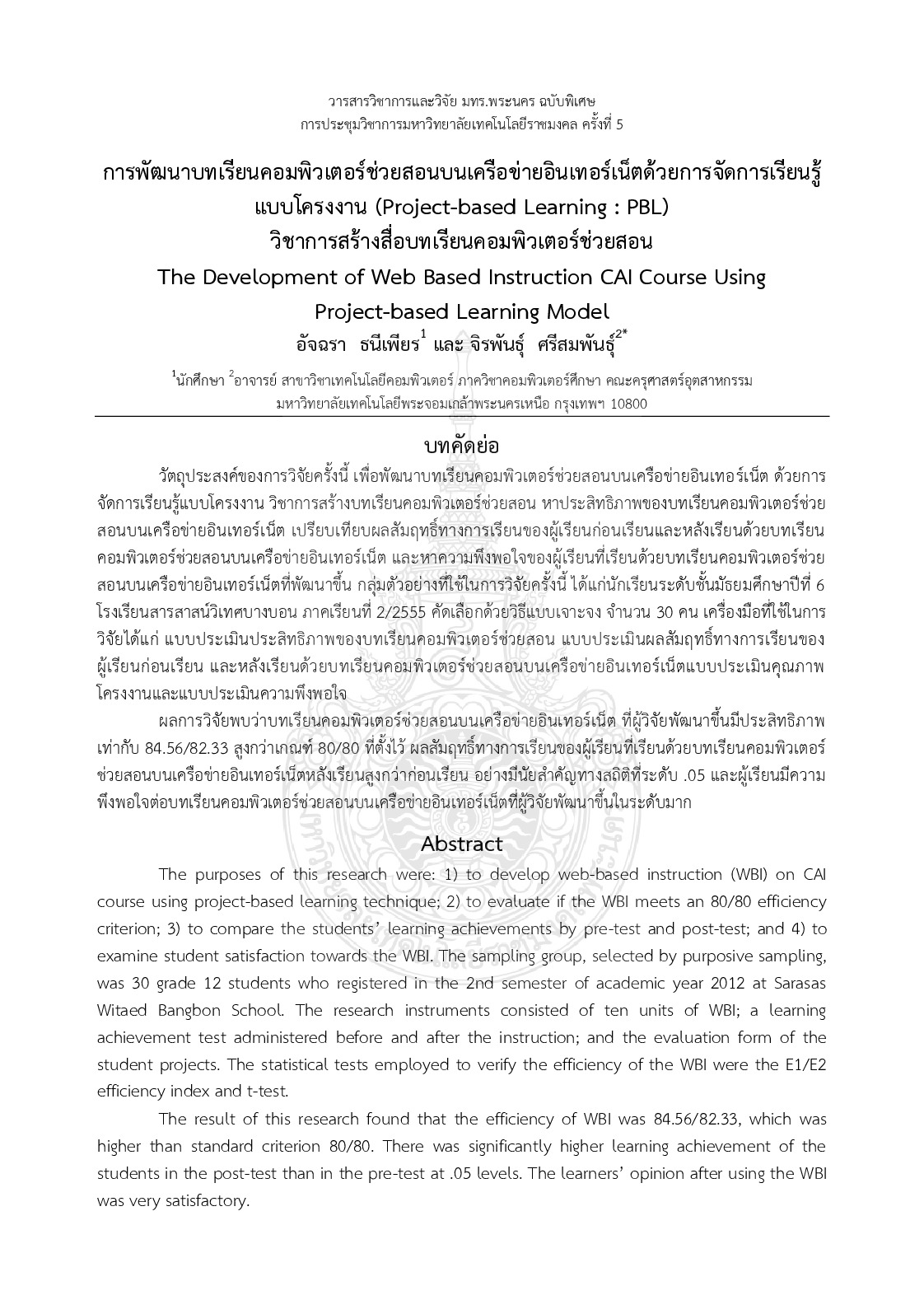
The development of web based instruction CAI course using project-based learning model
The purposes of this research were: 1) to develop web-based instruction (WBI) on CAI course using project-based learning technique; 2) to evaluate if the WBI meets an 80/80 efficiency criterion; 3) to compare the students’ learning achievements by pre-test and post-test; and 4) to examine student satisfaction towards the WBI. The sampling group selected by purposive sampling was 30 grade 12 students who registered in the 2nd semester of academic year 2012 at Sarasas Witaed Bangbon School. The research instruments consisted of ten units of WBI; a learning achievement test administered before and after the instruction; and the evaluation form of the student projects. The statistical tests employed to verify the efficiency of the WBI were the E1/E2 efficiency index and t-test. The result of this research found that the efficiency of WBI was 84.56/82.33 which was higher than standard criterion 80/80. There was significantly higher learning achievement of the students in the post-test than in the pre-test at .05 levels. The learners’ opinion after using the WBI was very satisfactory.
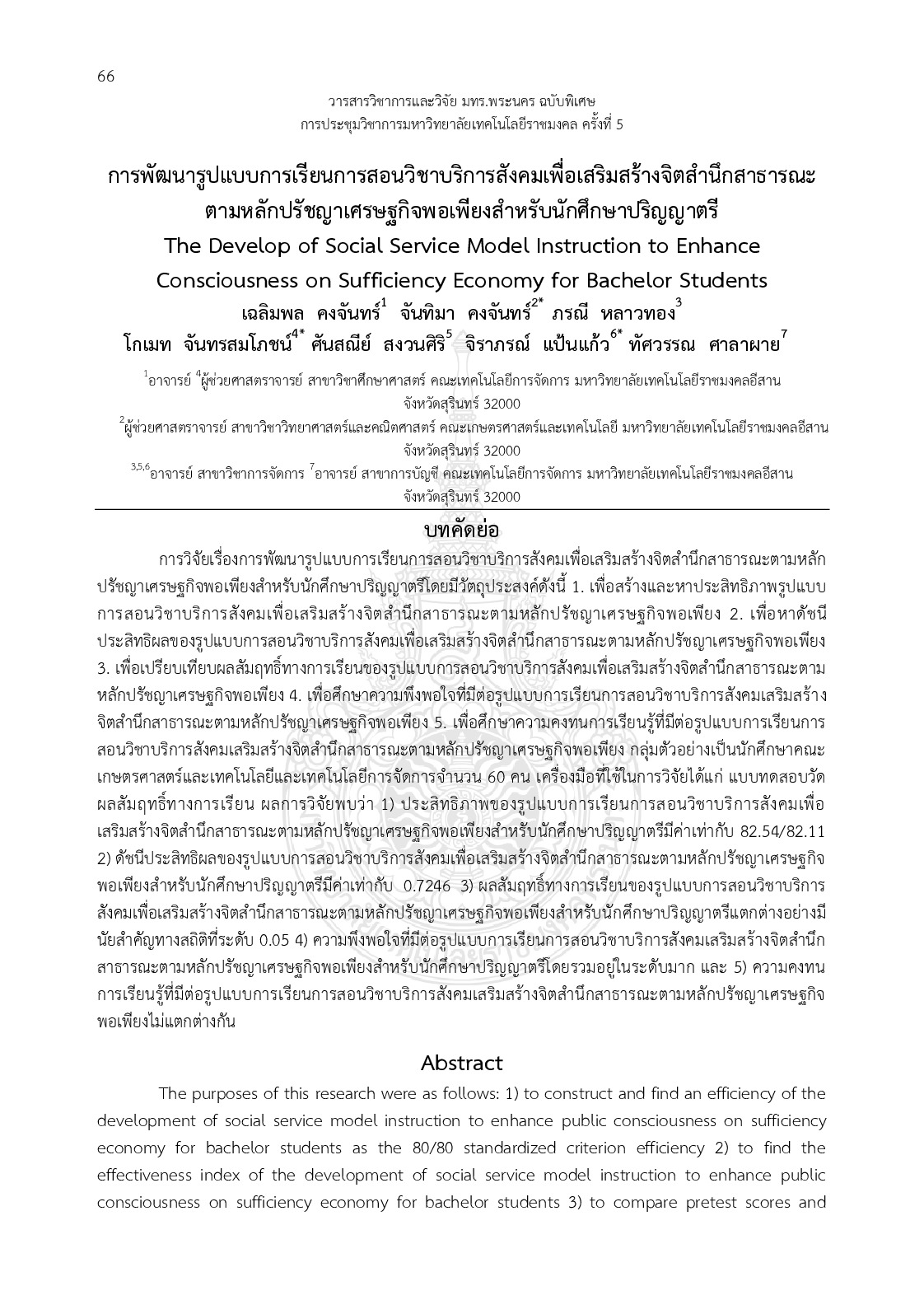
The develop of social service model instruction to enhance consciousness on sufficiency economy for bachelor students
The purposes of this research were as follows: 1) to construct and find an efficiency of the development of social service model instruction to enhance public consciousness on sufficiency economy for bachelor students as the 80/80 standardized criterion efficiency 2) to find the effectiveness index of the development of social service model instruction to enhance public consciousness on sufficiency economy for bachelor students 3) to compare pretest scores and post-test scores all lessons 4) to study the satisfaction of students after they join the class 5) to study the attitude of students after they join the class and 6) to find the retention of students after join the class in two weeks. The sixty students were area on simple random sampling selected from students in Rajamangala Technology University. The results the study was as follows: 1) An efficiency of the development of social service model instruction to enhance public consciousness on sufficiency economy for bachelor students was 82.54/82.11 which higher than the 80/80 standardized criterion efficiency. 2) The efficiency index of the development of social service model instruction to enhance public consciousness on sufficiency economy for bachelor students was 0.7246. 3) The results of the comparisons of pre-test scores and post-test scores all lesson significantly different at 0.05. 4) The results of the satisfaction of the development of social service model instruction to enhance public consciousness on sufficiency economy for bachelor students was found to be a high level. 5) The retention of the teachers after join the class in two was no significantly different.
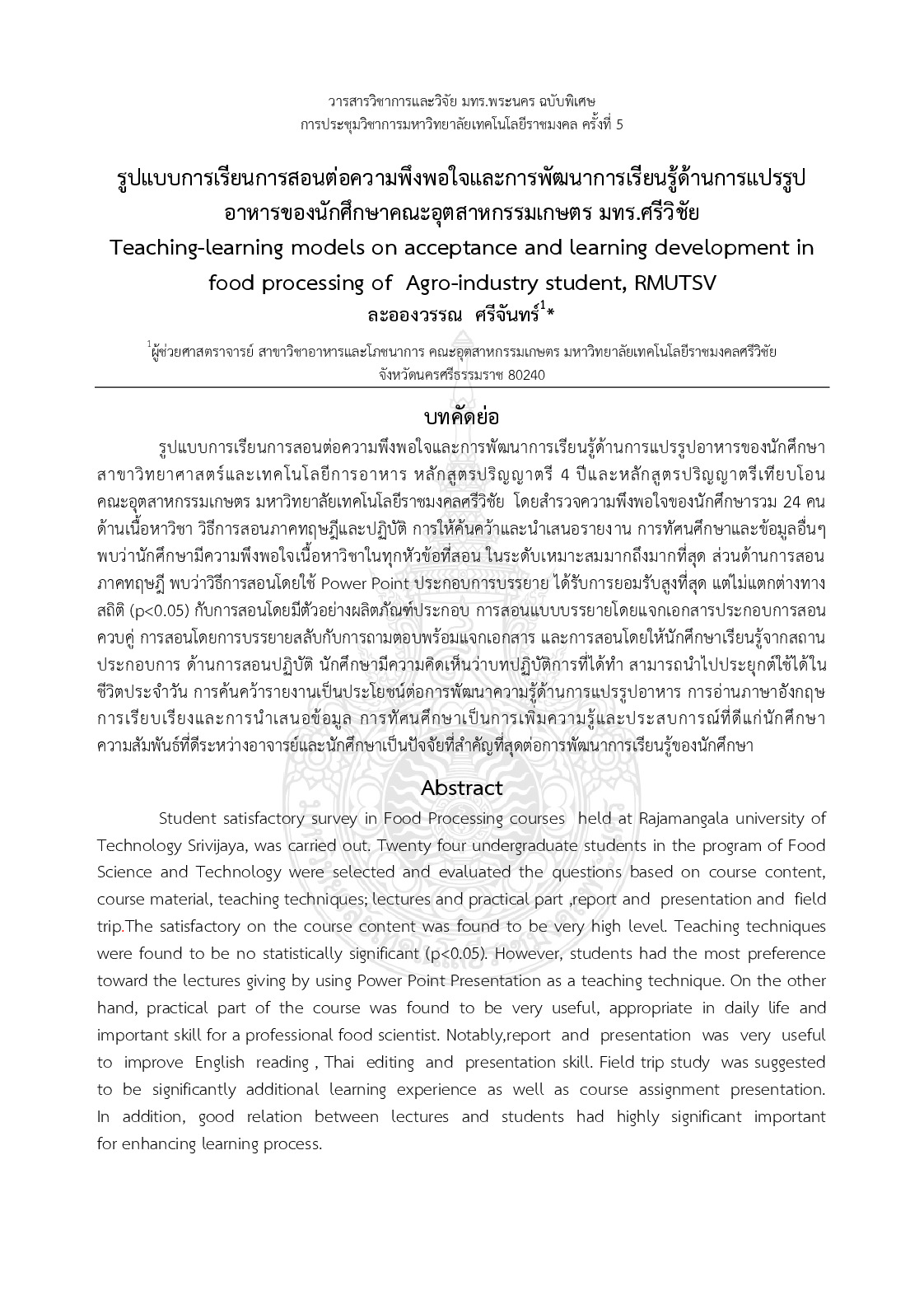
Teaching-learning models on acceptance and learning development in food processing of agro-industry student, RMUTSV
Student satisfactory survey in Food Processing courses held at Rajamangala university of Technology Srivijaya was carried out. Twenty four undergraduate students in the program of Food Science and Technology were selected and evaluated the questions based on course content course material teaching techniques; lectures and practical part report and presentation and field trip.The satisfactory on the course content was found to be very high level. Teaching techniques were found to be no statistically significant (p<0.05). However students had the most preference toward the lectures giving by using Power Point Presentation as a teaching technique. On the other hand practical part of the course was found to be very useful appropriate in daily life and important skill for a professional food scientist. Notablyreport and presentation was very useful to improve English reading Thai editing and presentation skill. Field trip study was suggested to be significantly additional learning experience as well as course assignment presentation. In addition good relation between lectures and students had highly significant important for enhancing learning process.
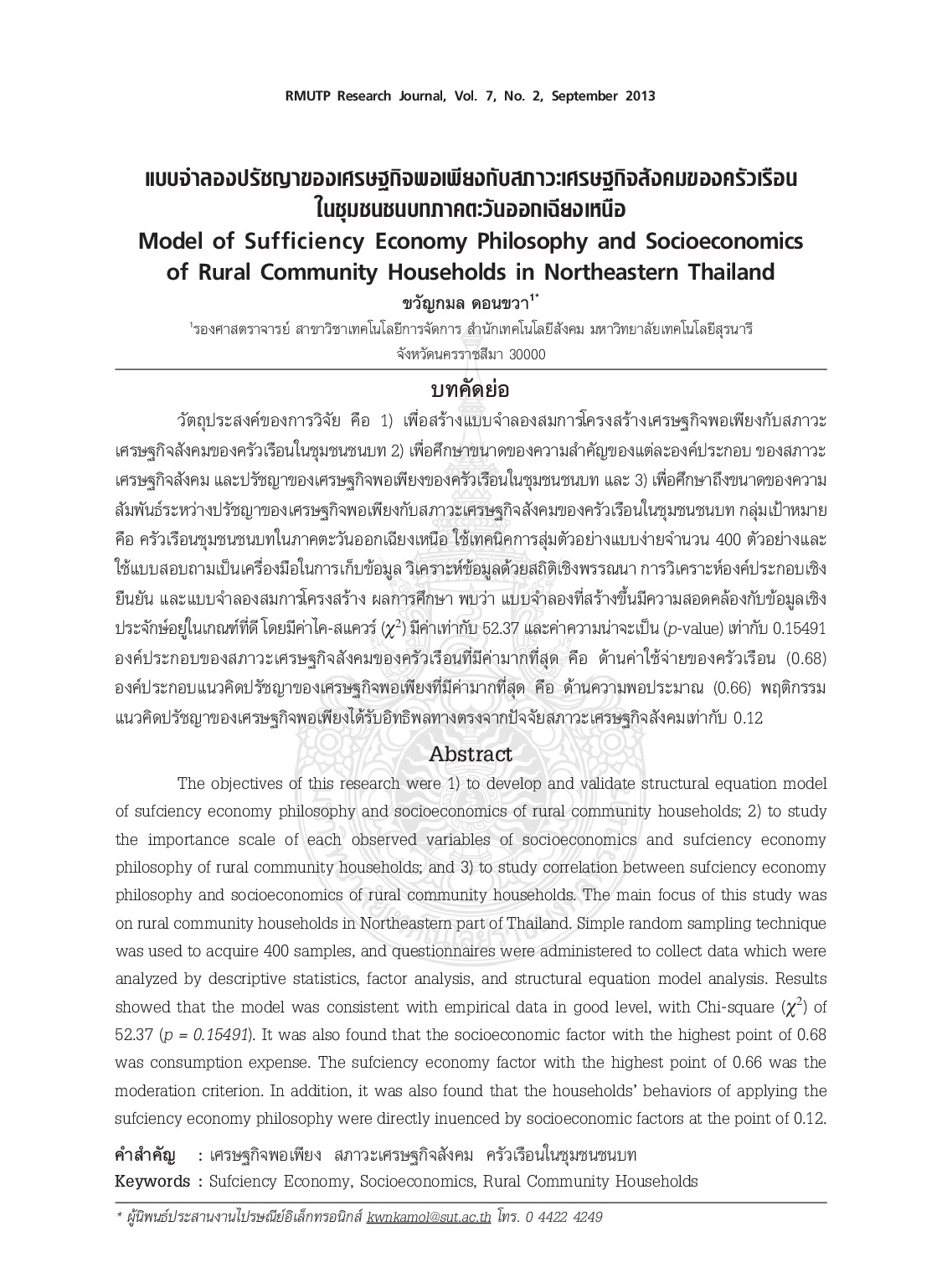
The model of a sufficiency economy philosophy with socioeconomics of rural community’s households, Northeastern Thailand
The objectives of this research were 1) to develop and validate the structural equation model of application of the sufficiency economy philosophy with socioeconomics of rural community households 2) to study the importance scale of each of the observed variables with socioeconomics and the sufficiency economy philosophy of rural community households and 3) to study the correlation level between the sufficiency economy philosophy and socioeconomics of rural community households. The main focus of this study was on rural community households. Simple random sampling technique was used to arrive at 400 samples and a questionnaire was administered to collect data and analyzed by descriptive statistics factor analysis and structural equation model analysis. The result showed that the model was consistent with the empirical data. Goodness of fit measures were found to be: Chi-square 52.37(p- value= 0.15491). It was also found that the factor loading of socioeconomics with the highest point was the consumption expenditure at 0.68 whereas the factor loading of the sufficiency economy philosophy with the highest point was the criterion of moderation at 0.66. Besides it was found that the rural community households’ behavior of applying the sufficiency economy philosophy received direct influence from the socioeconomic factors at the point of 0.12.