จำนวน Repository ( 1852 )
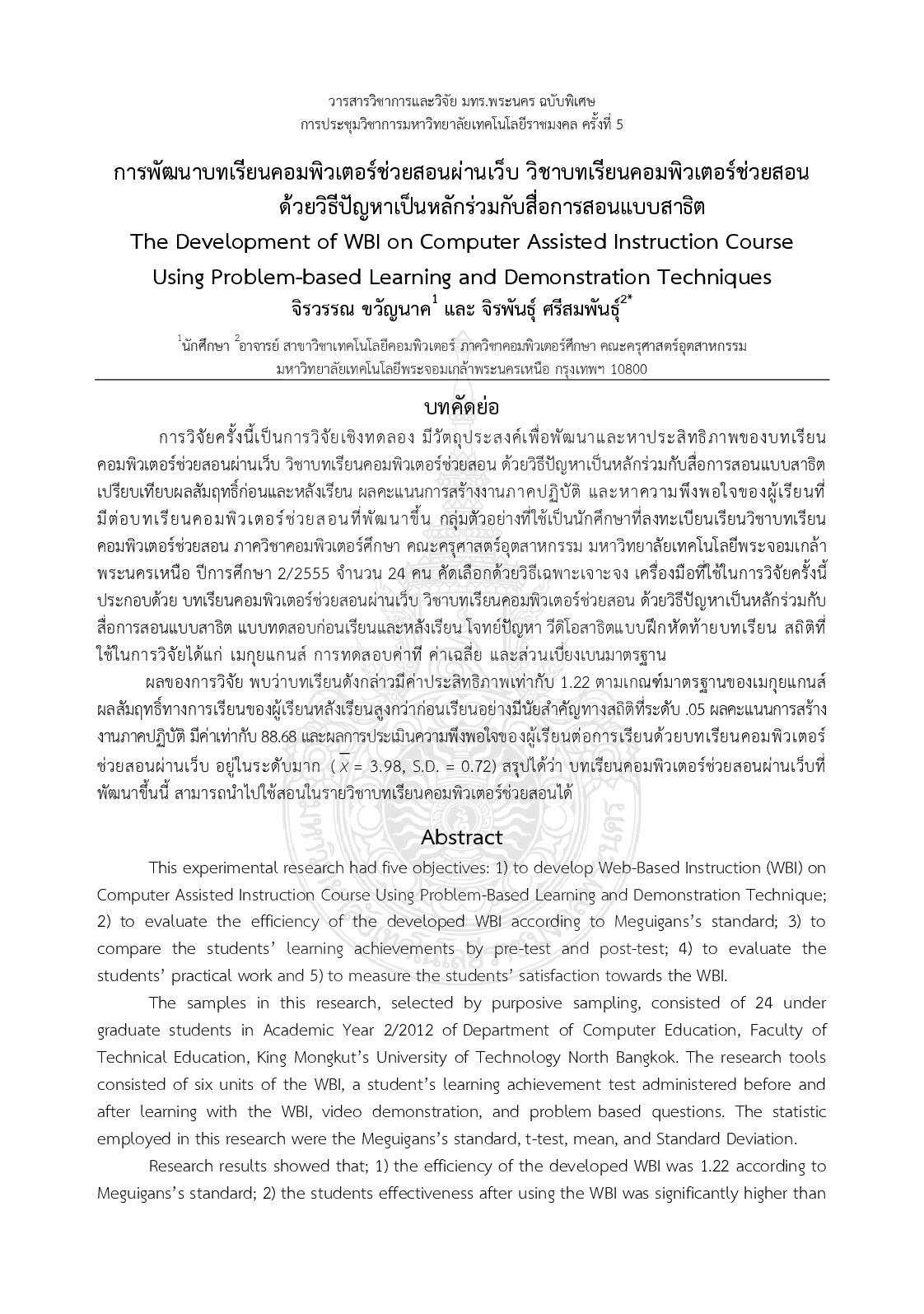
The development of wbi on computer assisted instruction course using problem-based learning and demonstration techniques
This experimental research had five objectives: 1) to develop Web-Based Instruction (WBI) on Computer Assisted Instruction Course Using Problem-Based Learning and Demonstration Technique; 2) to evaluate the efficiency of the developed WBI according to Meguigans’s standard; 3) to compare the students’ learning achievements by pre-test and post-test; 4) to evaluate the students’ practical work and 5) to measure the students’ satisfaction towards the WBI. The samples in this research selected by purposive sampling consisted of 24 under graduate students in Academic Year 2/2012 of Department of Computer Education Faculty of Technical Education King Mongkut’s University of Technology North Bangkok. The research tools consisted of six units of the WBI a student’s learning achievement test administered before and after learning with the WBI video demonstration and problem based questions. The statistic employed in this research were the Meguigans’s standard t-test mean and Standard Deviation. Research results showed that; 1) the efficiency of the developed WBI was 1.22 according to Meguigans’s standard; 2) the students effectiveness after using the WBI was significantly higher than before using it at .05; 3) the average score of the practical work was 88.68 higher than 80; 4) the students’ satisfactory was at a good level. In conclusion the developed WBI can be used for the target group properly.
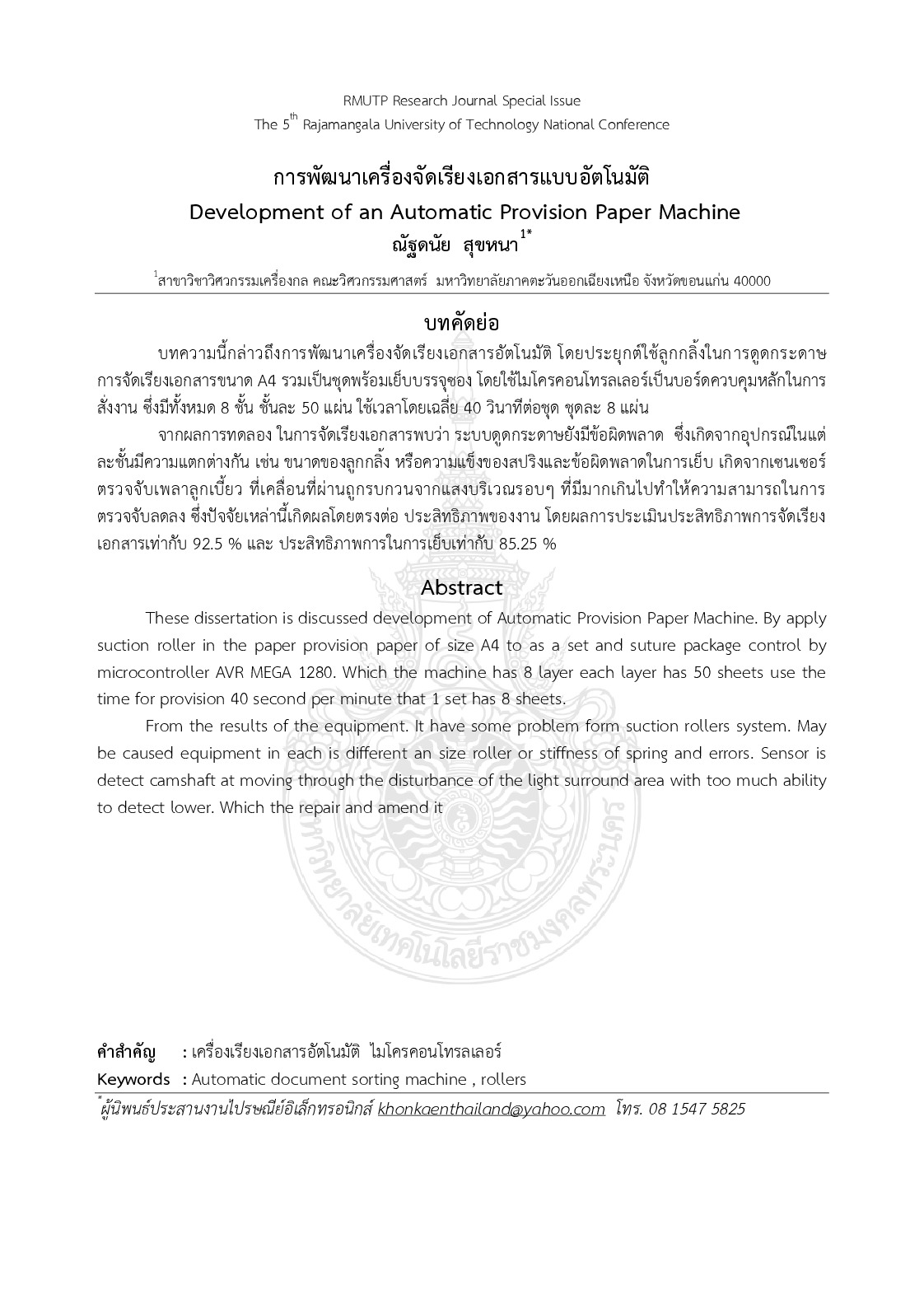
Development of an automatic provision paper machine
These dissertation is discussed development of Automatic Provision Paper Machine. By apply suction roller in the paper provision paper of size A4 to as a set and suture package control by microcontroller AVR MEGA 1280. Which the machine has 8 layer each layer has 50 sheets use the time for provision 40 second per minute that 1 set has 8 sheets. From the results of the equipment. It have some problem form suction rollers system. May be caused equipment in each is different an size roller or stiffness of spring and errors. Sensor is detect camshaft at moving through the disturbance of the light surround area with too much ability to detect lower. Which the repair and amend it
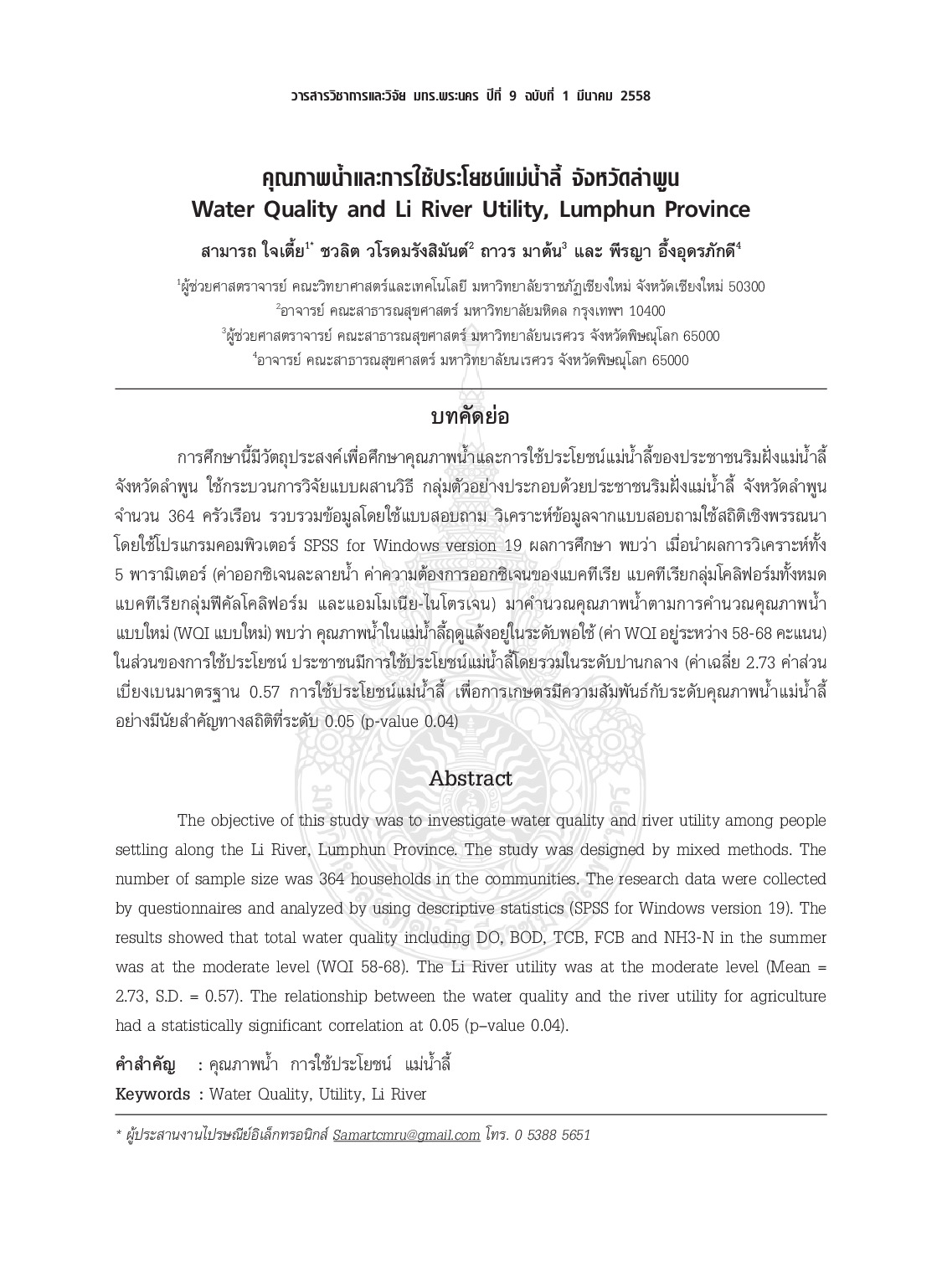
Water quality and li river utility, lumphun province
The objective of this study was to investigate water quality and river utility among people settling along the Li River Lumphun Province. The study was designed by mixed methods. The number of sample size was 364 households in the communities. The research data were collected by questionnaires and analyzed by using descriptive statistics (SPSS for Windows version 19 ).The results showed that total water quality including DO BOD TCB FCB and NH3-N in the summer was at the moderate level (WQI 58 - 68). The Li River utility was at the moderate level (Mean = 2.73 S.D. = 0.57). The relationship between the water quality and the river utility for agriculture had a statistically significant correlation at 0.05 (p –value 0.04).
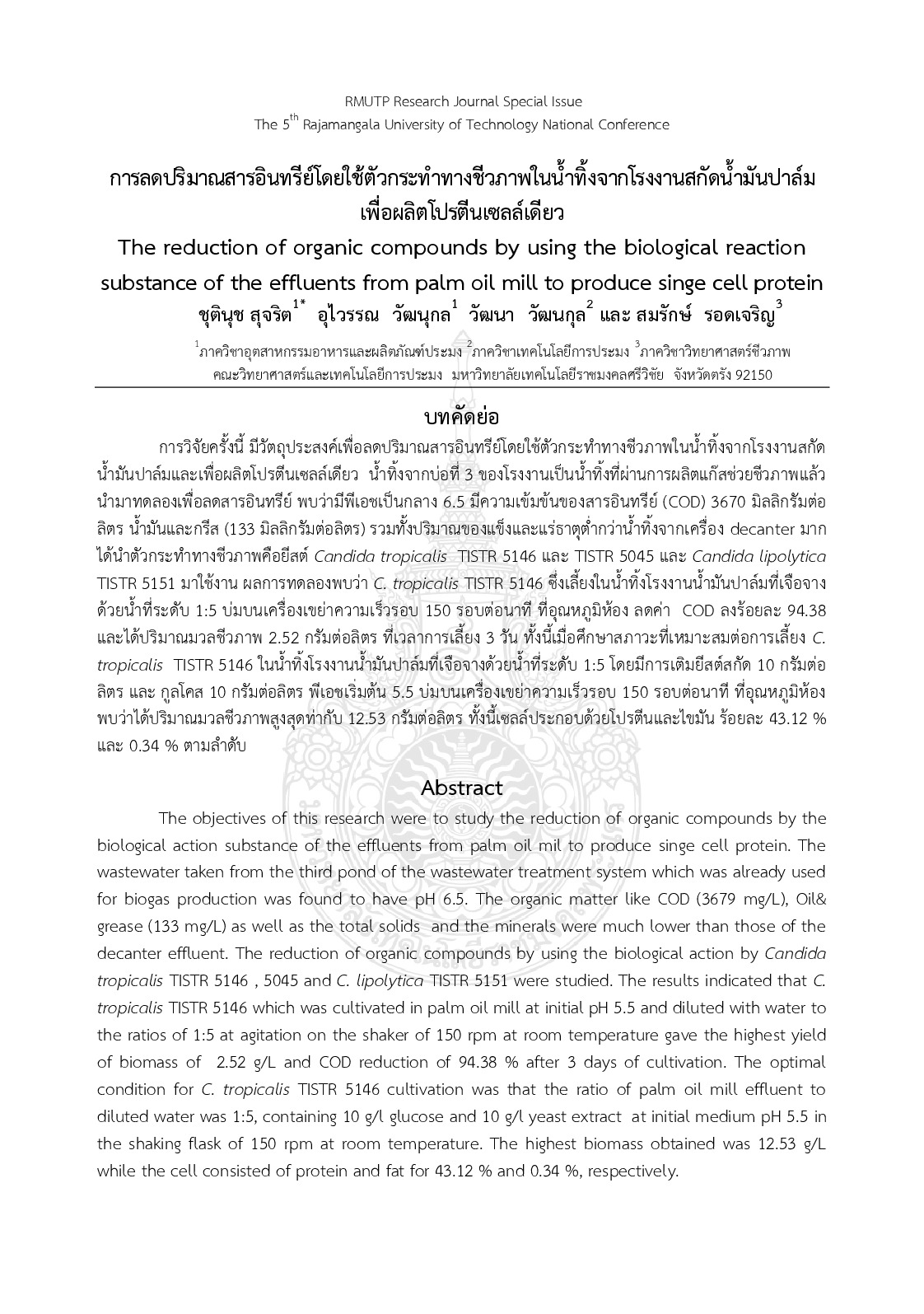
The reduction of organic compounds by using the biological reaction substance of the effluents from palm oil mill to produce singe cell protein
The objectives of this research were to study the reduction of organic compounds by the biological action substance of the effluents from palm oil mil to produce singe cell protein. The wastewater taken from the third pond of the wastewater treatment system which was already used for biogas production was found to have pH 6.5. The organic matter like COD (3679 mg/L) Oil& grease (133 mg/L) as well as the total solids and the minerals were much lower than those of the decanter effluent. The reduction of organic compounds by using the biological action by Candida tropicalis TISTR 5146 5045 and C. lipolytica TISTR 5151 were studied. The results indicated that C. tropicalis TISTR 5146 which was cultivated in palm oil mill at initial pH 5.5 and diluted with water to the ratios of 1:5 at agitation on the shaker of 150 rpm at room temperature gave the highest yield of biomass of 2.52 g/L and COD reduction of 94.38 % after 3 days of cultivation. The optimal condition for C. tropicalis TISTR 5146 cultivation was that the ratio of palm oil mill effluent to diluted water was 1:5 containing 10 g/l glucose and 10 g/l yeast extract at initial medium pH 5.5 in the shaking flask of 150 rpm at room temperature. The highest biomass obtained was 12.53 g/L while the cell consisted of protein and fat for 43.12 % and 0.34 % respectively.
Processing of fish tofu product from fresh water fish in bo-klue district, nan Province
The research aimed to study the processing of fish tofu from fresh water fish such as Pla Pluang Hin (Neolissochilus stracheyi) Pla Jad (Hypsibarbus malcolmi) and Pla Mum (Scanphiodonichthys acanthopterus) that are usually found in Bo-klue district Nan province. These three fresh water fish tofu were compared with tofu from Threadfin bream (Nemipterus hexodon) that was a commercial raw material of fish tofu. The fish tofus were experimented on 1) physical attributes 2) chemical compositions and 3) sensory preference. The physical attributes of color size amount of air bubble and firmness were studied. The results showed that lightness (L) of tofu from Pla Pluang Hin and Pla Jad was higher than Pla Mum and Threadfin bream. Threadfin bream tofu showed the highest redness (a*). There was not difference in the yellowness (b*) of all fish tofu. The sizes of the air bubbles in four fish tofu products were between 1.3 to 1.6 mm. which was 80% of air bubble amounts found in a square centimeter. The firmness of all fresh water fish tofu was lower than Threadfin bream tofu. The Percentage of moisture ash fat and protein contents were between 74.2 to 75.7 2.1 to 3.2 0.5 to 3.6 and 21.1 to 25.5 percent respectively. The sensory attribute acceptance of three types fresh water fish tofu were not significant to Threadfin bream tofu. The products were accepted at level of moderate to high preference.