จำนวน Repository ( 1852 )
Production planning for SMEs: a case study in quilt products of hmon-oon group
Nowadays one of major problems of SMEs is improperly planning the production to serve for the true demand of customers. Therefore this research was set the objective to apply forecasting techniques to predict the right demands and feed them together with other constraints as inputs for the LP model in production planning to get maximum profit and also conform to the restriction constraints such as production processes sales volume labor constraints inventory and investment requirements. As a result from this study the Decomposition Technique by Minitab program was the most accurate technique for sales forecasting of Quilt Products of Hmon-Oon Group. The sales forecasting information was then used as input to a mathematical model (LP) targeting maximized profit processing by Solver program in Microsoft Excel 2010. Eventually the business can gain more benefit by using this method from 358830 Baht in one quarter to 504425 Baht or 40.57% increase. Cost of inventory decreases from 17764 Baht to 16670 Baht or 6.16% decrease. Production labor hours in one quarter decreases from 2984.12 hours to 2378.77 hours or 20.29% decrease
Application of differential evolution optimization algorithm for raw material allocation problems in multi-stage rice transportation
The research aims to compare results of algorithm for solving allocation problem in multi-stage rice transportation between formulation of mathematical model with computation by Lingo V.11 and application of Differential Evolution (DE). The research was conducted in two stages: 1) comparing efficiency of the two employed applications in terms of economic and 2) comparing for minimum computation time. The proposed algorithm was tested with problems in six simulated case studies. Results show that in terms of economic DE did not generate better solutions than Lingo V.11 at an average of 0.525%. However it used faster response time at an average of 206 minutes when compared to Lingo V.11.
Development of the prototype for dc motor speed control with computer
This research is to study and develop a DC motor speed control by using Visual Basic.Net 2008 in computer programming to use the computer and the microcontroller is processing from computer via the serial port. So that a signal to the motor driver circuit motor speed work as assigned. By the speed can be entered via the computer screen is measured in rpm. and motor control to control the PWM (Pulse Width Modulation) control circuit and the principles of the hardware by using the digital output signal of the microcontroller control Motor speed can be configured to be from 100 to 3000 rpm. And the motor starts to spin at maximum speed and then gradually reduce the speed down to the specified value. Control both the speed and the average error of 4.6% compared to the speed measurement using infrared light. And found that at speeds below 100 rpm. to a maximum error of 12% and the error decreases when the speed increases. The error value is at least 2000 rpm. and 3000 rpm the speed error is 0.5%
Manufacturing valuation for the standards for community products in kamphaeng phet province
The objective of this study is to upgrade the quality of community product manufacturers in Kamphaeng Phet province to the national and international level of the standard for community products by using a knowledge implementation workshop promoted its processing and standard specification followed up by sample screening test of Thai FDA certified or none products; and then qualified each screened sample quality for the standards for community products by Thai Industrial Standards Institute. The result of this study revealed that the dry fish chili paste fry tapioca butter aloe vera in syrup mushroom fermented soya milk cookies noodle and chili paste which must be improved is aflatoxin sorbic acid the definition and scope of products Staphylococus aureus moisture content benzoic acid water activity respectively. Screening test showed net weight measurement and product labeling problems. The product information which met the standards could be applied for the standard quality of community product in Kamphaeng Phet province and upgraded to the quality of community product to food safety and food security.
Continuous production of biodiesel in a continuous reactor with minimal
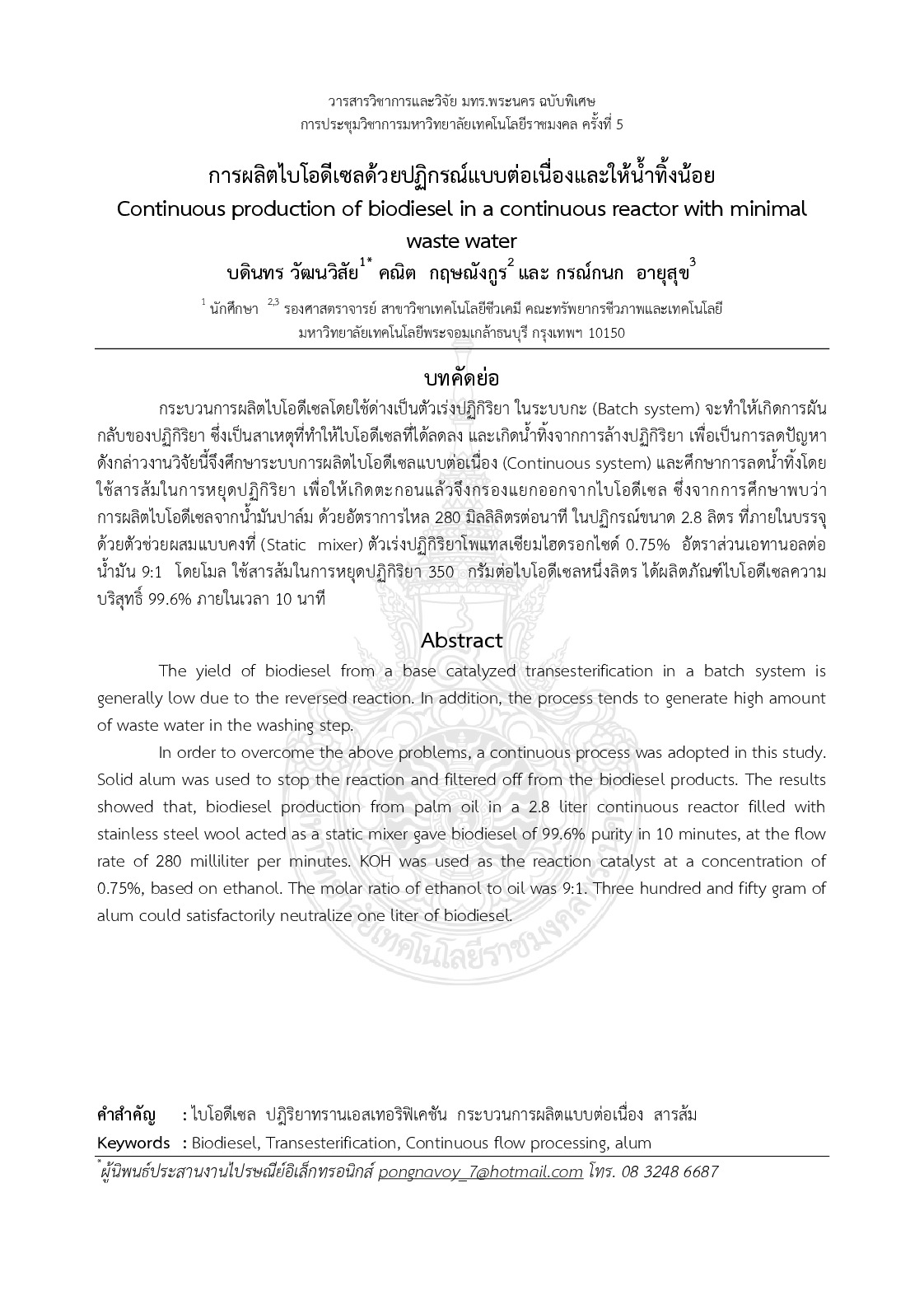
The yield of biodiesel from a base catalyzed transesterification in a batch system is generally low due to the reversed reaction. In addition the process tends to generate high amount of waste water in the washing step. In order to overcome the above problems a continuous process was adopted in this study. Solid alum was used to stop the reaction and filtered off from the biodiesel products. The results showed that biodiesel production from palm oil in a 2.8 liter continuous reactor filled with stainless steel wool acted as a static mixer gave biodiesel of 99.6% purity in 10 minutes at the flow rate of 280 milliliter per minutes. KOH was used as the reaction catalyst at a concentration of 0.75% based on ethanol. The molar ratio of ethanol to oil was 9:1. Three hundred and fifty gram of alum could satisfactorily neutralize one liter of biodiesel.