จำนวน Repository ( 644 )
การพัฒนาฟิล์มย่อยสลายได้จากแป้งมันแกวเพื่อประยุกต์ใช้เป็นถุงเพาะชำ
This research aimed to study the production of a biodegradable film from Jicama starch (Pachyrhizus erosus (L.) Urbar) for plant bag application. The film was prepared by dissolving Jicama starch in water to the concentration of 5 wt%. To study the effect of the glycerol content the glycerol was added at 6 levels; 0 10 20 30 40 50 and 60 wt%. The film was casted in a molded and dried at 60 oC for 24 h. After drying properties of films; thickness water activity (aw) solubility tensile strength (TS) elongation (%E) puncture strength and the degradation of the films were evaluated. The thickness of the films was in the range of 0.16-0.28 mm. The aw of films ranged from 0.36-0.49. The water vapor permeability water solubility and flexibility of the film increased with the increasing of glycerol content. Tensile and puncture strength of the starch films tended to increased when the glycerol content decrease. After the films were buried under the ground (8-10 cm depth) for 12 weeks they were degraded by 100%. The Jicama starch film with 40 wt% glycerol showed the best overall properties.
การพัฒนาผลิตภัณฑ์เปลือกเสาวรสแช่อิ่มอบแห้ง
The development product of dried pickled passion fruit peel aimed to study appropriate production process of dried pickled passion fruit peel to study the preservation and examine the acceptance from the customers. The result showed that the appropriate way to produce dried pickled passion fruit peel was the 30% 40% and 50% of intensity in syrup. With the intensity of syrup started from 30% the appearance color and smell of final product got highest average score. Therefore the production should be slow pickled with 30% of syrup intensity. In terms of preservation there was no microorganism over Thai industrial standard institute of fruits and vegetables 161/2015. Finally most of the customers accepted this product
การพัฒนารูปแบบผลิตภัณฑ์หัตกรรมชุมชนเตยปาหนันจากภูมิปัญญาท้องถิ่น บ้านร่าหมาด ตำบลเกาะกลาง อำเภอเกาะลันตา จังหวัดกระบี่
Development guideline local wisdom product of Pandanus Odortissimus Linn. Banramad Lanta Krabi a purpose (1) the study local wisdom product of Pandanus Odortissimus Linn. (2) Develop guideline product for handicraft demand with the customer (3) Develop guideline productBased on local wisdom. The collect information local wisdom product of Pandanus Odortissimus Linn. Banramad Lanta Krabi With the method of interview and develop product for handicraft demand with the customer. The sample is People interested product of Pandanus Odortissimus Linn. The research results (1) product of Pandanus Odortissimus Linn. Banramad Lanta Krabi has evolved from a product of mats used since the ancestors and inherit. Developed according to usage until the group Pandanus Odortissimus Linn. Banramad Lanta Krabi Since 1999 has developed products for sale In other product. Emphasize the fairness in the form of traditional wisdom and the productivity of its members group Pandanus Odortissimus Linn. Banramad Lanta Krabi (2) Develop guideline product for handicraft demand with the customer provide feedback on product variations results Most of the respondents were female 198 representing 80.77 % age range 51-60 years 102 persons or 38.46%. And give opinions aspect convenience on form bag (=4.6) pattern ( =4.5) and benefit ( =4.4)
การพัฒนาธุรกิจโฮมสเตย์อย่างยั่งยืนตามแนวปรัชญาเศรษฐกิจพอเพียง จังหวัดสมุทรสงคราม
This study aimed to develop a homestay village for environmental conservation services. The study divided into 2 stages. The first stage was to study and survey general information and operations of the homestay villages for conservation tourism services. The second stage was to develop the homestay village for environmental conservation tourism services. The mixed methods were employed. The major findings revealed the following: 1. The developed homestay village for environmental conservation tourism services had 6 component’s: (1) Survey a study of document survey of community environment and tourism resources ; (2) Operation planning operation publicizing information to the village people organizing a training on an environmental conservation ; (3) Organization Setting; (4) Relations ; (5) Service welcoming to tourists tourists activities and nearby tourist activities ; and (6) Evolution assessing within the homestays and requesting for evolution from the Tourism Authority of Thailand. In confusion the developed homestay village for environmental conservation tourism services could develop knowledge attitude and behaviors in environmental conservation of the people with homestay service experiences. These people had awareness and responsibility in sustainably environmental conservation in the future.
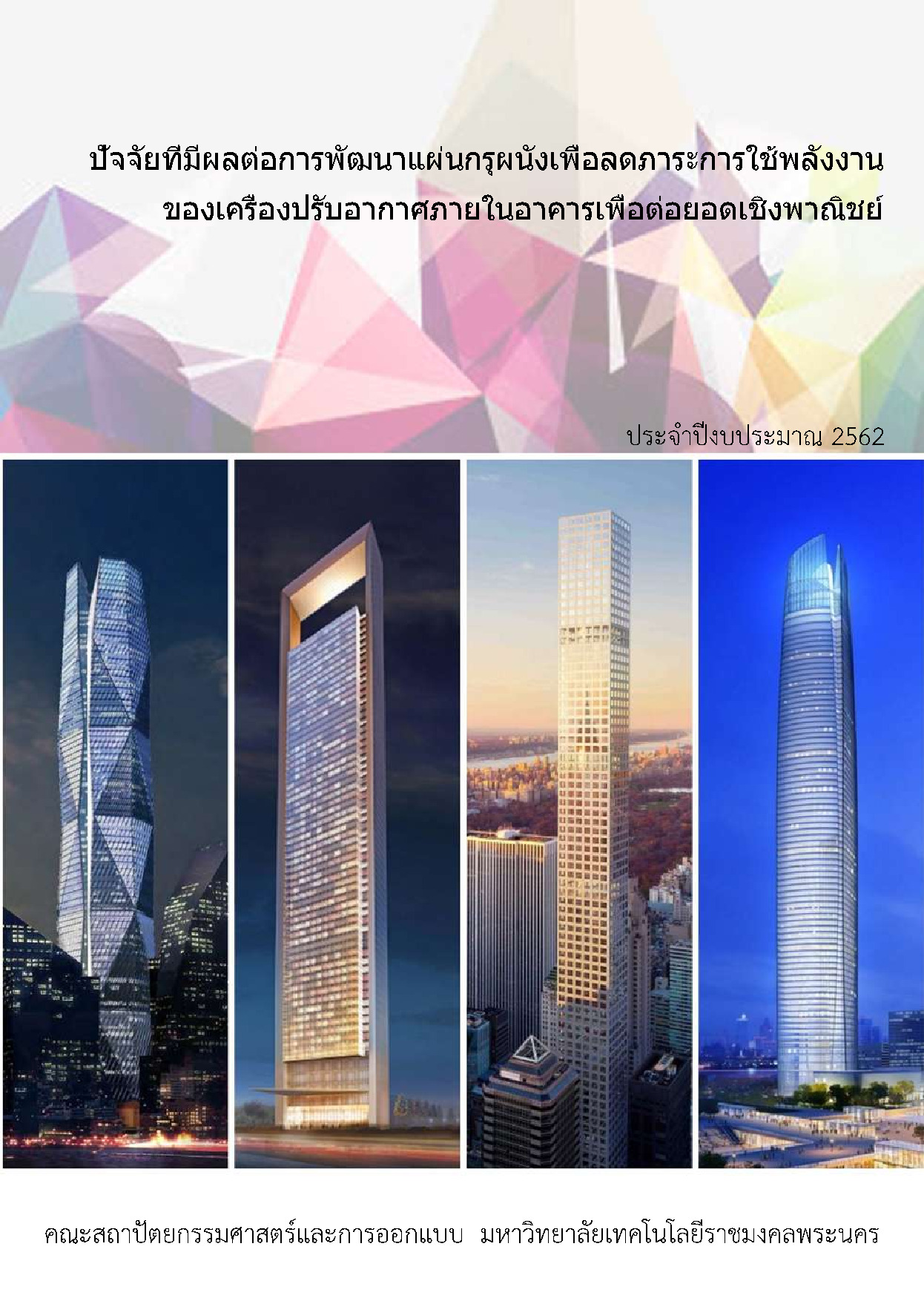
ปัจจัยที่มีผลต่อการพัฒนาแผ่นกรุผนังเพื่อลดภาระการใช้พลังงานของเครื่องปรับอากาศภายในอาคารเพื่อต่อยอดเชิงพาณิชย์
This research approach to study the development of interior wall for reduce energy consumption by air conditioning in the building. In order to be a prototype in the development of an industrial system for the export of green architecture in order to generate income for the community or entrepreneurs to bring money into the country to upgrade the industrial economy to be sustainable It is an architectural material that is compatible with the weather in Thailand. It can be used as a guideline for people interested in applying it to their own home building or disseminating through various media to reduce energy costs for a comfortable living. The objective is to study the factors that affect the development of wall paneling in order to reduce the energy burden of the air conditioner in the building in order to further the commercial production. The researcher collected data for the past 6 months not including other thermal energy. Used to calculate the energy consumption index for 2 building groups it was found that the electricity consumption of green buildings were 531100 kilowatt hours. And an average of 5.31 kilowatt hours per square meter While the non-green building has an average of 653360 kilowatt hours. And an average of 6.53 kilowatt hours per square meter As for the results of the data analysis the damage level is mostly at level 1 which is the wall surface and no obvious damage. Especially the 4th and 5th height is 1.55 meters and 1.85 meters from the floor level in the building. Damage level 3 is found at the height level 3 at a height of 1.00 meters from the floor level in the building. Assessment of damage caused to the interior wall of the building that occurred in 3 levels. The results of the data analysis showed that most damage levels were at level 1 namely the wall surface without obvious damage. Especially the 4th and 5th height is 1.55 meters and 1.85 meters from the floor level in the building. Damage level 3 is found at the height level 3 at a height of 1.00 meters and from the results of collecting moisture content in the exterior wall materials And analyzed to find the average for each of the 5 levels of height which are 0.55 meters 0.75 meters 0.95 meters 1.55 meters and 1.85 meters found that the buildings have different moisture content in each wall level (p <0.05). In conclusion this green building index equation can be applied to other buildings to reduce energy consumption and meet the standards of the green building. From the equation the electricity consumption can be predicted using the electricity usage index and systematically designed energy management in buildings. The area with the most damage will find the humidity in the range of 47% -98% the highest damage level 3 at an elevation of 0.80 meters from the floor level in the building