จำนวน Repository ( 197 )
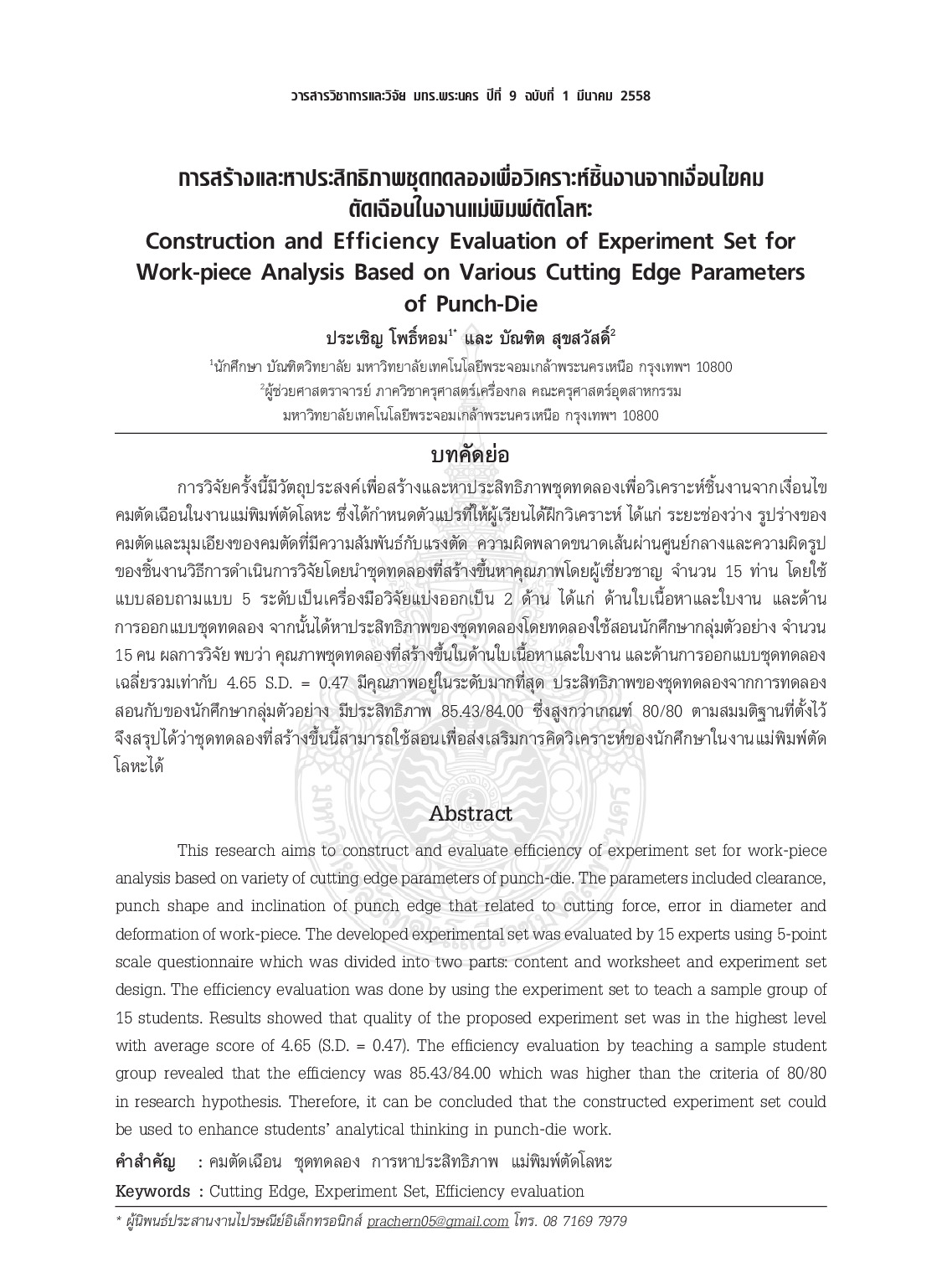
Construction and efficiency evaluation of experiment set for work-piece analysis based on various cutting edge parameters of punch-die
This research aims to construct and evaluate efficiency of experiment set for work-piece analysis based on variety of cutting edge parameters of punch-die. The parameters included clearance punch shape and inclination of punch edge that related to cutting force error in diameter and deformation of work-piece. The developed experimental set was evaluated by 15 experts using 5-point scale questionnaire which was divided into two parts: content and worksheet and experiment set design. The efficiency evaluation was done by using the experiment set to teach a sample group of 15 students. Results showed that quality of the proposed experiment set was in the highest level with average score of 4.65 (SD = 0.47). The efficiency evaluation by teaching a sample student group revealed that the efficiency was 85.43/84.00 which was higher than the criteria of 80/80 in research hypothesis. Therefore it can be concluded that the constructed experiment set could be used to enhance students’ analytical thinking in punch-die work.
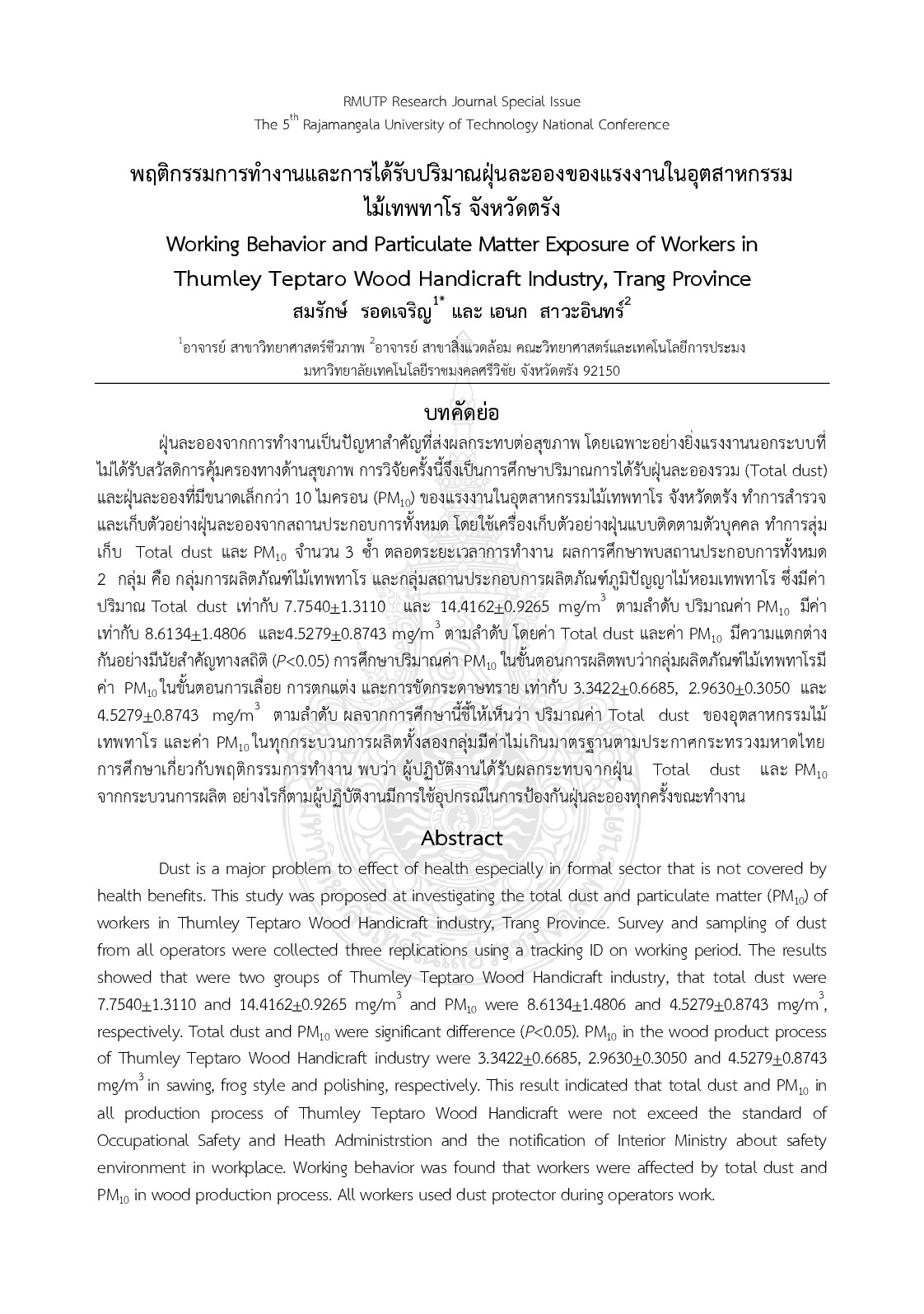
Working behavior and particulate matter exposure of workers in thumley teptaro wood handicraft industry, trang province
Dust is a major problem to effect of health especially in formal sector that is not covered by health benefits. This study was proposed at investigating the total dust and particulate matter (PM10) of workers in Thumley Teptaro Wood Handicraft industry Trang Province. Survey and sampling of dust from all operators were collected three replications using a tracking ID on working period. The results showed that were two groups of Thumley Teptaro Wood Handicraft industry that total dust were 7.7540+1.3110 and 14.4162+0.9265 mg/m3 and PM10 were 8.6134+1.4806 and 4.5279+0.8743 mg/m3 respectively. Total dust and PM10 were significant difference (P<0.05). PM10 in the wood product process of Thumley Teptaro Wood Handicraft industry were 3.3422+0.6685 2.9630+0.3050 and 4.5279+0.8743 mg/m3 in sawing frog style and polishing respectively. This result indicated that total dust and PM10 in all production process of Thumley Teptaro Wood Handicraft were not exceed the standard of Occupational Safety and Heath Administrstion and the notification of Interior Ministry about safety environment in workplace. Working behavior was found that workers were affected by total dust and PM10 in wood production process. All workers used dust protector during operators work.
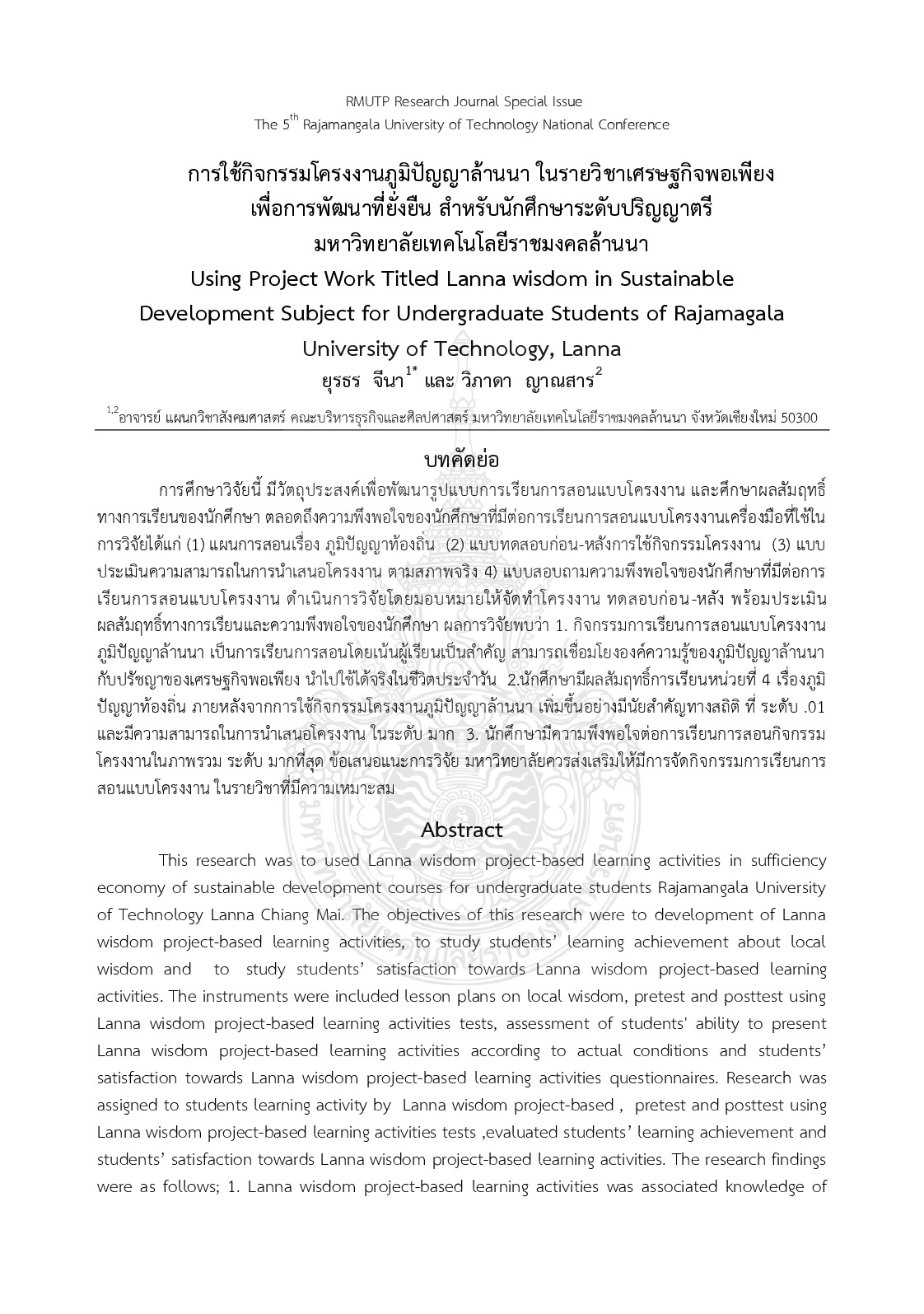
Using project work titled lanna wisdom in sustainable development subject for undergraduate students of Rajamagala University of Technology, lanna
This research was to used Lanna wisdom project-based learning activities in sufficiency economy of sustainable development courses for undergraduate students Rajamangala University of Technology Lanna Chiang Mai. The objectives of this research were to development of Lanna wisdom project-based learning activities to study students’ learning achievement about local wisdom and to study students’ satisfaction towards Lanna wisdom project-based learning activities. The instruments were included lesson plans on local wisdom pretest and posttest using Lanna wisdom project-based learning activities tests assessment of students ability to present Lanna wisdom project-based learning activities according to actual conditions and students’ satisfaction towards Lanna wisdom project-based learning activities questionnaires. Research was assigned to students learning activity by Lanna wisdom project-based pretest and posttest using Lanna wisdom project-based learning activities tests evaluated students’ learning achievement and students’ satisfaction towards Lanna wisdom project-based learning activities. The research findings were as follows; 1. Lanna wisdom project-based learning activities was associated knowledge of Lanna wisdom with sufficiency economy for application in daily life 2. Students’ learning achievement about local wisdom in lesson 4 after using Lanna wisdom project-based learning activities are increase at statistically significant level of 0.01 and capable of Lanna wisdom project-based learning activities presentation at a higher level. 3. Student overalls satisfaction towards Lanna wisdom project-based learning activities at the highest level. The recommendation of research that universities should support of appropriate teaching curriculum by project-based learning activities.
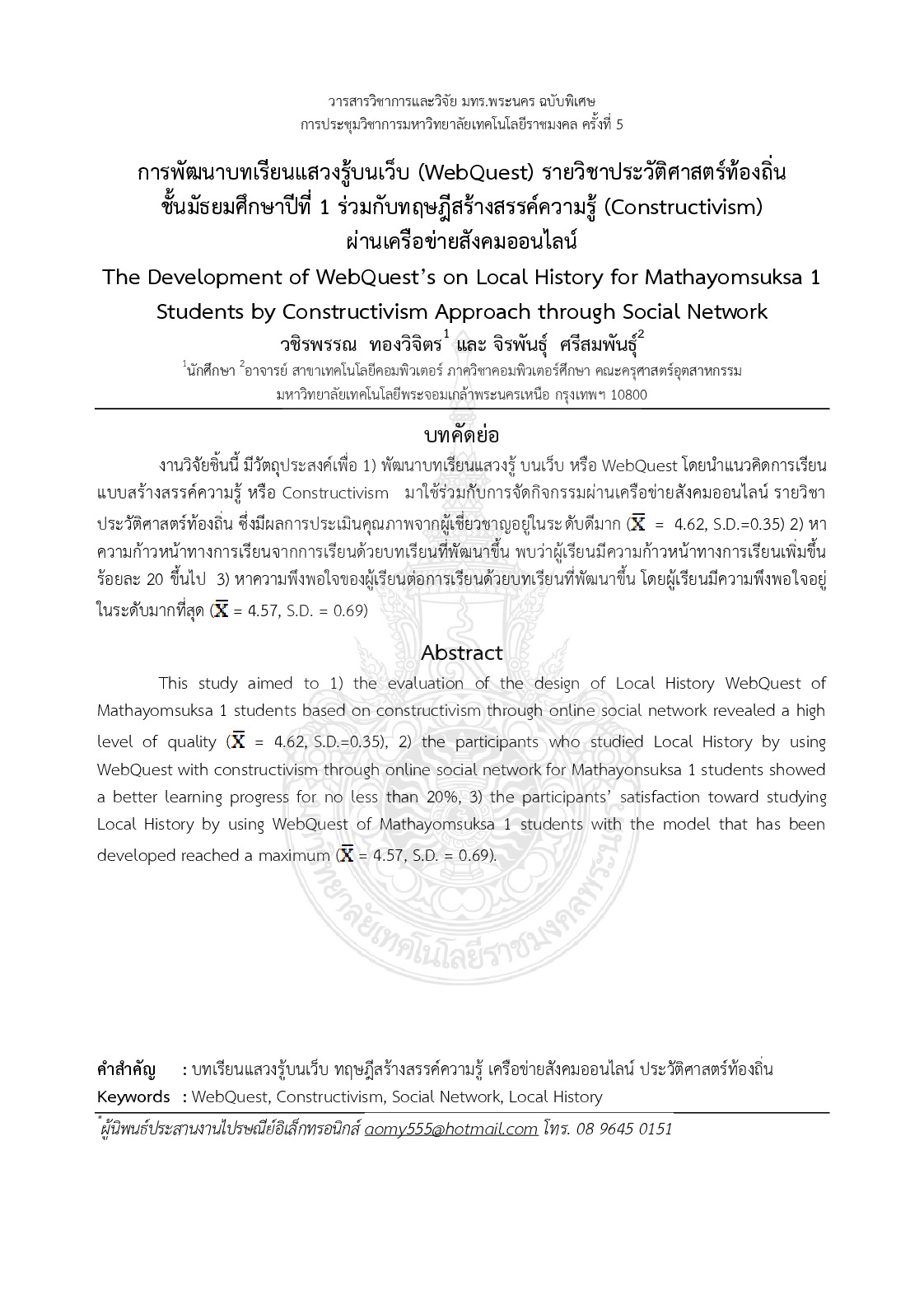
The development of webQuest’s on local history for mathayomsuksa 1 students by constructivism approach through social Network
This study aimed to 1) the evaluation of the design of Local History WebQuest of Mathayomsuksa 1 students based on constructivism through online social network revealed a high level of quality (= 4.62 S.D.=0.35) 2) the participants who studied Local History by using WebQuest with constructivism through online social network for Mathayonsuksa 1 students showed a better learning progress for no less than 20% 3) the participants’ satisfaction toward studying Local History by using WebQuest of Mathayomsuksa 1 students with the model that has been developed reached a maximum ( = 4.57 S.D. = 0.69).
Problems and Barriers for cooperative Education Student Trainee Recruitment according to the Work Place’s concept : A Case Study of Undergraduates of Business Administration Faculty : A Case Study of Undergraduates of Business Administration Faculty, Rajamangala University of Technology Phra Nakhon
This research is to study the problems and barriers for cooperative education student trainee recruitment according to the work place’s concept the aspects of training management training format training students’ qualifications and training students’ knowledge. The population are owners of various workplaces who accept 180 fourth year undergraduate students in training. Questionnaires are used to collect data statistically analyzed by Percentage Mean and Standard Deviation. The findings of the research reveals problems and obstacles as follow : 1. For the training management aspect the workplaces are not able to cooperate with the university to set aims and prepare the students before training the workplaces do not recognize purposes of the university’s training course the suitable positions for the students are not provided by the workplaces. 2. For the training students’ qualifications the students are unlikely to make decision in their performances’ problem solving no self-confidence and carefulness in their performances. 3. For the training students’ knowledge the students are unable to analyze and plan their performances; they have not a good command of both written and spoken English and Thai. In addition they lack of vocational skills.