จำนวน Repository ( 198 )

ปัญหาและความต้องการของนักศึกษาที่มีต่อการจัดการศึกษาของคณะอุตสาหกรรมสิ่งทอและออกแบบแฟชั่น มหาวิทยาลัยเทคโนโลยีราชมงคลพระนคร
The Purposes of this research were to study and compare the problems and the requirement of students were arrangement the educational administration in instructor content teaching method measurement and evaluation educational administration building place and audiovisual aids and service in Faculty of Industrial Textiles and Fashion Design. The samples were used every fields and every years students in Faculty of Industrial Textiles and Fashion Design who study in 2008. The tools used consisted of 400 questionnaires of samples group. Statistics used to analyze the data were frequence value percentage value standard evaluation analysis of variance T-value and F-value in hypothesis test and differential comparison.The results were as follows: 1. The students of the faculty of Industrial textile Fashion design satisfied in education management i.e. instructor content teaching method and measurement and education was high level. It was found that the teaching method was the most satisfactory.!t showed X= 3.81 and S.D = 0.67 The satisfaction of students in education administration building place and audiovisual aids and service was average level. The building place was worst satisfied. It showed X= 2.67 and S.D = 0.81 1.The open-ended questions of this research showed that the requirement about building place was the most interesting especially the clean restroom and maintenance it showed 23.13% and small sport area was 16.33%. The students also commented that the sport area should not be a car park for the instructor. The third comment was the dirty canteen that showed 15.65%. The student complained that the canteen should contain various food. 2.From the comparative analysis result in problems and the requirement of students were the administration study of the Faculty of Industrial Textile and Fashion Design as the follow the hypothesis of the research that gender education year age the study field were different no problems and different requirement statistics significance were 0.05
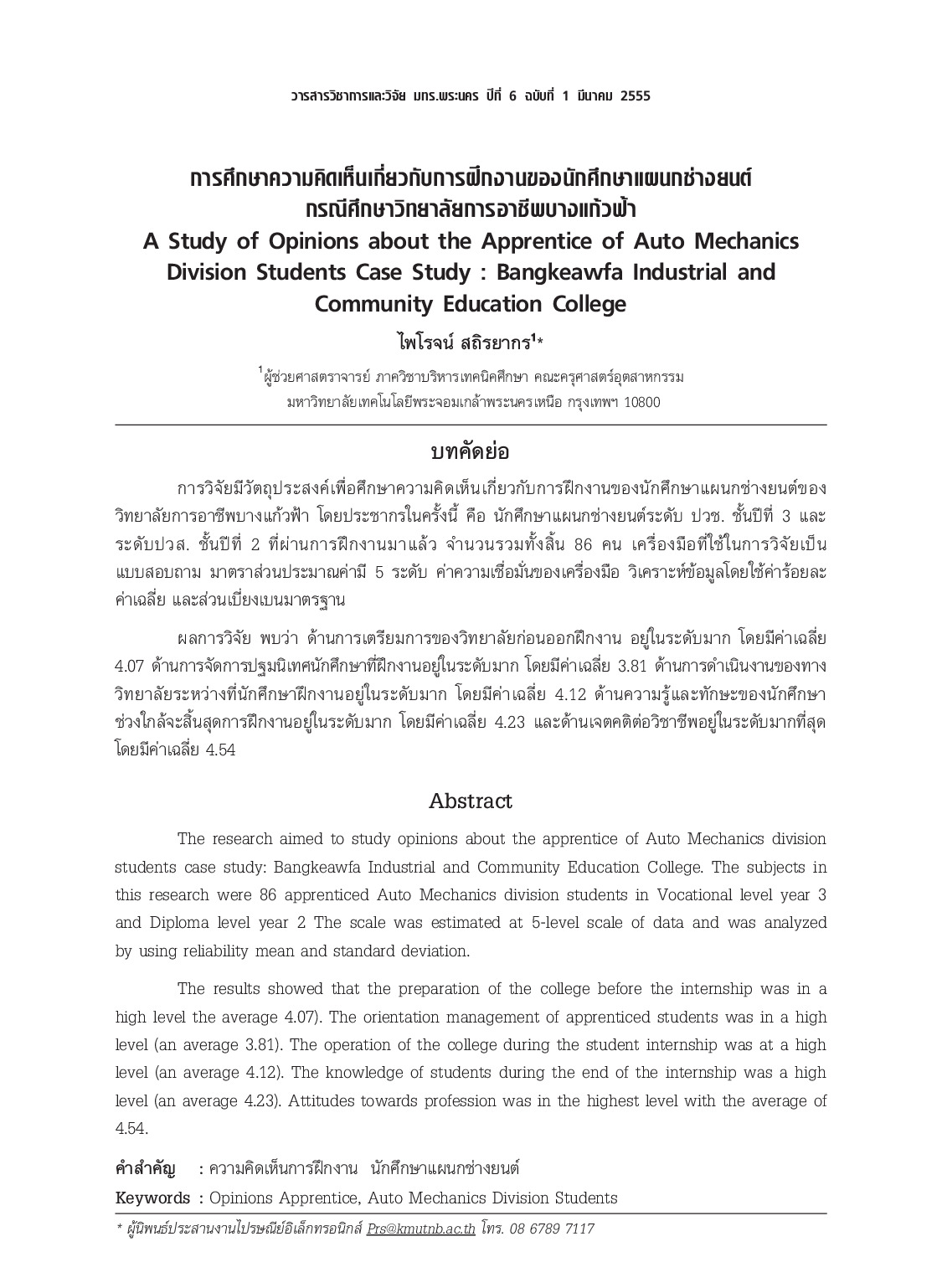
A Study of Opinions about the Apprentice of Auto Mechanics Division Students Case Study : Bangkeawfa Industrial and Community Education College
The research aimed to study opinions about the apprentice of Auto Mechanics division students case study: Bangkeawfa Industrial and Community Education College. The subjects in this research were 86 apprenticed Auto Mechanics division students in Vocational level year 3 and Diploma level year 2 The scale was estimated at 5-level scale of data and was analyzed by using reliability mean and standard deviation. The results showed that the preparation of the college before the internship was in a high level the average 4.07). The orientation management of apprenticed students was in a high level (an average 3.81). The operation of the college during the student internship was at a high level (an average 4.12). The knowledge of students during the end of the internship was a high level (an average 4.23). Attitudes towards profession was in the highest level with the average of 4.54.
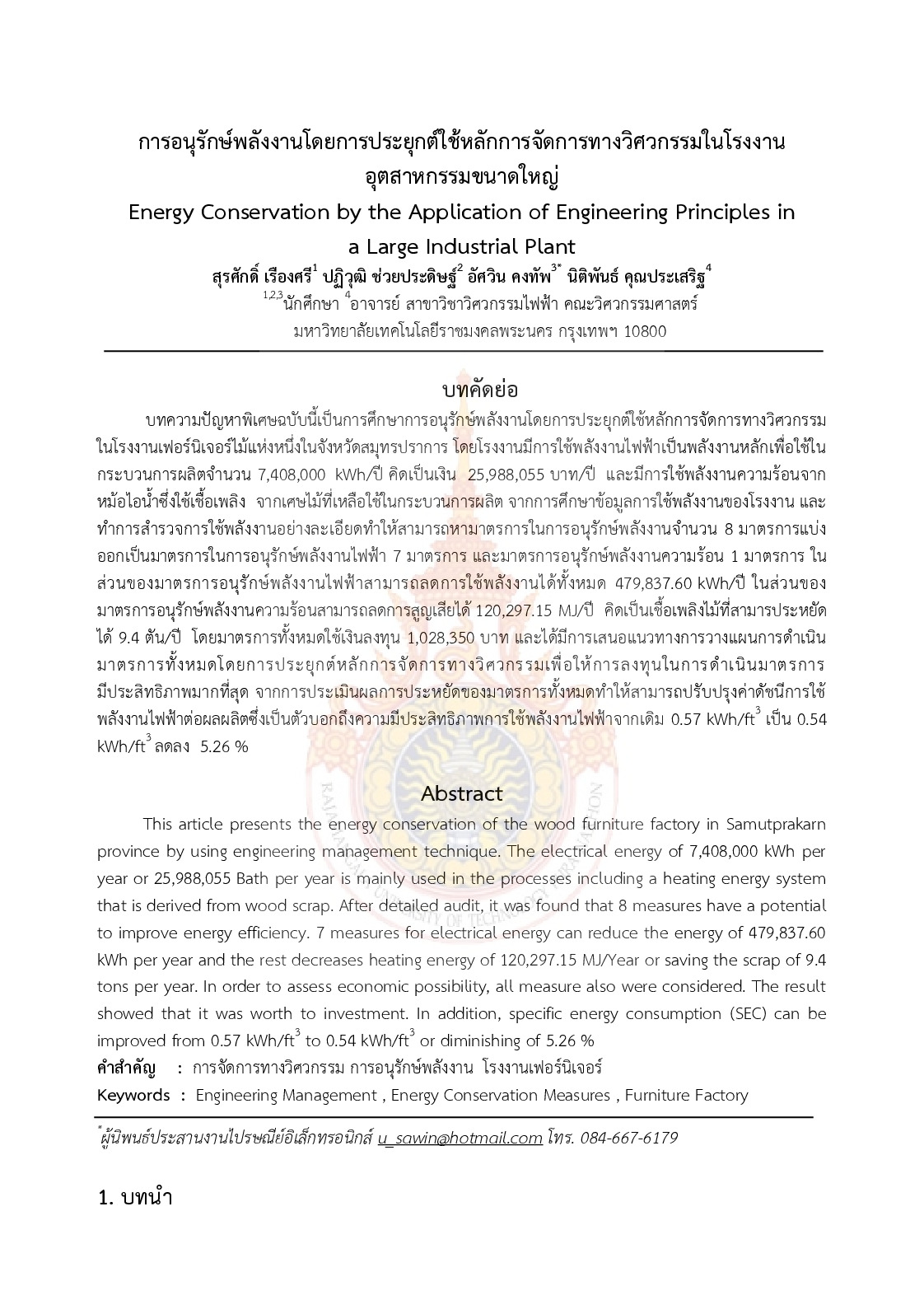
Energy Conservation by the Application of Engineering Principles in a Large Industrial Plant
This article presents the energy conservation of the wood furniture factory in Samutprakarn province by using engineering management technique. The electrical energy of 7408000 kWh per year or 25988055 Bath per year is mainly used in the processes including a heating energy system that is derived from wood scrap. After detailed audit it was found that 8 measures have a potential to improve energy efficiency. 7 measures for electrical energy can reduce the energy of 479837.60 kWh per year and the rest decreases heating energy of 120297.15 MJ/Year or saving the scrap of 9.4 tons per year. In order to assess economic possibility all measure also were considered. The result showed that it was worth to investment. In addition specific energy consumption (SEC) can be improved from 0.57 kWh/ft3 to 0.54 kWh/ft3 or diminishing of 5.26 %
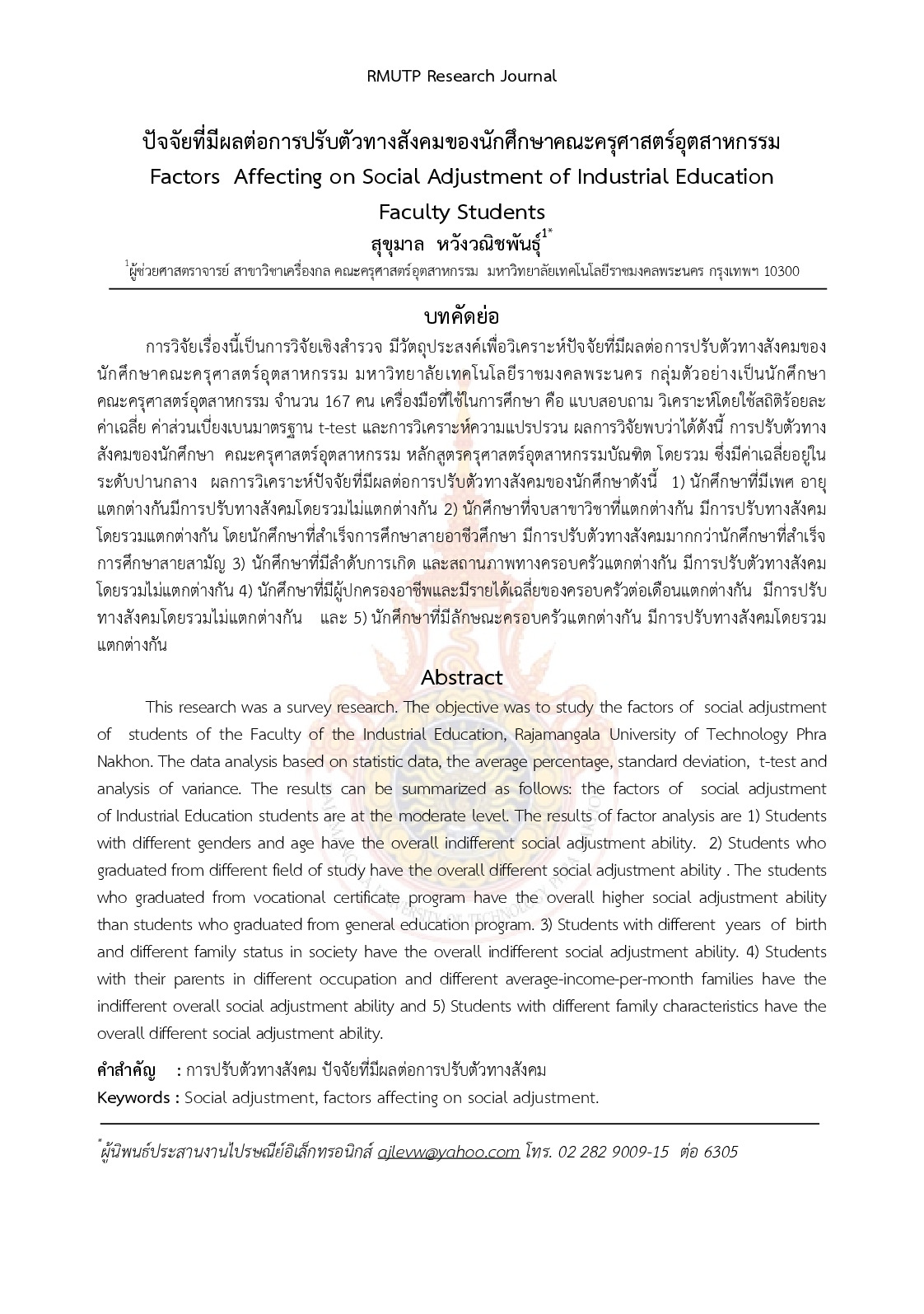
Factors Affecting on Social Adjustment of Industrial Education Faculty Students
This research was a survey research. The objective was to study the factors of social adjustment of students of the Faculty of the Industrial Education Rajamangala University of Technology Phra Nakhon. The data analysis based on statistic data the average percentage standard deviation t-test and analysis of variance. The results can be summarized as follows: the factors of social adjustment of Industrial Education students are at the moderate level. The results of factor analysis are 1) Students with different genders and age have the overall indifferent social adjustment ability. 2) Students who graduated from different field of study have the overall different social adjustment ability . The students who graduated from vocational certificate program have the overall higher social adjustment ability than students who graduated from general education program. 3) Students with different years of birth and different family status in society have the overall indifferent social adjustment ability. 4) Students with their parents in different occupation and different average-income-per-month families have the indifferent overall social adjustment ability and 5) Students with different family characteristics have the overall different social adjustment ability.
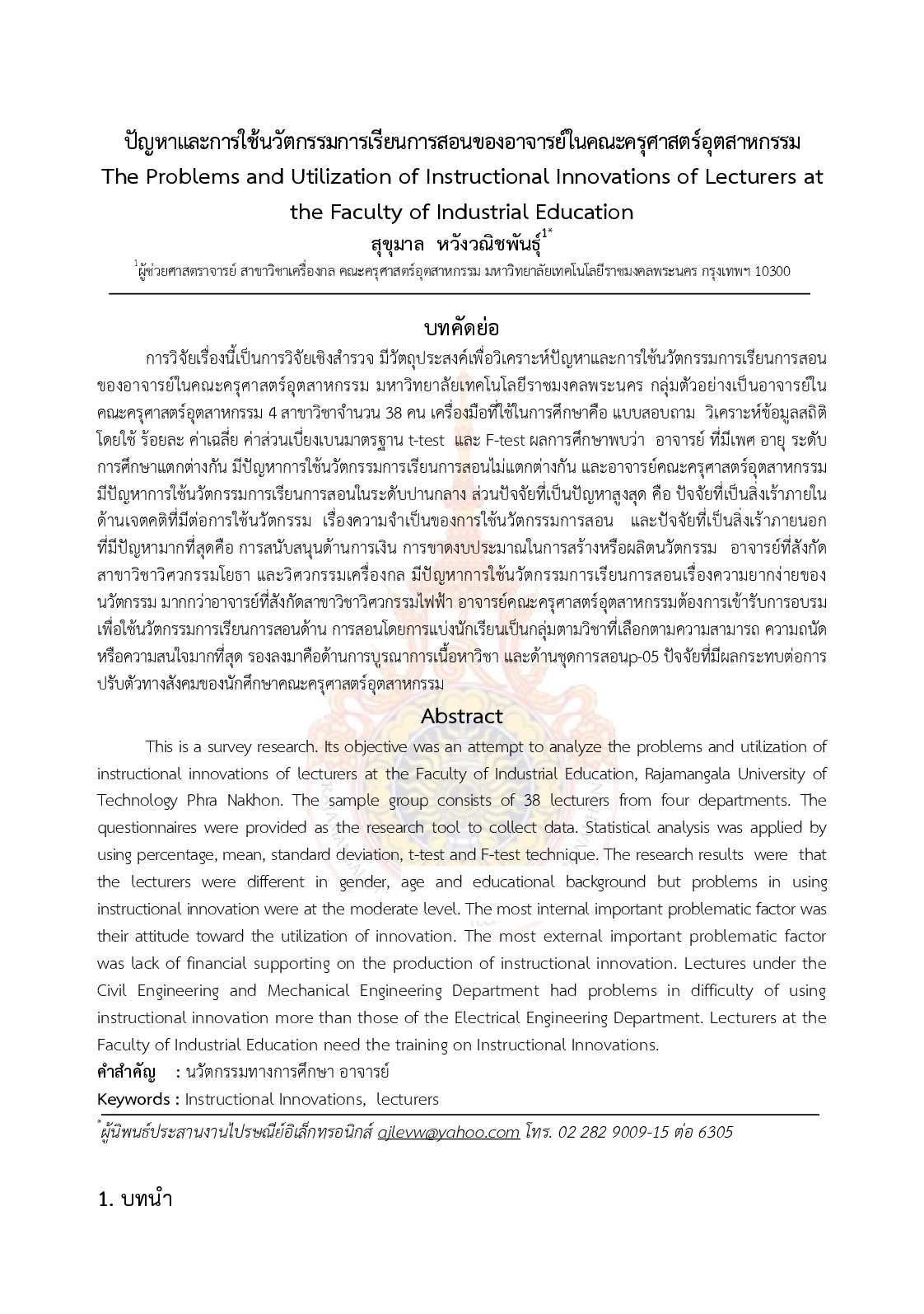
The Problems and Utilization of Instructional Innovations of Lecturers atthe Faculty of Industrial Education
This is a survey research. Its objective was an attempt to analyze the problems and utilization of instructional innovations of lecturers at the Faculty of Industrial Education Rajamangala University of Technology Phra Nakhon. The sample group consists of 38 lecturers from four departments. The questionnaires were provided as the research tool to collect data. Statistical analysis was applied by using percentage mean standard deviation t-test and F-test technique. The research results were that the lecturers were different in gender age and educational background but problems in using instructional innovation were at the moderate level. The most internal important problematic factor was their attitude toward the utilization of innovation. The most external important problematic factor was lack of financial supporting on the production of instructional innovation. Lectures under the Civil Engineering and Mechanical Engineering Department had problems in difficulty of using instructional innovation more than those of the Electrical Engineering Department. Lecturers at the Faculty of Industrial Education need the training on Instructional Innovations.