จำนวน Repository ( 167 )
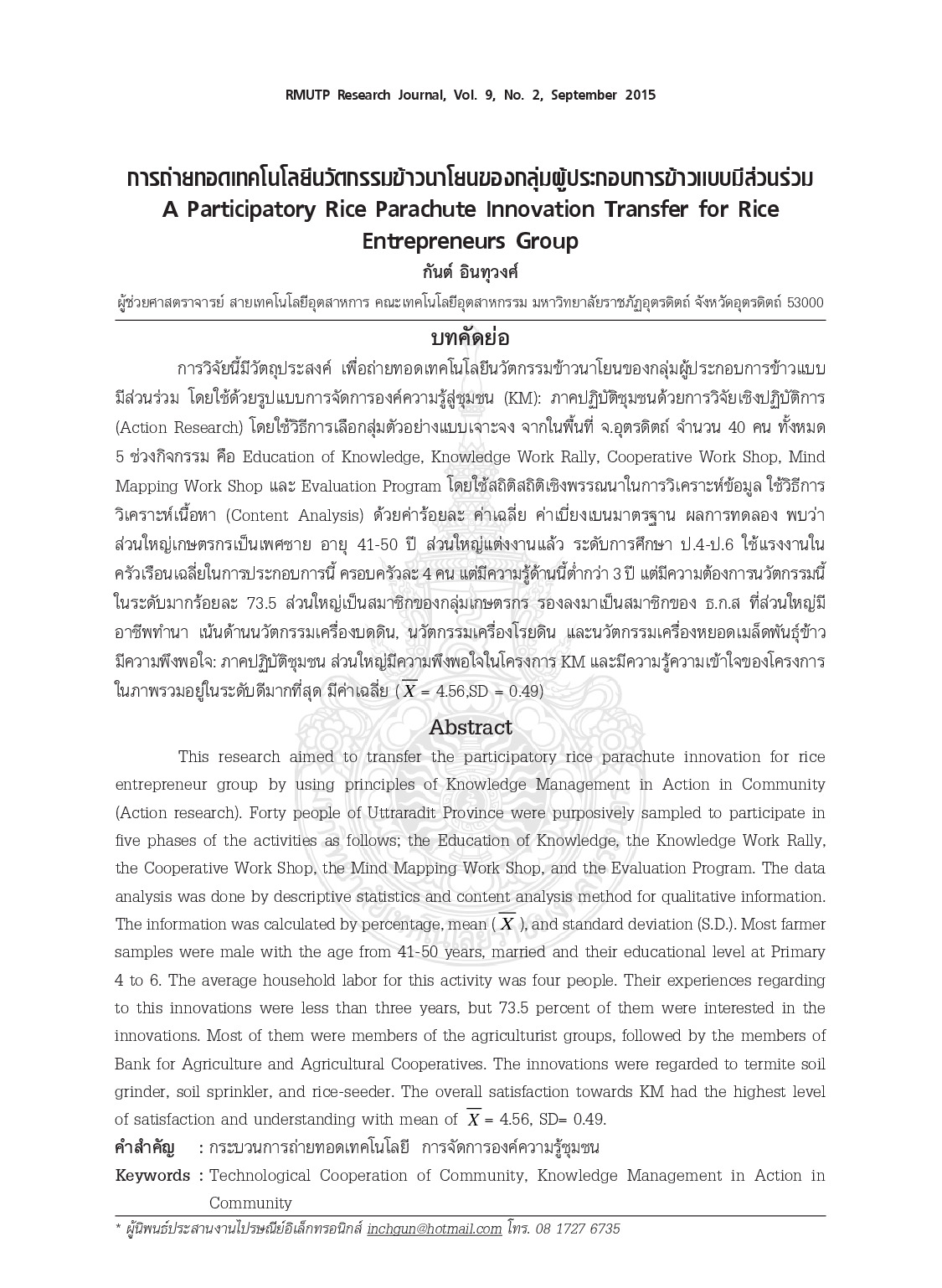
การถ่ายทอดเทคโนโลยีนวัตกรรมข้าวนาโยนของกลุ่มผู้ประกอบการข้าวแบบมีส่วนร่วม
This research aimed to transfer the participatory rice parachute innovation for rice entrepreneur group by using principles of KM: Knowledge Management in Action in Community (Action Research). Forty people of Uttraradit Province were purposively sampled to participate in five phases of the activities. The first activity was the Education of Knowledge the second activity was the Knowledge Work Rally the third activity was the Cooperative Work Shop the fourth activity was the Mind Mapping Work Shop and the fifth activity was the Evaluation Program. Statistics used in data analysis was descriptive statistics and qualitative information was analyzed by using content analysis method. The information was calculated by percentage mean ( ) and standard deviation (S.D.). Most of the samples were male with the age ranged from 41-50 years. Most farmers were married and their educational level was between Primary 4 and Primary 6. The average household labor amount for rice parachute agricultural practice was four people. Their experiences regarding to the rice parachute innovations were less than three years but 73.5 percent of them were interested in the innovations. Most of them were members of the agriculturist groups followed by the members of Bank for Agriculture and Agricultural Cooperatives. Most of them were farmers who have learned the innovations regarding termite soil grinder soil sprinkler and rice-seeder. As for the overall satisfaction towards KM: Knowledge Management in Action in Community most of them had the highest level of satisfaction and understanding with mean of = 4.56 SD= 0.49. In conclusion the participatory innovation transfer project by providing the know-how to the communities using the KM Principle: Knowledge Management in Action in Community was at the highest satisfactory level.
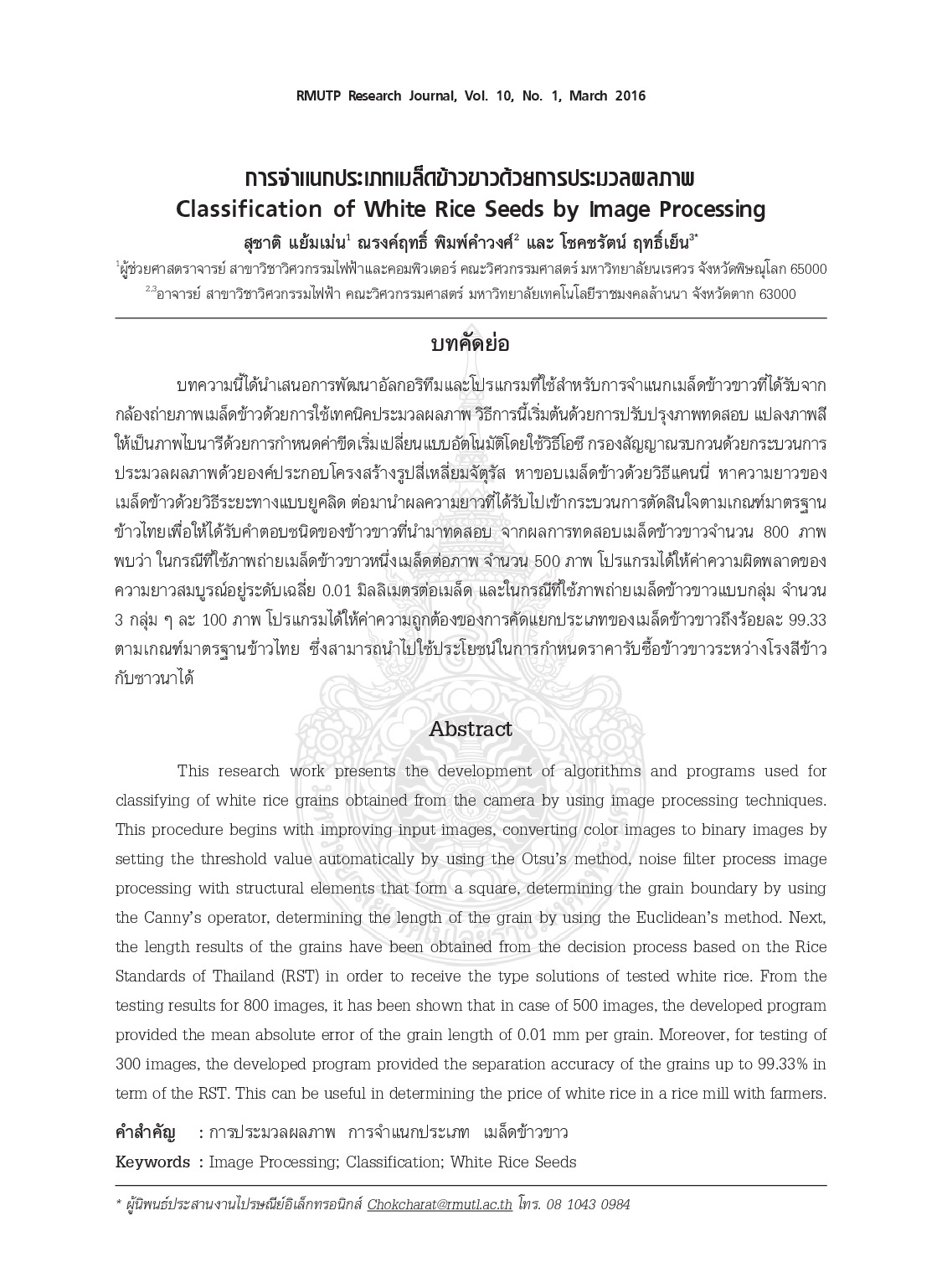
การจำแนกประเภทเมล็ดข้าวขาวด้วยการประมวลผลภาพ
This research work presents the development of algorithms and programs used for classifying of white rice grains obtained from the camera by using image processing techniques. This procedure begins with improving input images converting color images to binary images by setting the threshold value automatically by using the Otsu’s method noise filter process image processing with structural elements that form a square determining the grain boundary by using the Canny’s operator determining the length of the grain by using the Euclidean’s method. Next the length results of the grains have been obtained from the decision process based on the Rice Standards of Thailand (RST) in order to receive the type solutions of tested white rice. From the testing results for 800 images it has been shown that in case of 500 images the developed program provided the mean absolute error of the grain length of 0.01 mm per grain. Moreover for testing of 300 images the developed program provided the separation accuracy of the grains up to 99.33% in term of the RST. This can be useful in determining the price of white rice in a rice mill with farmers.
กระบวนการสโตแคสติก สำหรับการวิเคราะห์ตัวแบบอนุกรมเวลา โดยประยุกต์ใช้กับข้อมูลราคาจริง และราคาในตลาดล่วงหน้าของข้าวในประเทศไทย
The objective of this research is to use a stochastic process for building a model using Bayesian parameter estimation. The model is applied to the of crash prices and future prices of rice in Thailand for 120 moths including monthly closing average price of white rice 5% non-glutinous paddy 15% and Hom Mali non-glutinous paddy 105. The data are time series data containing autocorrelation trend seasonality and outliers. The algorithms are turned into codes in OpenBugs and the performance of the model is evaluated using simulation in R. The model with a Weibull cumulative distribution function trend the model with an exponential cumulative distribution function trend and the exponential smoothing model are compared. The root mean squared error (RMSE) mean absolute percentage error (MAPE) and mean absolute error (MAE) are used as the criteria. The results show that the model with the model with an exponential cumulative distribution function trend gives smallest RMSE MAPE and MAE for the crash prices of non-glutinous paddy 15% and Hom Mali non-glutinous paddy 105 for both model fitting part and model validation part. The model with a Weibull cumulative distribution function trend gives the smallest RMSE MAPE and MAE for the closing average price of white rice 5% for both model fitting part and model validation part.

Eco-product development from rice stubble for community economy
In this research it was investigated in detail about the physical and specific characteristics of rice stubble to develop eco-product for the community economy. The amounts of heavy metals and volatile organic compounds (VOCs) in rice stubble spread thinly by variety of wood finishes and paints were examined for selection of the most appropriate materials which reduced the environmental impacts. Finishes were used in this study such as lacquer vanish wood preservative polyurethane shellac aerosol paint oil color natural dye and synthetic dye. This research was divided into two parts; the first part of this study consisted of analysis of seven heavy metals such as lead cadmium chromium cobalt tin arsenic and mercury (product criteria of green label Green Label Thailand and Eco-labeling 2009/894/EC) the second part consisted of analysis of volatile organic compounds and Environmental Impact Assessment for analyzing product life cycle through choices about materials and energy. Finally the respondents’ perception of the factors affecting product design were examined by measuring the satisfaction toward the designed products. The subjects were classified into three categories such as producer group designer group and consumer group. The experimental results showed that the standardized finishes of rice stubble were shellac lacquer wood preservative vanish and polyurethane respectively. Basket Weaving Techniques were the appropriate ones for the processing of the finished rice stubble because of less waste reducing urea formaldehyde usage man-based method less energy intensive less transportation energy and less adjusted procedure. The examples of designed products were desk lamp tablemat and hand bag. Producer group and designer group had a different opinion about the use of low-impact materials and the avoidance of hazardous substances. Producer group had significant differences of opinion with designer group and consumer group about the appropriate proportion of product design and the color making a product aesthetic. Among three groups of respondents there were not different opinions about the product aesthetic the ergonomically designed products the environmentally conscious products the friendly processed products the natural processed products and the easily end-of-life treatments.
The study and development of building construction material : wall construction material from para rubber and rice straw to reduce the internal e
This research is a studying and developing building constructing material that is reducing the usage of energy in a building and it is made from rubber and rice straw. This research aims to both improve the economic and raise the energy conservation idea. This research will find the proper building material that is heat resistance. From interviewing the expert the researcher came up with the best formula to produce this heat resistance board. The formula is to add water to the rubber (one part rubber and three parts water) and spay it on a flatted bed of rice straw. Then heat it for one hour in a temperature of one hundred degree Celsius. After that mix in borax to make this material heat and fire resistance. All theses testing; the heat resisting and water absorbing this material has past the standard to be used in an indoor building constructing (มยผ. 8101-51) Department of Public works and town planning Ministry of Interior 2008. From that point on the researchers designed a pattern on the material to add the look for home and building decorating. Therefore they are two sizes of the material; 0.60 x 0.60 x 0.10 meter and 0.60 x 1.20 x 0.10 meter.