จำนวน Repository ( 103 )

Satisfaction of the students in Rajamangala University of Technology Phra Nakhon on the administration of student affairs
The purpose of this study was to study and compare satisfaction of the students in Rajamangala University of Technology Phra Nakhon on the administration of student affairs. Each task as follow guidance art and culture sport education loan fund student activities welfare and health development discipline morality and ethics and alumni and community. In this research the students which study in ninth faculties of the academic years 2012 were classified by gender faculties and academic years. The questionnaires of rating scales was used as the research instrument. Percentage mean standard deviation T - test for independent sample F - test for analysis of variance one-way : (ANOVA) were statistical method to analyze data and using Fishers Least - Significant Different (LSD) for comparison the average paired difference. The results were as follows : 1. The satisfaction of the students RMUTP in overview to the administration students affairs were in great levels. When the considered separately each task in student affairs. welfare and health was the highest student activities and development discipline morality and ethics education loan fund Art and culture alumni and community guidance academic soldier and sport was the lowest 2. Classified by gender there was significant difference for satisfaction of the students at the 0.05 level. When considering satisfaction each task there was significant difference for satisfaction of the students in guidance and sport at the 0.05 level among students in different gender. 3. Classified by faculties In overview there was significant difference for satisfaction of the students at the 0.05 level. And when considering satisfaction each task there was significant difference for satisfaction of the students in guidance art and culture sport education loan fund and the student activities at the 0.05 level among students in different faculties. 4. Finally there was non significant difference for satisfaction of the students in each task and whole task at the 0.05 level among students in different academic years.
Queuing Analysis The Study of Student’s Admission System at Rajamangala University of Technology Phra Nakhon, North Bangkok Campus
The objectives of the study were to find the arrival rate of applicants who applied to study at Rajamangala of Technology Pra Nakhon North Bangkok Campus the service rate of admission officers and to analyze queuing system in order to improve the admission system. The sample was 1722 technical students who applied to study in 10 divisions in 2007 and 2008. The plication date was collected every 10 minutes in each one-hour period from 09.00 am. to 16.00 pm. For 6 days. The study found that the distribution of the number of applicants was Poisson distribution. The highest arrival rate 1.29 student/min was at the second period and the lowest arrival rate 0.06 students/min was at the sixth period. The Distribution of service time at each station was exponential distribution. The highest service rate 0.67 min/student or 1.49 students/min was at the second station entering data into a computer. Queuing analysis in this study was series network. The analysis found that the highest expected number of applicants in the system 150 student/hour was at the first station in the second period and in the sixth period there was almost none. The highest expected number of applicants in the queuing system107.40 student/hour was at the first station in the second period The highest expected waiting time in the system.1.92 min/student and in the queuing system 1.37 min/student were at the first station. The probabilities of none of applicants in the system at the first the second and the third station in the sixth period were high 0.97 0.95 and 0.98 respectively. The proper value of the expected number of applicants in the system set in this study was not more than 60 student/hour and not less than 30 student/hour. The proper value of the waiting time in the system was not more than 1 min/student and not less than 0.5 min/student for stations for stations with more than one servers. The analysis found that at the first station one more server should be added in the second the third and the forth period and one less server should be reduced in the sixth period.
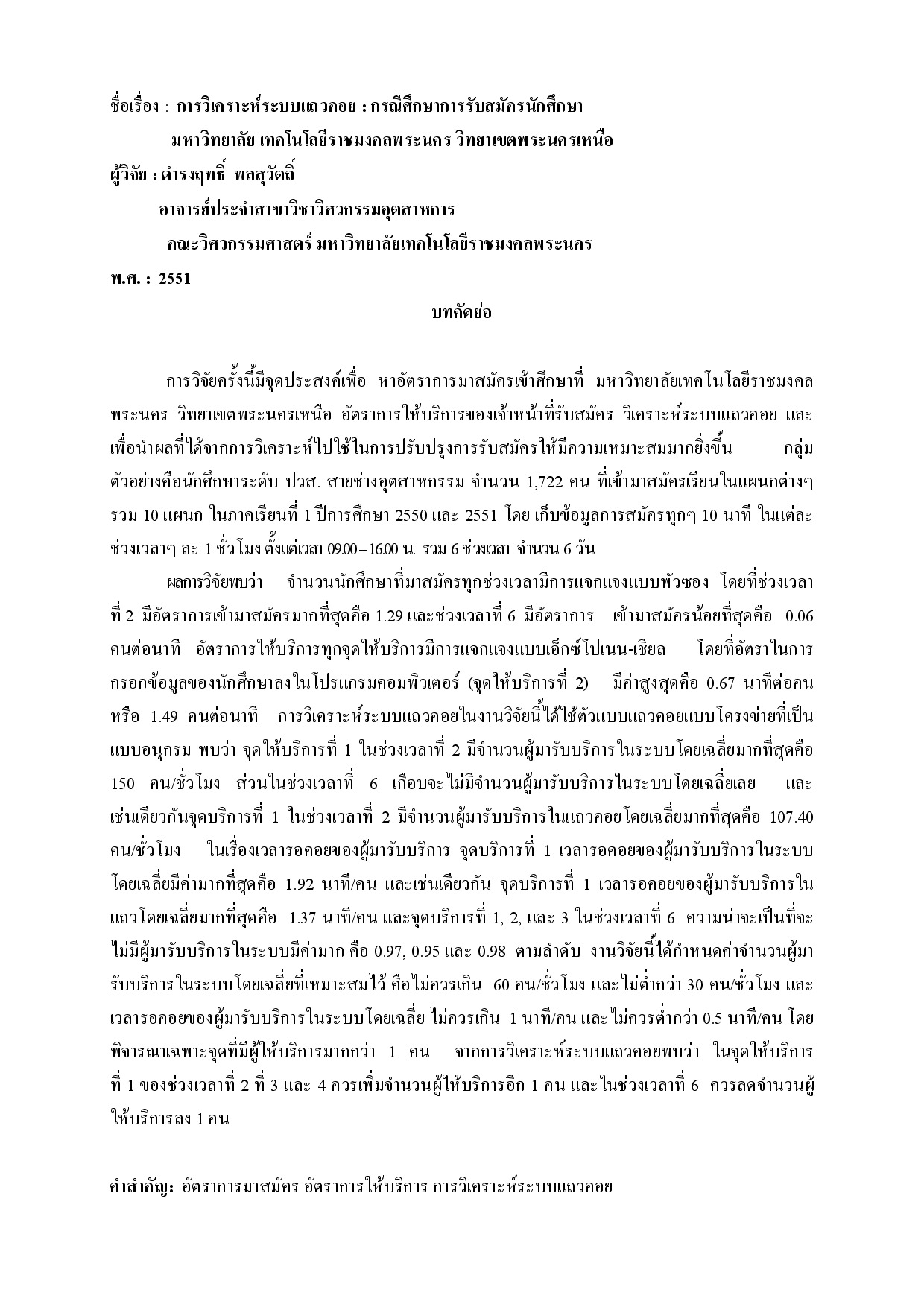
การวิเคราะห์ระบบแถวคอย, กรณีศึกษาการรับสมัครนักศึกษามหาวิทยาลัยเทคโนโลยีราชมงคลพระนคร วิทยาเขตพระนครเหนือ
The objectives of the study were to find the arrival rate of applicants who applied to study at Rajamangala university of Technology Pra Nakhon North Bangkok Campus the service rate of admission officers and to analyze queuing system in order to improve the admission system. The sample was 1722 technical students who applied to study in 10 divisions in 2007 and 2008. The application data was collected every 10 minutes in each one-hour period from 09.00 am. to 16.00 pm. for 6 days. The study found that the distribution of the number of applicants was Poisson distribution. The highest arrival rate 1.29 students/min was at the second period and the lowest arrival rate 0.06 students/min was at the sixth period. The distribution of service time at each station was exponential distribution. The highest service rate 0.67 min/student or 1.49 students/min was at the second station entering data into a computer. Queuing analysis in this study was series network. The analysis found that the highest expected number of applicants in the system 150 students/hour was at the first station in the second period and in the sixth period there was almost none. The highest expected number of applicants in the queuing system 107.40 students/hour was at the first station in the second period. The highest expected waiting time in the system 1.92 min/student and in the queuing system 1.37 min/student were at the first station. The probabilities of none of applicants in the system at the first the second and the third station in the sixth period were high 0.970.95 and 0.98 respectively. The proper value of the expected number of applicants in the system set in this study was not more than 60 students/hour and not less than 30 students/hour. The proper value of the waiting time in the system was not more than 1 min/student and not less than 0.5 min/students for stations with more than one servers. The analysis found that at the first station one more server should be added in the second the third and the forth period and one less server should be reduced in the sixth period.