จำนวน Repository ( 1174 )
Development of Green Energy Block Made from Paper Mill Waste Sludge
Sludge from paper mill wastewater treatment plant is the residual composed of fibres fibre particles and miscellaneous debris. Sludge with high fibre contents were collected from BP paper mill industry. They were retreated by 2 days drying and mixing dried sludge with tapioca starch as ratios were: 100:0 95:5 90:10 85:15 and 80:20(sludge: tapioca starch). To make the green energy block by using screw-press machine compressed sludge that mixed with various ratios of tapioca starch. A size of green energy block was 6 inches diameter 2 inches high and 150 g. weight. Energy values were tested by using Bomb-calorimeter measurement instrument. The results of testing found: the best ratio of green energy compressed for high heating value was 95:5(sludge : tapioca starch by weight) and the maximum heating value was about 19638 J/g. This green energy block made from waste of paper mill wastewater treatment plant is a way of recycle waste to be energy and reducing waste from industry.
Investigated on Removal of Residual Dyestuff in Effluent from Dyeing Process: Physical Method
This study was investigated the pretreatment of dye effluent from dyeing process by activated carbon. The study parameters were color strength operating time and types of dyestuff such as direct dye reactive dye acid dye basic dye and disperse dye. The results found the activated carbon was achieved to adsorb the colorant. The pretreatment process used 100 – 200 gram activated carbon to one liter of dye effluent. The contact time was 2 hours at room temperature. The dyeing conditions had an influent for pretreatment process. The acidic condition was favored than neutral and basic condition. In addition the dye removal efficiency was basic dye > acid dye > disperse dye > direct dye > reactive dye.
Effects of Fat Substitute on Survived Probiotic Bacteria in Yoghurt Ice Cream
The objective of this research was to compare amounts of fat substitutes supplied in the industries in order to determine their ability to encapsulate probiotic microbes in the production of yoghurt ice cream to ensure maximum survived probiotic microbes. In this research two fat substitutes Purity SM 100 and CRYSTAL texTM 648 were used to substitute skim milk in the standard formulas in order to study numbers of survived probiotic microbes and to test the sensory acceptance. For the sensory acceptance it was found that the probiotic yoghurt ice cream containing 20% Purity SM100 is acceptable at the maximum significance (p ≤ 0.05) because its flavor and taste was better than other samples as well as the best overrun with statistical significant differences (p ≤ 0.05). However by addition of both fat substitutes at different concentrations pH values of probiotic yoghurt ice cream products did not have statistical significant differences (p ≥ 0.05). When Lactobacillus acidophilus Bifidobacterium and Streptococcus thermophilus microbial starters were added into the probiotic yoghurt ice cream using both fat substitutes in place of skim milk at ratios of 10% 15% and 20% respectively under a storage condition of -20oC for 4 weeks it was found that types and amounts of fat substitutes affected the surviving rate of probiotic microbes in the product with a statistical significance (p ≤ 0.05). The addition of fat substitutes Purity SM100 and CRYSTAL texTM 648 at all concentration levels made probiotic microbes survived in the product which illustrated that both fat substitutes used in above experiments could encapsulate probiotic microbe cells. The survived probiotic microbes were in the range of 107 – 108 CFU/ml in comparison to the probiotic yoghurt ice cream with the standard formula without the addition of fat substitutes that has survived probiotic microbes of only 106 CFU/ml.
Low Calorie Soy Milk Product Fortified with Beta-Carotene
The purposes of the study on low calorie soy milk product fortified with beta-carotene were 1) to study the suitable content of carrot which was one source of beta-carotene and sugar 2) to study the physical and chemical quality of the product 3) to study shelf- life of the product and 4) to investigate the product acceptance. Standard soy milk formula was studied and fortified with 3 levels of carrot and reduced 4 levels of sugar content. The 3x4 factorial Design was used to experiment and 9-points hedonic scale was used for sensory evaluation from 30 panelists. The results were found as follows: 1. For the content of carrot and sugar the panelists had the acceptance of carrot with 2000 gram and 65% of sugar reduction. The use of carrot and sugar had significant (p<0.05) effects on over all liking and milk’s taste. 2. For the physical quality it was found that L* value was 6.50 a* value was 20.13 b* value was 10.44 viscosity was 27.80 centipoint total soluble solid was 11.33 + 0.01 degree Brix and ph was 6.55. For the chemical quality 100 gram of soy milk fortified with beta-carotene contained 37.45 kcal energy 2.48 g protein 0.01 g fat 6.86 g carbohydrate and 3.18 ml beta- carotene. 3. For shelf-life study it was found that the product did not change when kept in the temperature of 7 degree Celsius for 0-10 days except for 11-14 days. Total bacteria count was 4.8x10 CFU/cm3 when compared to Thai Community Product Standard (529/2547) it should be found lower than 1x10⁴ colony/ 1 cm3 . It was evidently found that low calorie soy milk fortified with beta-carotene was safety for consumer when kept for 14 days. 4. For the product acceptance it was found that 93% of the consumer satisfied the product price of 10 baht per 200 ml consumption.
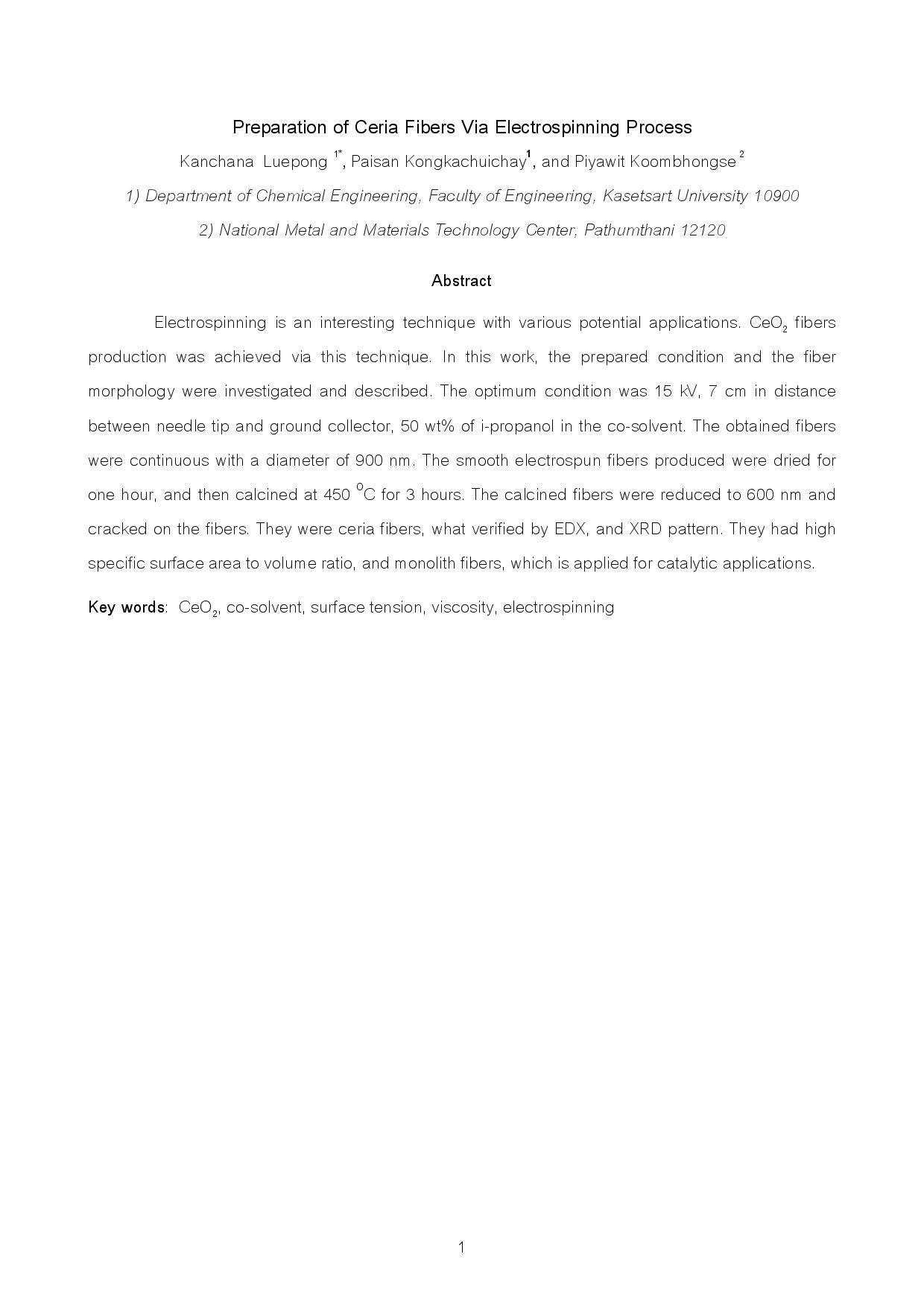
Preparation of Ceria Fibers Via Electrospinning Process
Electrospinning is an interesting technique with various potential applications. CeO2 fibers production was achieved via this technique. In this work the prepared condition and the fiber morphology were investigated and described. The optimum condition was 15 kV 7 cm in distance between needle tip and ground collector 50 wt% of i-propanol in the co-solvent. The obtained fibers were continuous with a diameter of 900 nm. The smooth electrospun fibers produced were dried for one hour and then calcined at 450 OC for 3 hours. The calcined fibers were reduced to 600 nm and cracked on the fibers. They were ceria fibers what verified by EDX and XRD pattern. They had high specific surface area to volume ratio and monolith fibers which is applied for catalytic applications.