จำนวน Repository ( 1139 )

The Development of Computer Assisted Instruction in Bio-Organic chemistry
The pupose of this study was to examine The Factors of the Students That Effect To Produce The Graduates of Rajamangala University of Technology Phra Nakhon. The focused on the level of The Factors from students effecting to produce the graduate of the University Tajamangala of Technology Phra Nakhon. The sample 350 students. Data was collected from a set of Questionnaire and analyzed with a statistical software program. The statistical method were percentahe average t-test One-way ANOVA. The level of statistical significance was set at 05 The result indicated that the level of the Factors from students effecting to produce the graduate of Rajamangala University of Technology Phra Nakhon was high. In hypothetical testing the students was influcnced by the following factors ; Age Faculty Leaming Grade of Education. Education before leaming Household Behavior of students Leaming situation and The satisfied of bachelor degree excepted sex and course of study.
Effect of Powder Sizes on Heat Transfer Characteristics of Miniature Sintered – Wick Heat Pipe
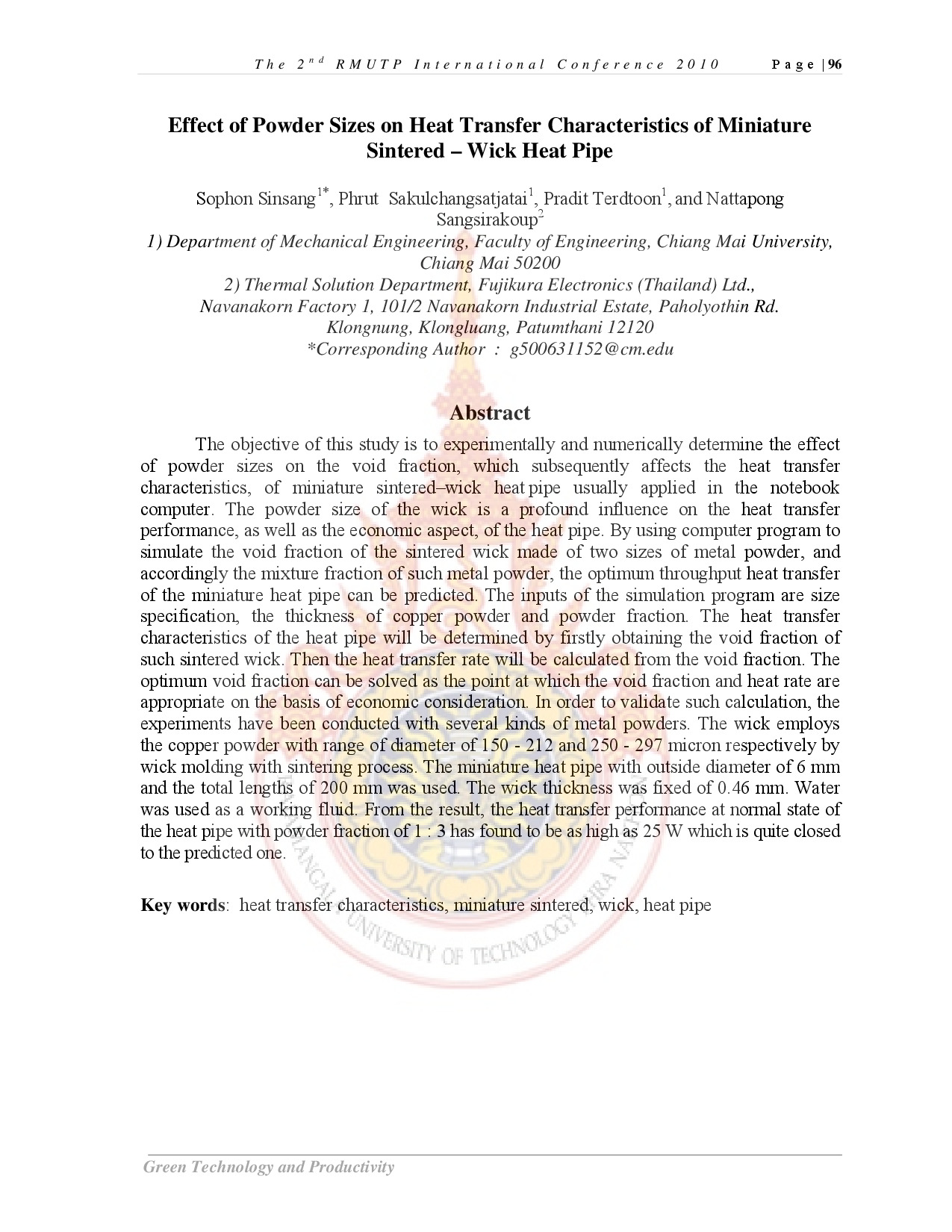
The objective of this study is to experimentally and numerically determine the effect of powder sizes on the void fraction which subsequently affects the heat transfer characteristics of miniature sintered–wick heat pipe usually applied in the notebook computer. The powder size of the wick is a profound influence on the heat transfer performance as well as the economic aspect of the heat pipe. By using computer program to simulate the void fraction of the sintered wick made of two sizes of metal powder and accordingly the mixture fraction of such metal powder the optimum throughput heat transfer of the miniature heat pipe can be predicted. The inputs of the simulation program are size specification the thickness of copper powder and powder fraction. The heat transfer characteristics of the heat pipe will be determined by firstly obtaining the void fraction of such sintered wick. Then the heat transfer rate will be calculated from the void fraction. The optimum void fraction can be solved as the point at which the void fraction and heat rate are appropriate on the basis of economic consideration. In order to validate such calculation the experiments have been conducted with several kinds of metal powders. The wick employs the copper powder with range of diameter of 150 - 212 and 250 - 297 micron respectively by wick molding with sintering process. The miniature heat pipe with outside diameter of 6 mm and the total lengths of 200 mm was used. The wick thickness was fixed of 0.46 mm. Water was used as a working fluid. From the result the heat transfer performance at normal state of the heat pipe with powder fraction of 1 : 3 has found to be as high as 25 W which is quite closed to the predicted one.
A Smart Mobile PV-Wind Hybrid System Prototype for isolated electrification
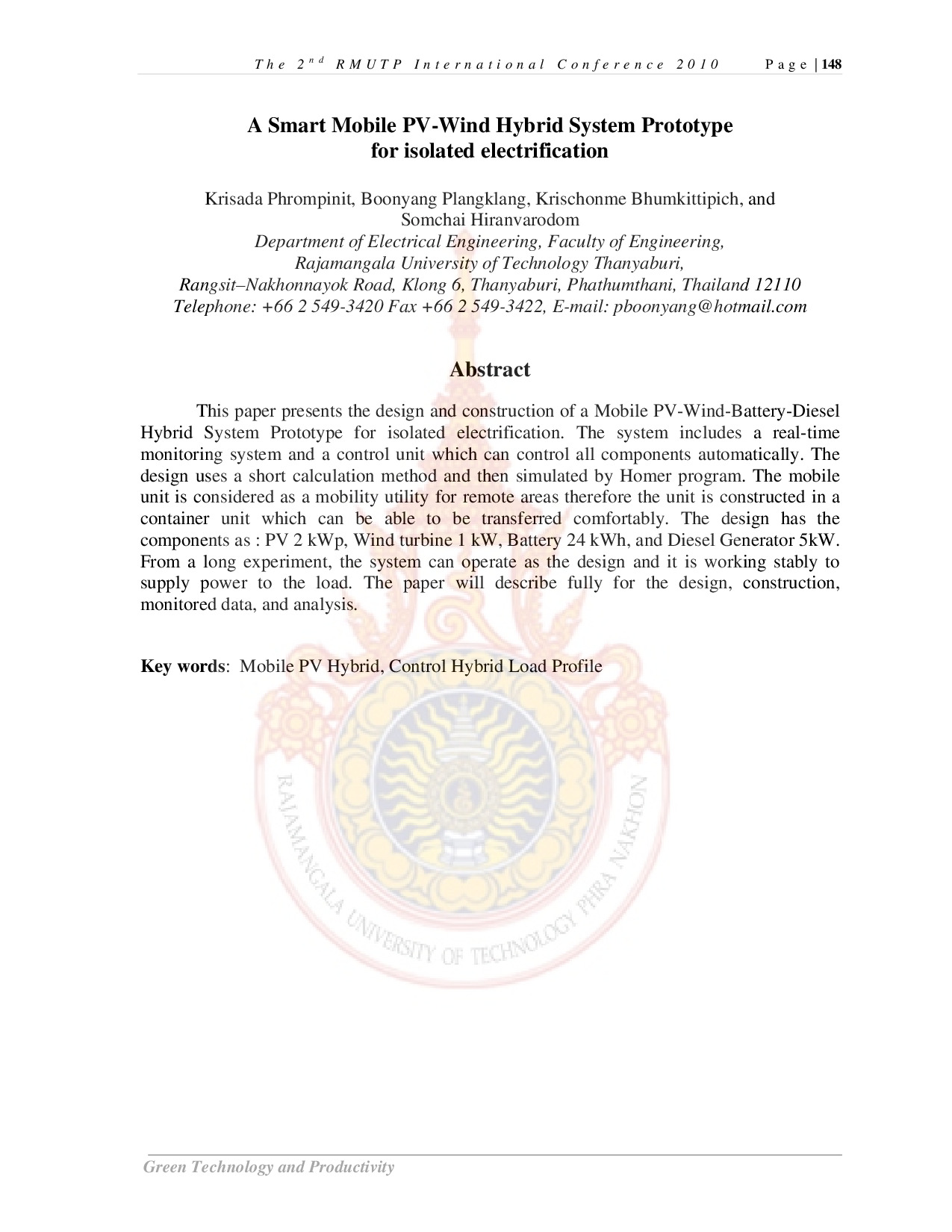
This paper presents the design and construction of a Mobile PV-Wind-Battery-Diesel Hybrid System Prototype for isolated electrification. The system includes a real-time monitoring system and a control unit which can control all components automatically. The design uses a short calculation method and then simulated by Homer program. The mobile unit is considered as a mobility utility for remote areas therefore the unit is constructed in a container unit which can be able to be transferred comfortably. The design has the components as : PV 2 kWp Wind turbine 1 kW Battery 24 kWh and Diesel Generator 5kW. From a long experiment the system can operate as the design and it is working stably to supply power to the load. The paper will describe fully for the design construction monitored data and analysis.
A Solid-State Device for Fault Protection in Low Voltage Wind Turbine System
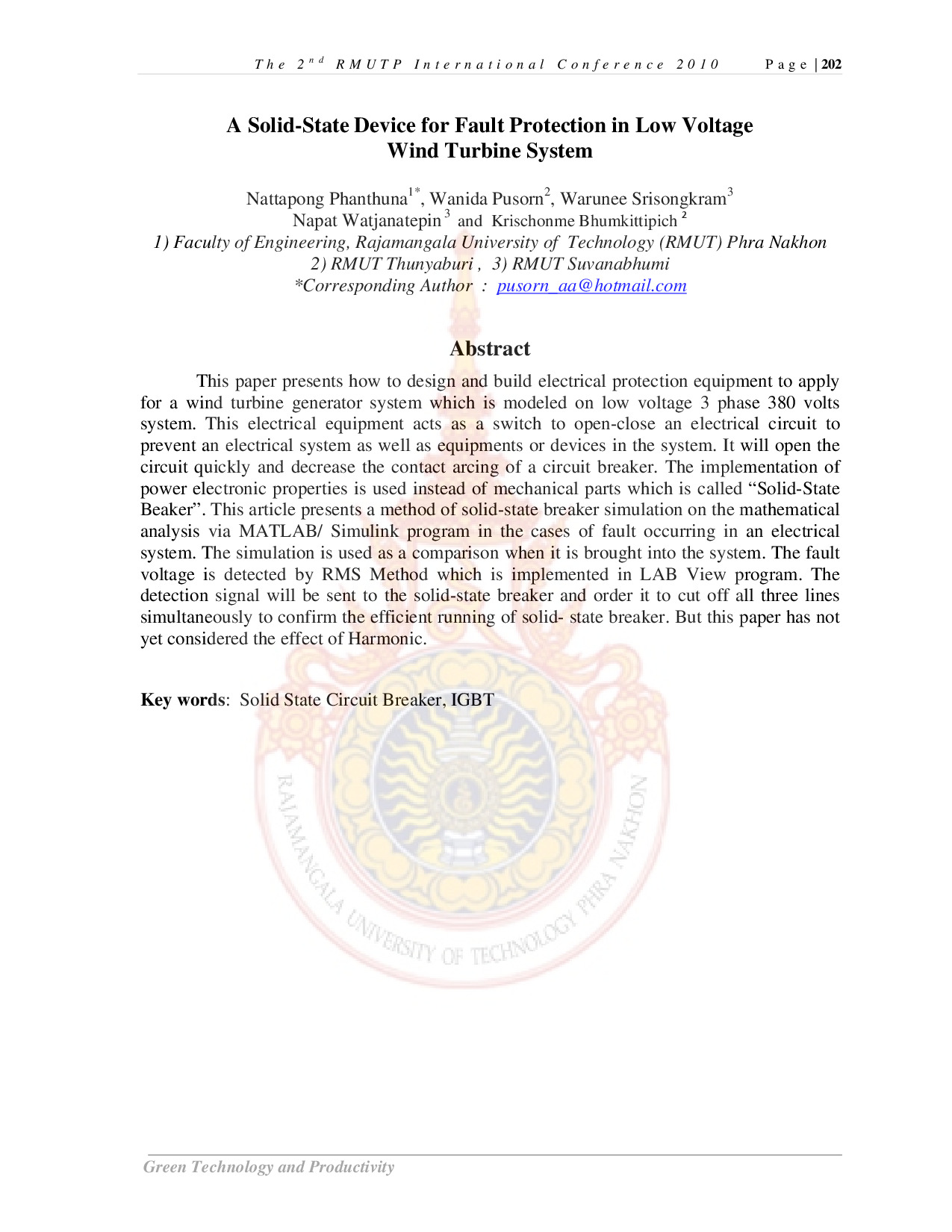
This paper presents how to design and build electrical protection equipment to apply for a wind turbine generator system which is modeled on low voltage 3 phase 380 volts system. This electrical equipment acts as a switch to open-close an electrical circuit to prevent an electrical system as well as equipments or devices in the system. It will open the circuit quickly and decrease the contact arcing of a circuit breaker. The implementation of power electronic properties is used instead of mechanical parts which is called “Solid-State Beaker”. This article presents a method of solid-state breaker simulation on the mathematical analysis via MATLAB/ Simulink program in the cases of fault occurring in an electrical system. The simulation is used as a comparison when it is brought into the system. The fault voltage is detected by RMS Method which is implemented in LAB View program. The detection signal will be sent to the solid-state breaker and order it to cut off all three lines simultaneously to confirm the efficient running of solid- state breaker. But this paper has not yet considered the effect of Harmonic.
A Study of Coconut Oil Pressing Machine
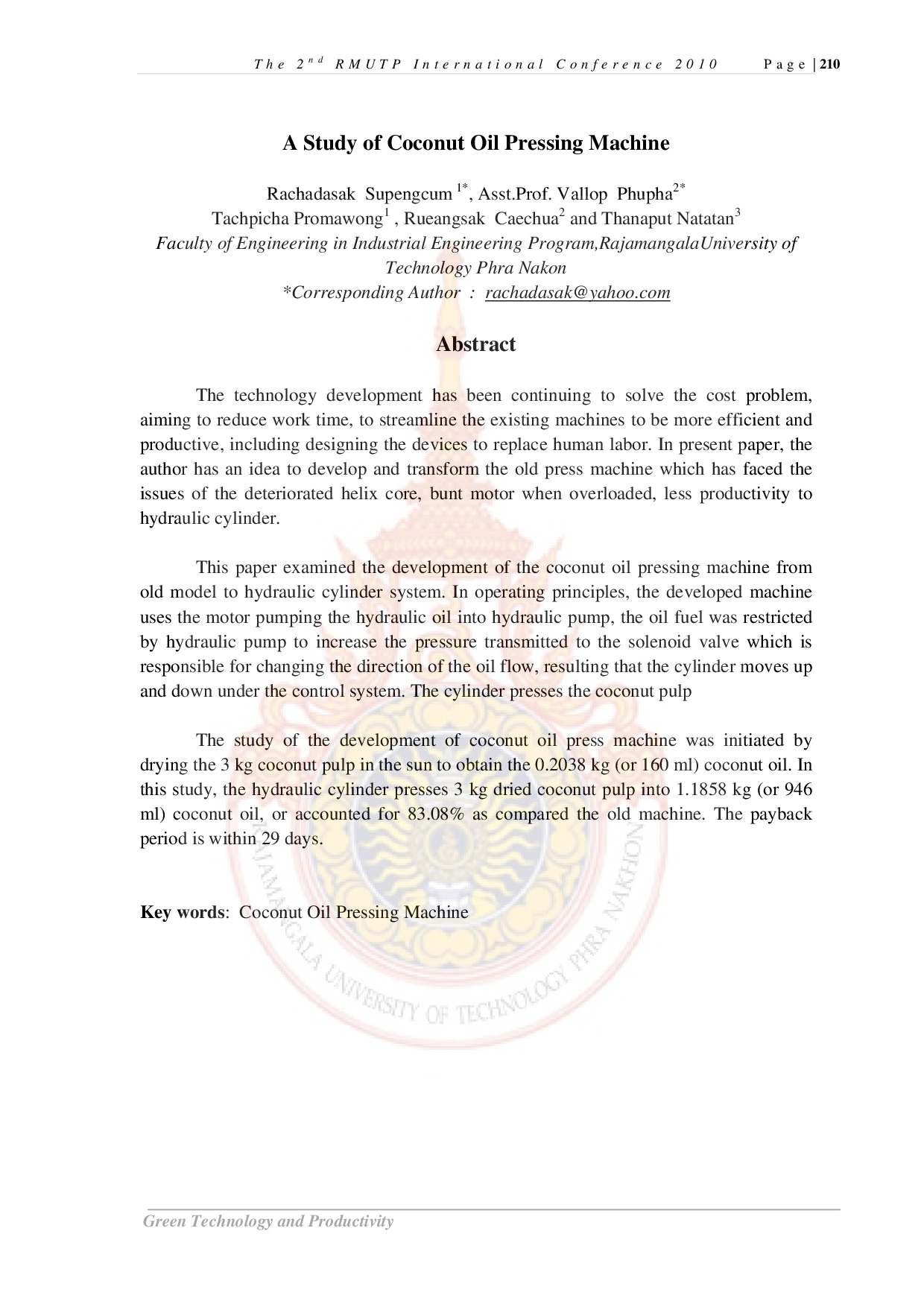
The technology development has been continuing to solve the cost problem aiming to reduce work time to streamline the existing machines to be more efficient and productive including designing the devices to replace human labor. In present paper the author has an idea to develop and transform the old press machine which has faced the issues of the deteriorated helix core bunt motor when overloaded less productivity to hydraulic cylinder. This paper examined the development of the coconut oil pressing machine from old model to hydraulic cylinder system. In operating principles the developed machine uses the motor pumping the hydraulic oil into hydraulic pump the oil fuel was restricted by hydraulic pump to increase the pressure transmitted to the solenoid valve which is responsible for changing the direction of the oil flow resulting that the cylinder moves up and down under the control system. The cylinder presses the coconut pulp The study of the development of coconut oil press machine was initiated by drying the 3 kg coconut pulp in the sun to obtain the 0.2038 kg (or 160 ml) coconut oil. In this study the hydraulic cylinder presses 3 kg dried coconut pulp into 1.1858 kg (or 946 ml) coconut oil or accounted for 83.08% as compared the old machine. The payback period is within 29 days.