จำนวน Repository ( 1139 )
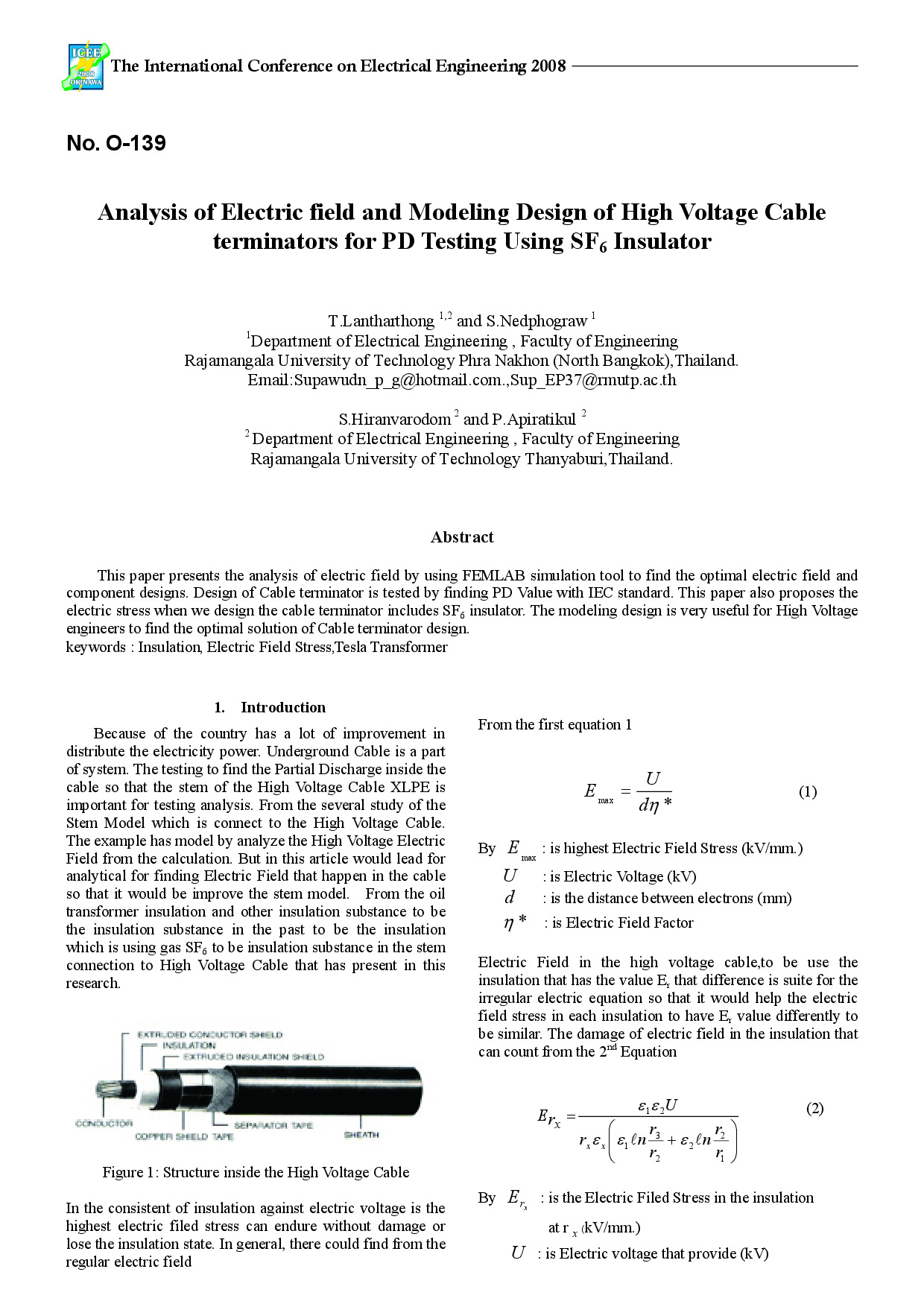
Analysis of Electric field and Modeling Design of High Voltage Cable terminators for PD Testing Using SF6 Insulator
This paper presents the analysis of electric field by using FEMLAB simulation tool to find the optimal electric field and component designs. Design of Cable terminator is tested by finding PD Value with IEC standard. This paper also proposes the electric stress when we design the cable terminator includes SF6 insulator. The modeling design is very useful for High Voltage engineers to find the optimal solution of Cable terminator design.
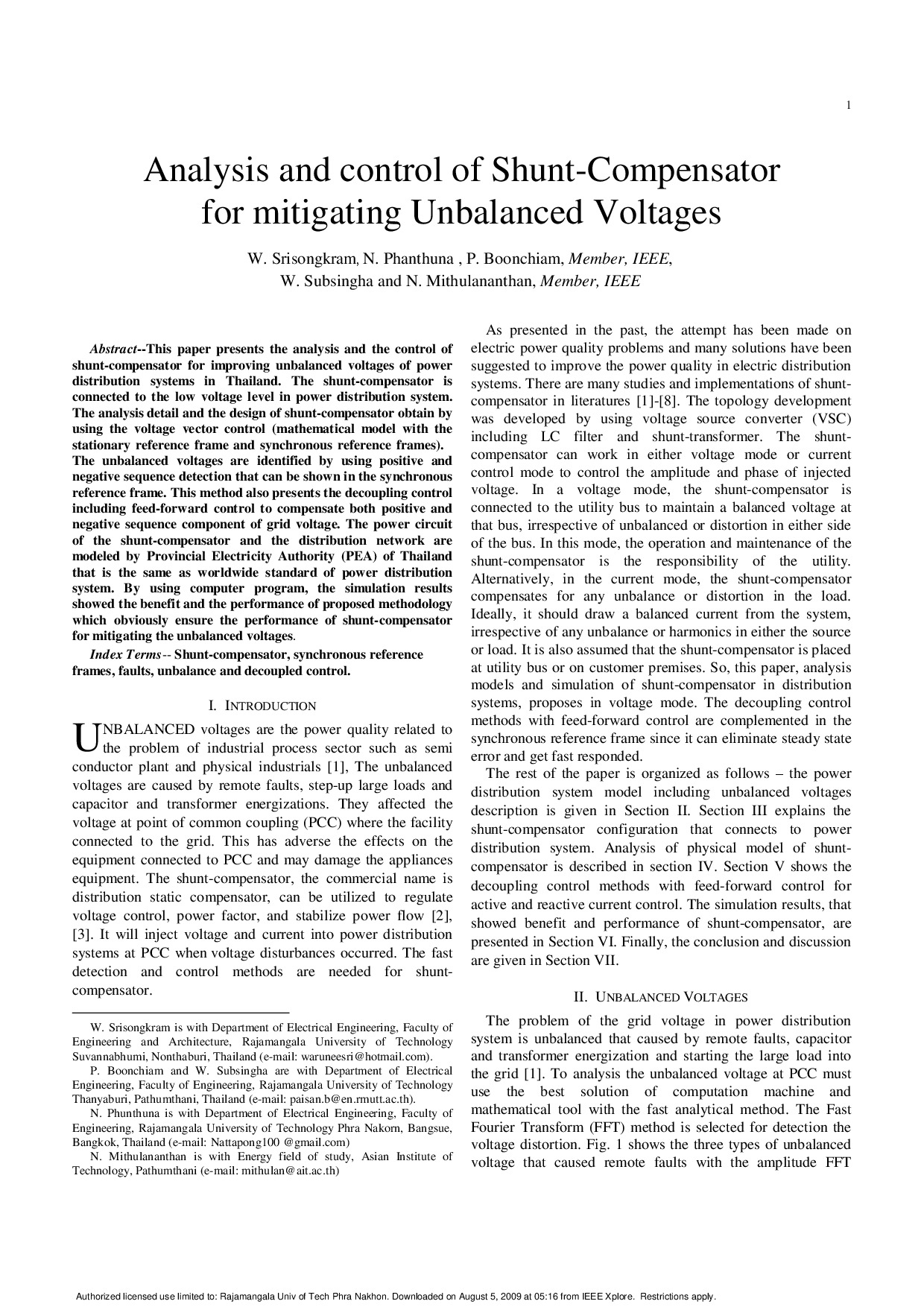
Analysis and control of Shunt-Compensator for mitigating Unbalanced Voltages
This paper presents the analysis and the control of shunt-compensator for improving unbalanced voltages of power distribution systems in Thailand. The shunt-compensator is connected to the low voltage level in power distribution system. The analysis detail and the design of shunt-compensator obtain by using the voltage vector control (mathematical model with the stationary reference frame and synchronous reference frames). The unbalanced voltages are identified by using positive and negative sequence detection that can be shown in the synchronous reference frame. This method also presents the decoupling control including feed-forward control to compensate both positive and negative sequence component of grid voltage. The power circuit of the shunt-compensator and the distribution network are modeled by Provincial Electricity Authority (PEA) of Thailand that is the same as worldwide standard of power distribution system. By using computer program the simulation results showed the benefit and the performance of proposed methodology which obviously ensure the performance of shunt-compensator for mitigating the unbalanced voltages.
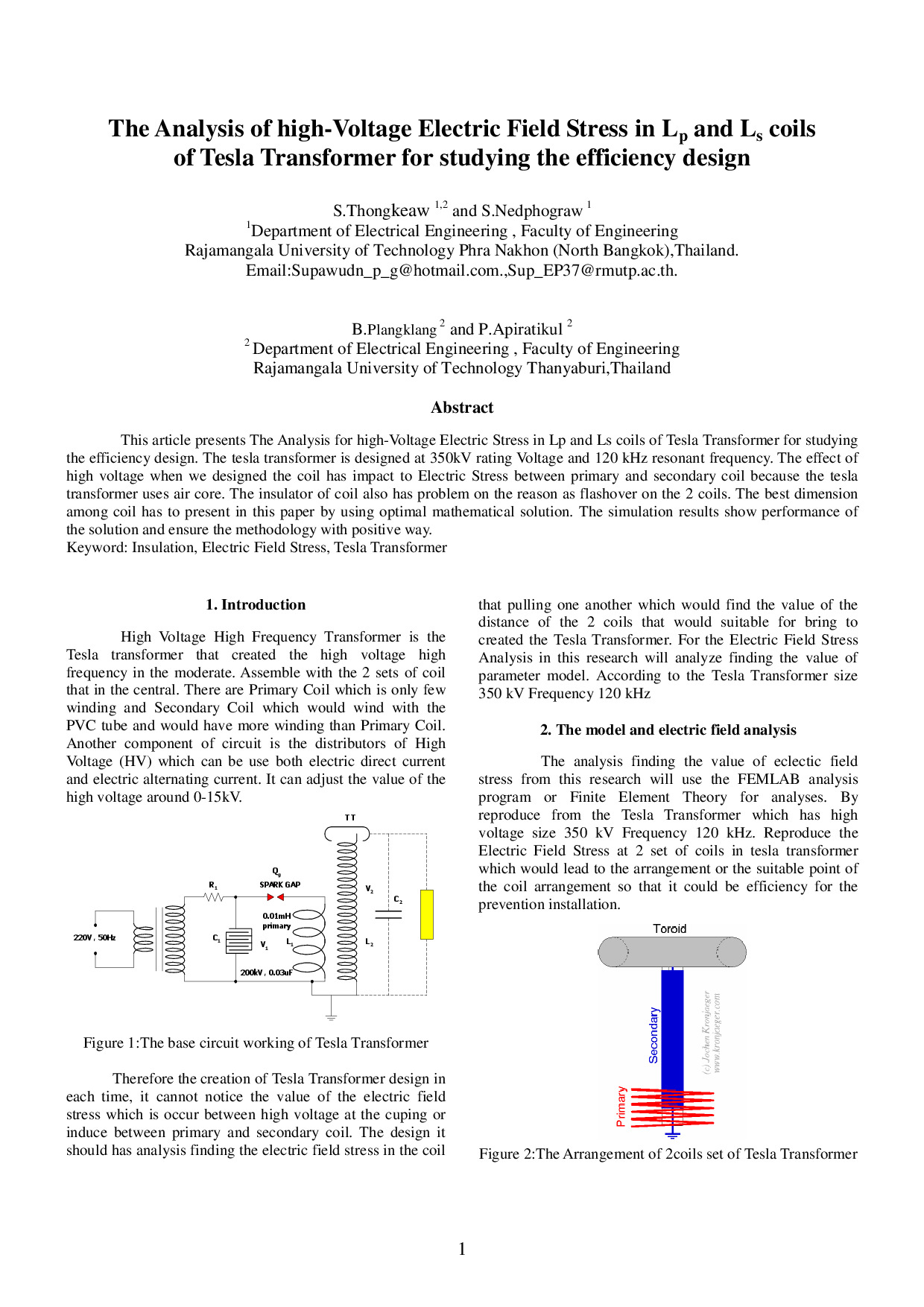
The Analysis of high-Voltage Electric Field Stress in Lp and Ls coils of Tesla Transformer for studying the efficiency design
This article presents The Analysis for high-Voltage Electric Stress in Lp and Ls coils of Tesla Transformer for studying the efficiency design. The tesla transformer is designed at 350kV rating Voltage and 120 kHz resonant frequency. The effect of high voltage when we designed the coil has impact to Electric Stress between primary and secondary coil because the tesla transformer uses air core. The insulator of coil also has problem on the reason as flashover on the 2 coils. The best dimension among coil has to present in this paper by using optimal mathematical solution. The simulation results show performance of the solution and ensure the methodology with positive way.
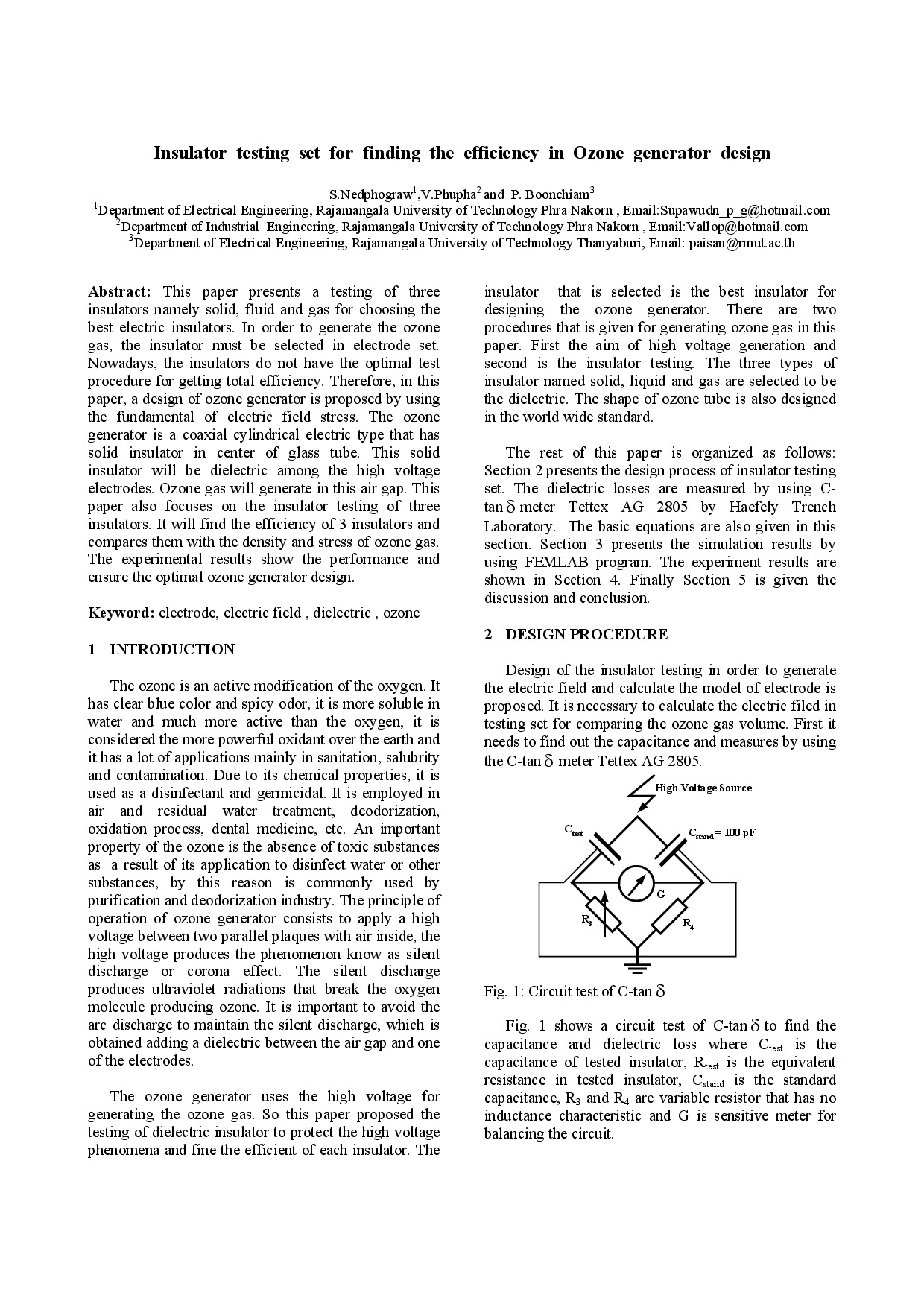
Insulator testing set for finding the efficiency in Ozone generator design
This paper presents a testing of three insulators namely solid fluid and gas for choosing the best electric insulators. In order to generate the ozone gas the insulator must be selected in electrode set. Nowadays the insulators do not have the optimal test procedure for getting total efficiency. Therefore in this paper a design of ozone generator is proposed by using the fundamental of electric field stress. The ozone generator is a coaxial cylindrical electric type that has solid insulator in center of glass tube. This solid insulator will be dielectric among the high voltage electrodes. Ozone gas will generate in this air gap. This paper also focuses on the insulator testing of three insulators. It will find the efficiency of 3 insulators and compares them with the density and stress of ozone gas. The experimental results show the performance and ensure the optimal ozone generator design.
A Dynamic Associative e-learning model based on a spreading activation network
Presenting information to an e-learning environment is a challenge mostly because of the hypertext/hypermedia nature and the richness of the context and information provides. This paper proposes a dynamic semantic model for e-learning system based on the psycholinguistic theories of human memory Spreading Activation Network (SAN). This work employs a SAN as a technique to provide the interfaces action selection mechanism in an uncertain environment. The paper combines the SAN with the temporal logic to provide an e-learning system that a learning activity level evolves according to their expected contextual relevance. The system differs from the other e-learning by representing dynamic associations between learning activities and the relevance subjects. This system equipped with an Event-Triggered learning interface (context) adaptation component. This component provides multiple parallel processes for perception. These processes provide context screen selection and learning task operation based upon the user current situation. The SAN attempts to achieve a number of goals in an unpredictable complex dynamic environment. Spreading activation explains the predictive top-down effect of knowledge. It supports general heuristics which may be used as the first step of more elaborated methods. This model is suited to deal with the interaction between semantic and episodic memories as well as many other practical issues regarding e-learning including the retroactive effect of semantics over perception. The system uses the SAN to activate the most suitable interface screen (context) in response to the current conditions (learning activities) while the system continues working towards the learning objective goal. The paper presents our efforts to realize such e-learning system. The proposed paradigm has been implemented to develop a prototypical system and the experiments also illustrate the robustness of such an e-learning framework.