จำนวน Repository ( 170 )
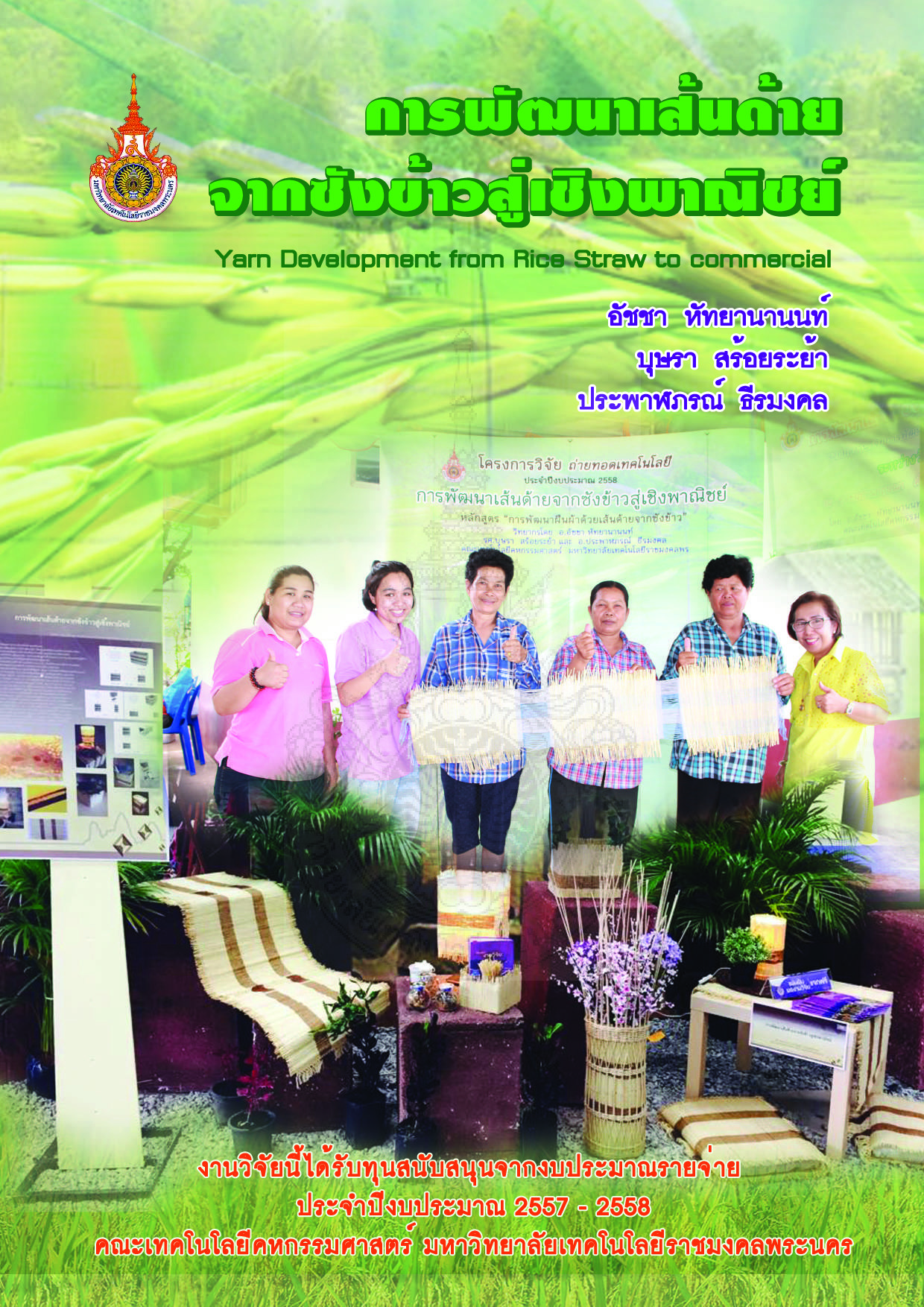
การพัฒนาเส้นด้ายจากซังข้าวสู่เชิงพาณิชย์
This research is Yarn Development from Rice straw to commercial. It aims to study the process of seperating fibers from rice straw. To study the physical properties of fibers from rice straw and to study the process of manufacturing yarn from rice straw fibers. The research material is rice straw fibers after that data was analyzed byphysical textile testing laboratory. The result of the first year’s research was the rice straw yarn has been developed as woven and develop into commercial products to promote. The process of separating fibers from rice straw which dried the sun for a few days. Selecting the rice straw fiber length at least 30 cm. to subtract the joints of the lower end of the stem by hand. peel off the rice straw fiber and place flat on a horizontal line. Then Rice straw fiber were tested in the physical laboratory was found that it is cellulose fibers tensile strength (Newton) at 28.18 elongation (percent) is at 2.01. The amounts of metals has plenty of CADMIUM at 0.1 mg/kg CHROMIUM (TOTAL) / (VI) at 0.5 mg/kg COPPER at 0.5 mg/kg and LEAD at 0.1 mg/kg which was not found to be risk for using. The fiber cross-section of rice straw fiber were found to be oval the middle is clearly. The fiber length is smooth and transparent when viewed from the side to see the clarity of the fiber. Rice straw fiber was weave in plain structure. Warp yarn uses a special brown cream and brown flat yarns. We use rice straw fiber with the same type of yarn. There are 2 warp yarn and using natural color without blench. Rice straw fabric was dyeing with dried hibiscus flowers (Kaa-Jeab herb) and mordant as ashes. The result is red light because of rice straw fiber surface is smooth and lustrous. Therefrom When woven as a fabric to develop be 4 products prototype : table lamps tablecloths in Japanese style potted plants and Accessories Box The result of the second year’s research there are focus group inquire for people it is interesting in this research and Date for transfer knowledge as: Ban-Krit-Sa- Na community Krit-Sa-Na sub-district bang-pra-ma district in Supanburi province. To plan the schedule and set the date place amount of participate and lectures 34 people The range of time to transfer as 3 days on 3 – 5 May 2015 and asking for consumer satisfaction of the curriculum and lecture for “transfer knowledge Yarn Development from Rice straw to commercial” by Questionnaire of participate satisfaction. Last the evaluation data was analyzed by using SPSS program in mean and percentage. The second year found that mostly participates were female aged under 21 years old finished the secondary school and also there are farmer. The participates are their income under 5000 baht and no income. For the participates questions relation to technology transfer of “Yarn Development from Rice straw to commercial” about course divided into 3 parts: The purpose The curriculum and The knowledge. The satisfaction of participates about project divided into 3 parts: Service process Lecturer and Facilities found that have been satisfied at maximum average and highest level of satisfaction in every parts of both satisfied participates questions. The participants are mainly used to provide benefits to themselves for one month to apply the gained after the training. Satisfaction with the benefits of technology transfer and utilization. Satisfaction at the highest level the participants used knowledge to apply with local and waste material. Moreover the participates make product as soon as finish course and they are planning to produce the table Hand Woven for weaving the Rice straw yarn fabric and push it to be OTOP products. The comments and suggestions of the participants found that they need for re-training again. They would like to have a longer period of training in order to gain more knowledge. All lecturer can transfer knowledge during the training as well.
การถ่ายทอดเทคโนโลยีนวัตกรรมข้าวนาโยนของกลุ่มผู้ประกอบการข้าวแบบมีส่วนร่วม
This research aimed to transfer the participatory rice parachute innovation for rice entrepreneur group by using principles of KM: Knowledge Management in Action in Community (Action Research). Forty people of Uttraradit Province were purposively sampled to participate in five phases of the activities. The first activity was the Education of Knowledge the second activity was the Knowledge Work Rally the third activity was the Cooperative Work Shop the fourth activity was the Mind Mapping Work Shop and the fifth activity was the Evaluation Program. Statistics used in data analysis was descriptive statistics and qualitative information was analyzed by using content analysis method. The information was calculated by percentage mean ( ) and standard deviation (S.D.). Most of the samples were male with the age ranged from 41-50 years. Most farmers were married and their educational level was between Primary 4 and Primary 6. The average household labor amount for rice parachute agricultural practice was four people. Their experiences regarding to the rice parachute innovations were less than three years but 73.5 percent of them were interested in the innovations. Most of them were members of the agriculturist groups followed by the members of Bank for Agriculture and Agricultural Cooperatives. Most of them were farmers who have learned the innovations regarding termite soil grinder soil sprinkler and rice-seeder. As for the overall satisfaction towards KM: Knowledge Management in Action in Community most of them had the highest level of satisfaction and understanding with mean of = 4.56 SD= 0.49. In conclusion the participatory innovation transfer project by providing the know-how to the communities using the KM Principle: Knowledge Management in Action in Community was at the highest satisfactory level.
การจำแนกประเภทเมล็ดข้าวขาวด้วยการประมวลผลภาพ
This research work presents the development of algorithms and programs used for classifying of white rice grains obtained from the camera by using image processing techniques. This procedure begins with improving input images converting color images to binary images by setting the threshold value automatically by using the Otsu’s method noise filter process image processing with structural elements that form a square determining the grain boundary by using the Canny’s operator determining the length of the grain by using the Euclidean’s method. Next the length results of the grains have been obtained from the decision process based on the Rice Standards of Thailand (RST) in order to receive the type solutions of tested white rice. From the testing results for 800 images it has been shown that in case of 500 images the developed program provided the mean absolute error of the grain length of 0.01 mm per grain. Moreover for testing of 300 images the developed program provided the separation accuracy of the grains up to 99.33% in term of the RST. This can be useful in determining the price of white rice in a rice mill with farmers.
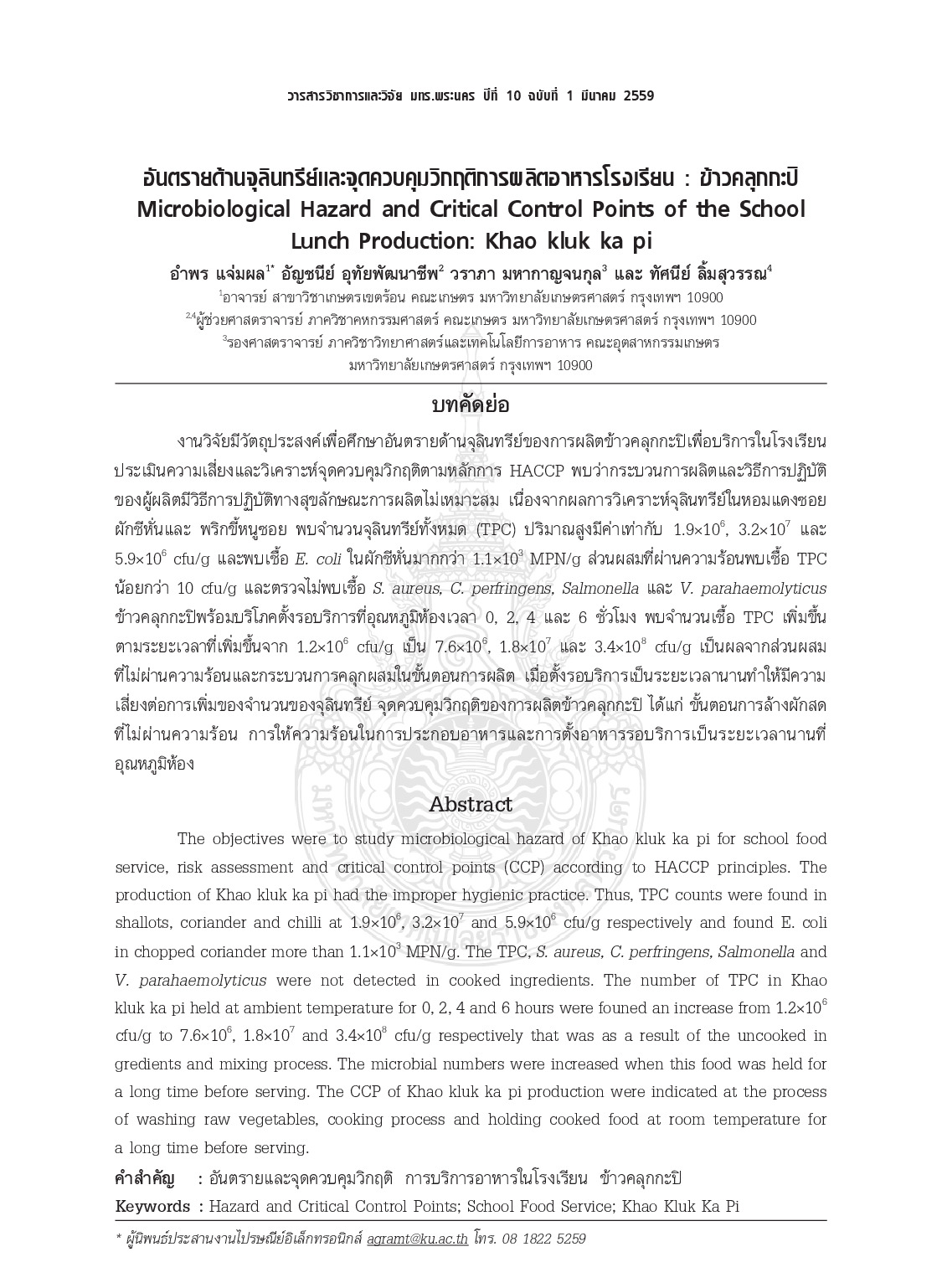
อันตรายด้านจุลินทรีย์และจุดควบคุมวิกฤติการผลิตอาหารโรงเรียน : ข้าวคลุกกะปิ
The objectives were to study microbiological hazard of Khao kluk ka pi for school food service risk assessment and critical control points (CCP) according to HACCP principles.The production of Khao kluk ka pi had the improper hygienic practice. Thus TPC counts were found in shallots coriander and chilli at 1.9×10⁶ 3.2×10⁷ and 5.9×10⁶ cfu/g respectively and found E. coli in chopped coriander more than 1100 MPN/g. The TPC S. aureus C. perfringens Salmonella and V. parahaemolyticus were not detected in cooked ingredients. The number of TPC in Khao kluk ka pi held at ambient temperature for 0 2 4 and 6 hours were founed an increase from 1.2×10⁶ cfu/g to 7.6×10⁶ 1.8×10⁷ and 3.4×10⁸ cfu/g respectively that was as a result of the uncooked ingredients and mixing process. The microbial numbers were increased when this food was held for a long time before serving. The CCP of Khao kluk ka pi production were indicated at the process of washing raw vegetables cooking process and holding cooked food at room temperature for a long time before serving.