จำนวน Repository ( 137 )

Queuing Analysis The Study of Student’s Admission System at Rajamangala University of Technology Phra Nakhon, North Bangkok Campus
The objectives of the study were to find the arrival rate of applicants who applied to study at Rajamangala of Technology Pra Nakhon North Bangkok Campus the service rate of admission officers and to analyze queuing system in order to improve the admission system. The sample was 1722 technical students who applied to study in 10 divisions in 2007 and 2008. The plication date was collected every 10 minutes in each one-hour period from 09.00 am. to 16.00 pm. For 6 days. The study found that the distribution of the number of applicants was Poisson distribution. The highest arrival rate 1.29 student/min was at the second period and the lowest arrival rate 0.06 students/min was at the sixth period. The Distribution of service time at each station was exponential distribution. The highest service rate 0.67 min/student or 1.49 students/min was at the second station entering data into a computer. Queuing analysis in this study was series network. The analysis found that the highest expected number of applicants in the system 150 student/hour was at the first station in the second period and in the sixth period there was almost none. The highest expected number of applicants in the queuing system107.40 student/hour was at the first station in the second period The highest expected waiting time in the system.1.92 min/student and in the queuing system 1.37 min/student were at the first station. The probabilities of none of applicants in the system at the first the second and the third station in the sixth period were high 0.97 0.95 and 0.98 respectively. The proper value of the expected number of applicants in the system set in this study was not more than 60 student/hour and not less than 30 student/hour. The proper value of the waiting time in the system was not more than 1 min/student and not less than 0.5 min/student for stations for stations with more than one servers. The analysis found that at the first station one more server should be added in the second the third and the forth period and one less server should be reduced in the sixth period.
Canonical Correlation Analysis Between some Factors and Motivation on Producing Academic Papers of Instructors in The Office of Rajamangala University of Techlnology Phra Nakhon
The purposes of this research were to study the canonical relationship between some factors and motivation on producing that relative contribute to academic papers and to study the canonical weights of some factory motivation on producing academic papers. The Sample were the 222 instructors in the office Rajamangala University of technology Phra Nakhon who work during the first semester of Academic year 2005. The stratified random sampling technique was used for selecting the sample. The instruments were the questionnaire considering the salary work load working experience Attitudes toward producing academic papers Self development Internal control Academic ability Motivation on advancement Motivation on recognition and Motivation on environment of producing academic papers. The findings were as follow: 1. The canonical correlation between Salary Work load Working experience Attitudes toward producing academic papers Self development Internal control Academic ability Motivation on advancement Motivation on recognition and Motivation on environment of producing academic papers were .510 .231 and .134 respectively. The first canonical function was Statistically Significant at .05 level. The second and third canonical function were Statistically nonsignificant. 2. The canonical weights for Attitudes toward producing academic papersself development and Internal Control relative contributed to Motivation on advancement Motivation on recognition and Motivation on environment of producing academic papers in the first canonical function.
Performance Analysis of Adsorption Refrigeration System with Water-Thermosyphon Cool Adsorber and Evaporator Enhanced with Near-Ultrasonic Wave
Here we present an experimental study of the single-effect adsorption cooling system using activated carbon-methanol working pair. The test unit was comprised of an adsorber a condenser and evaporator in vertical alignment. Heating and cooling of adsorber was mainly done by hot and cold water circulating through the water jacket. The evaporator and condenser was heated or cooled by flows of water through the internal coil. The adsorber was analyzed for its cooling rate when cooling was done by two approaches either cooling water and/or three thermosyphon heat pipes which both methods gave shortest cooling time. The investigated heat source and sink temperatures are; hot water temperature supplied to adsorber (70 80 90 oC) and cooling water temperature supplied to condenser (5 10 15 oC). An ultrasonic wave generator was attached to the bottom end of the evaporator to generate wave frequency varied by 8 10 and 14 kHz during evaporation phase. The ultrasonic wave can obviously reduce the evaporation time of methanol as well as to improve the system performance in terms of COP SCP and VCP. The system performance was considerably comparable to those from literatures. The highest COP and SCP obtained from this system was 0.718 and 248.90 W/kg respectively.
Development program for heat balance analysis fuel to steam efficiency boiler and data wireless transfer
This research aim to improve a combustion system of boiler within increase combustion efficiency and use all out of the energy. The large boilers were used in the industrial factories which consume a lot of energy for production. By oil and gas fuel will be increasing costs everyday cause many factories interested in energy saving with any method technical engineering specifically for production costs and environment effect decreasing. This researching was installed and program was invented in the industrial factory. This industry factory consumed cogeneration energy for fabric dying. The efficiency before installing the software is measured about 65.85 - 71.98% which heat in exhaust gas about 20% of overall energy is filled in the system. After installing heat loss in the system has been fallen until remain about 5 - 12% and efficiency of heat in system has been reached a peak of 80 - 85%.
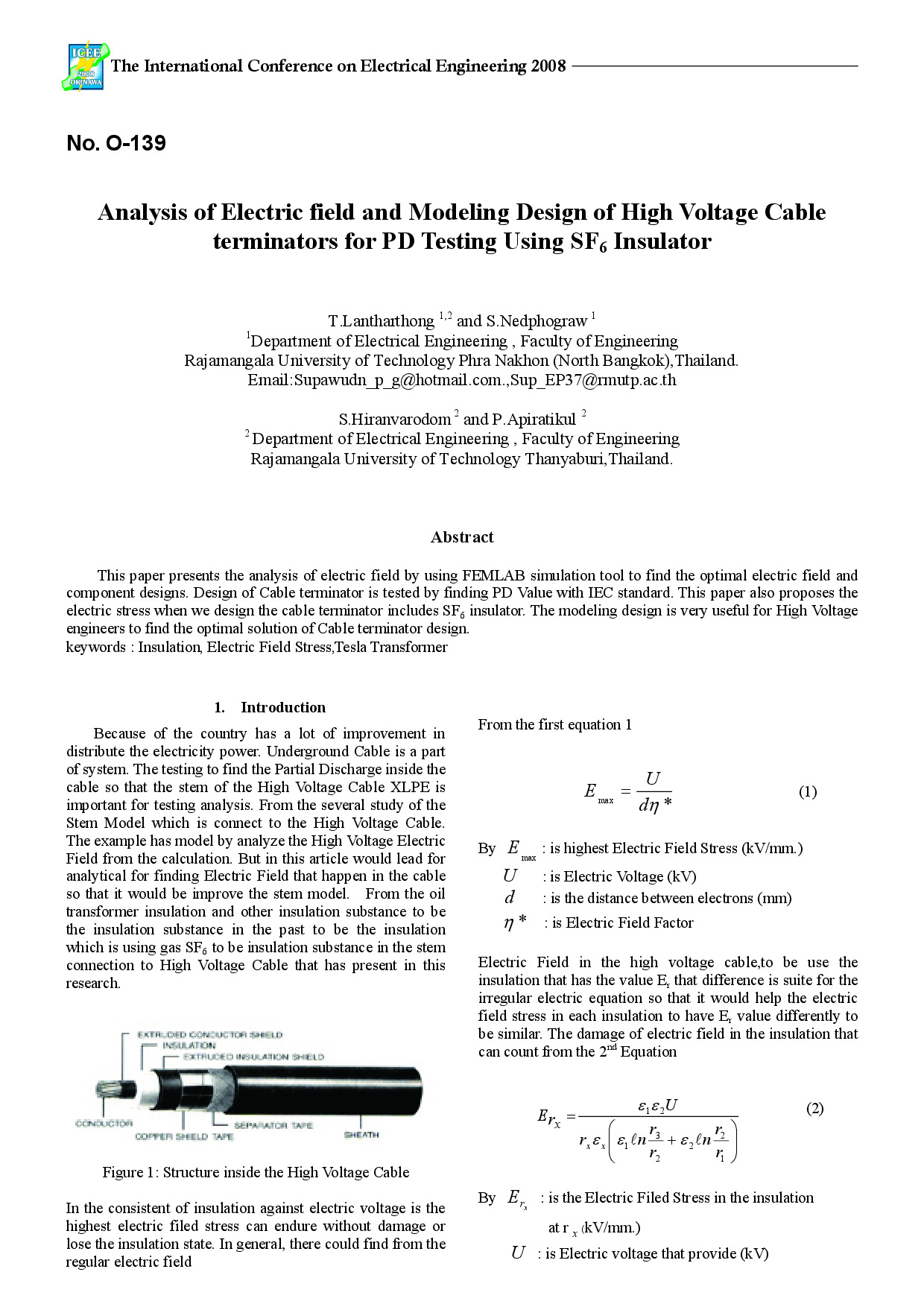
Analysis of Electric field and Modeling Design of High Voltage Cable terminators for PD Testing Using SF6 Insulator
This paper presents the analysis of electric field by using FEMLAB simulation tool to find the optimal electric field and component designs. Design of Cable terminator is tested by finding PD Value with IEC standard. This paper also proposes the electric stress when we design the cable terminator includes SF6 insulator. The modeling design is very useful for High Voltage engineers to find the optimal solution of Cable terminator design.