จำนวน Repository ( 291 )

Complete security protection for remote desktop – microsoft windows server
Remote Desktop is one of the most popular method to access to the microsoft windows server which locate as Co-location in the Internet Data Center. But there is still a security problem because a password can be hacked by Trojan infected PC or password can be sniffed via network or even taking a random for password from Password Generator program. This paper presents the completed security protection even the password has been hacked or stolen the hacker can not access to the server via the remote desktop. Normally the port 3389 of Remote Desktop will be closed thus any computer from the internet cannot be accessed. To get access permission it must be done with special requisition with the other password which access through the port 80 (port of web server) that is always generally opened. Only single IP address can get the permission at the time. This method of protection was never published anywhere yet. Result of using this method in the most popular mobile web in Thailand for more than 2 years there is no one can hack into the system at all.
The feasibility study of recovery N-Methyl-Pyrrolidone and Acetone
The objective of this work was to study the feasibility of recovery N-Methyl-Pyrrolidone (NMP) and acetone solution in cleaning the slider fabrication process in the manufacturing process of hard disk drive by distillation. The operating parameters such as pressure (50 - 500 mbar) temperature (60 - 110 C) and time (20 - 70 minutes) were investigated. The highest purity of solution was ca 98.12 %of N-Methyl-Pyrrolidone at 110 C 200 mbar with 30 minutes that it is sufficiently purity to be re-used. This solution could be produced with 0.33 Liter/hour with 405 Baht/Liter (excluding investment cost) that would be saved 565 Baht/Liter and environmentally friendly with clean technology.
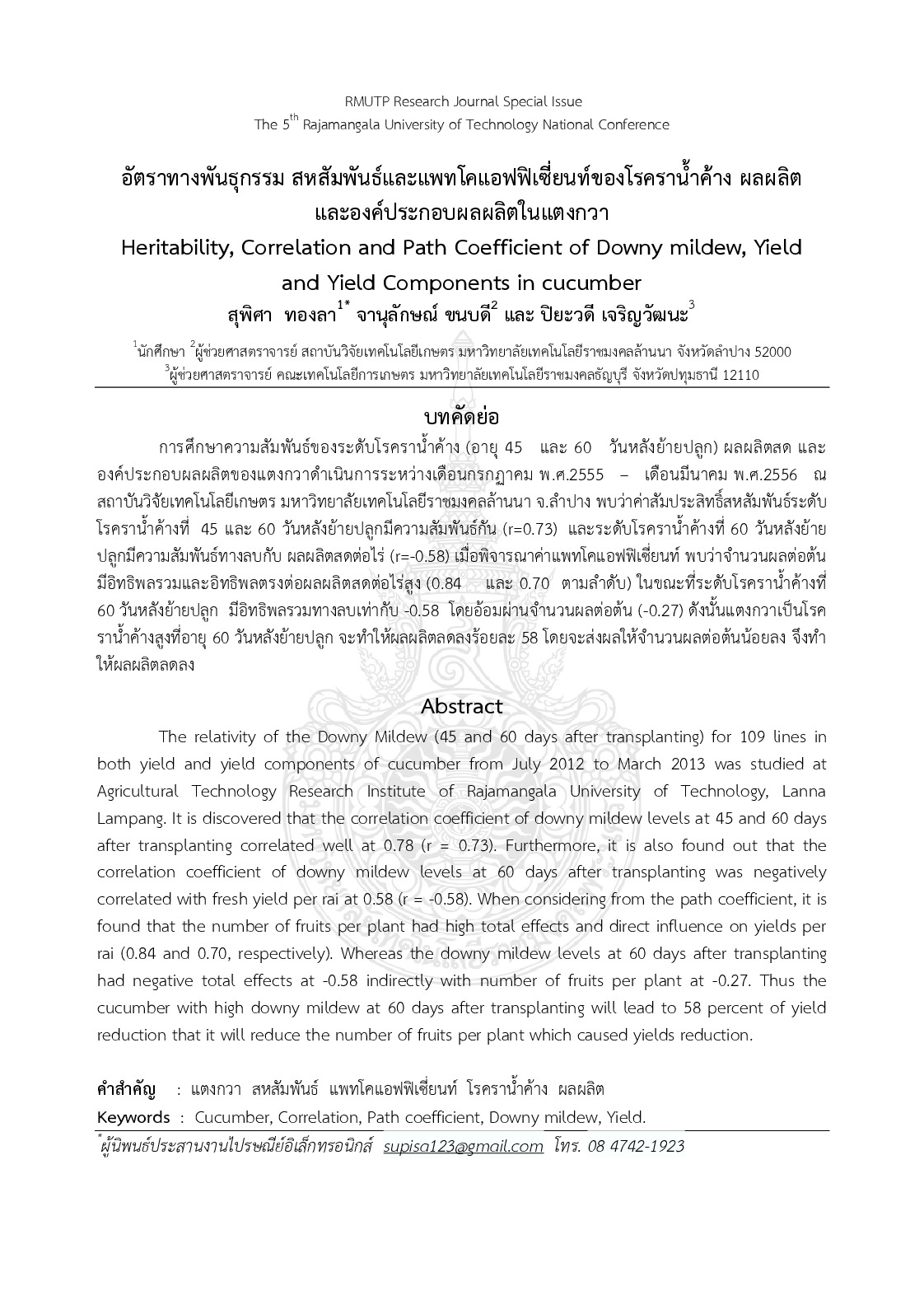
Heritability, correlation and path coefficient of downy mildew, yield and yield components in cucumber
The relativity of the Downy Mildew (45 and 60 days after transplanting) for 109 lines in both yield and yield components of cucumber from July 2012 to March 2013 was studied at Agricultural Technology Research Institute of Rajamangala University of Technology Lanna Lampang. It is discovered that the correlation coefficient of downy mildew levels at 45 and 60 days after transplanting correlated well at 0.78 (r = 0.73). Furthermore it is also found out that the correlation coefficient of downy mildew levels at 60 days after transplanting was negatively correlated with fresh yield per rai at 0.58 (r = -0.58). When considering from the path coefficient it is found that the number of fruits per plant had high total effects and direct influence on yields per rai (0.84 and 0.70 respectively). Whereas the downy mildew levels at 60 days after transplanting had negative total effects at -0.58 indirectly with number of fruits per plant at -0.27. Thus the cucumber with high downy mildew at 60 days after transplanting will lead to 58 percent of yield reduction that it will reduce the number of fruits per plant which caused yields reduction.
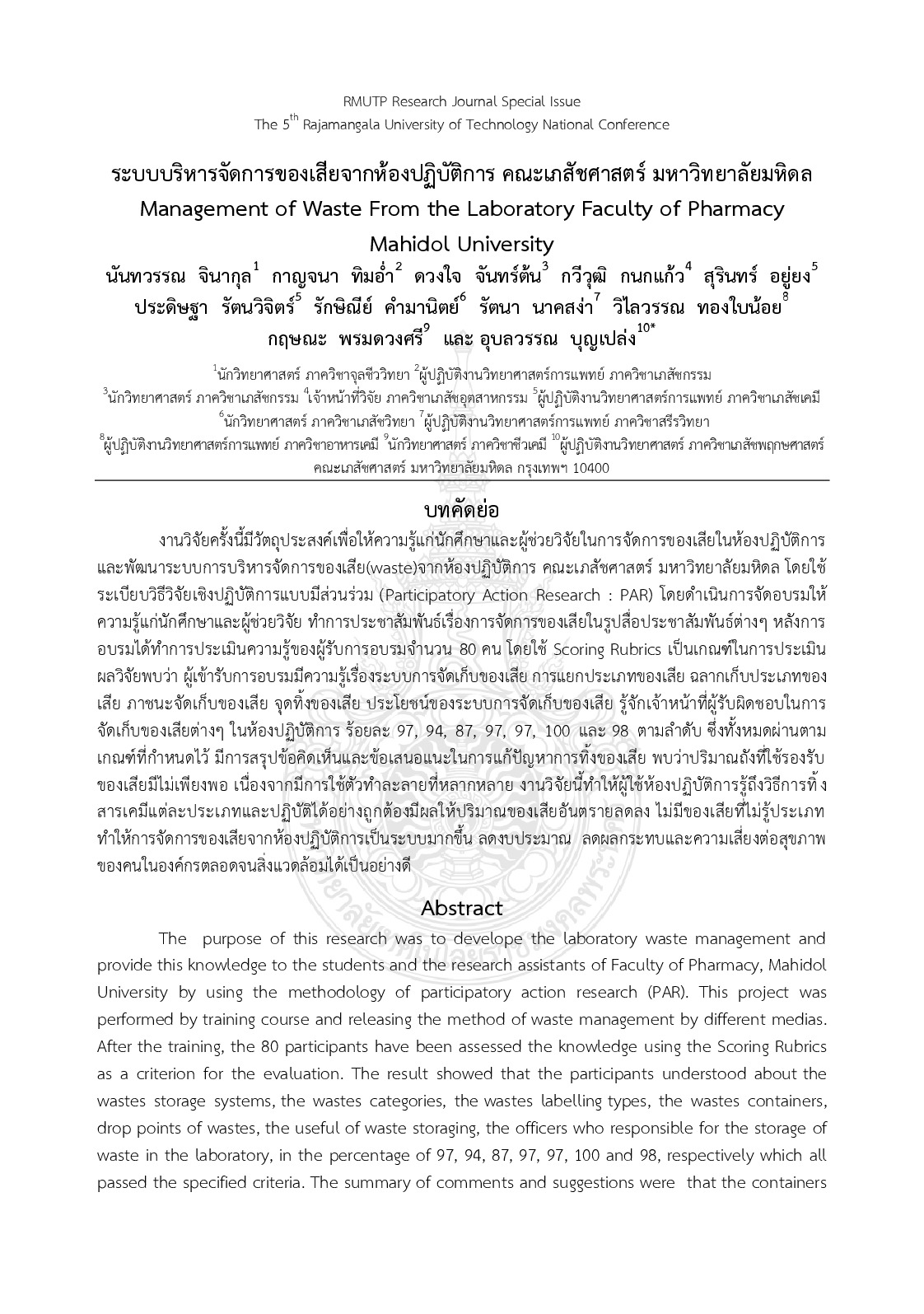
Management of waste from the laboratory faculty of pharmacy mahidol university
The purpose of this research was to develope the laboratory waste management and provide this knowledge to the students and the research assistants of Faculty of Pharmacy Mahidol University by using the methodology of participatory action research (PAR). This project was performed by training course and releasing the method of waste management by different medias. After the training the 80 participants have been assessed the knowledge using the Scoring Rubrics as a criterion for the evaluation. The result showed that the participants understood about the wastes storage systems the wastes categories the wastes labelling types the wastes containers drop points of wastes the useful of waste storaging the officers who responsible for the storage of waste in the laboratory in the percentage of 97 94 87 97 97 100 and 98 respectively which all passed the specified criteria. The summary of comments and suggestions were that the containers to collect the waste were not enough due to there were many varieties of solvents. This research enables the users to know how to dispose the wastes by differentiating the chemicals types and perform accurately which leading to the reduction of the amount of hazardous waste reduction the unknown waste the waste management from the laboratory become more systematic which will reduce the budgets and decreasing the risk to the health.
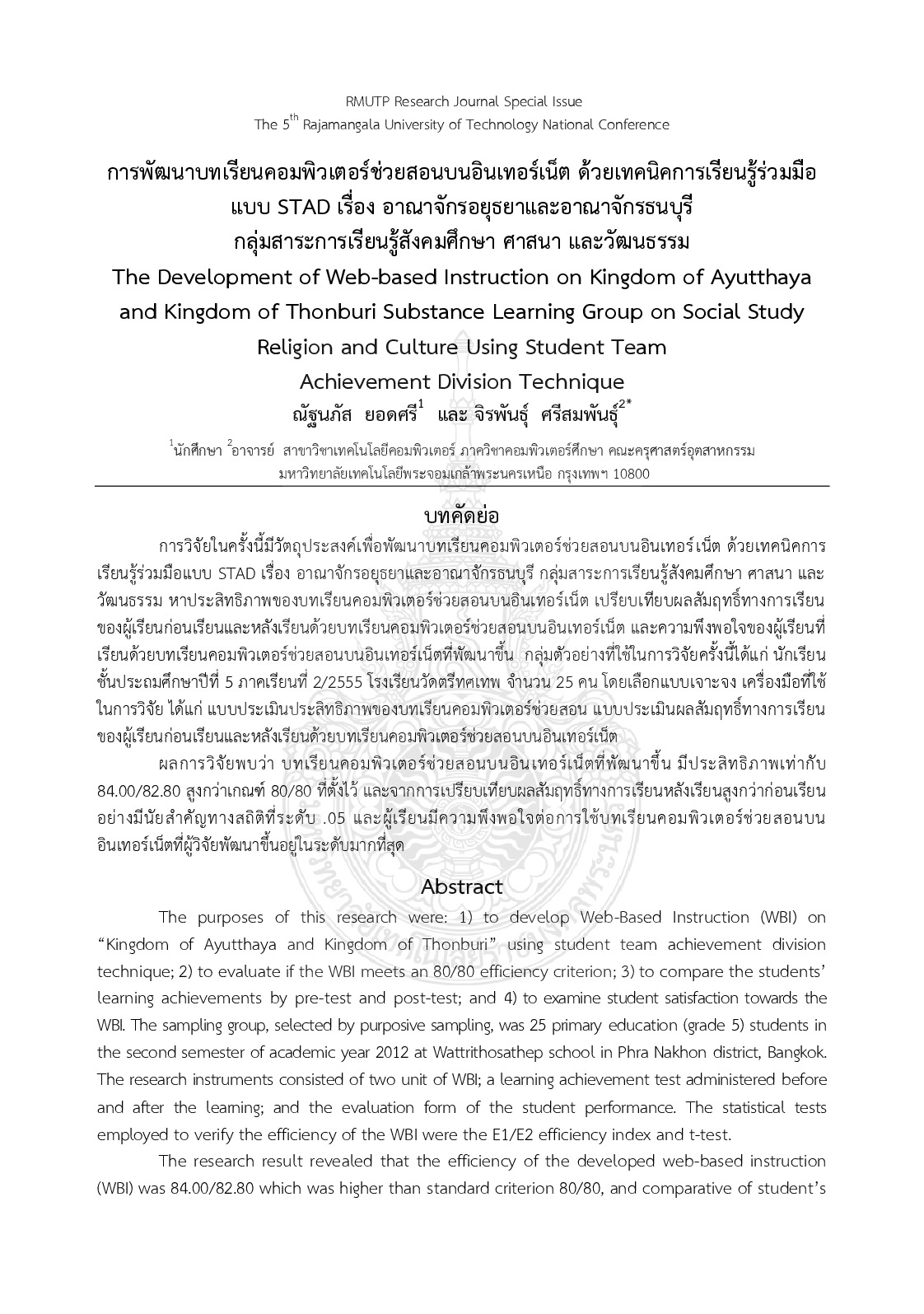
The development of web-based instruction on kingdom of ayutthaya and kingdom of thonburi substance learning group on social study religion and culture using student team achievement division technique
The purposes of this research were: 1) to develop Web-Based Instruction (WBI) on “Kingdom of Ayutthaya and Kingdom of Thonburi”กusing student team achievement division technique; 2) to evaluate if the WBI meets an 80/80 efficiency criterion; 3) to compare the students’ learning achievements by pre-test and post-test; and 4) to examine student satisfaction towards the WBI. The sampling group selected by purposive sampling was 25 primary education (grade 5) students in the second semester of academic year 2012 at Wattrithosathep school in Phra Nakhon district Bangkok. The research instruments consisted of two unit of WBI; a learning achievement test administered before and after the learning; and the evaluation form of the student performance. The statistical tests employed to verify the efficiency of the WBI were the E1/E2 efficiency index and t-test. The research result revealed that the efficiency of the developed web-based instruction (WBI) was 84.00/82.80 which was higher than standard criterion 80/80 and comparative of student’s achievement it was found that the student achieved learning progress significantly level of .05. Finally it was found that the learners opinion after using the developed web-based instruction (WBI) was very satisfactory.