จำนวน Repository ( 121 )
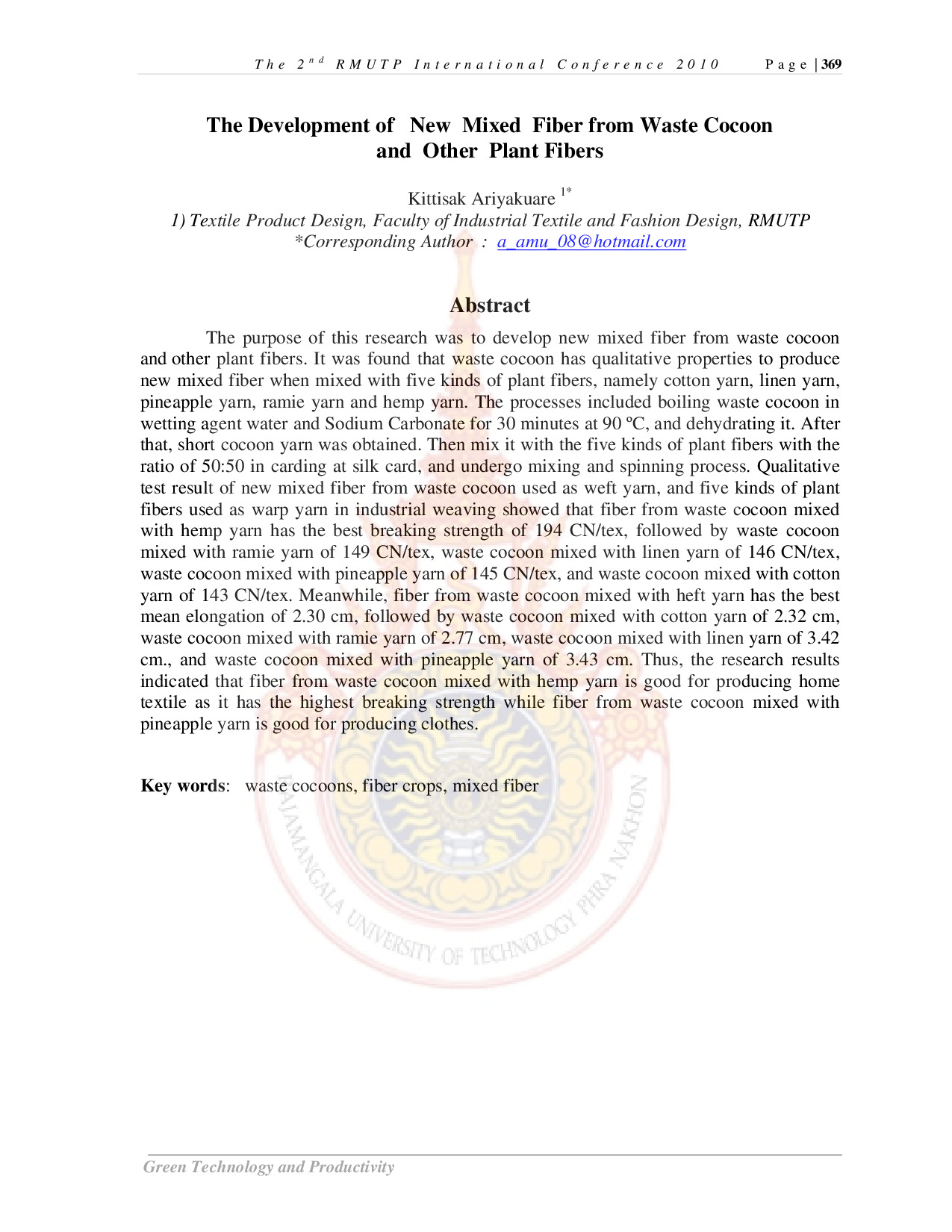
The Development of New Mixed Fiber from Waste Cocoon and Other Plant Fibers
The purpose of this research was to develop new mixed fiber from waste cocoon and other plant fibers. It was found that waste cocoon has qualitative properties to produce new mixed fiber when mixed with five kinds of plant fibers namely cotton yarn linen yarn pineapple yarn ramie yarn and hemp yarn. The processes included boiling waste cocoon in wetting agent water and Sodium Carbonate for 30 minutes at 90 ºC and dehydrating it. After that short cocoon yarn was obtained. Then mix it with the five kinds of plant fibers with the ratio of 50:50 in carding at silk card and undergo mixing and spinning process. Qualitative test result of new mixed fiber from waste cocoon used as weft yarn and five kinds of plant fibers used as warp yarn in industrial weaving showed that fiber from waste cocoon mixed with hemp yarn has the best breaking strength of 194 CN/tex followed by waste cocoon mixed with ramie yarn of 149 CN/tex waste cocoon mixed with linen yarn of 146 CN/tex waste cocoon mixed with pineapple yarn of 145 CN/tex and waste cocoon mixed with cotton yarn of 143 CN/tex. Meanwhile fiber from waste cocoon mixed with heft yarn has the best mean elongation of 2.30 cm followed by waste cocoon mixed with cotton yarn of 2.32 cm waste cocoon mixed with ramie yarn of 2.77 cm waste cocoon mixed with linen yarn of 3.42 cm. and waste cocoon mixed with pineapple yarn of 3.43 cm. Thus the research results indicated that fiber from waste cocoon mixed with hemp yarn is good for producing home textile as it has the highest breaking strength while fiber from waste cocoon mixed with pineapple yarn is good for producing clothes.

Use of disposed waste ash from landfills to replace Portland cement
In this study waste ash was utilized as a pozzolanic material in blended Portland cement in order to reduce negative environmental effects and landfill volume required to dispose of waste ash. The influence of waste ash namely palm oil fuel ash rice husk ash and fly ash on compressive strength and sulfate resistance in mortar were studied and evaluated by some accelerated short–term techniques in sodium sulfate solutions. Ordinary Portland cement (OPC) was partially replaced with ground palm oil fuel ash (POA) ground rice husk ash (RHA) and classified fly ash (FA). Single pozzolan and a blend of equal weight portions of POA RHA and FA were also used. The resistance to sulfate attack of mortar improves substantially with partial replacement of OPC with POA RHA and FA. The use of a blend of equal weight portions of FA and POA or RHA produced mixes with good strength and resistance to sulfate attack. POA RHA and FA have a high potential to be used as a pozzolanic material.
Use of waste ash from various by-product materials in increasing the durability of mortar
This paper presents a study on the strength and corrosion resistance of mortars made with binary blends of ordinary Portland cement (OPC) and ground rice husk ash (RHA) or ground palm oil fuel ash (POA). The mortar mixtures were made with Portland cement Type I containing 0-40% RHA and POA. RHA and POA with 1-3% by weight retained on a sieve No.325 were used. The water to binder ratio was kept constant at 0.5 and the flow of mortar was maintained at 110±5% with the aid of superplasticizer (SP). Scanning electron microscopy (SEM) was used for analysis. The compressive strength chloride penetration and corrosion resistance of the mortar were determined. The results show that strength as well as the resistance of mortar to chloride and corrosion can be improved by blending with RHA and POA. Thus RHA and POA have a high potential to be used as a good pozzolanic material.
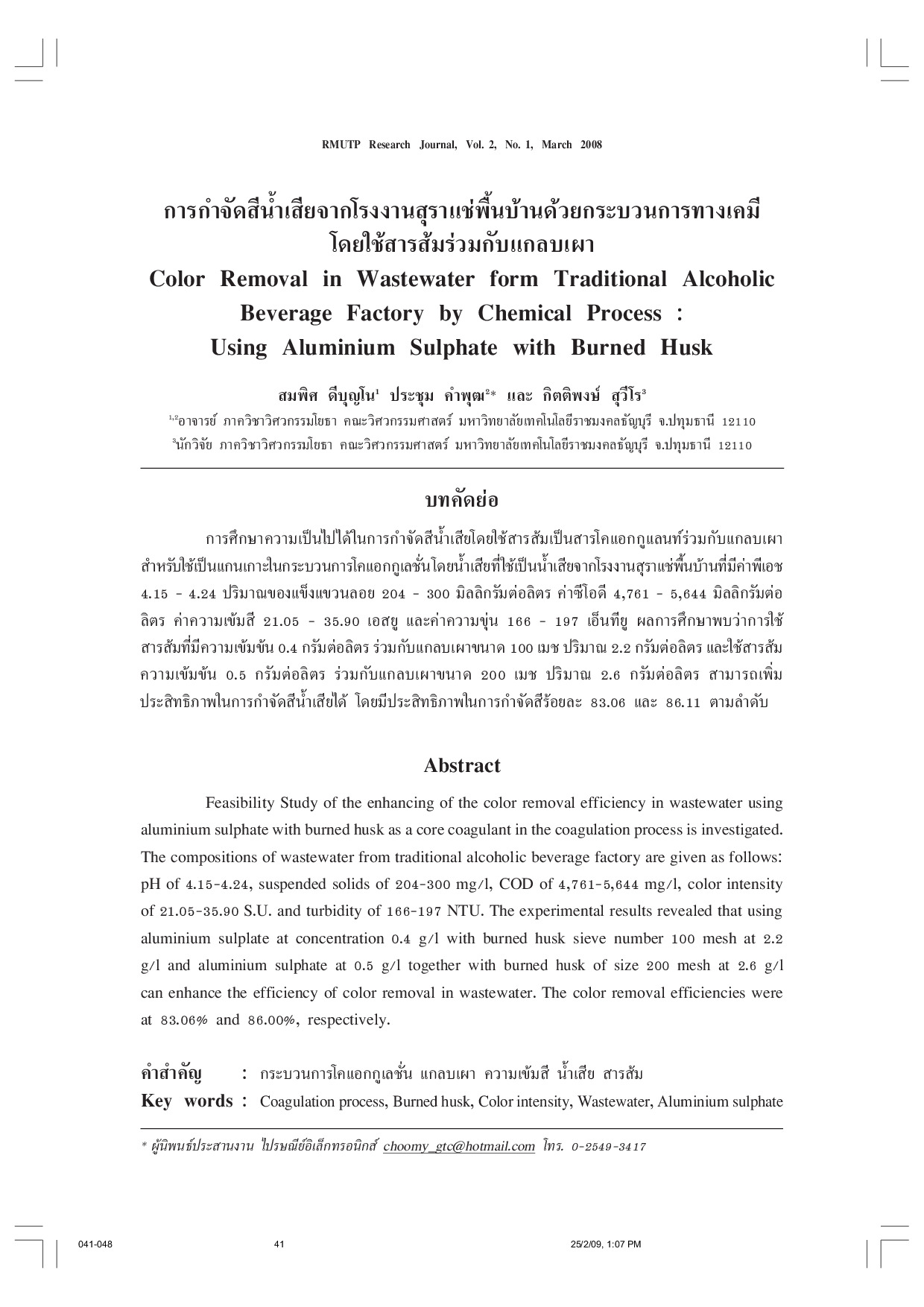
Color Removal in Wastewater form Traditional Alcoholic Beverage Factory by Chemical Process : Using Aluminium Sulphate with Burned Husk
Feasibility Study of the enhancing of the color removal efficiency in wastewater using aluminium sulphate with burned husk as a core coagulant in the coagulation process is investigated. The compositions of wastewater from traditional alcoholic beverage factory are given as follows: pH of 4.15-4.24 suspended solids of 204-300 mg/l COD of 4761-5644 mg/l color intensity of 21.05-35.90 S.U. and turbidity of 166-197 NTU. The experimental results revealed that using aluminium sulplate at concentration 0.4 g/l with burned husk sieve number 100 mesh at 2.2 g/l and aluminium sulphate at 0.5 g/l together with burned husk of size 200 mesh at 2.6 g/l can enhance the efficiency of color removal in wastewater. The color removal efficiencies were at 83.06% and 86.00% respectively.
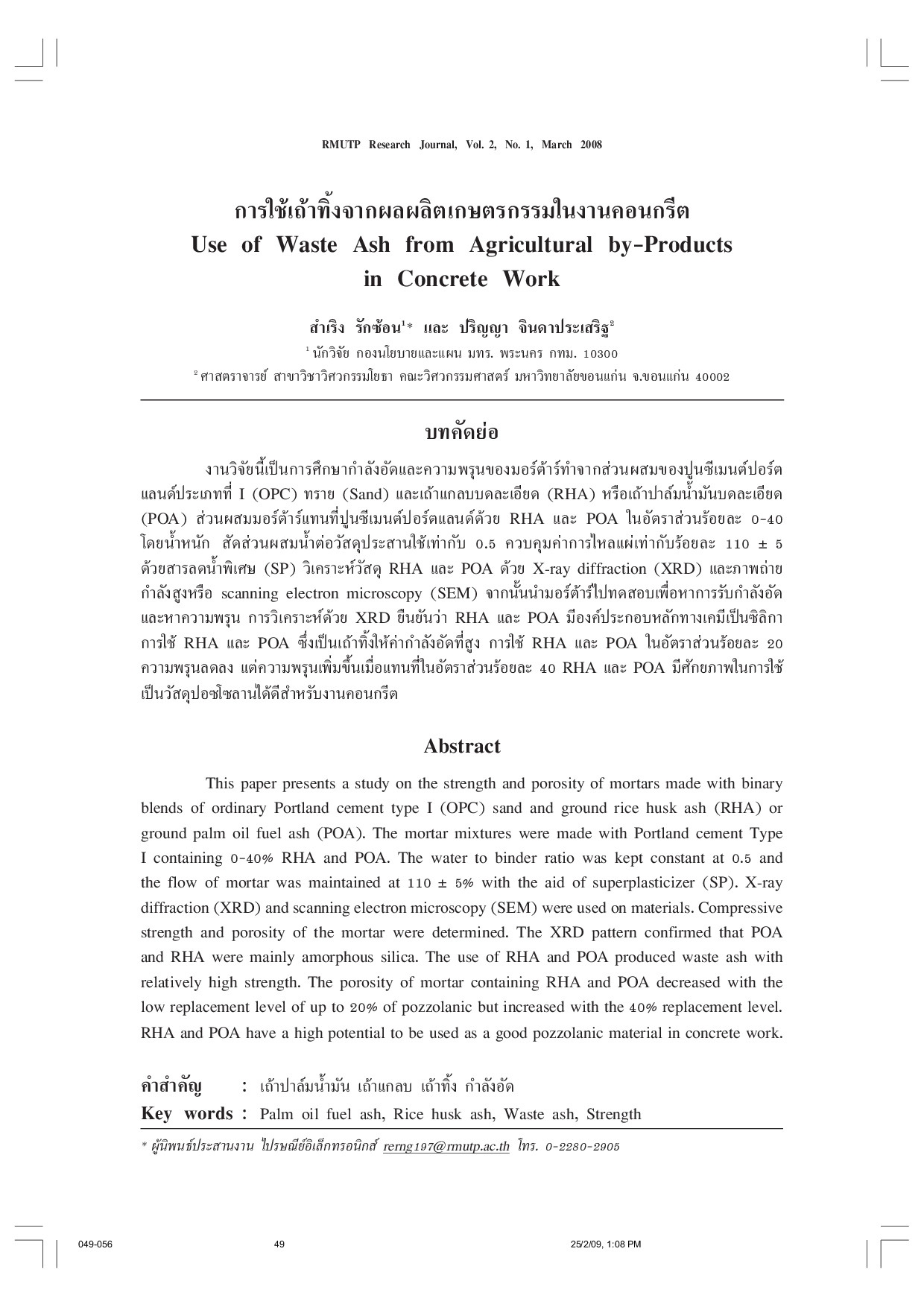
Use of Waste Ash from Agricultural by-Products in Concrete Work
This paper presents a study on the strength and porosity of mortars made with binary blends of ordinary Portland cement type I (OPC) sand and ground rice husk ash (RHA) or ground palm oil fuel ash (POA). The mortar mixtures were made with Portland cement Type I containing 0-40% RHA and POA. The water to binder ratio was kept constant at 0.5 and the flow of mortar was maintained at 110 +/- 5% with the aid of superplasticizer (SP). X-ray diffraction (XRD) and scanning electron microscopy (SEM) were used on materials. Compressive strength and porosity of the mortar were determined. The XRD pattern confirmed that POA and RHA were mainly amorphous silica. The use of RHA and POA produced waste ash with relatively high strength. The porosity of mortar containing RHA and POA decreased with the low replacement level of up to 20% of pozzolanic but increased with the 40% replacement level. RHA and POA have a high potential to be used as a good pozzolanic material in concrete work.