จำนวน Repository ( 198 )
Aggregate planning for optimal production quantity under uncertainty demand : Case study of food animals industry.
The objectives of this research were to find the distribution of food demand for laying hens and to find the optimum amount of that food production which had minimum cost. The data consisted of customer purchase orders for the food of laying hens price of food for laying hens cost per unit for the food inventory cost related to food of laying hens in which the food was out of stock such as fine overtime urgent purchase for material. They were collected in 2008-2009 form a factory in Nakhonratchasima province. The collected data were analized in order to explore the distribution of the monthly food demand for the laying hens and to see the rate of inventory per unit. The results were used in the stochastic linear programming model for aggregate planning in which the optimum production minimum cost could be obtained. Programming algorithm in MATLAB and tools in Linprog software were used to get the solution. The distribution of the food demand for laying hens and the random numbers were used in the model. The study found that the distribution of food demand for laying hens every month has normal distribution (January to December). The monthly average amount of production from January to December were 10936.94 12913.74 11898.12 13096 15443.26 14916.33 10322.64 10818.21 11393.11 11700.72 9706.05 and 11702.05 respectively. The minimum total cost average for 12months was Baht 62422386.98.
Analysis of steel industries in thailand : Case study of production planning and control by determination of time limited free back orders.
The objectives of this research were to find the distribution of food demand for laying hens and to find the optimum amount of that food production which had minimum cost. The data consisted of customer purchase orders for the food of laying hens price of food for laying hens cost per unit for the food inventory cost related to food of laying hens in which the food was out of stock such as fine overtime urgent purchase for material. They were collected in 2008-2009 form a factory in Nakhonratchasima province. The collected data were analized in order to explore the distribution of the monthly food demand for the laying hens and to see the rate of inventory per unit. The results were used in the stochastic linear programming model for aggregate planning in which the optimum production minimum cost could be obtained. Programming algorithm in MATLAB and tools in Linprog software were used to get the solution. The distribution of the food demand for laying hens and the random numbers were used in the model. The study found that the distribution of food demand for laying hens every month has normal distribution (January to December). The monthly average amount of production from January to December were 10936.94 12913.74 11898.12 13096 15443.26 14916.33 10322.64 10818.21 11393.11 11700.72 9706.05 and 11702.05 respectively. The minimum total cost average for 12months was Baht 62422386.98.
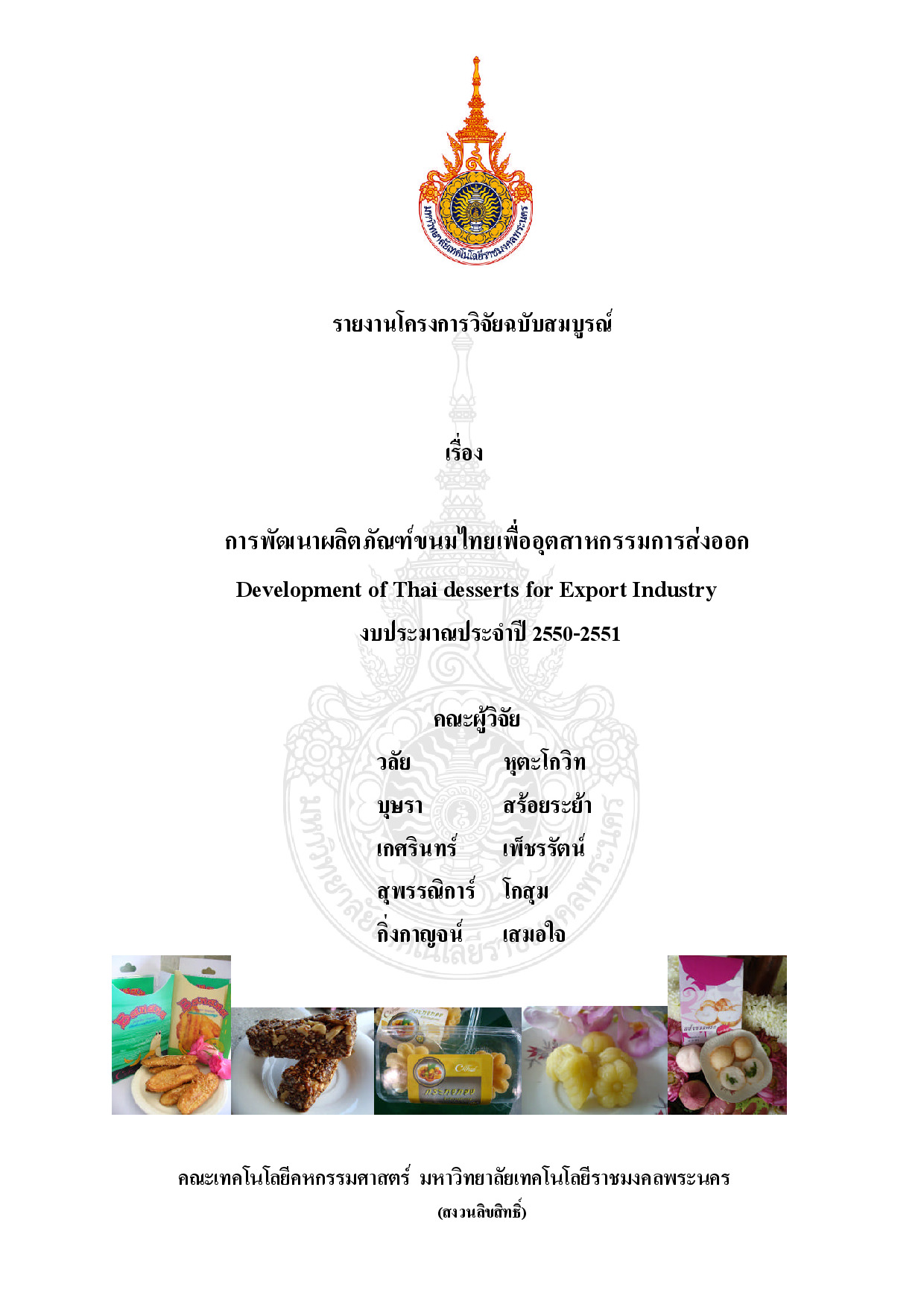
การพัฒนาผลิตภัณฑ์ขนมไทยเพื่ออุตสาหกรรมการส่งออก
Development Project of Thai dessert products for export industry aimed to develop 5 kinds of Thai dessert recipes and process which consisted of cereal bar instant peanut paste powder instant fried banana flour Kratong Thong (Golden Thai Pastry Cups) adapted for keeping longer and instant Kanom Krok flour (Coconut Rice Cake). The result was found that cereal bar from black sticky rice was developed by using 2 % high-fructose syrup and 12% glucose syrup and total soluble solid of syrup was at 90 Brix. The product tested was accepted moderately. Instant peanut paste powder recipe development made by Miss Suphannika Kosum was tested for sensory evaluation to compare with other peanut paste produced in marketplace. It was found that the product was accepted and there was statistically significant difference at p< 0.05. The five sensory overall liking attributes (colour smell taste texture and total impression) were 7.83 7.76 7.73 7.63 and 8.03 respectively. The product had high preference score. Instant fried banana flour recipe development was done by using rice flour to wheat flour ratio at 120:20 12.5% baking soda and 0.5% calcium chloride. Water requirement was 200 milliliter. The product was accepted at medium to high level. The second recipe of Kratong Thong (Golden Thai Pastry Cups) was the most accepted because it was golden yellow and smooth and stir frying for 1.3 minutes. The product was accepted at medium to high level. For instant Kanom Krok flour (Coconut Rice Cake) it was found that 3 recipes of them were significantly different for texture liking at p< 0.05. 100 and 90 gram of rice flour were studied for producing Kanom Krok it was found that there was no statistically significant difference for overall liking attributes (p> 0.05). Because of indifferent quantity of flour Kanom Krok was slightly different. However Kanom Krok made by 90 gram rice flour was less firming when compared to 100 gram rice flour and the product quantity obtained was also less. There was no statistically significant difference for overall liking attributes. The researcher transferred this knowledge and technology to the target private organization. The first time held on “Thai Dessert Products Course” in Lopburi province between 12-13 May 2008. The result of the technology transfer was found that 80 % of the participants’ satisfaction was accepted and after the course was finished the target groups applied this knowledge and technology for their careers to increase community’s income. It is regarded that this project was accomplished according to its success in the goal and objectives. Remark: 1Assistant Professor 2Lecturer of the Faculty of Home Economics Technology 3Lecturer of the Faculty of Architecture and Design

การพัฒนาอุปกรณ์พิมพ์สกรีนต้นแบบเพื่องานอุตสาหกรรมสิ่งทอ
Devlopment of Screen Printign Devices Prototypes for Textile lndustry was a research project which it was established to solve the practical learning of the faculty of industrial textile and fashhion desing students at Rajamangala University of Technology Phra Nakhon. This set had 3 important machines such as a self assembly aluminum block screen an automatic aluminum screen could saved the saved the screen fabric1.76 m2 reduced the chemical usageand waste minimization in the process.The practical time reduced from 16 minutes to 1 minute using the automatic aluminum screen coating. The efficiency time was 97.81. The 400 gram emulsion consumed obtained the thin film layer on the screen fabricand evenness.The sharpen pattern displayed when the exposed time was 3minutes.Moreoverthe drying and fixation machine was completely for natural fiber and synthetic fibers at 80-180 C. Therefore the Screen Printing Devices Prototypes was effectively used in textile industrialdispose of the practical learning problemraw material savingand waste minimization adjacent to clean technology process.The prototype set was produced by house equipmentsand extended for textile industrial.