จำนวน Repository ( 3447 )
การพัฒนารูปแบบชุดคอสเพลย์ด้วยผ้าทอลายไทย
: The purpose of this project is wale laying and make cosplay costumes using Thai woven fabrics. To study the satisfaction with the cosplay costumes that are sewn with Thai woven fabrics to study about how to produce cosplay costumes with Thai woven fabrics.to study the wale and the pattern from those and satisfaction survey in both times the first is the sample survey about wale laying on the pattern by 300 people buy online. Tools include The Disney Princess Cosplay Costume wale laying with Praewa pattern and Pikul flower pattern 4 sets and the second satisfaction survey is the satisfaction for those who cosplay at the JAPAN EXPO THAILAND event 2019 at Central World tools include Princess Cinderella Cosplay Costume that is sewn with Thai fabric Praewa pattern and Princess Jasmine cosplay costume which is sewn with Thai fabric Pikul flower pattern and satisfaction survey by 100 people. Statistics used to describe the results of data analysis in project work Use percentage pie chart and average. The result of the development of the cosplay costume style with Thai woven fabric was found that the cosplay costumes were cut by 4 patterns of Thai woven fabrics. The opinions from the groups who were interested in the majority of opinions were very beautiful. The design fits well with the set. Wanting to make more dresses and applying Thai fabrics is a good idea. Because Thai people now start to wear less Thai fabrics. The 1st evaluation results the development of a cosplay costume style with Thai woven fabrics by wale laying Found that each set was satisfied with the average score as Jasmine Princess Dress wale laying with Pikul flower pattern wale laying with Pikul flower pattern Received 28% Princess Jasmine wale laying with Praewa pattern Received 27.7% Princess Cinderella wale laying with Praewa pattern Received 27.3%. Princess Cinderella wale laying with Pikul flower pattern Received 17% Summary of opinions about the wale laying of princess dresses found that the two jasmine princess dresses are the most popular. But the selection of the set to create the second satisfaction survey selected the most popular princess dress by using the selection by choosing Princess Cinderella to dress The sewing is with Praewa woven fabric and Princess Jasmine with Pikul woven fabric The result of the second evaluation the development of a cosplay costume pattern with Thai woven fabric by sewing found that each set was satisfied by being able to average score as follows. Princess Cinderella dress with Praewa woven fabric has received 51%. Princess Jasmine with Pikul woven fabric has received 49% Summary of opinions about the sewing of a cosplay costume with Thai woven fabric Princess Cinderella dress The sewing is made with Praewa woven fabric the most popular because it is the beauty of the Praewa on the fabric that is sewn to make it exciting for every people to get the highest score
การศึกษาเชิงเปรียบเทียบระหว่างโรงไฟฟ้าโออาร์ซีแบบซับคริติคัลโรงไฟฟ้าโออาร์ซีแบบซุปเปอร์คริติคัล และโรงไฟฟ้าแรงคินไซเคิลแบบไตรแลทเตอรัลสำหรับแหล่งความร้อนที่อุณหภูมิ 210-250 องศาเซลเซียส
The performance investigations of subcritical ORC supercritical ORC and trilateral Rankine cycle (TLC) power plants with the heat source temperatures of 210-250°C were conducted and compared in this study. Several working fluids were evaluated. A MATLAB code was developed and used in this study. The thermodynamic properties of the working fluids were calculated by using NIST REFPROP program. The justification of the code was validated with a result taken from the literature. The optimal operating conditions were searched using the golden-section technique. The maximum net output power of 141.72 kW was obtained when using the supercritical ORC plant with R141b as its working fluid and the heat source temperature was at 250°C. The corresponding cycle efficiency was 16.25%. When using the subcritical plant at the same heat source temperature the maximum net output power of 133.40 kW and cycle efficiency of 15.70% are obtained when pentane is used as the working fluid. Furthermore the net output power of 133.82 kW and cycle efficiency of 14.90% are obtained when using R141b as the working fluid in the TLC power plant. According to the off-design simulations an appropriate adjustment of the working fluid flow rate can mitigate the variation of the net output power.
การทดสอบสมรรถนะของเครื่องขยายไอแบบสโครลสำหรับโรงไฟฟ้าโออาร์ซีขนาด 1 กิโลวัตต์
The ORC power plant is a promising technology to generate electricity from low-temperature heat sources. However implementation of the ORC for low capacity electricity generation is unattractive at the commercial level. Scroll compressors are massively produced to be used in refrigeration and air-conditioning applications. Using a scroll compressor in reverse as an expander can reduce the investment cost of low-capacity ORC power plants. In this study 2 scroll compressors that are available in the automotive air-conditioning market of Thailand were modified and used as the expander of a 1 kW ORC power plant. The performances of these 2 scrolls were compared and the plant performance was investigated. A heat source temperature from 100°C to 150°C was supplied to the plant. It was found that the gross power is higher by 18-35% for the larger expander (110 cc/rev) than for the smaller expander (85.7 cc/rev). The larger one provides the isentropic efficiency of 37-76% and the gross power of 806-1926 W. In addition the effects of check valve installation were examined and compared with those of the tests without check valve installation. It was revealed that the isentropic efficiency increases by 18% while the gross power decreases by 4-22% when the check valve was installed.
การจำลองโรงไฟฟ้าปล่องแดดแบหลังค่าเอียงขนาด 500 กิโลวัตต์ที่ใช้ความร้อนทิ้งจากอุตสาหกรรม
The solar chimney power plant (SCPP) has been proposed as a promising alternative power plant. According to the literature the chimney for commercial-scale SCPPs should be about 1 km high. The construction of these tall chimneys is very challenging and the construction cost is enormous. The sloped solar chimney power plant (SSCPP) is a variation of the SCPP. One of the SSCPP’s prominent feature is that its collector is sloped and then its chimney can be shorter than that of the SCPP. This leads to a lower investment cost of SSCPPs compared with that of SCPPs. Also previous studies show that the industrial waste heat potential of Thailand is considerable and should be investigated. As a result this study developed a mathematical model for designing a sloped solar chimney power plant powered by industrial waste heat (SSCPP-WH). The model was justified by validation using experimental data. Then several SSCPPs with different geometrical dimensions were simulated to determine a proper dimension that has the lowest levelized cost of electricity (LCOE). It was found that the LCOE is about 0.14 USD/kWh the payback period is about 11 years system efficiency of 1.3% and collector efficiency of 36%. for an SSCPP-WH with a collector area of 49000 m2 chimney height of 45m flow area ratio between solar collector inlet and solar collector outlet (AR12) of 14 and waste heat of 10 MW. It was also found that the payback period of SSCPP with no supplied waste heat is lower than that of some SSCPP-WHs. To make sure that the payback period for the SSCPP-WH is faster than that of SSCPP with no waste heat a ratio of the supplied waste heat to the absorbed solar energy of the SSCPP-WH must be greater than 0.34.
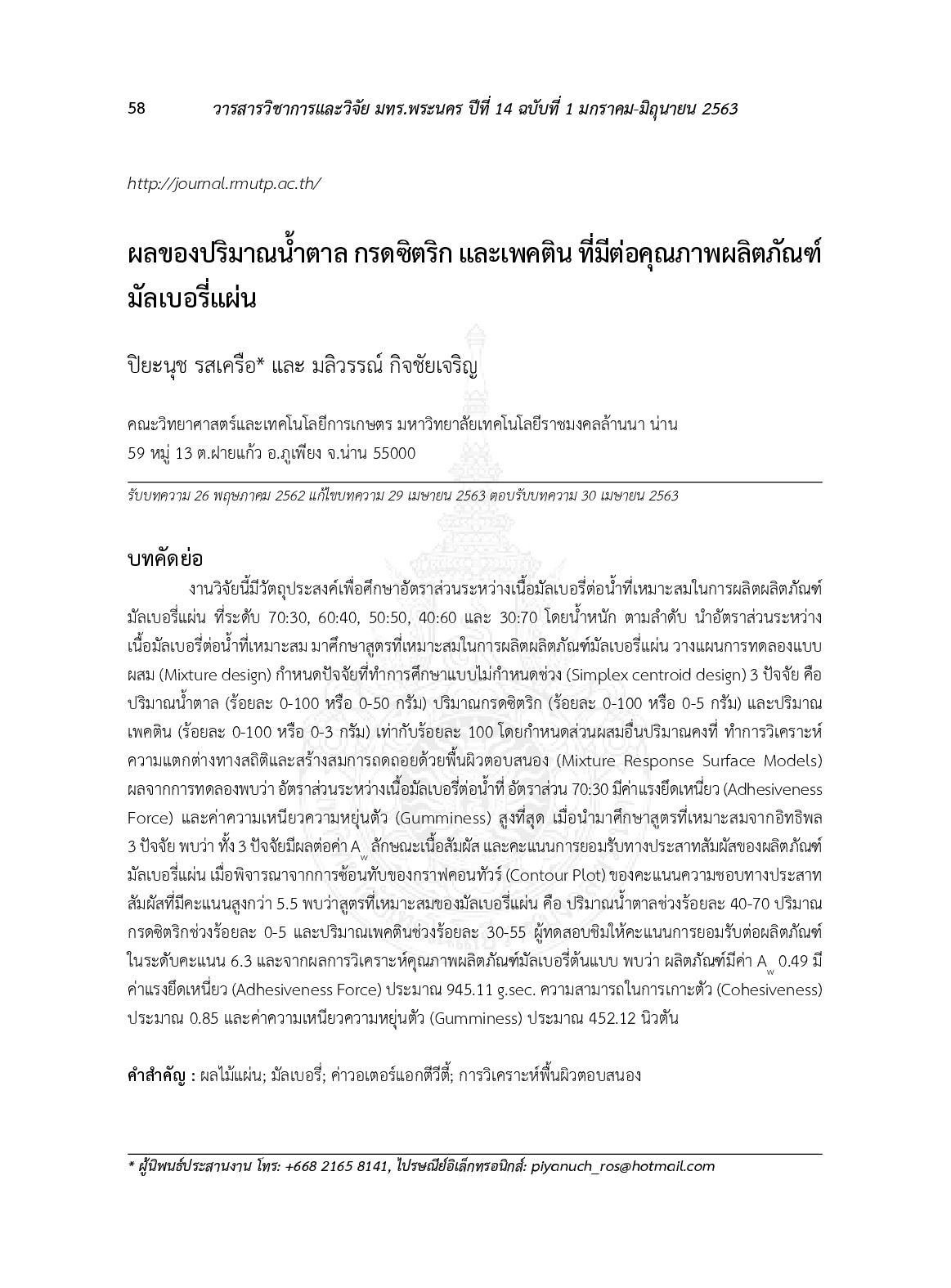
ผลของปริมาณน้ำตาล กรดซิตริก และเพคติน ที่มีต่อคุณภาพผลิตภัณฑ์มัลเบอรี่แผ่น
The objective of this study was to investigate the optimal formulation of mulberry fruit leather product when varying the weight ratio of mulberry fruit: water as 70:30 60:4050:50 40:60 and 30:70. Three factors were then determined by simplex centroid design; sugar (0-100% or 0-50 grams) citric acid (0-100% or 0-5 grams) and pectin (0-100% or 0-3 grams) which the sum of them equivalent to 100% while other ingredients remained constant. Analysis of the data was performed using ANOVA and Mixture Response Surface Models. The results indicated that the highest adhesiveness force and gumminess of mulberry fruit leather product were founded when the weight ratio of mulberry fruit to water was 70:30. The amount of sugar acid and pectin had effects on water activity (Aw) texture profile and sensory score of overall liking of product. From contour plot the predictive models were obtained by plottin g the contour line of all sensory attributes with acceptable score greater than 5.5 and thus the optimization area was selected. After overlapping contour plots an optimal formulation obtained was composed of 40-70% sugar 0-5% citric acid and 30-55% pectin. The sensory score of overall liking of product using a 9-point hedonic scale was 6.3. The water activity (Aw)adhesiveness force cohesiveness and gumminess of the prototype mulberry fruit leather product was 4.9 945.11 g. sec. 0.85 N and 452.12 N. respectively.