จำนวน Repository ( 171 )
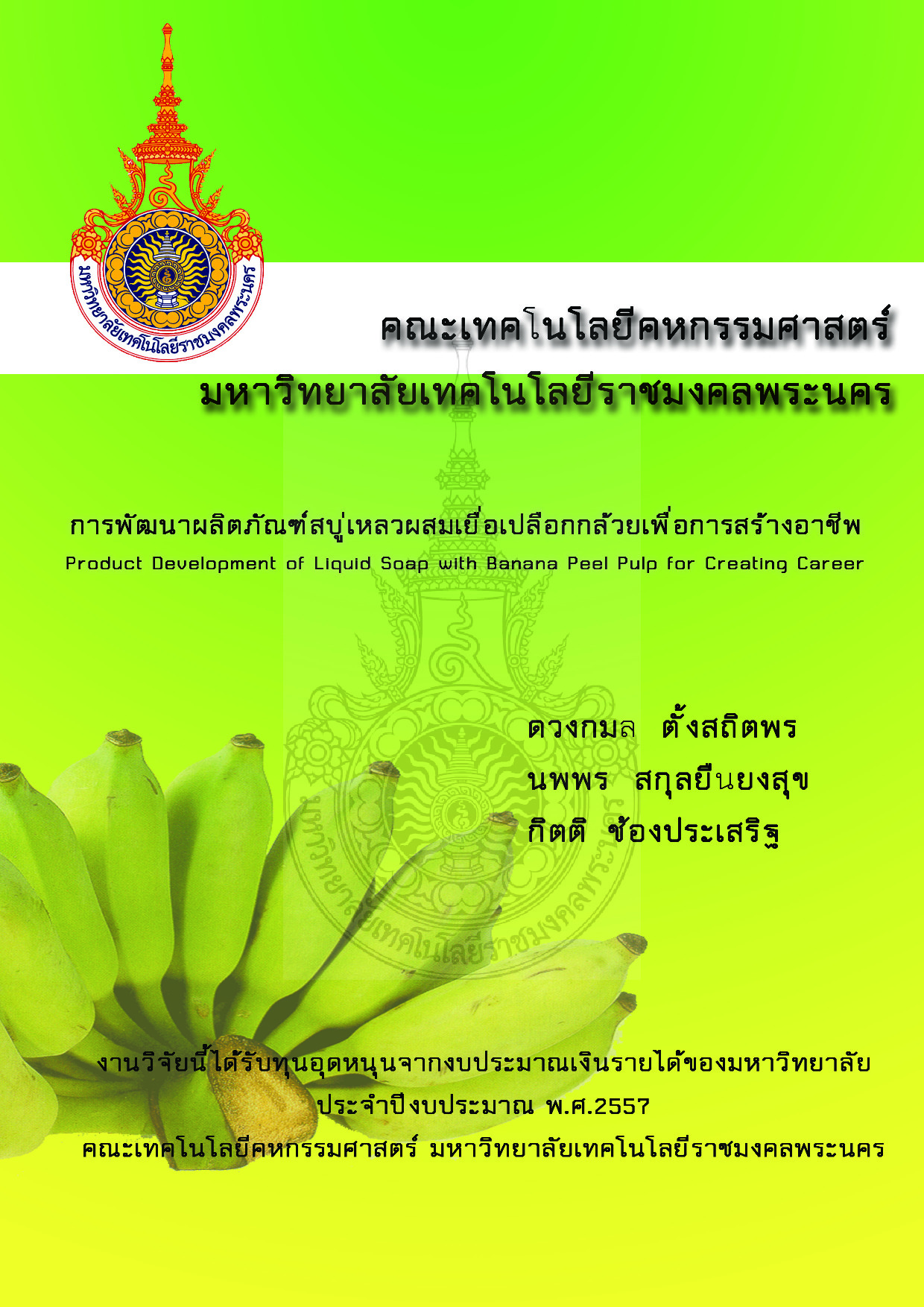
การพัฒนาผลิตภัณฑ์สบู่เหลวผสมเยื่อเปลือกกล้วยเพื่อการสร้างอาชีพ
Development of Liquid Soap with Banana Peel Pulp. We have studied the process of developing a recipe and product processing pulp peel bananas: banana peel and pulp of 3levels which take data from a survey of consumer behavior to suit the application. Andhave studied the sensory quality of the products liquid soap mixed pulp banana peel on 3 levels 5: 48.6 10 43.6 and 15 38.6% indicated that test scores give the formula 2 (20:10). in terms of color homogeneity. And texture (thick) overall. Levels like moderately to like verymuch. In terms of cleansing and smell no different at a statistically significant (p> 0.05) werethen tested for quality physical found that Liquid Soap with Banana Peel Pulp Formula 10:43.6% of the color. lightness (L *) was 59.6 ± 0.01 redness (a *) was -0.42 ± 0.01 andyellowness (b *) were 1.31 ± 0.01 which liquid soap is opaque. Because of the banana pulp is mixed in liquid viscosity in the 2584 Point Centrino bubble volume 370 ml and the water chemistry. The pH value of 6.52 ± 00.1 in the pH range 5-8 Thai Community Product Standard. Microbiological quality The shelf life of the product liquid membrane banana: banana peel and pulp. Store in a sealed jar per piece. Kept at room temperature The products were analyzed analyzed microbiological quality. Therefore the total plate count And yeast and mold By sampling every 1 week for a period of 8 weeks the total plate count<10 (CFU / g) Clostridium spp. Was not found Staphylococcus aureus None Streptococcusspp. Did not find Salmonella spp. Did not find Pseudomonas aeruginosa is found Coliform bacteria less. 3 MPN per gram Escherichai coli has been found safe for consumption. The resort complying with (TCPS. 95/2552) is to be a Thai Community Product Standard LiquidSoap of bacteria must be less than 1000 colonies per gram. Or cubic centimeters Meet ThaiCommunity Product Standard Liquid Soap education acceptable to the liquid membranebanana: banana peel and pulp were found to have a moderate satisfaction. Irritation andfeeling 100 percent.
การพัฒนาผลิตภัณฑ์ขนมหม้อแกงจากข้าวโพดหวาน
The objective of this research to study the basic formulas of Thai egg custard type of cutting corn kernel physicals and chemical properties of final product of this research by -9 point hedonic scale of 30 examiner laboratory. The results show the basic formula of Thai egg custard be recognized to study in the next step. The results show the basic formula of Thai egg custard accept on the like moderately (7). Then conduct 3 type of corn kernel are whole slide and chop for choose by 30 examiner laboratory. The examiner choose slide of corn kernel in enhancing of Thai egg custard at 20% 30% and 40% by total weight. The result show that the % of enhanced slide corn kernel was significant in acceptance and color liking (p<). The texture profile analysis of sweet corn Thai egg custard75.98 to 111.08 of firmness and-30.72 to-35.04 of Cohesiveness. The chemical composition of 20% slide sweet corn kernel Thai egg custard were 243.86 Kcals of total energy 95.95 Kcals of energy from fat6.25 of protein10.66 of fat0.91 of ash29.87 of carbohydrate and 1.70 of crude fiber. However enhancing of sweet corn in Thai egg custard can be extra Consideration of chemical composition of ingredients such as sugar and starch for acceptance of Thai egg custard of these features may affect to physical properties such as in color and texture of production should be intensive studied.
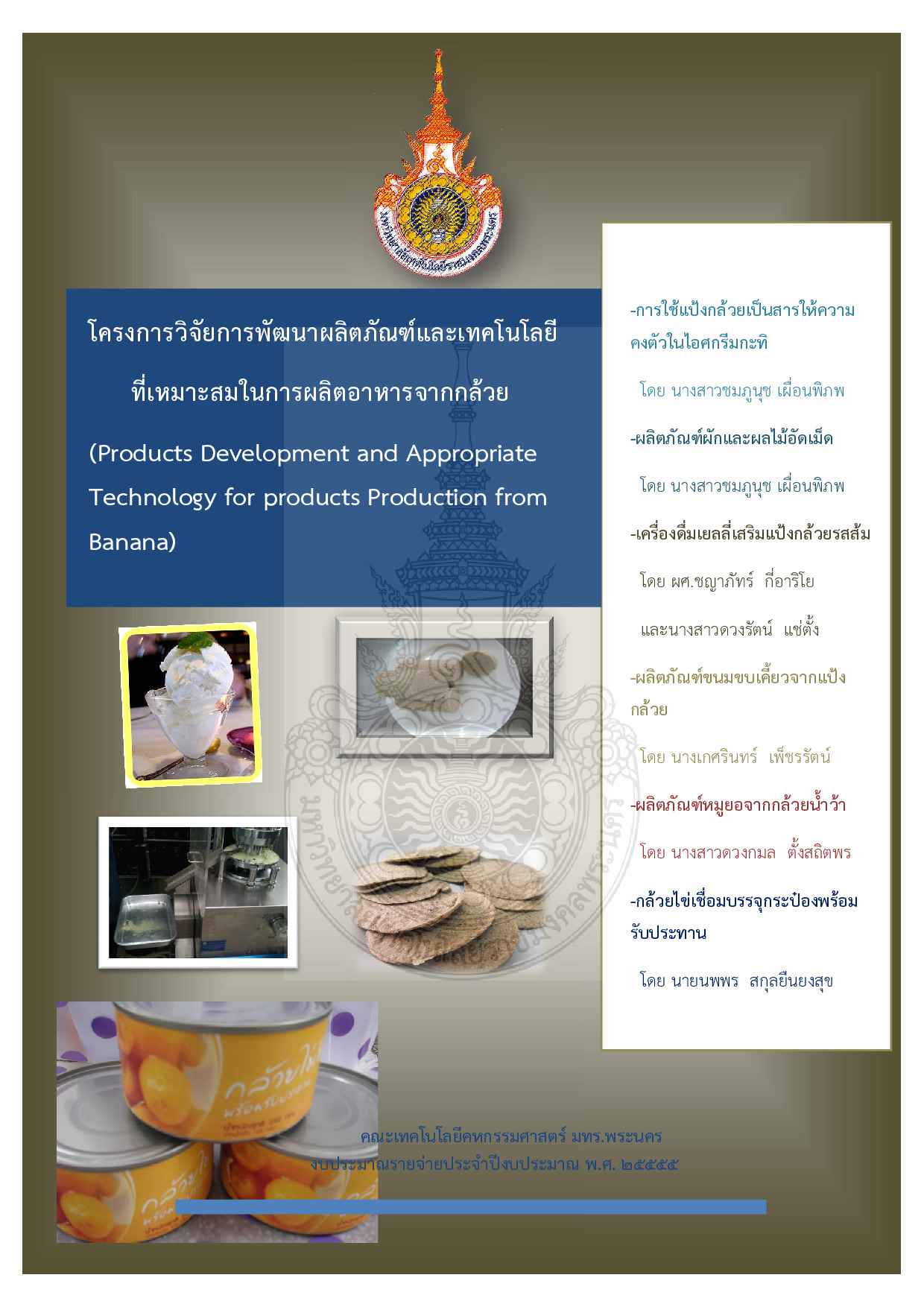
การพัฒนาผลิตภัณฑ์ขนมไทยจากกากมะพร้าวเหลือใช้
The purposes of the study regarding the development of Thai dessert products from used coconut residue are to study about appropriate amount of used coconut residue from oil extraction to study quality of Thai dessert products by using used coconut residue from oil extraction and to study acceptance of consumers towards Thai dessert products by using used coconut residue from oil extraction.
การพัฒนาผลิตภัณฑ์กล้วยไม้ป่าไทยจากโสนหางไก่ กรณีศึกษา อ.พระนครศรีอยุธยา จ.พระนครศรีอยุธยา
The purposes of this research were to make artificial wild orchids from joint-vetch to imitate the natural one. Researchers studied joint-vetch dyeing Thai wild orchids forming from joint-vetch Thai wild orchids selecting by considering appropriate appearance shape and composition and five experts gave the opinions on the chosen researched orchids. The development of wild orchid product from joint-vetch was transferred to housewife’s group artificial flower entrepreneur and interested people in Phra Nakhon Si Ayutthaya province. The satisfaction of the research product was investigated from 60 target groups. The research’s results were: The appropriate types of Thai wild orchid were Ueang Matchaanu (Purple Bauhinia) Chang Iyares (Rhynchostylis retusa (L.) Blume) Ueang Sae Mon (Dendrobium bellatulum Rolfe) Ueang Sainamkrung (Dendrobium parishii) and Leuang Junthaboon (Dendrodium friedericksianum Rchb. f.). They were made into Thai wild orchid box Thai wild orchid bouquet Thai wild orchid garden in the glass and Thai wild orchid bouquet decoration. After the target groups attended the knowledge and technology transfer training course the investigation found was as follows: Most participants 73.33 % were female and 26.76 % were male. Most participants (33.33%) were in the 41-50 years age category and 26.66% were in the 21 – 30 years age group 21.66% were in the 31 – 40 years age group 10 % were more than 50 years old and 8.33% were younger than 20 years old. 33.33 % of the participants were famers 20% were freelance and merchants 16.66% were students and 13.33% were civil servant officers. The overall satisfaction of the participants after attending the training course was at the high level (4.73). Other aspects were found that the average mean (4.68) of the instructor was at the highest level. The average mean (4.74) of the facility was at the highest level. The average mean (4.71) of the product was at the highest level. The average mean (4.35) of the understanding was at the high level. The average mean (4.73) of the knowledge application was at the highest level.