จำนวน Repository ( 291 )
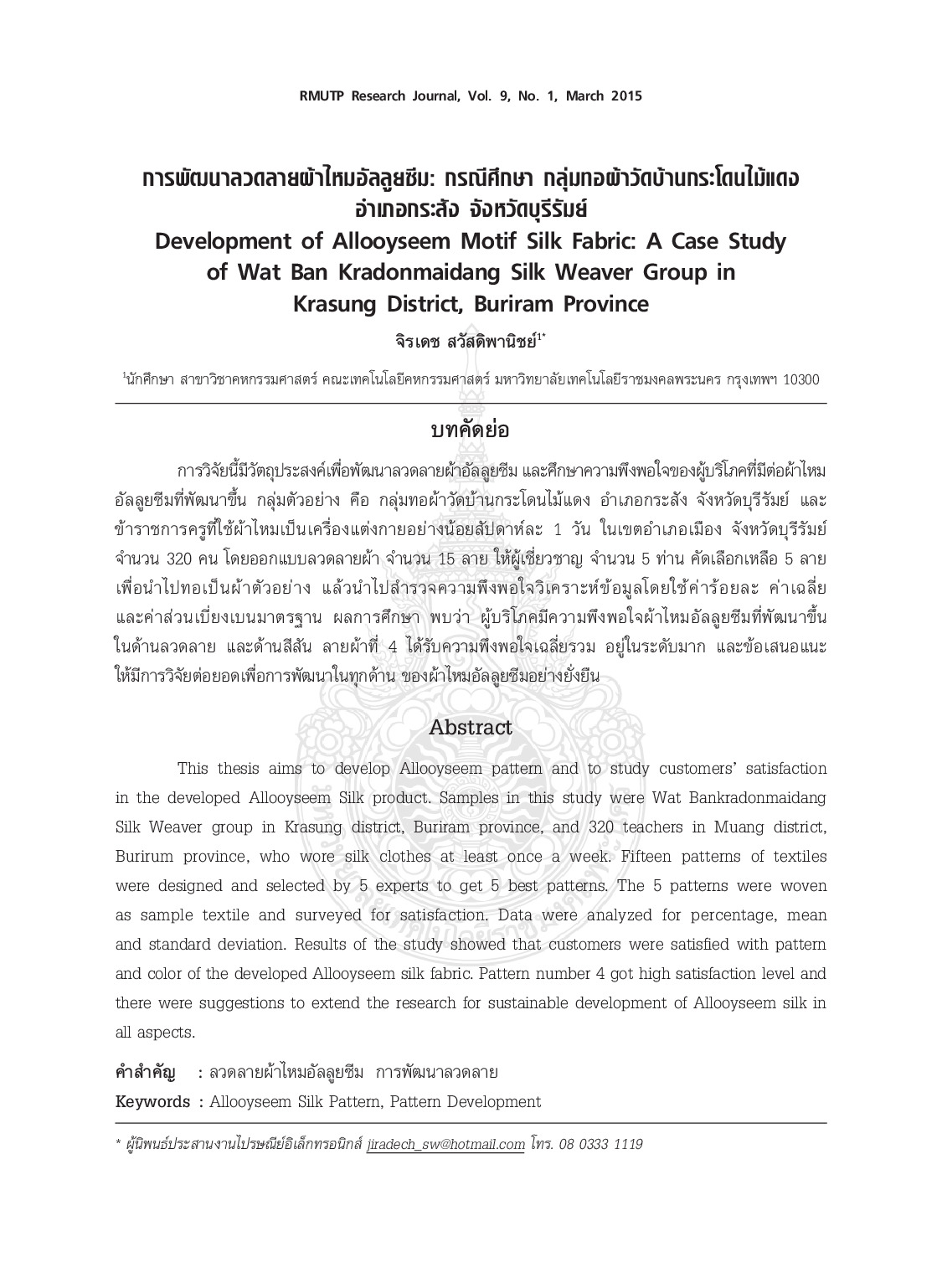
Development of allooyseem motif silk fabric : a case study of wat ban kradonmaidang silk weaver group in krasung district, buriram province
This thesis aims to develop Allooyseem pattern and to study customers’ satisfaction in the developed Allooyseem Silk product. Samples in this study were Wat Bankradonmaidang Silk Weaver group in Krasung district Buriram province and 320 teachers in Muang district Burirum province who wore silk clothes at least once a week. Fifteen patterns of textiles were designed and selected by 5 experts to get 5 best patterns. The 5 patterns were woven as sample textile and surveyed for satisfaction. Data were analyzed for percentage mean and standard deviation Results of the study showed that customers were satisfied with pattern and color of the developed Allooyseem silk fabric. Pattern number 4 got high satisfaction level and there were suggestions to extend the research for sustainable development of Allooyseem silk in all aspects.
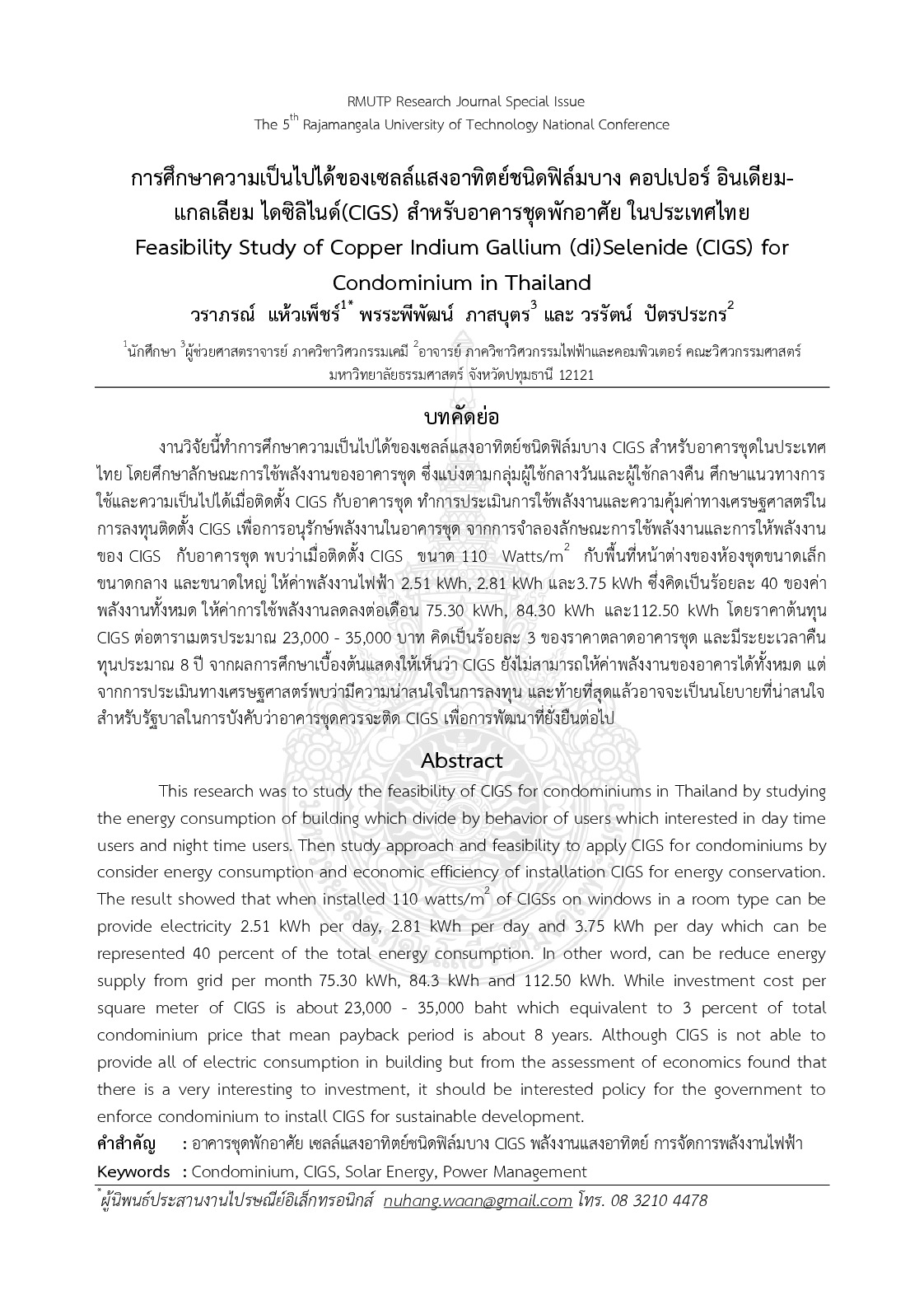
Feasibility study of copper indium gallium (di)selenide (CIGS) for condominium in thailand
This research was to study the feasibility of CIGS for condominiums in Thailand by studying the energy consumption of building which divide by behavior of users which interested in day time users and night time users. Then study approach and feasibility to apply CIGS for condominiums by consider energy consumption and economic efficiency of installation CIGS for energy conservation. The result showed that when installed 110 watts/m2 of CIGSs on windows in a room type can be provide electricity 2.51 kWh per day 2.81 kWh per day and 3.75 kWh per day which can be represented 40 percent of the total energy consumption. In other word can be reduce energy supply from grid per month 75.30 kWh 84.3 kWh and 112.50 kWh. While investment cost per square meter of CIGS is about 23000 - 35000 baht which equivalent to 3 percent of total condominium price that mean payback period is about 8 years. Although CIGS is not able to provide all of electric consumption in building but from the assessment of economics found that there is a very interesting to investment it should be interested policy for the government to enforce condominium to install CIGS for sustainable development.
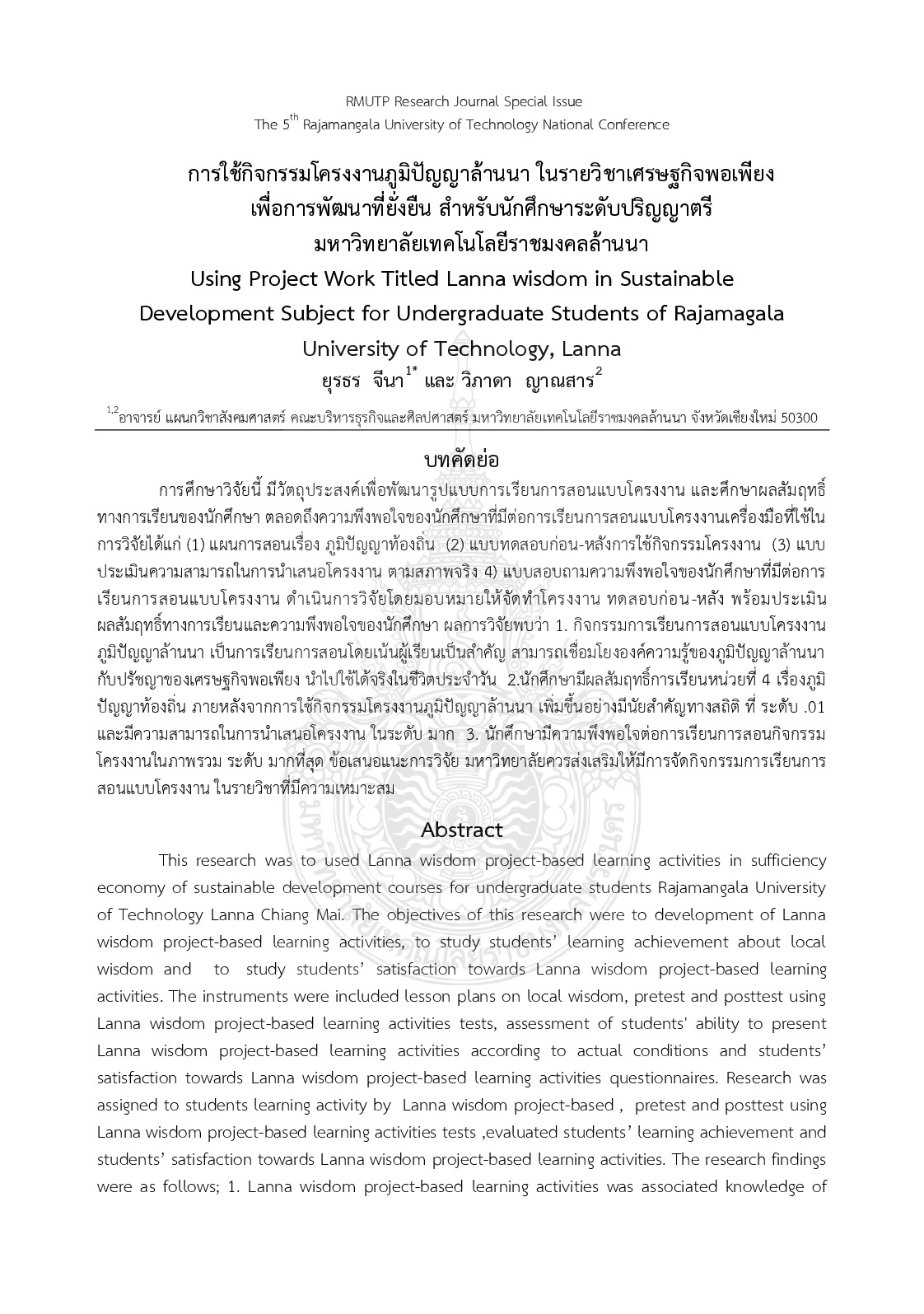
Using project work titled lanna wisdom in sustainable development subject for undergraduate students of Rajamagala University of Technology, lanna
This research was to used Lanna wisdom project-based learning activities in sufficiency economy of sustainable development courses for undergraduate students Rajamangala University of Technology Lanna Chiang Mai. The objectives of this research were to development of Lanna wisdom project-based learning activities to study students’ learning achievement about local wisdom and to study students’ satisfaction towards Lanna wisdom project-based learning activities. The instruments were included lesson plans on local wisdom pretest and posttest using Lanna wisdom project-based learning activities tests assessment of students ability to present Lanna wisdom project-based learning activities according to actual conditions and students’ satisfaction towards Lanna wisdom project-based learning activities questionnaires. Research was assigned to students learning activity by Lanna wisdom project-based pretest and posttest using Lanna wisdom project-based learning activities tests evaluated students’ learning achievement and students’ satisfaction towards Lanna wisdom project-based learning activities. The research findings were as follows; 1. Lanna wisdom project-based learning activities was associated knowledge of Lanna wisdom with sufficiency economy for application in daily life 2. Students’ learning achievement about local wisdom in lesson 4 after using Lanna wisdom project-based learning activities are increase at statistically significant level of 0.01 and capable of Lanna wisdom project-based learning activities presentation at a higher level. 3. Student overalls satisfaction towards Lanna wisdom project-based learning activities at the highest level. The recommendation of research that universities should support of appropriate teaching curriculum by project-based learning activities.
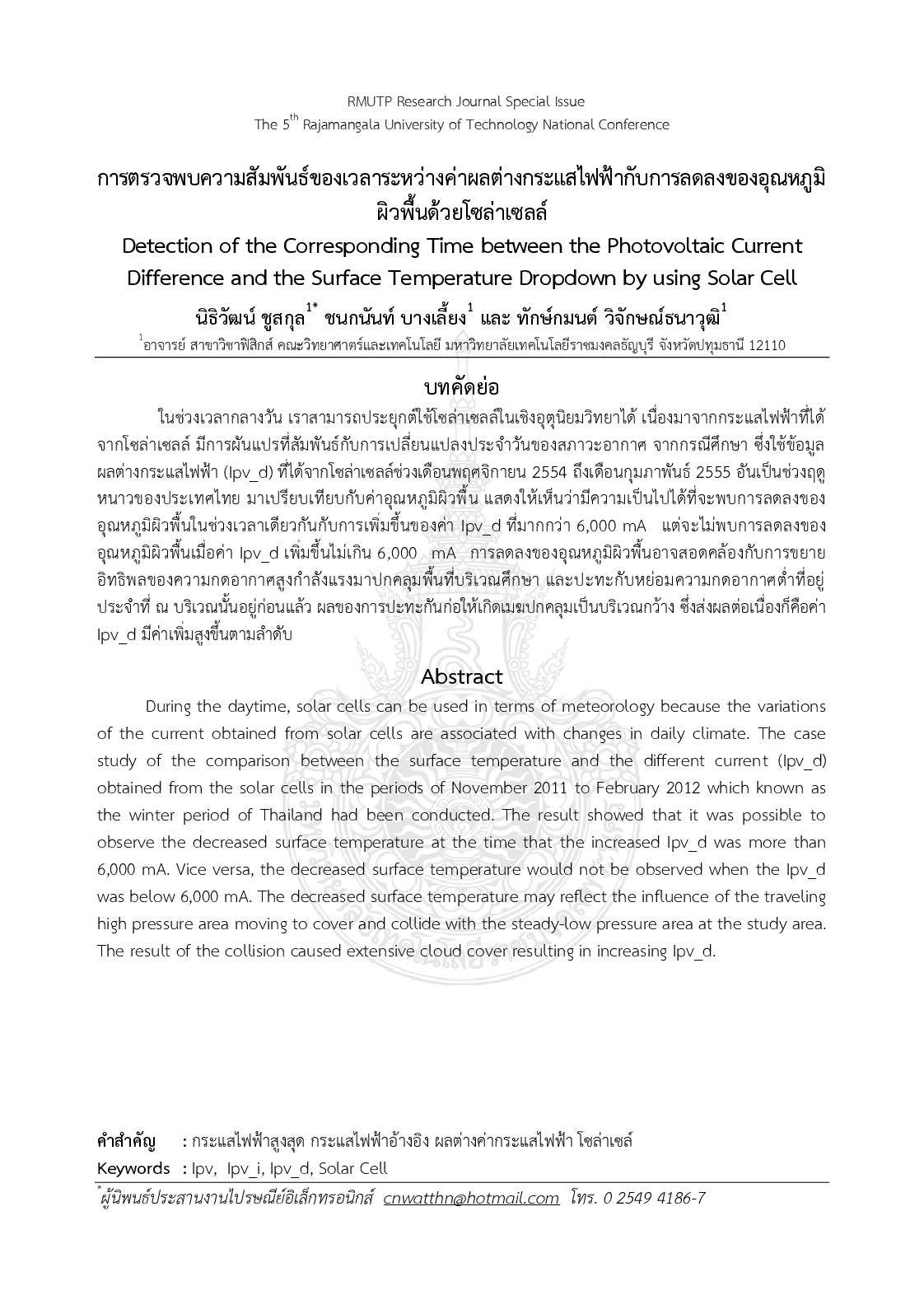
Detection of the corresponding time between the photovoltaic current difference and the surface temperature dropdown by using solar cell
During the daytime solar cells can be used in terms of meteorology because the variations of the current obtained from solar cells are associated with changes in daily climate. The case study of the comparison between the surface temperature and the different current (Ipv_d) obtained from the solar cells in the periods of November 2011 to February 2012 which known as the winter period of Thailand had been conducted. The result showed that it was possible to observe the decreased surface temperature at the time that the increased Ipv_d was more than 6000 mA. Vice versa the decreased surface temperature would not be observed when the Ipv_d was below 6000 mA. The decreased surface temperature may reflect the influence of the traveling high pressure area moving to cover and collide with the steady-low pressure area at the study area. The result of the collision caused extensive cloud cover resulting in increasing Ipv_d.
The development of a participatory learning process model for conserving the forest-resources of communities around doi-khun-tan national park
The purposes of this study were: 1) to develop the model of a participatory learning process for conserving the forest-resources of communities around Doi-Khun-Tan National Park 2) to compare knowledge attitudes and behaviors of the samples’ in conserving the forest resources and 3) to study the satisfaction of participatory learning process. The sample selected by a purposive sampling consisted of 48 subjects representing the communities around the area of Doi Khun Tan. The instruments included all these: 1) an interview 2) a participatory learning process program for conserving the forest-resources the area of Doi Khun Tan National Park 3) a questionnaire about the knowledge attitude and behavior of conserving forest resources and 4) a questionnaire about their satisfaction with the program. The data elicitation was drawn from three sources: 1) interviews and brainstorming 2) the assessment of the knowledge attitudes behaviors by the questionnaire and 3) the assessment of the satisfaction with the participatory learning process by the questionnaire. The study revealed these findings: 1) the participatory learning process of model fell into 6 steps consisting of a) the analysis of communities key informants and literature reviews b) the implementation of the knowledge to conserve the forest resources c) the implementation of the attitude towards conserving the forest resources d) the implementation of the behaviors of conserving the forest resources e) the assessment of the participatory learning process and f) the evaluation of satisfaction with the program; 2) the subjects’ knowledge attitudes and behaviors regarding forest conservation at the boundary of Doi Khun Tan before and after the participatory learning process are statistically different at the significance level of .05; and 3) the level of their satisfaction with the participatory learning process was high.