จำนวน Repository ( 160 )

The optimization of formulation and cost on homemade dairy yogurt
The objective of this study was investigate the optimal formulation of Homemade dairy yogurt that 100 percent of dairy milk ratio of dairy milk to skim milk powder and milk powder was 90:10 85:15 and 80:20 respectively as compared to the control (commercial-yogurt Dutch mill). The Yogurt mixeds were heated to 85 C and held for 5 min incubated at 43 C until the pH reached 4.3. The mixes were then stored at 4 C. Yogurt were prepared from higher ratio of dairy milk : skim milk powder and milk powder led to the more time of incubation. The 31 participated sensory evaluation of the sample. From the result choosed first three formulas to analysed in chemical characteristic and bacterial chariacteristic. Total solid of yogurt were prepare from 90:10 and 85:15 of dairy milk : milk powder ratio were not different with control (p>0.05). Total cell count was found to range between 8.08 – 8.50 LogCFU/g and Lactic acid bacteria was found to range between 6.71 – 8.88 LogCFU/g. The optimum formula of homemade dairy yogurt that ratio of dairy milk to milk powder was 90 : 10 and cost per unit (140 g.) was 10.51 Baht compare with control was 14 Baht.
Utilization of sludge from power plant as cement substitution
The feasibility of wastewater treatment sludge from the power plant was studied as cement substituted material. The sludge were used as the air dried sample and the oven dried sludge at 300o C. Their properties then the optimum ratio of cement substituted portion for cement block were determined. In the control set; cement sand and water ratio were 1 2.75 and 0.825 (w/w) respectively while the treatment set sludge replacing were varied at 10 20 and 30 %. The blocks were produced and cured in tap water for 7 14 and 28 days and tested their compressive strength. The leaching ability of heavy metals namely Cd Cr Cu and Pb were determined by Waste Extraction Test or WET (according to the standard from the Notification of Ministry of Industry A.D. 2005) and Toxicity Characteristic Leaching Procedure; TCLP (US EPA method 1311). The results showed that the solution from cement block curing both of control set treatment block had basicidic pH range 11 – 12 and caused reduction of the heavy metal solubility. The solution conductivity range 5 - 7 mS/cm. The 10% dried sludge cement blocks were the suitable ratio compared with the control set which the maximum compressive strength at 28th day was 253.81 Kg/cm2 and 4.73 % moisture. All metal leaching abilities were less than those Notification and US EPA standard. Those optimum ratios 10 % can be applied to produce cement pot.
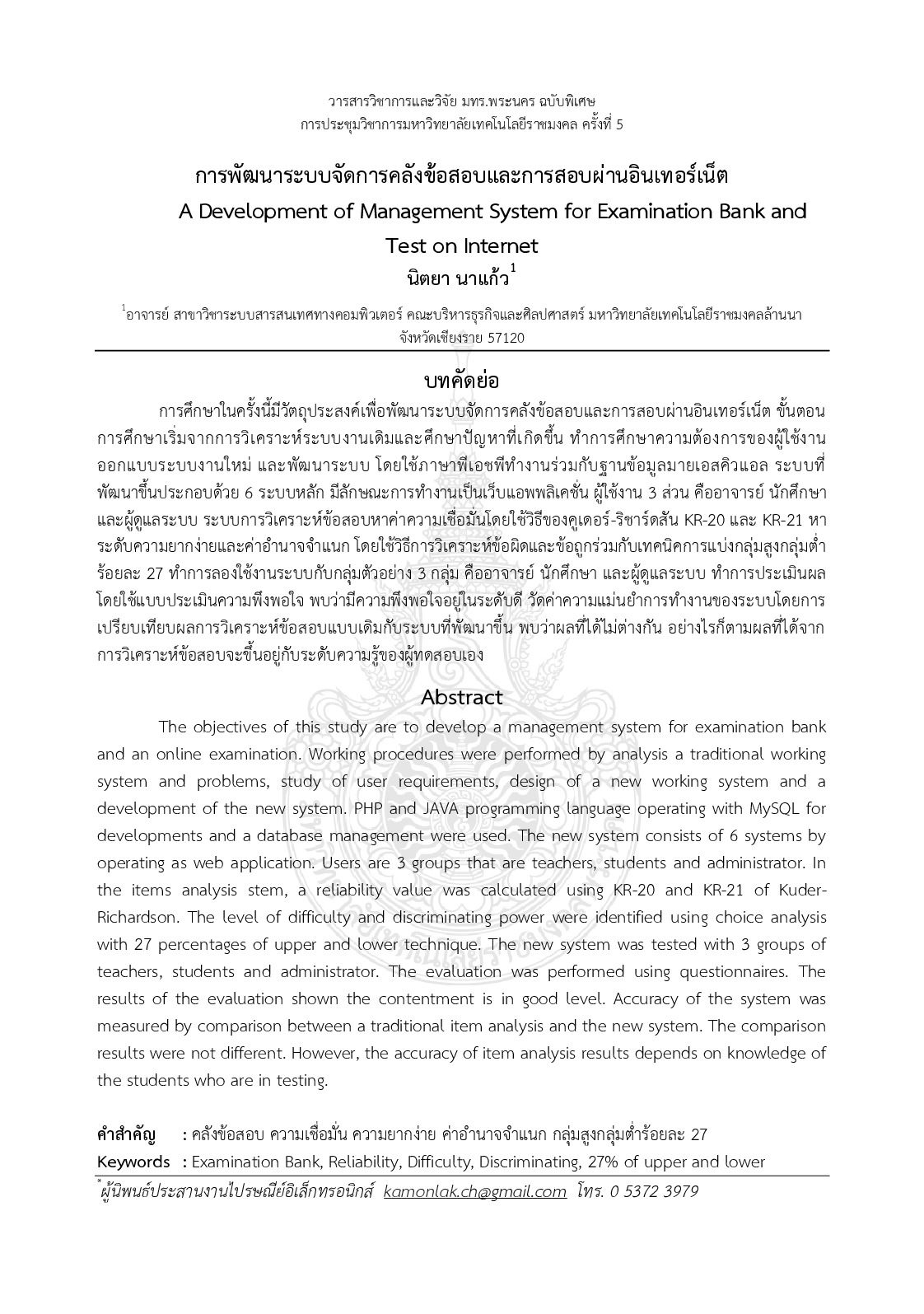
A development of management system for examination bank and test on internet
The objectives of this study are to develop a management system for examination bank and an online examination. Working procedures were performed by analysis a traditional working system and problems study of user requirements design of a new working system and a development of the new system. PHP and JAVA programming language operating with MySQL for developments and a database management were used. The new system consists of 6 systems by operating as web application. Users are 3 groups that are teachers students and administrator. In the items analysis stem a reliability value was calculated using KR-20 and KR-21 of Kuder-Richardson. The level of difficulty and discriminating power were identified using choice analysis with 27 percentages of upper and lower technique. The new system was tested with 3 groups of teachers students and administrator. The evaluation was performed using questionnaires. The results of the evaluation shown the contentment is in good level. Accuracy of the system was measured by comparison between a traditional item analysis and the new system. The comparison results were not different. However the accuracy of item analysis results depends on knowledge of the students who are in testing.
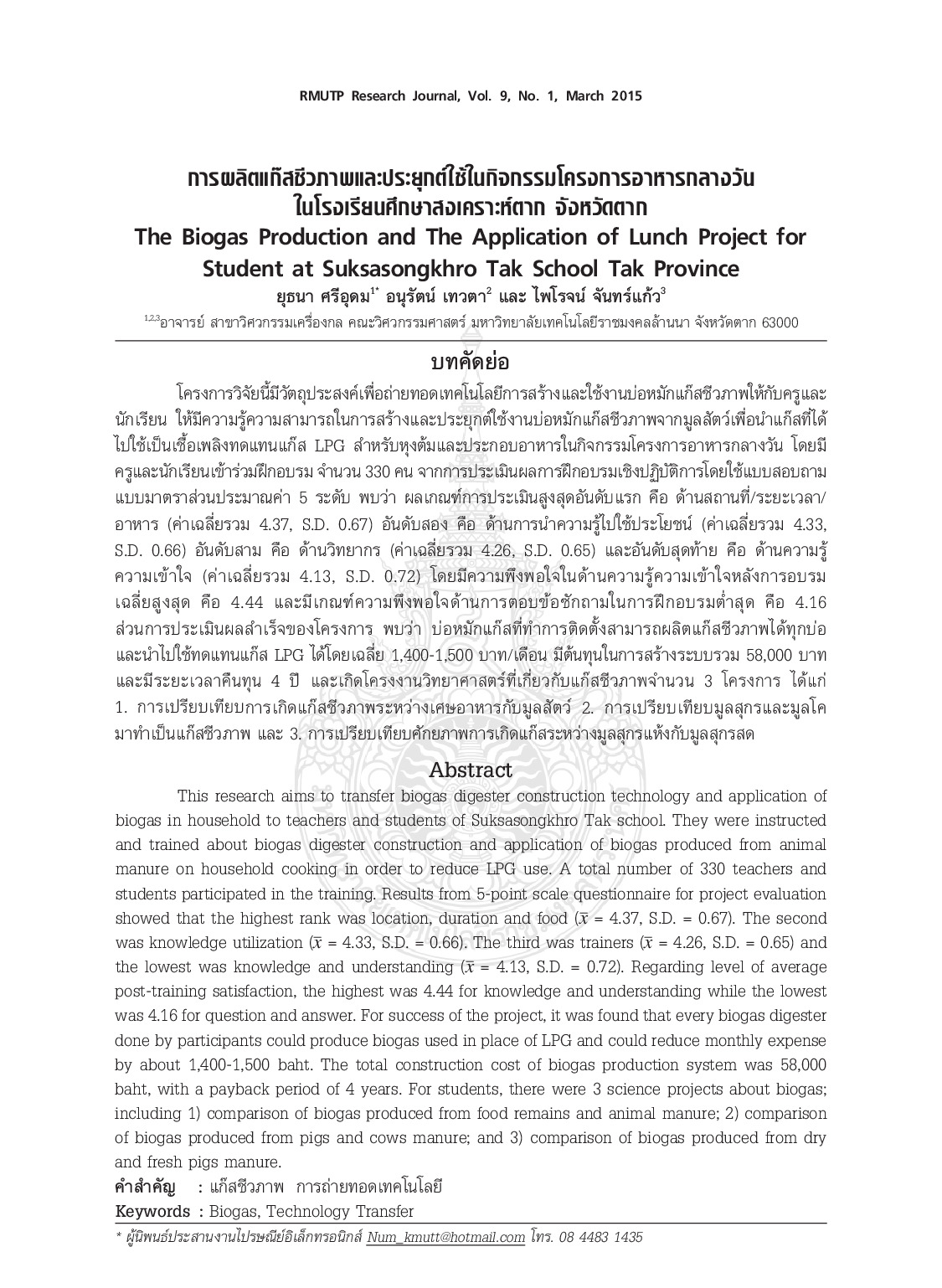
The biogas production and the application of lunch project for student at suksasongkhro tak school tak province
This research aims to transfer biogas digester construction technology and application of biogas in household to teachers and students of Suksasongkhro Tak school. They were instructed and trained about biogas digester construction and application of biogas produced from animal manure on household cooking in order to reduce LPG use. A total number of 330 teachers and students participated in the training. Results from 5-point scale questionnaire for project evaluation showed that the highest rank was location duration and food ( = 4.37 SD = 0.67). The second was knowledge utilization ( = 4.33 SD = 0.66). The third was trainers ( = 4.26 SD = 0.65) and the lowest was knowledge and understanding ( = 4.13 SD = 0.72). Regarding level of average post-training satisfaction the highest was 4.44 for knowledge and understanding while the lowest was 4.16 for question and answer. For success of the project it was found that every biogas digester done by participants could produce biogas used in place of LPG and could reduce monthly expense by about 1400 – 1500 baht. The total construction cost of biogas production system was 58000 baht with a payback period of 4 years. For students there were 3 science projects about biogas; including 1) comparison of biogas produced from food remains and animal manure; 2) comparison of biogas produced from pigs and cows manure; and 3) comparison of biogas produced from dry and fresh pigs manure.
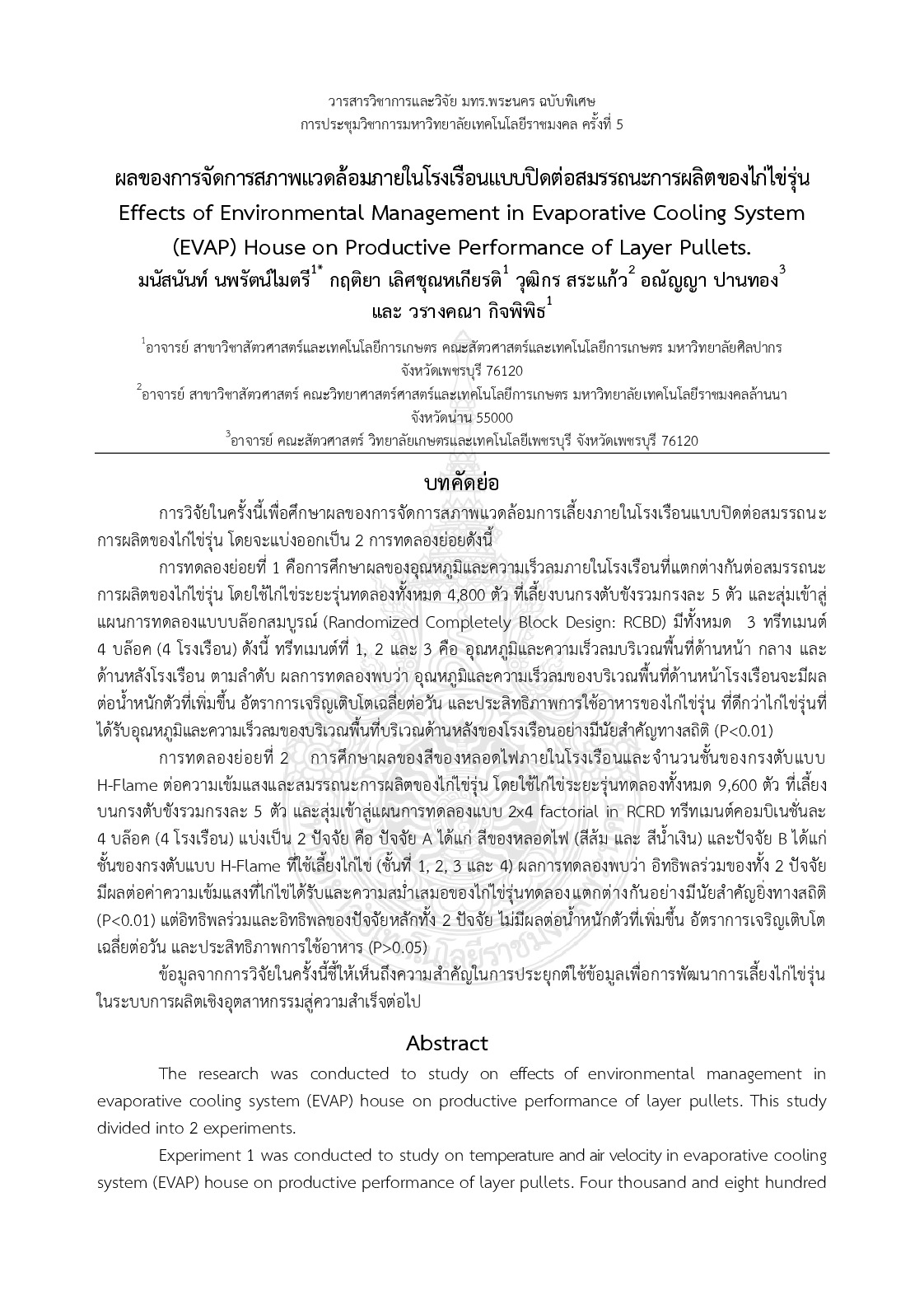
Effects of environmental management in evaporative cooling system (EVAP) house on productive performance of layer pullets
The research was conducted to study on effects of environmental management in evaporative cooling system (EVAP) house on productive performance of layer pullets. This study divided into 2 experiments. Experiment 1 was conducted to study on temperature and air velocity in evaporative cooling system (EVAP) house on productive performance of layer pullets. Four thousand and eight hundred layer pullets were raised on battery cage with 5 birds per cage and assigned in a Randomized Completely Block Design (RCBD) experiment with three treatments. Each treatment consisted of four blocks (four houses) and followed different temperature and air velocity in raising area of evaporative cooling system (EVAP) house as front area central area and back area. Results showed that temperature and air velocity in front area was grater body weight gain (BWG) average daily gain (ADG) and feed conversion ratio (FCR) of layer pullets than layer pullets were raised in back area of evaporative cooling system (EVAP) house (P<0.01) Experiment 2 was conducted to study on light color and number of H-Flame battery cage row in evaporative cooling system (EVAP) house on light intensity and productive performance of layer pullets. Nine thousand and six hundred layer pullets were raised on H-Flame battery cage with 5 birds per cage and assigned in a 2x4 factorial in Randomized Completely Block Design (RCBD) experiment with two factors. Factor A was light color comprised of range and blue). While Factor B was number of battery cage row comprised (first row second row third row and fourth row). Each treatment consisted of four blocks (four houses). Results showed that interaction between factor A and B on light intensity and uniformity of layer pullets with highly significantly different (P<0.01). However interaction between factor A and B and main effect (factor A and B) were investigated on body weight gain (BWG) average daily gain (ADG) and feed conversion ratio (FCR) (P>0.05). The data from this research was suggests the important for implicate to improve the egg production industry in further success.