จำนวน Repository ( 132 )
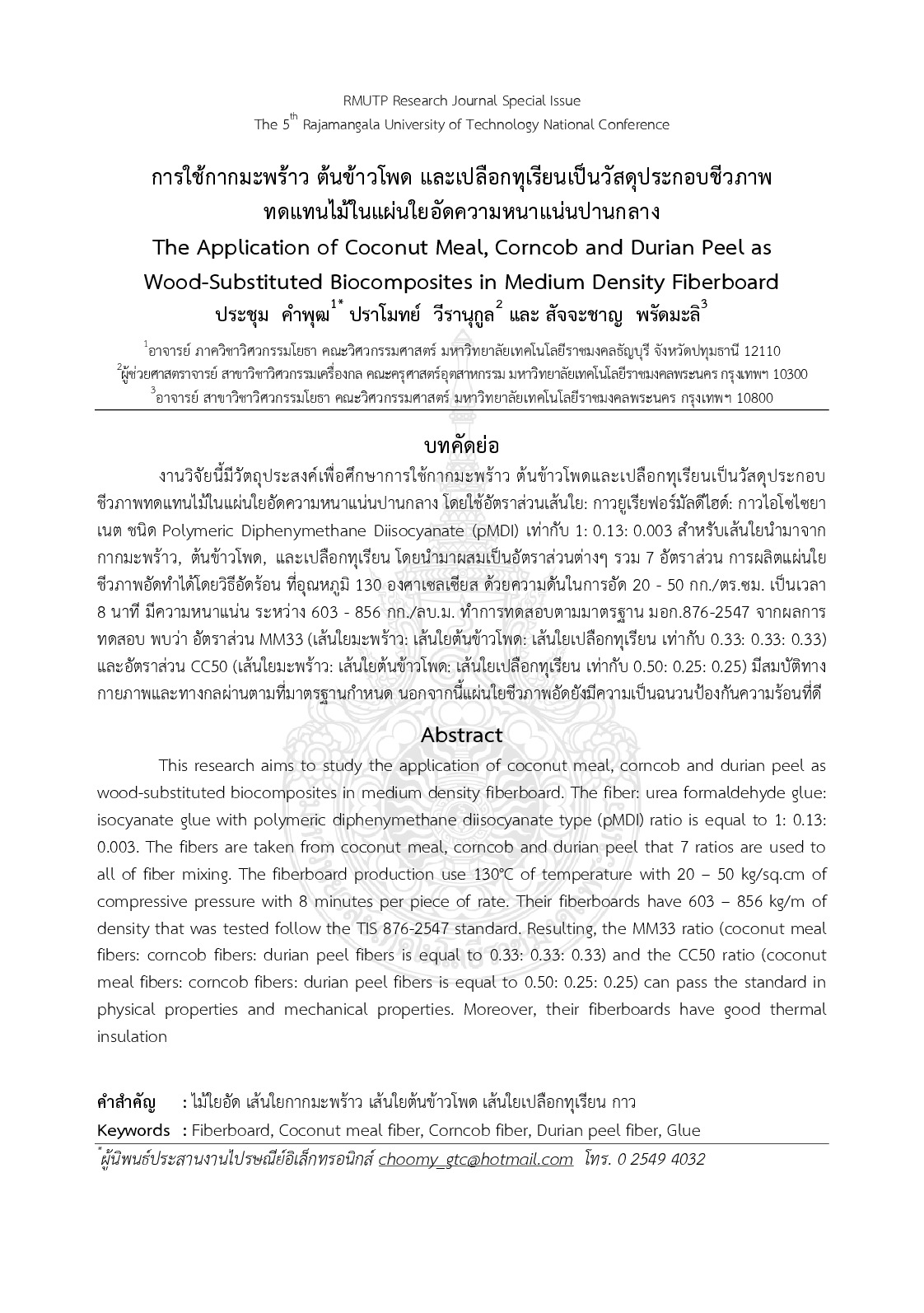
The application of coconut meal, corncob and durian peel as wood-substituted biocomposites in medium density fiberboard
This research aims to study the application of coconut meal corncob and durian peel as wood-substituted biocomposites in medium density fiberboard. The fiber: urea formaldehyde glue: isocyanate glue with polymeric diphenymethane diisocyanate type (pMDI) ratio is equal to 1: 0.13: 0.003. The fibers are taken from coconut meal corncob and durian peel that 7 ratios are used to all of fiber mixing. The fiberboard production use 130?C of temperature with 20 – 50 kg/sq.cm of compressive pressure with 8 minutes per piece of rate. Their fiberboards have 603 – 856 kg/m of density that was tested follow the TIS 876-2547 standard. Resulting the MM33 ratio (coconut meal fibers: corncob fibers: durian peel fibers is equal to 0.33: 0.33: 0.33) and the CC50 ratio (coconut meal fibers: corncob fibers: durian peel fibers is equal to 0.50: 0.25: 0.25) can pass the standard in physical properties and mechanical properties. Moreover their fiberboards have good thermal insulation

Thai dessert product development form palmyra - plum powder
A research was aimed to investigate appropriate procedures of cabinet drying of flour made from Toddy palm at 60 65 and 70 degree Celsius and employed it as an ingredient in 3 Thai traditional desserts - Kanom-Chun Kanom Num-dok-mai and Kanom Puy-fai respectively. The investigation emphasized on these effects on color and odor of the products. Palm flours at the level of 0% 10% 20% and 30% was added then physical and chemical properties consumer’s acceptance were investigated and their shelf-life of the products packed in polyvinyl chloride and double layer of polyvinyl chloride and polyethylene at room temperature was inspected every day. Drying temperature of 60 ?C and 10% flour addition in the formulation found to be the optimal condition and also produces best quality of the products accepted by consumers as in such conditions overall score of acceptance was statistically significantly highest ( P>0.05) with 7.73 7.95 and 7.62 average scores for Chun Kanom Num-dok-mai and Kanom Puy-fai consecutively. Proximate analysis of these products in terms of moisture ash fat fiber protein and carbohydrate revealed that they were statistically different ( P>0.05). When 100 consumers were asked to taste and rank their acceptances Kanom Puy-fai Kanom Num-dok-mai and Kanom Puy-fai was acceptable by 66 28 and 6 panels successively. However these products should not store for more than a day due to the fact that microbiologically total viable count would be exceeds specified standard by a day.
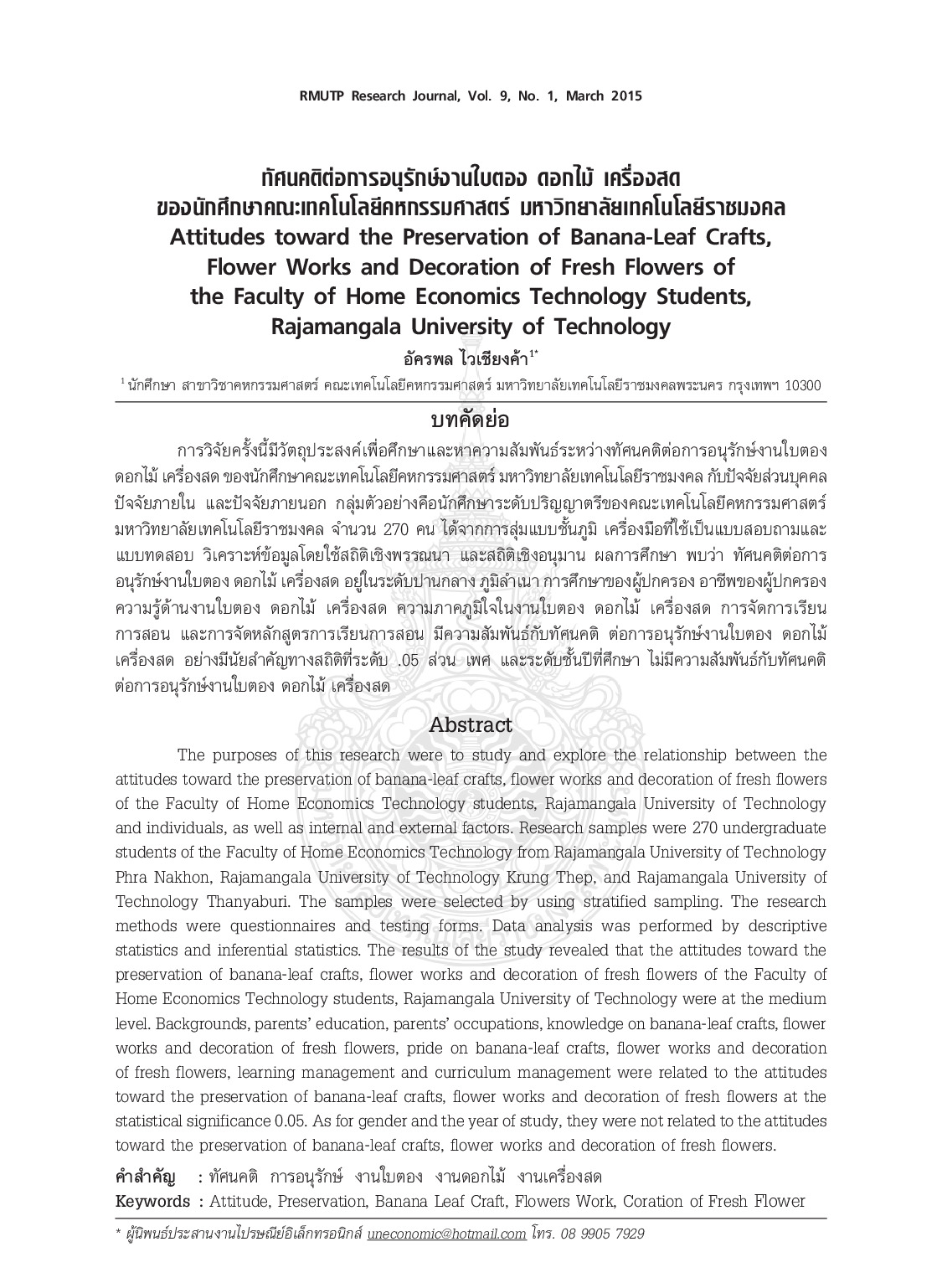
Attitudes toward the preservation of banana-leaf crafts, flower works and decoration of fresh flowers of the faculty of home economics technology students, Rajamangala University of Technology
The purposes of this research were to study and explore the relationship between the attitudes toward the preservation of banana-leaf crafts flower works and decoration of fresh flowers of the Faculty of Home Economics Technology students Rajamangala University of Technology and individuals as well as internal and external factors. Research samples were 270 undergraduate students of the Faculty of Home Economics Technology from Rajamangala University of Technology Phra Nakhon Rajamangala University of Technology Krung Thep and Rajamangala University of Technology Thanyaburi. The samples were selected by using stratified sampling. The research methods were questionnaires and testing forms. Data analysis was performed by descriptive statistics and inferential statistics. The results of the study revealed that the attitudes toward the preservation of banana-leaf crafts flower works and decoration of fresh flowers of the Faculty of Home Economics Technology students Rajamangala Univers
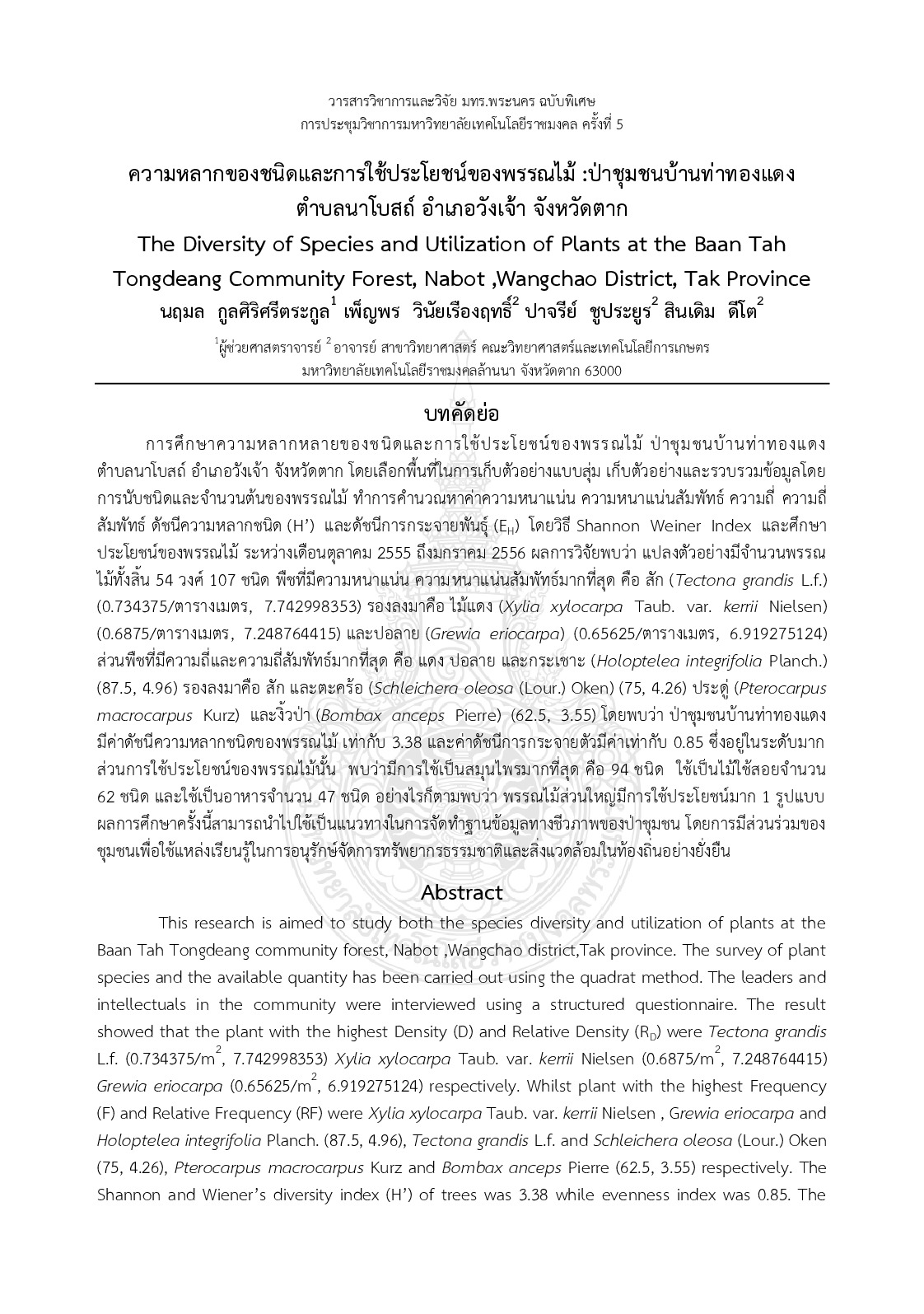
The diversity of species and utilization of plants at the baan tah tongdeang community forest, nabot ,wangchao district, tak province
This research is aimed to study both the species diversity and utilization of plants at the Baan Tah Tongdeang community forest Nabot Wangchao districtTak province. The survey of plant species and the available quantity has been carried out using the quadrat method. The leaders and intellectuals in the community were interviewed using a structured questionnaire. The result showed that the plant with the highest Density (D) and Relative Density (RD) were Tectona grandis L.f. (0.734375/m2 7.742998353) Xylia xylocarpa Taub. var. kerrii Nielsen (0.6875/m2 7.248764415) Grewia eriocarpa (0.65625/m2 6.919275124) respectively. Whilst plant with the highest Frequency (F) and Relative Frequency (RF) were Xylia xylocarpa Taub. var. kerrii Nielsen Grewia eriocarpa and Holoptelea integrifolia Planch. (87.5 4.96) Tectona grandis L.f. and Schleichera oleosa (Lour.) Oken (75 4.26) Pterocarpus macrocarpus Kurz and Bombax anceps Pierre (62.5 3.55) respectively. The Shannon and Wiener’s diversity index (H’) of trees was 3.38 while evenness index was 0.85. The utilization of the plants in the community included 94 species as wood (used as plank furniture firewood charcoal string chemical extraction etc. 62 species as medicinal herbs 47 species as wild vegetables fruits and foods. All of them are utilized in the community. The results of this research would be beneficial for administrative and management as a guideline to preparation a community biological database and learning resources for conservation and sustainable uses of natural resources and environments in Baan Tah Tongdeang community forest.
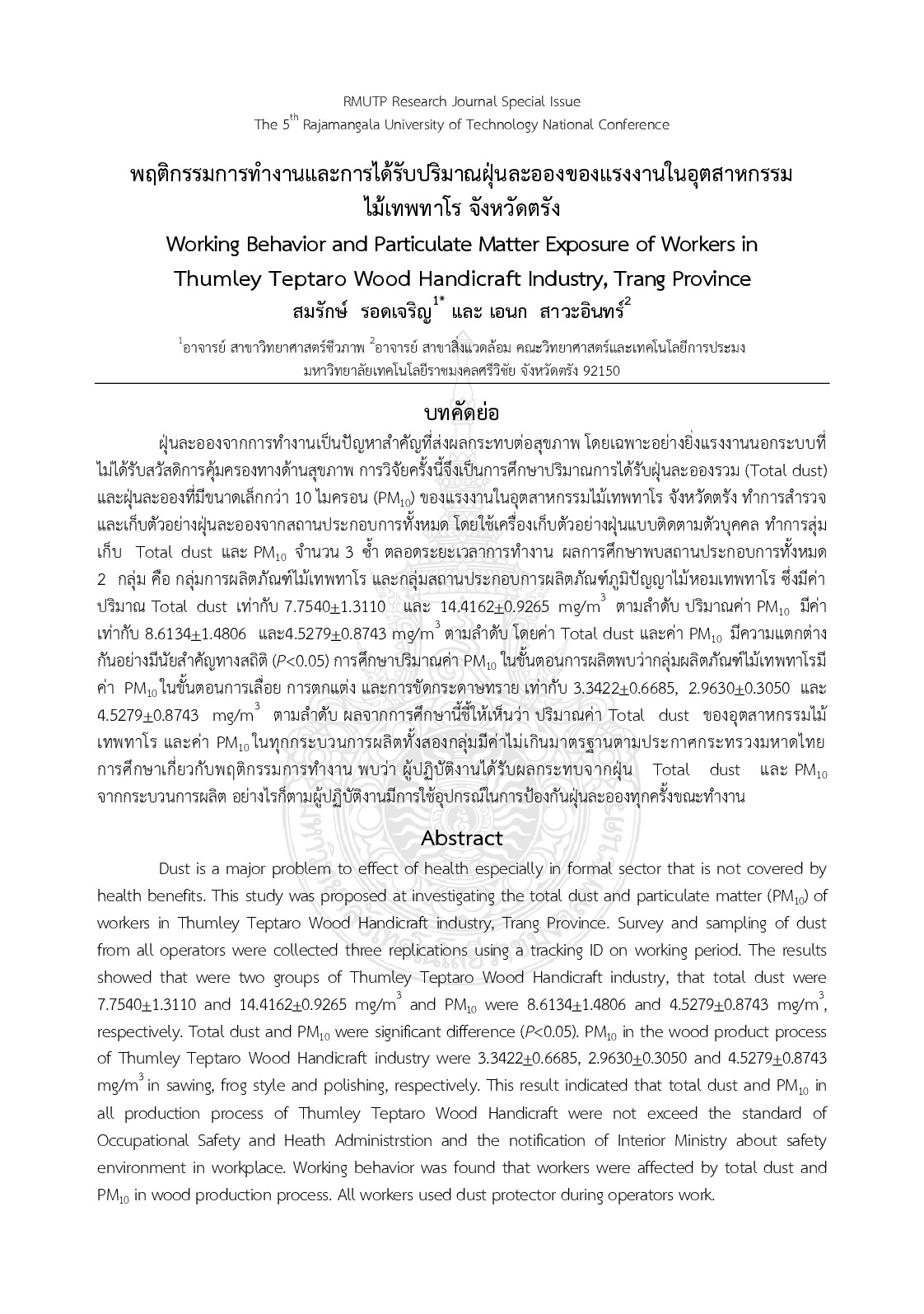
Working behavior and particulate matter exposure of workers in thumley teptaro wood handicraft industry, trang province
Dust is a major problem to effect of health especially in formal sector that is not covered by health benefits. This study was proposed at investigating the total dust and particulate matter (PM10) of workers in Thumley Teptaro Wood Handicraft industry Trang Province. Survey and sampling of dust from all operators were collected three replications using a tracking ID on working period. The results showed that were two groups of Thumley Teptaro Wood Handicraft industry that total dust were 7.7540+1.3110 and 14.4162+0.9265 mg/m3 and PM10 were 8.6134+1.4806 and 4.5279+0.8743 mg/m3 respectively. Total dust and PM10 were significant difference (P<0.05). PM10 in the wood product process of Thumley Teptaro Wood Handicraft industry were 3.3422+0.6685 2.9630+0.3050 and 4.5279+0.8743 mg/m3 in sawing frog style and polishing respectively. This result indicated that total dust and PM10 in all production process of Thumley Teptaro Wood Handicraft were not exceed the standard of Occupational Safety and Heath Administrstion and the notification of Interior Ministry about safety environment in workplace. Working behavior was found that workers were affected by total dust and PM10 in wood production process. All workers used dust protector during operators work.