จำนวน Repository ( 142 )
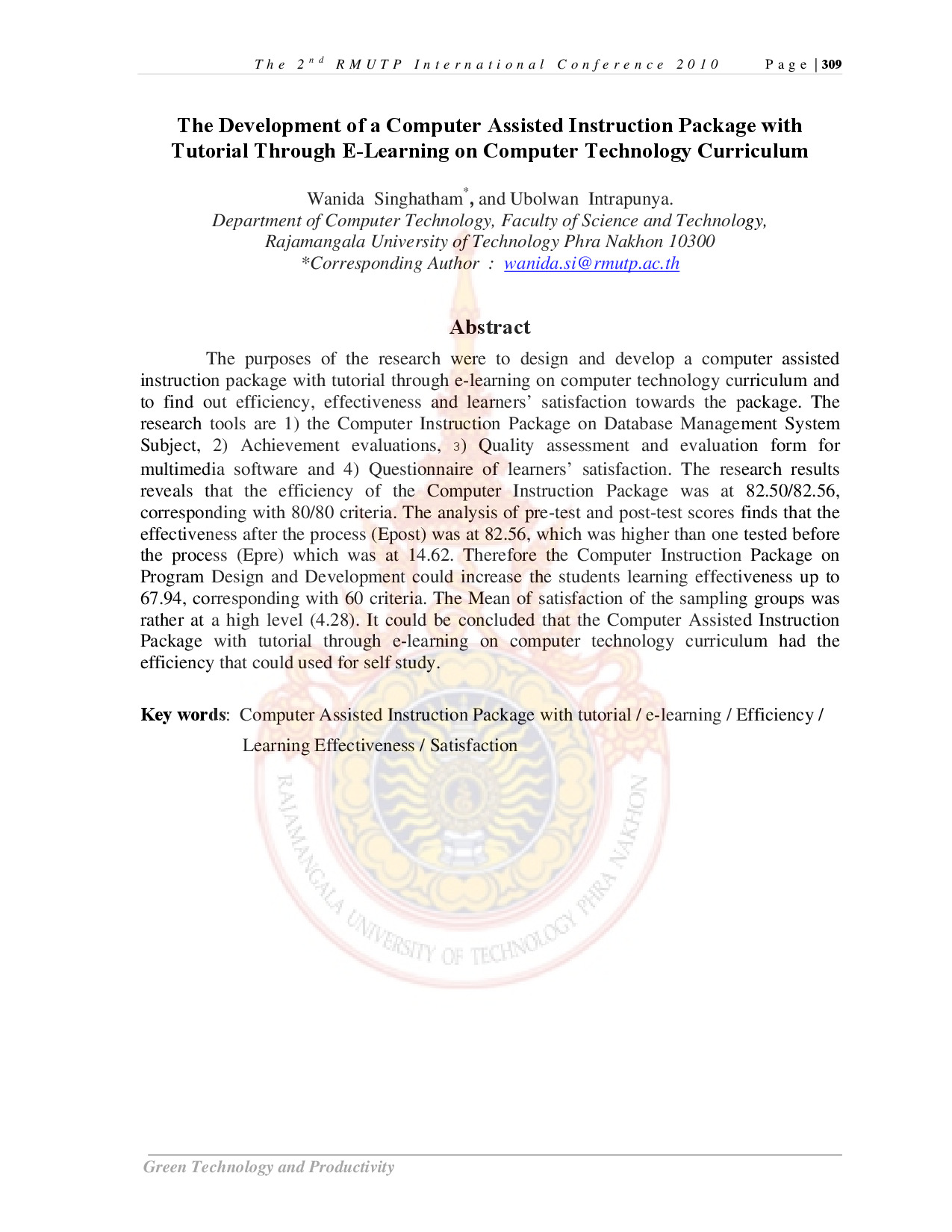
The Development of a Computer Assisted Instruction Package with Tutorial Through E-Learning on Computer Technology Curriculum
The purposes of the research were to design and develop a computer assisted instruction package with tutorial through e-learning on computer technology curriculum and to find out efficiency effectiveness and learners’ satisfaction towards the package. The research tools are 1) the Computer Instruction Package on Database Management System Subject 2) Achievement evaluations 3) Quality assessment and evaluation form for multimedia software and 4) Questionnaire of learners’ satisfaction. The research results reveals that the efficiency of the Computer Instruction Package was at 82.50/82.56 corresponding with 80/80 criteria. The analysis of pre-test and post-test scores finds that the effectiveness after the process (Epost) was at 82.56 which was higher than one tested before the process (Epre) which was at 14.62. Therefore the Computer Instruction Package on Program Design and Development could increase the students learning effectiveness up to 67.94 corresponding with 60 criteria. The Mean of satisfaction of the sampling groups was rather at a high level (4.28). It could be concluded that the Computer Assisted Instruction Package with tutorial through e-learning on computer technology curriculum had the efficiency that could used for self study.
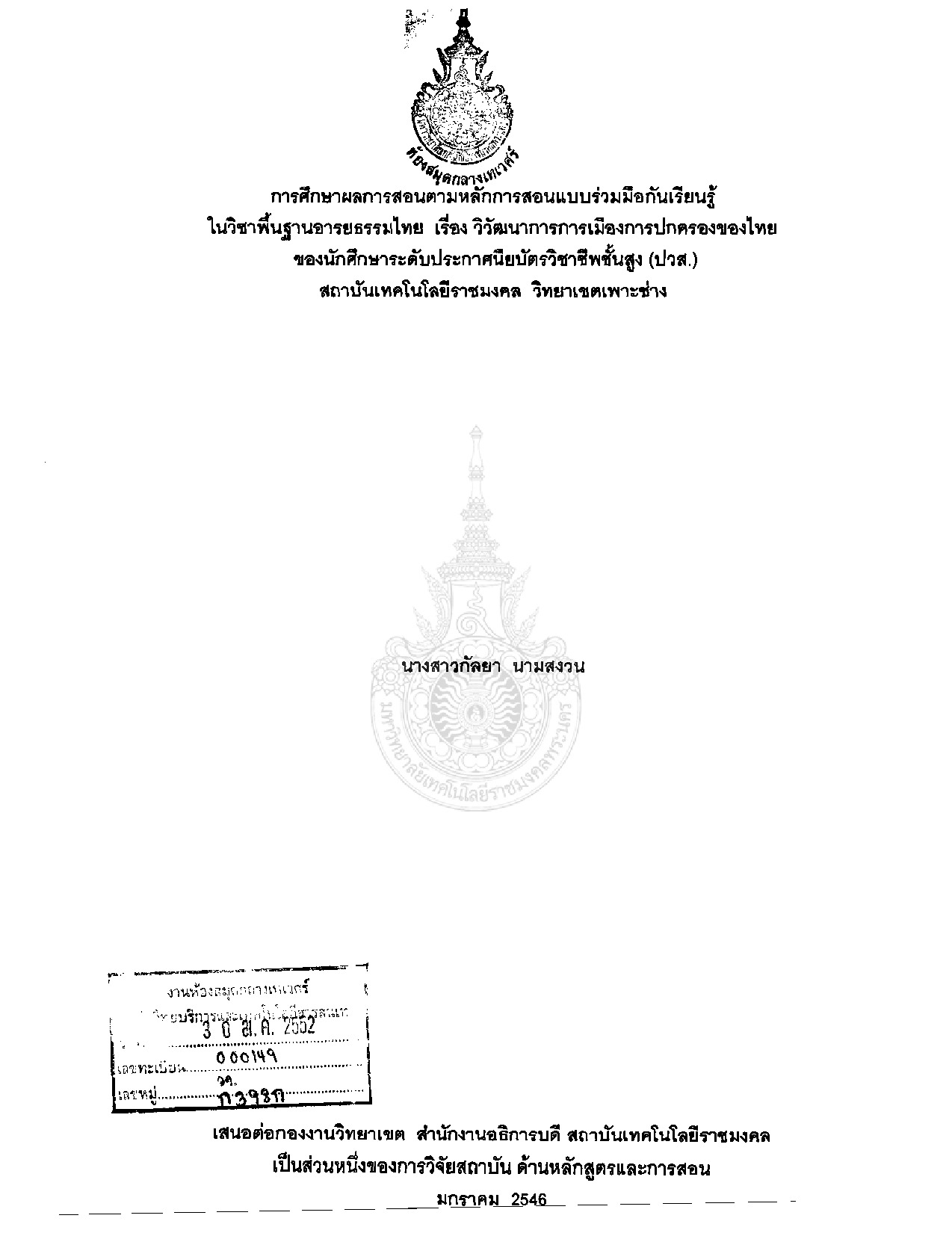
THE EFFECTS OF STUDY COOPERATIVE LEARNING MODEL THROUGH THE TEACHING OF FOUNDATION OF THAI CIVILIZATION SUBJECT: CERTIFICATED STUDENTS RAJAMANGALA INSTITUTE OF TECHONOLOGY ; POH-CHANG CAMPUS
The objective of this research was to compare the study achievement on Thai Government and Politics of Higher Technical Certificate students of Rajamangala Institute of Technology Poh Chang Art Campus based on the teaching techniques. The total of 49 Poh Chang art students of the 2nd Semester 2002 academic year were simple random sampled and then randomly divided into 2 grcJps; 20 students for the experimental group and the rest for controlled one. The learning-centered teaching technique was used for the experimental group whereas the standard teaching technique was for the other. This research was nonrandomized control group pretest-posttest design. The research tool were the measurement for study achievement teaching plan of StudentTeams-Achievement division: STAD) and the group observation form for collecting the qualitative and quantitative data. Statistics applied for quantitative data analysis was ANCOVA (One-Way Analysis of Covariance) with the pretest score as the covariate. Interpretation was used for qualitative data analysis. The findings revealed that 1.There was a significant difference between the study achievement of the students at the level of 0.05 based on teaching techniques. 2.The experimental group had a better team working performance.

The Lexical-Based EFL Learning Approach
English is now regarded as an important medium for international communication among people all around the world in politics education economics and tourism. Vocabulary is an important fundamental element for learning English. It is necessary for students to have lexical knowledge to develop their language proficiencies and communicative competence but Thai undergraduate students are not generally equipped with sufficient lexical items. The concepts and pedagogical implications of the lexical-based learning approach are proposed. It is hoped that this article will be highly beneficial to syllabus design and language instruction in the near future.
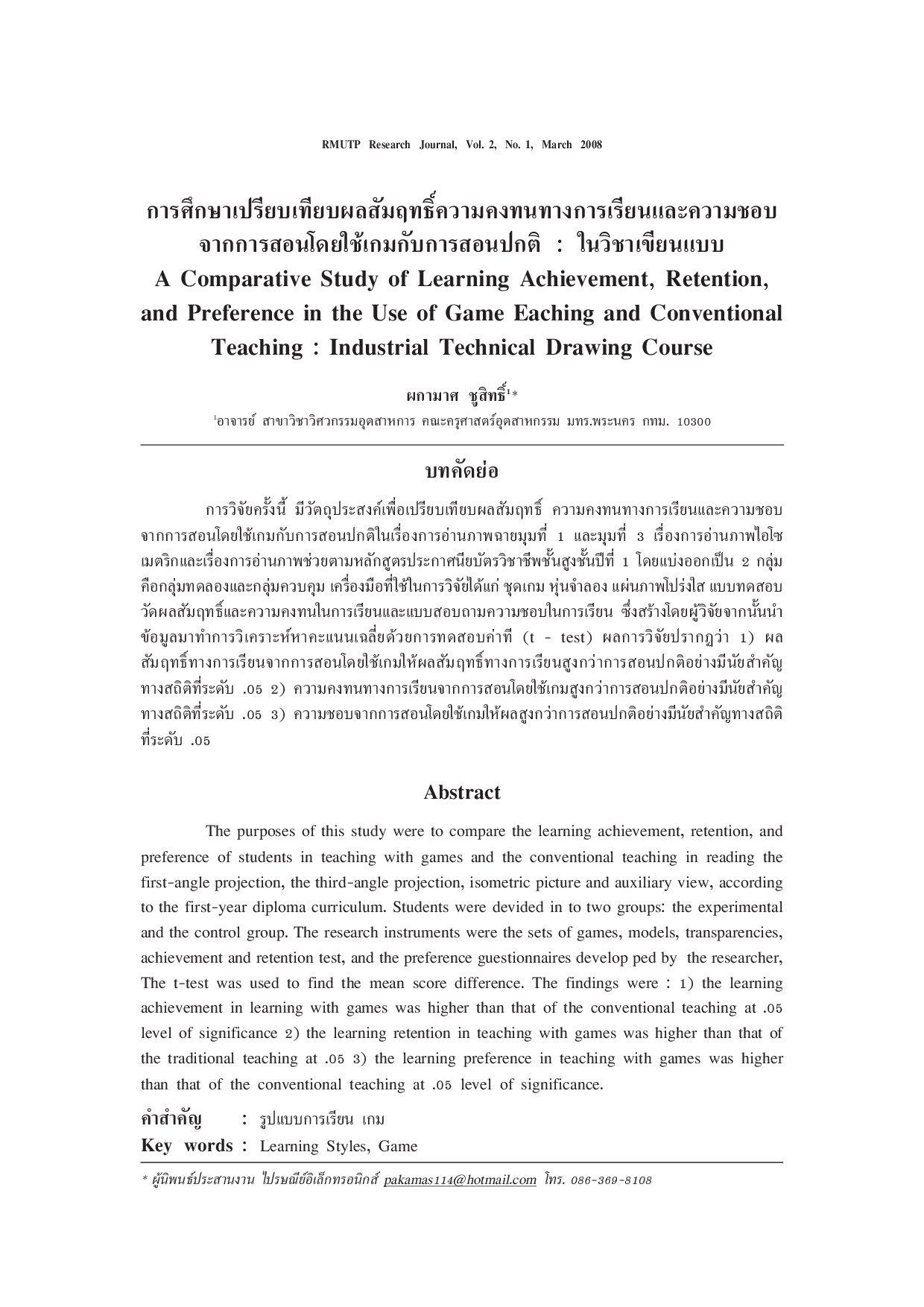
A Comparative Study of Learning Achievement, Retention, and Preference in the Use of Game Eaching and Conventional Teaching : Industrial Technical Drawing Course
The purposes of this study were to compare the learning achievement retention and preference of students in teaching with games and the conventional teaching in reading the first-angle projection the third-angle projection isometric picture and auxiliary view according to the first-year diploma curriculum. Students were devided in to two groups: the experimental and the control group. The research instruments were the sets of games models transparencies achievement and retention test and the preference guestionnaires develop ped by the researcher The t-test was used to find the mean score difference. The findings were : 1) the learning achievement in learning with games was higher than that of the conventional teaching at .05 level of significance 2) the learning retention in teaching with games was higher than that of the traditional teaching at .05 3) the learning preference in teaching with games was higher than that of the conventional teaching at .05 level of significance.
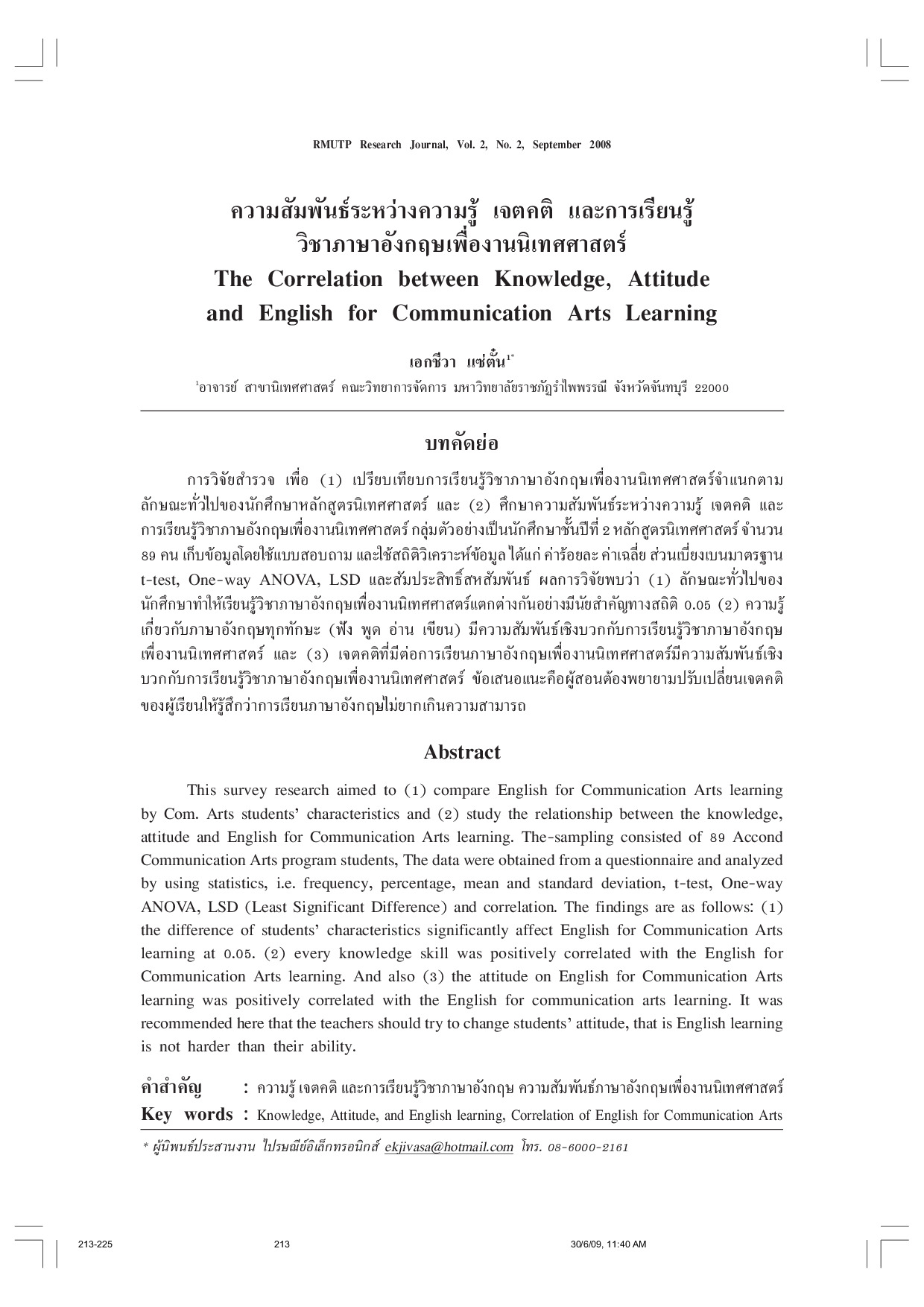
The Correlation between Knowledge, Attitude and English for Communication Arts Learning
This survey research aimed to (1) compare English for Communication Arts learning by Com. Arts students’ characteristics and (2) study the relationship between the knowledge attitude and English for Communication Arts learning. The-sampling consisted of 89 Accond Communication Arts program students The data were obtained from a questionnaire and analyzed by using statistics i.e. frequency percentage mean and standard deviation t-test One-way ANOVA LSD (Least Significant Difference) and correlation. The findings are as follows: (1) the difference of students’ characteristics significantly affect English for Communication Arts learning at 0.05. (2) every knowledge skill was positively correlated with the English for Communication Arts learning. And also (3) the attitude on English for Communication Arts learning was positively correlated with the English for communication arts learning. It was recommended here that the teachers should try to change students’ attitude that is English learning is not harder than their ability.