จำนวน Repository ( 141 )

ISQE-OTOP: An Interactive System for Quality Evaluation of OTOP Products
This research was aimed to develop criteria for quality evaluation of OTOP products of 5 types; namely food product beverage product cloth and costumes product utensils decoration and souvenirs product and herbal product. Which is not food Then the developed criteria were used as a quality evaluation form for OTOP products in interactive system on website. The usability of the system was tested by 72 persons in the group of OTOP product entrepreneurs and 96 persons in the group of customers. The results from the development of 5 types of criteria for product quality evaluation showed that: the criteria for food product consisted of 282 items; beverage product consisted of 41 items; cloth and costumes product consisted of 47 items; utensils decoration and souvenirs product consisted of 27 items and herbal product which is not food consisted of 77 items According to the usability tested by the entrepreneurs it was found that the effectiveness of usage was at the highest level. As for the usability tested by the customers it was found that the effectiveness of usage and the learnability were at the highest level.
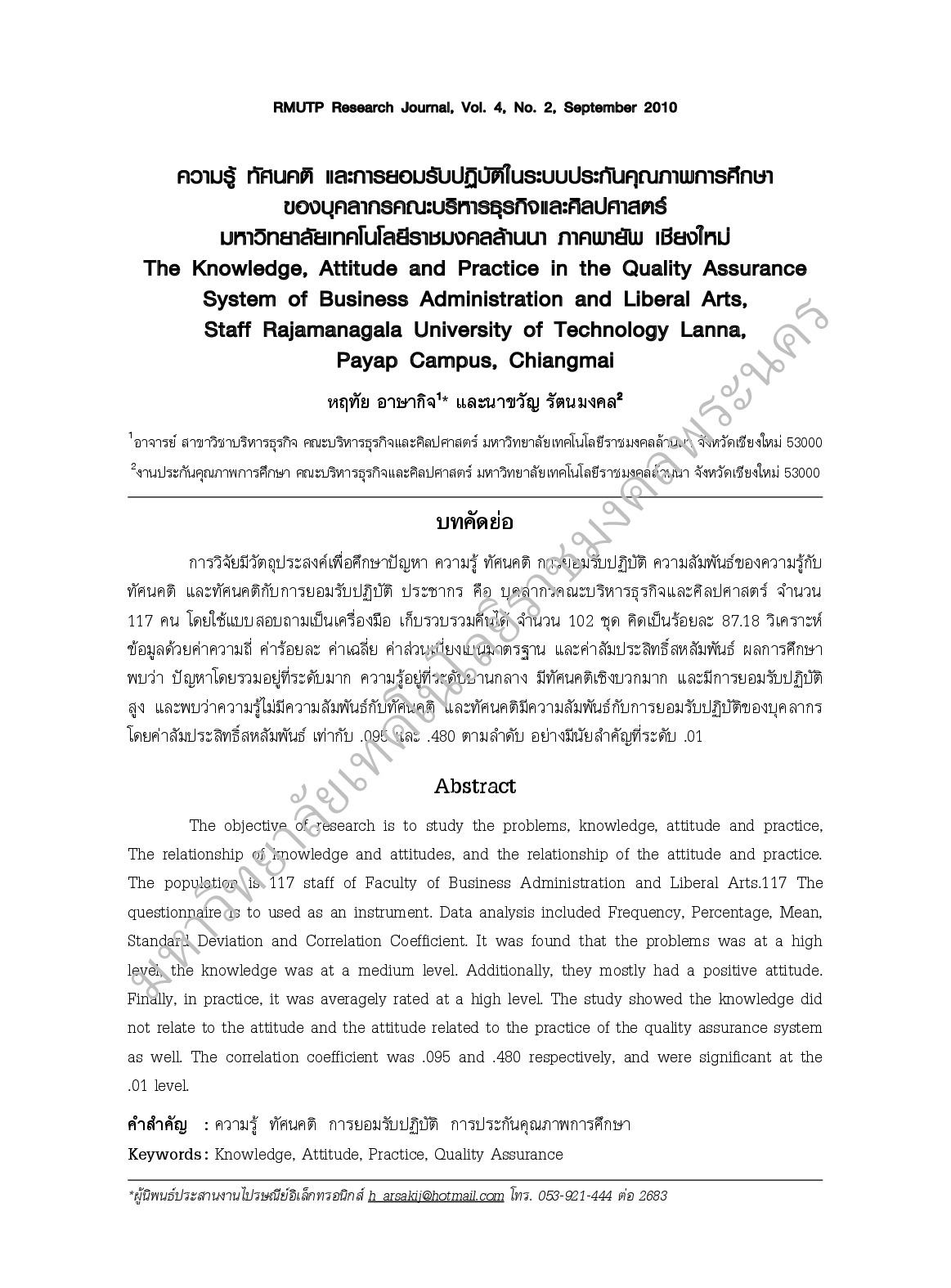
ความรู้ ทัศนคติ และการยอมรับปฏิบัติในระบบประกันคุณภาพการศึกษาของบุคลากรคณะบริหารธุรกิจและศิลปศาสตร์มหาวิทยาลัยเทคโนโลยีราชมงคลล้านนา ภาคพายัพ เชียงใหม่
The objective of research is to study the problems knowledge attitude and practice The relationship of knowledge and attitudes and the relationship of the attitude and practice. The population is 117 staff of Faculty of Business Administration and Liberal Arts.117 The questionnaire is to used as an instrument. Data analysis included Frequency Percentage Mean Standard Deviation and Correlation Coefficient. It was found that the problems was at a high level the knowledge was at a medium level. Additionally they mostly had a positive attitude. Finally in practice it was averagely rated at a high level. The study showed the knowledge did not relate to the attitude and the attitude related to the practice of the quality assurance system as well. The correlation coefficient was .095 and .480 respectively and were significant at the .01 level.
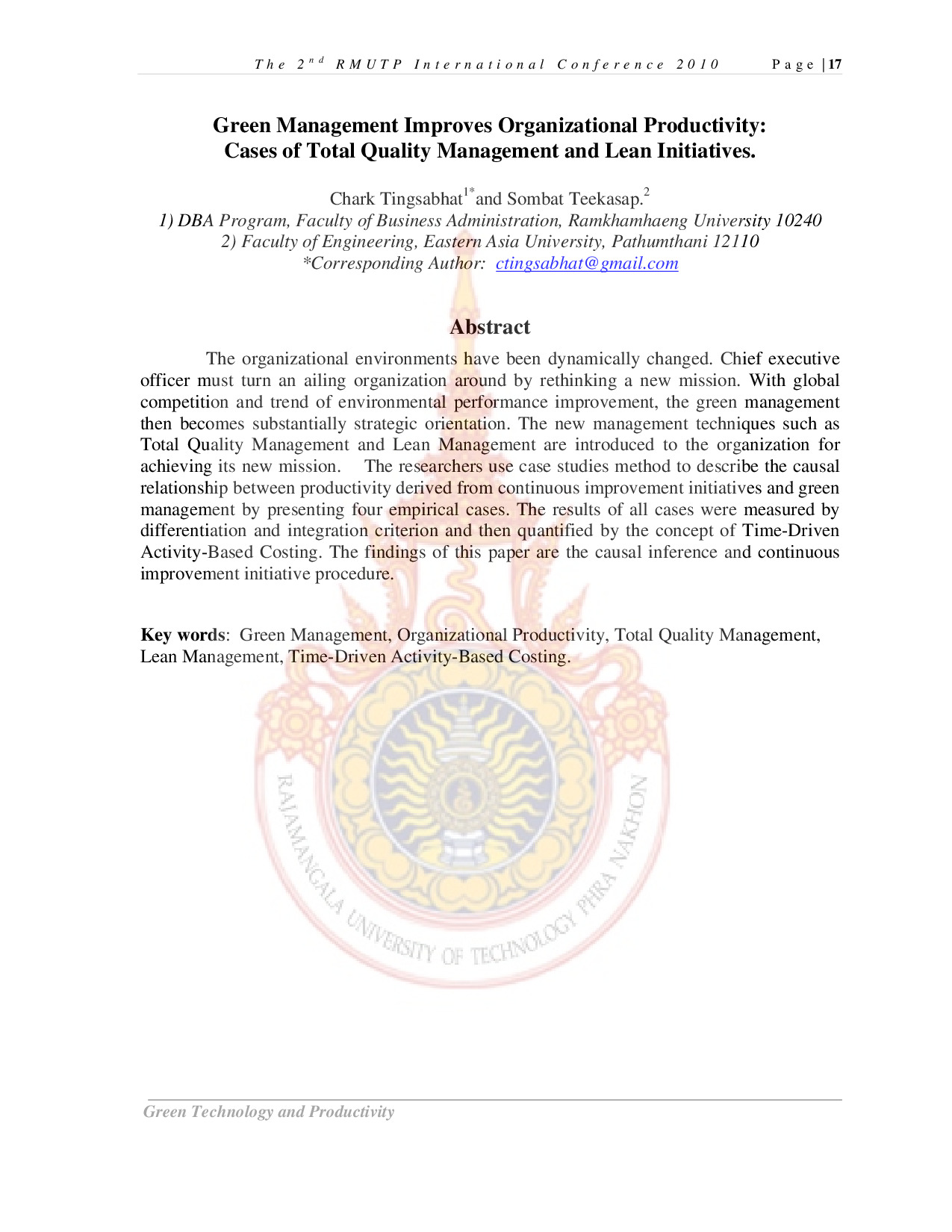
Green Management Improves Organizational Productivity:Cases of Total Quality Management and Lean Initiatives
The organizational environments have been dynamically changed. Chief executive officer must turn an ailing organization around by rethinking a new mission. With global competition and trend of environmental performance improvement the green management then becomes substantially strategic orientation. The new management techniques such as Total Quality Management and Lean Management are introduced to the organization for achieving its new mission. The researchers use case studies method to describe the causal relationship between productivity derived from continuous improvement initiatives and green management by presenting four empirical cases. The results of all cases were measured by differentiation and integration criterion and then quantified by the concept of Time-Driven Activity-Based Costing. The findings of this paper are the causal inference and continuous improvement initiative procedure
A study of the participation with the Education Quality Assurance in Rajamangala University of Technology Phra Nakhon
The objectives of this research were to examine the participation of students in the education quality assurance in Rajamangala University of Technology Phra Nakhon and compare the differences of participation rating scale based on personal factors. The study sample of 381 students was randomly selected from RMUTP undergraduate students in 9 faculties. The data were collected by questionnaire (5 rating scales) and analyzed by Statistical Package for Social Science (SPSS) to find statistic Percentage mean standard deviation (S.D) t-test and F-test. The test of hypotheses defined the statistical significance at level 0.5.
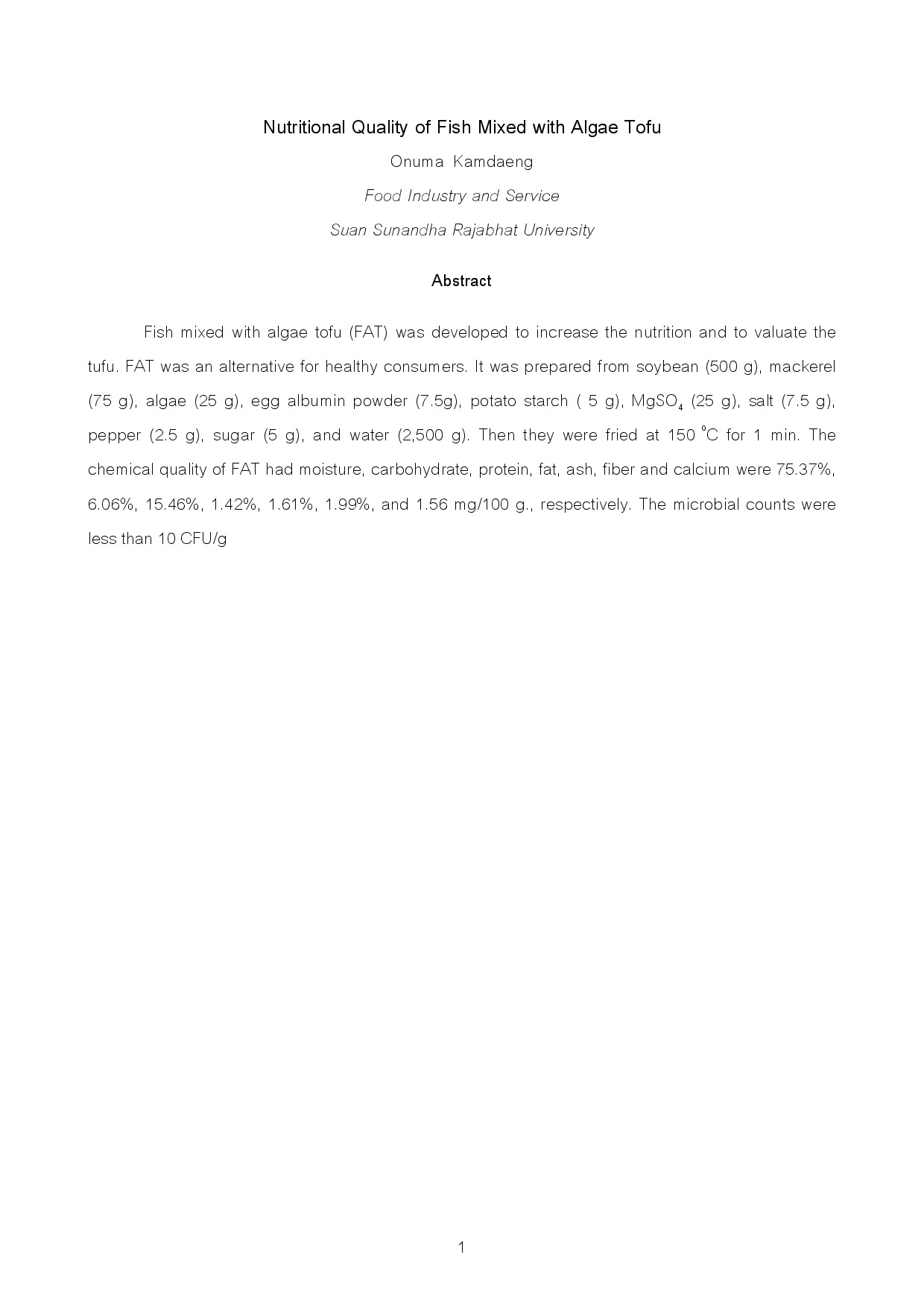
Nutritional Quality of Fish Mixed with Algae Tofu
Fish mixed with algae tofu (FAT) was developed to increase the nutrition and to valuate the tufu. FAT was an alternative for healthy consumers. It was prepared from soybean (500 g) mackerel (75 g) algae (25 g) egg albumin powder (7.5g) potato starch ( 5 g) MgSO4 (25 g) salt (7.5 g) pepper (2.5 g) sugar (5 g) and water (2500 g). Then they were fried at 150 oC for 1 min. The chemical quality of FAT had moisture carbohydrate protein fat ash fiber and calcium were 75.37% 6.06% 15.46% 1.42% 1.61% 1.99% and 1.56 mg/100 g. respectively. The microbial counts were less than 10 CFU/g.