จำนวน Repository ( 1574 )
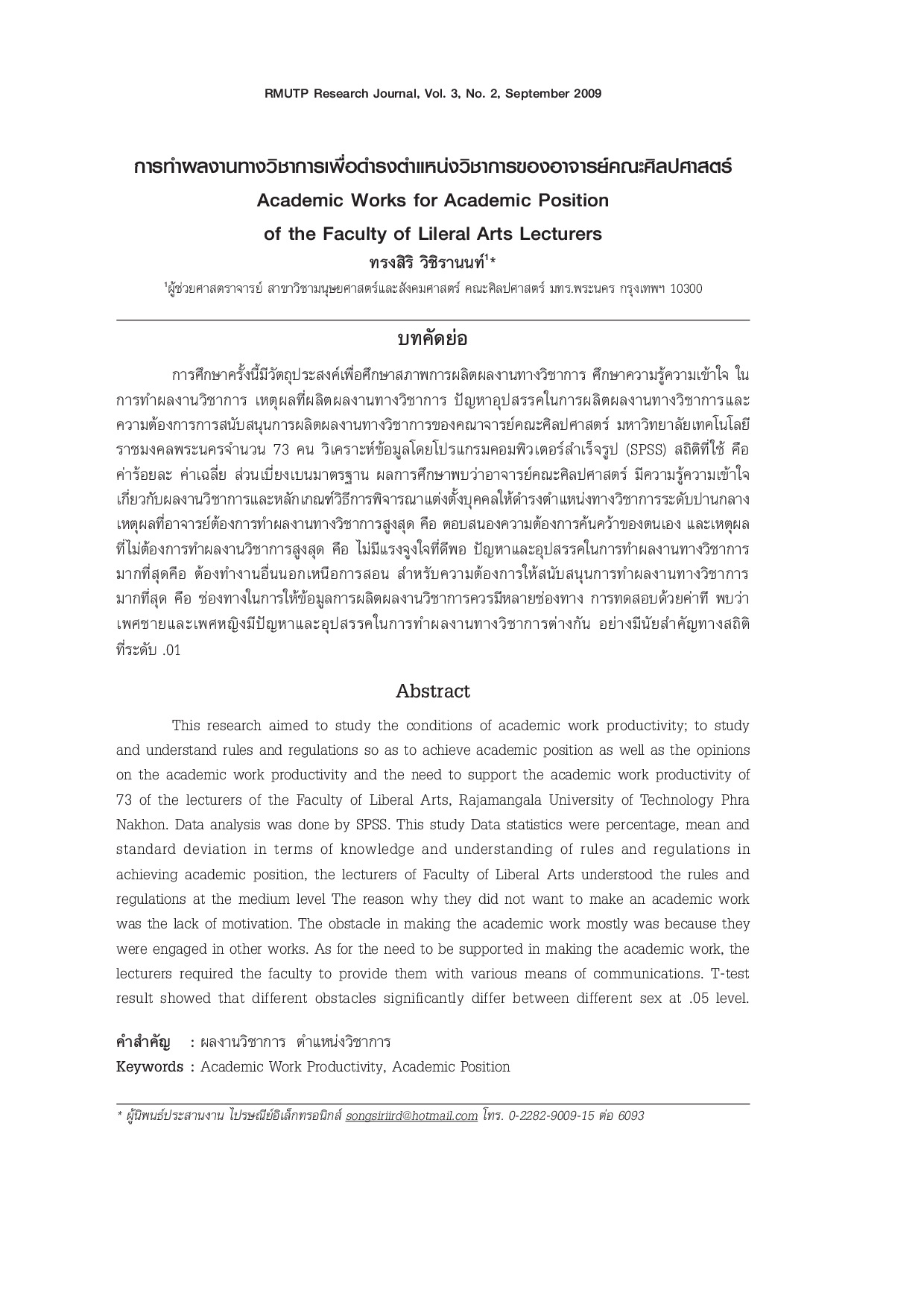
Academic Works for Academic Position of the Faculty of Liberal Arts Lecturers
This research aimed to study the conditions of academic work productivity; to study and understand rules and regulations so as to achieve academic position as well as the opinions on the academic work productivity and the need to support the academic work productivity of 73 of the lecturers of the Faculty of Liberal Arts Rajamangala University of Technology Phra Nakhon. Data analysis was done by SPSS. This study Data statistics were percentage mean and standard deviation in terms of knowledge and understanding of rules and regulations in achieving academic position the lecturers of Faculty of Liberal Arts understood the rules and regulations at the medium level The reason why they did not want to make an academic work was the lack of motivation. The obstacle in making the academic work mostly was because they were engaged in other works. As for the need to be supported in making the academic work the lecturers required the faculty to provide them with various means of communications. T-test result showed that different obstacles significantly differ between different sex at .05 level.
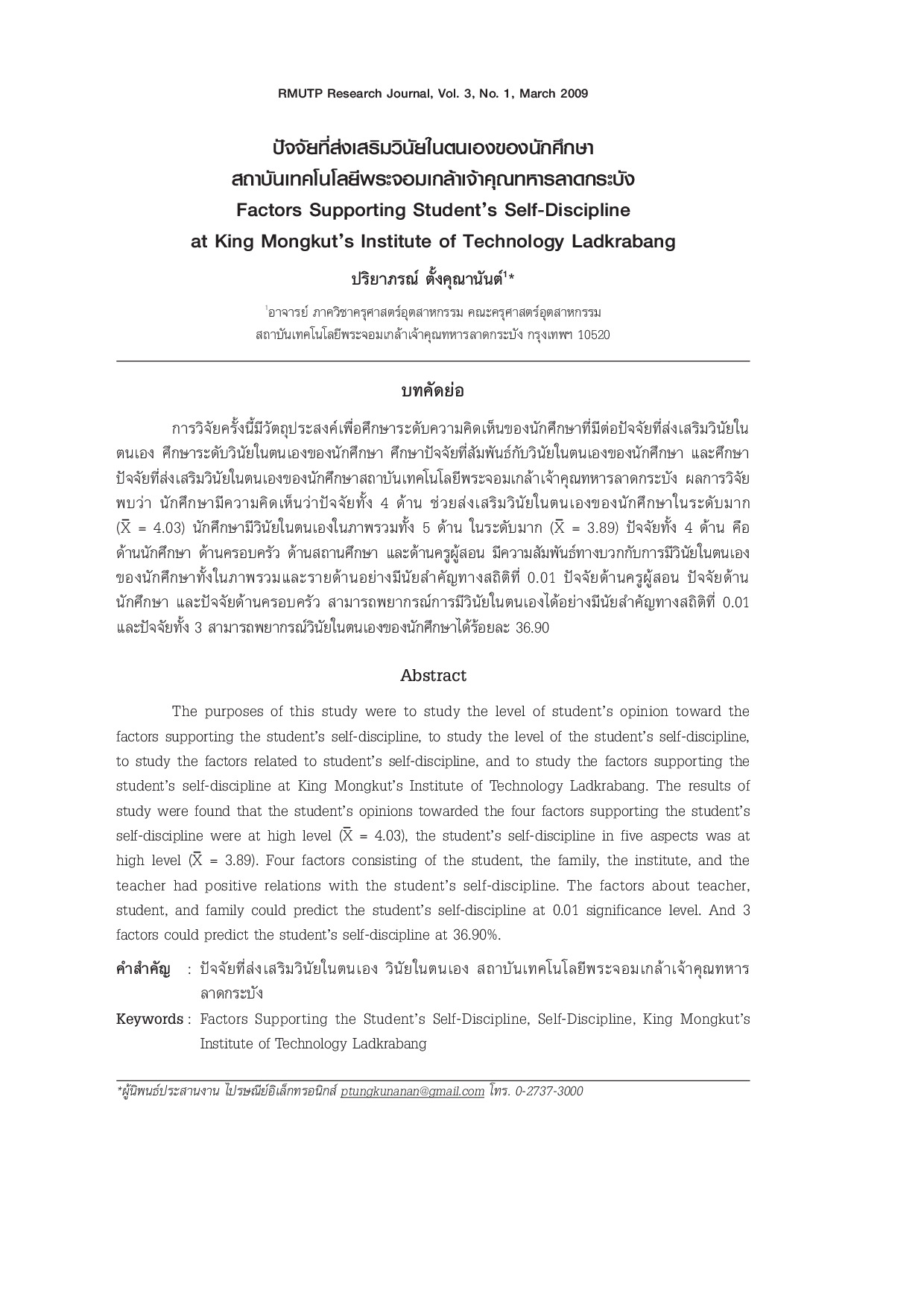
Factors Supporting Student’s Self-Discipline at King Mongkut’s Institute of Technology Ladkrabang
The purposes of this study were to study the level of student’s opinion toward the factors supporting the student’s self-discipline to study the level of the student’s self-discipline to study the factors related to student’s self-discipline and to study the factors supporting the student’s self-discipline at King Mongkut’s Institute of Technology Ladkrabang. The results of study were found that the student’s opinions towarded the four factors supporting the student’s self-discipline were at high level (X = 4.03) the student’s self-discipline in five aspects was at high level (X = 3.89). Four factors consisting of the student the family the institute and the teacher had positive relations with the student’s self-discipline. The factors about teacher student and family could predict the student’s self-discipline at 0.01 significance level. And 3 factors could predict the student’s self-discipline at 36.9%.
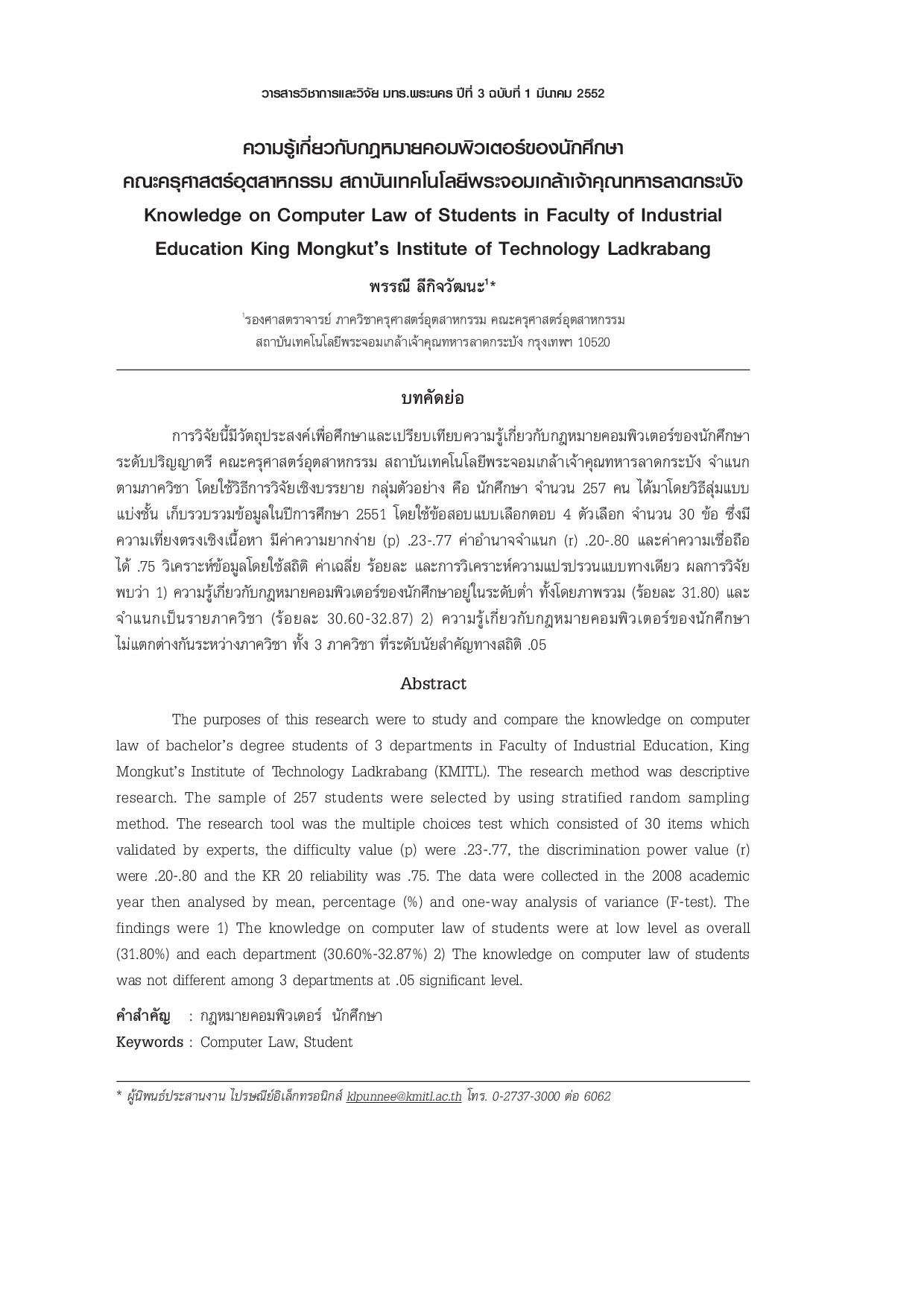
Knowledge on Computer Law of Students in Faculty of Industrial Education King Mongkut’s Institute of Technology Ladkrabang
The purposes of this research were to study and compare the knowledge on computer law of bachelor’s degree students of 3 departments in Faculty of Industrial Education King Mongkut’s Institute of Technology Ladkrabang (KMITL). The research method was descriptive research. The sample of 257 students were selected by using stratified random sampling method. The research tool was the multiple choices test which consisted of 30 items which validated by experts. the difficulty value (p) were 23 - 77 the discrimination power value (r) were 20 - 80 and the KR 20 reliability was .75. The data were collected in the 2008 academic year then analysed by mean percentage (%) and one-way analysis of variance (F-test). The findings were 1) The knowledge on computer law of students were at low level as overall (31.80%) and each department (30.60%-32.87%) 2) The knowledge on computer law of students was not different among 3 departments at .05 significant level.
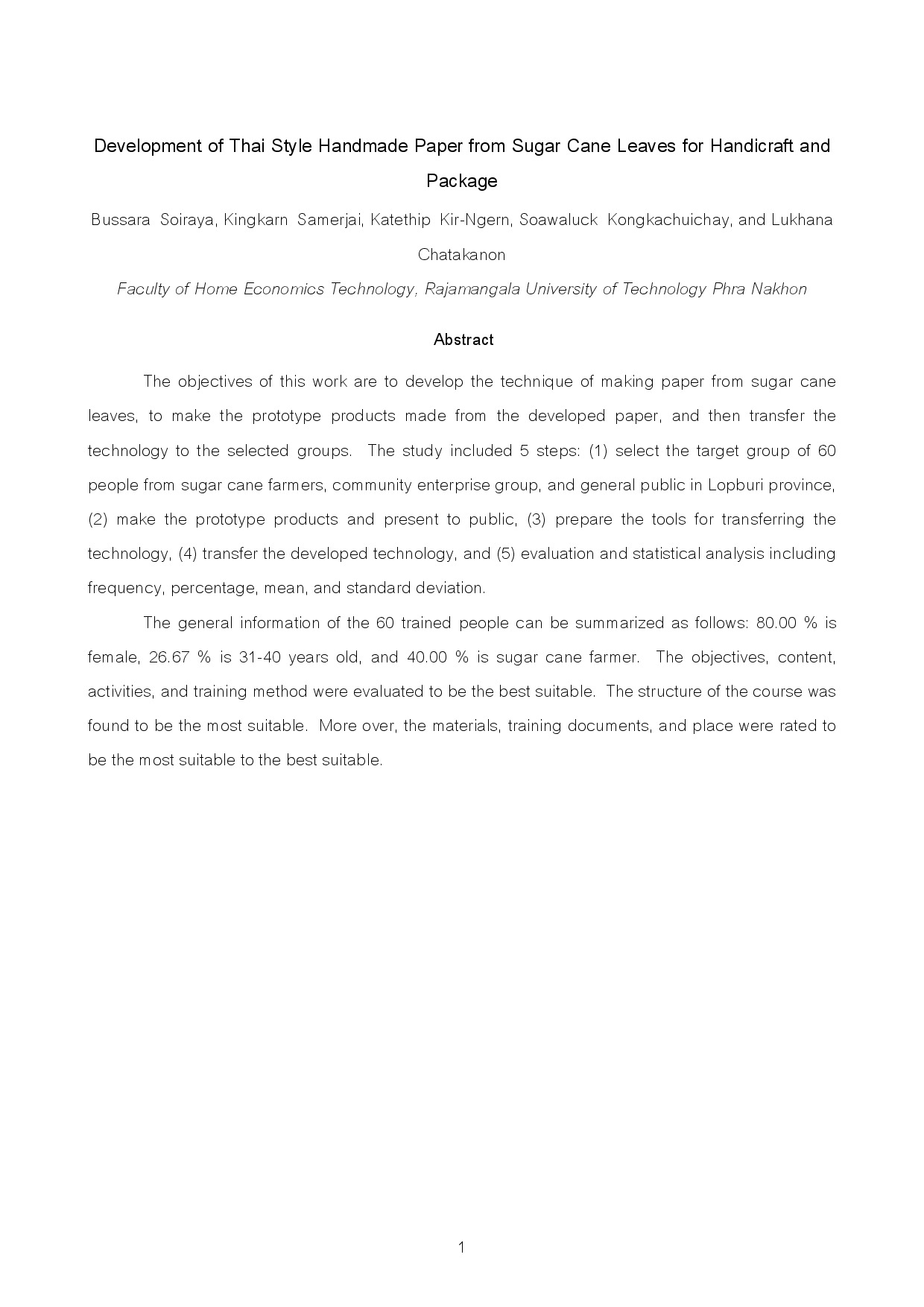
Development of Thai Style Handmade Paper from Sugar Cane Leaves for Handicraft and Package
The objectives of this work are to develop the technique of making paper from sugar cane leaves to make the prototype products made from the developed paper and then transfer the technology to the selected groups. The study included 5 steps: (1) select the target group of 60 people from sugar cane farmers community enterprise group and general public in Lopburi province (2) make the prototype products and present to public (3) prepare the tools for transferring the technology (4) transfer the developed technology and (5) evaluation and statistical analysis including frequency percentage mean and standard deviation. The general information of the 60 trained people can be summarized as follows: 80.00 % is female 26.67 % is 31-40 years old and 40.00 % is sugar cane farmer. The objectives content activities and training method were evaluated to be the best suitable. The structure of the course was found to be the most suitable. More over the materials training documents and place were rated to be the most suitable to the best suitable.
Effects of Fat Substitute on Survived Probiotic Bacteria in Yoghurt Ice Cream
The objective of this research was to compare amounts of fat substitutes supplied in the industries in order to determine their ability to encapsulate probiotic microbes in the production of yoghurt ice cream to ensure maximum survived probiotic microbes. In this research two fat substitutes Purity SM 100 and CRYSTAL texTM 648 were used to substitute skim milk in the standard formulas in order to study numbers of survived probiotic microbes and to test the sensory acceptance. For the sensory acceptance it was found that the probiotic yoghurt ice cream containing 20% Purity SM100 is acceptable at the maximum significance (p ≤ 0.05) because its flavor and taste was better than other samples as well as the best overrun with statistical significant differences (p ≤ 0.05). However by addition of both fat substitutes at different concentrations pH values of probiotic yoghurt ice cream products did not have statistical significant differences (p ≥ 0.05). When Lactobacillus acidophilus Bifidobacterium and Streptococcus thermophilus microbial starters were added into the probiotic yoghurt ice cream using both fat substitutes in place of skim milk at ratios of 10% 15% and 20% respectively under a storage condition of -20oC for 4 weeks it was found that types and amounts of fat substitutes affected the surviving rate of probiotic microbes in the product with a statistical significance (p ≤ 0.05). The addition of fat substitutes Purity SM100 and CRYSTAL texTM 648 at all concentration levels made probiotic microbes survived in the product which illustrated that both fat substitutes used in above experiments could encapsulate probiotic microbe cells. The survived probiotic microbes were in the range of 107 – 108 CFU/ml in comparison to the probiotic yoghurt ice cream with the standard formula without the addition of fat substitutes that has survived probiotic microbes of only 106 CFU/ml.