จำนวน Repository ( 1574 )
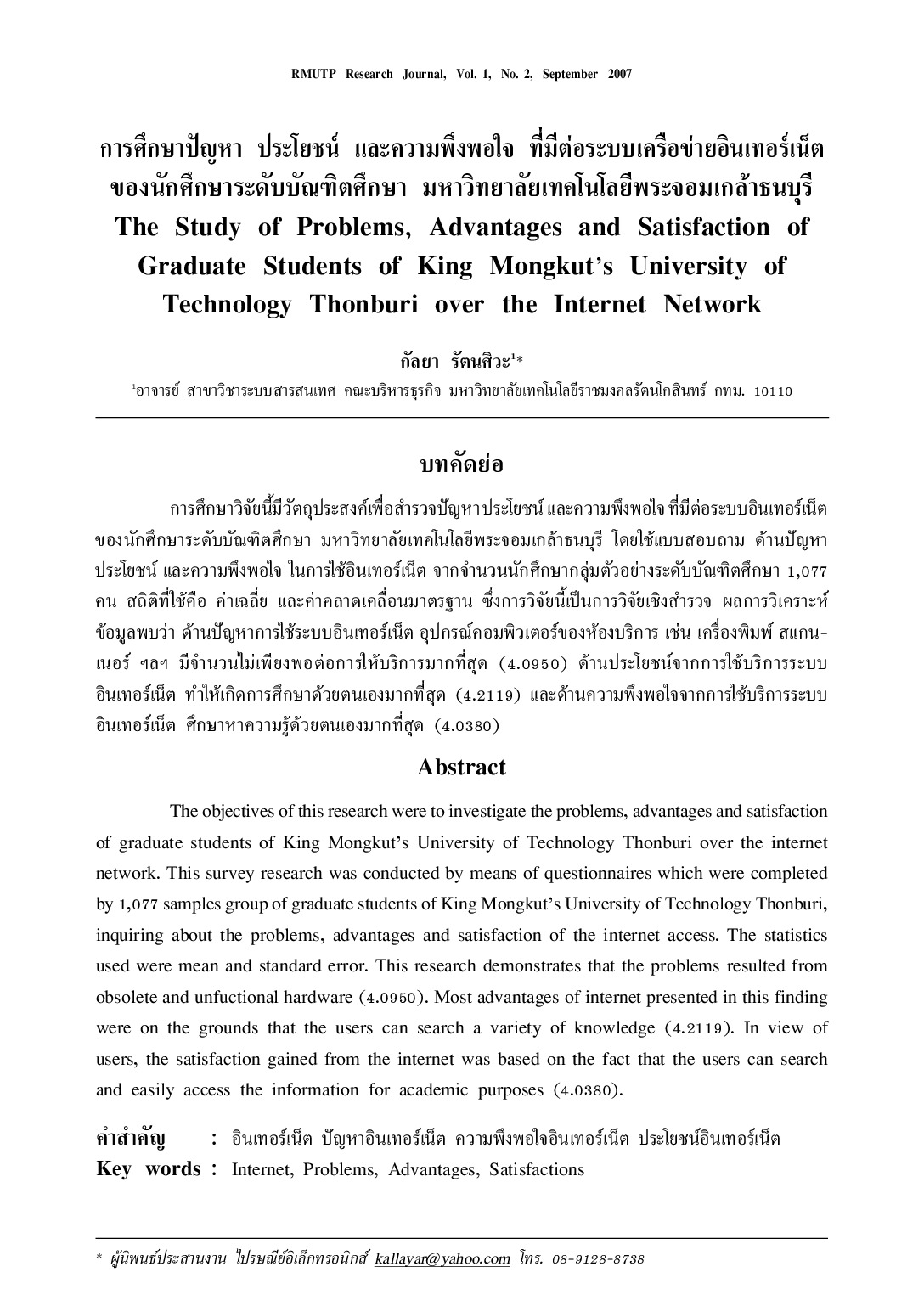
The Study of Problems, Advantages and Satisfaction of Graduate Students of King Mongkutûs University of Technology Thonburi over the Internet Network
The objectives of this research were to investigate the problems advantages and satisfaction of graduate students of King Mongkut’s University of Technology Thonburi over the internet network. This survey research was conducted by means of questionnaires which were completed by 1077 samples group of graduate students of King Mongkut’s University of Technology Thonburi inquiring about the problems advantages and satisfaction of the internet access. The statistics used were mean and standard error. This research demonstrates that the problems resulted from obsolete and unfuctional hardware (4.0950). Most advantages of internet presented in this finding were on the grounds that the users can search a variety of knowledge (4.2119). In view of users the satisfaction gained from the internet was based on the fact that the users can search and easily access the information for academic purposes (4.0380).
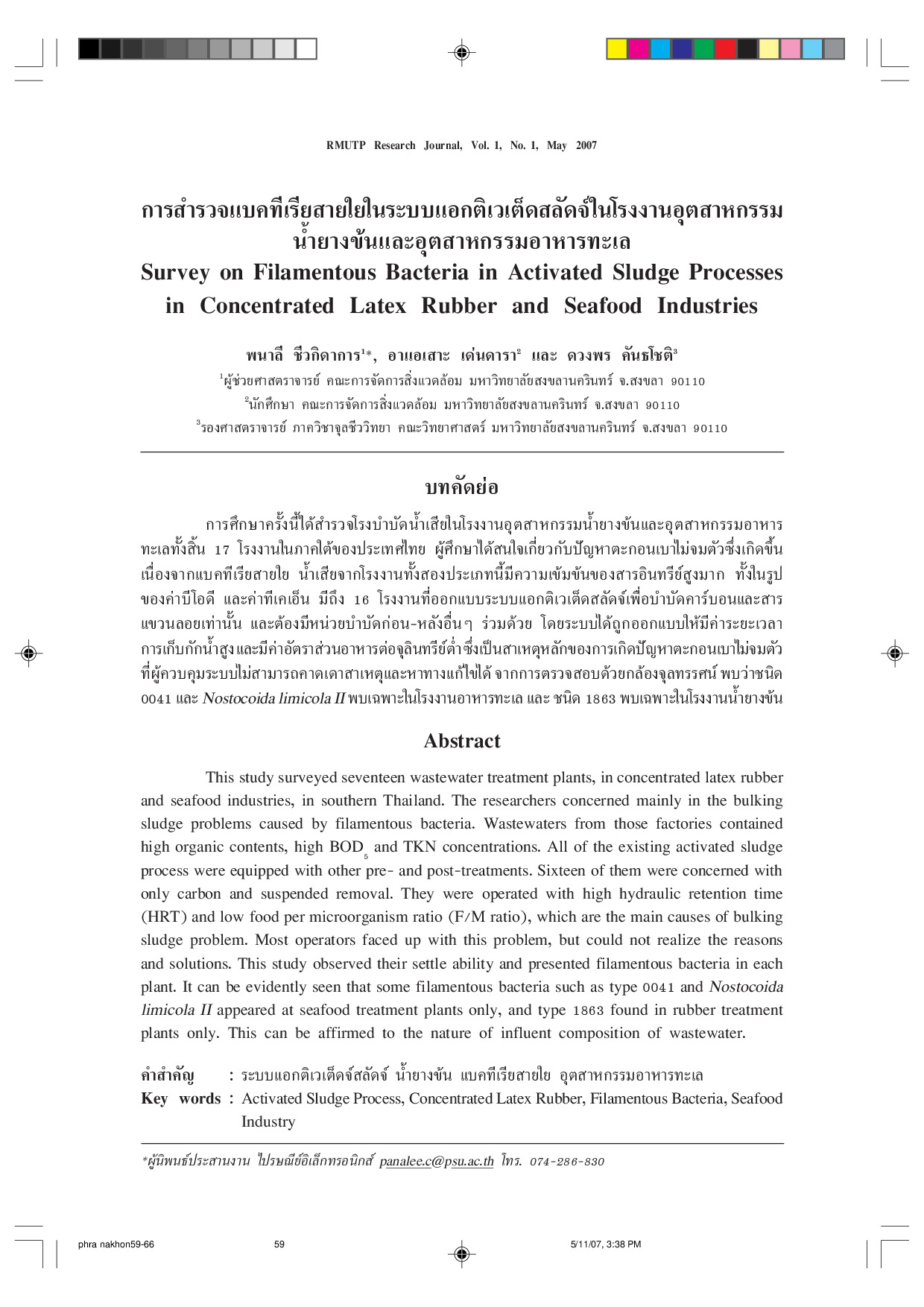
Survey on Filamentous Bacteria in Activated Sludge Processes in Concentrated Latex Rubber and Seafood Industries
This study surveyed seventeen wastewater treatment plants in concentrated latex rubber and seafood industries in southern Thailand. The researchers concerned mainly in the bulking sludge problems caused by filamentous bacteria. Wastewaters from those factories contained high organic contents high BOD5 and TKN concentrations. All of the existing activated sludge process were equipped with other pre- and post-treatments. Sixteen of them were concerned with only carbon and suspended removal. They were operated with high hydraulic retention time (HRT) and low food per microorganism ratio (F/M ratio) which are the main causes of bulking sludge problem. Most operators faced up with this problem but could not realize the reasons and solutions. This study observed their settle ability and presented filamentous bacteria in each plant. It can be evidently seen that some filamentous bacteria such as type 0041 and Nostocoida limicola II appeared at seafood treatment plants only and type 1863 found in rubber treatment plants only. This can be affirmed to the nature of influent composition of wastewater.
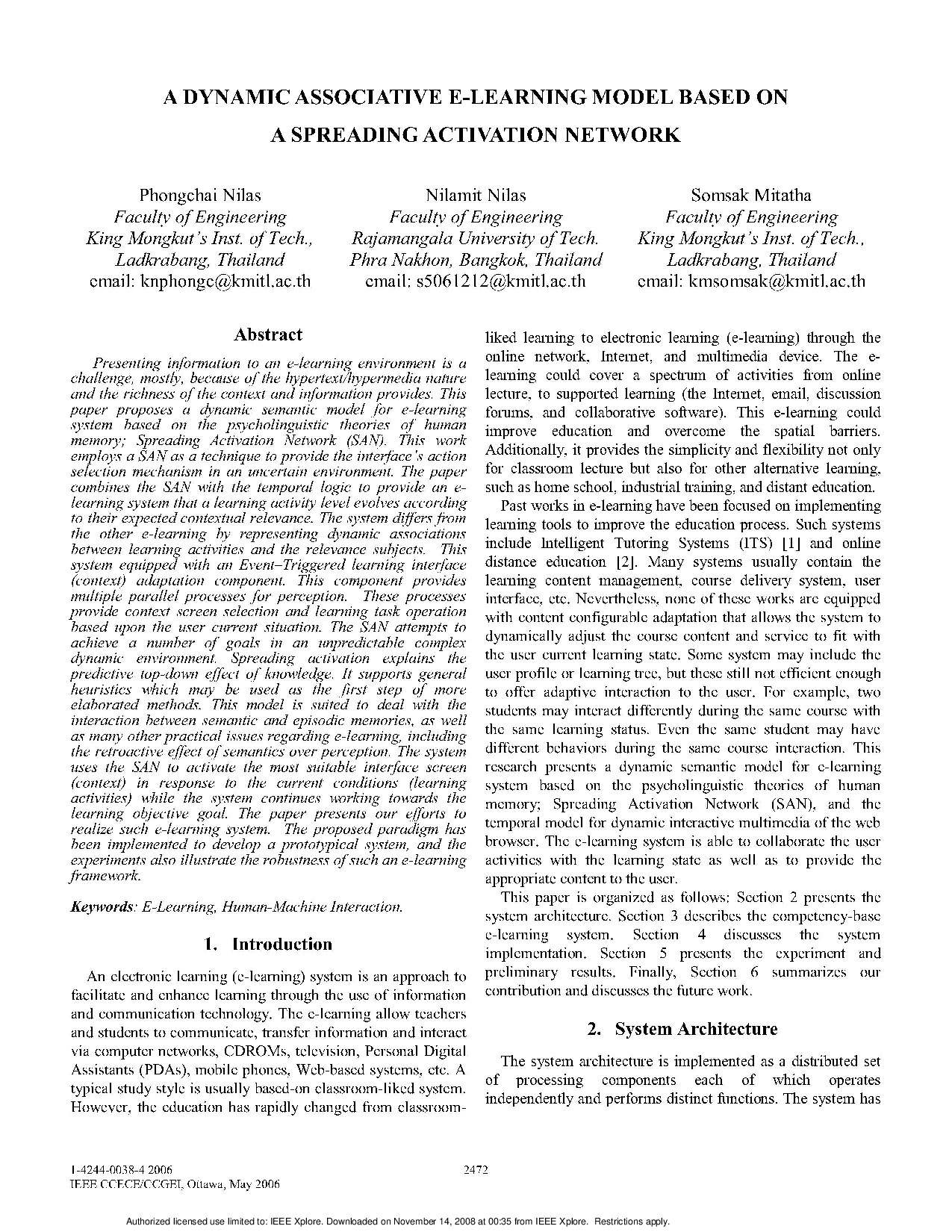
A Dynamic Associative e-learning model based on a spreading activation network
Presenting information to an e-learning environment is a challenge mostly because of the hypertext/hypermedia nature and the richness of the context and information provides. This paper proposes a dynamic semantic model for e-learning system based on the psycholinguistic theories of human memory Spreading Activation Network (SAN). This work employs a SAN as a technique to provide the interfaces action selection mechanism in an uncertain environment. The paper combines the SAN with the temporal logic to provide an e-learning system that a learning activity level evolves according to their expected contextual relevance. The system differs from the other e-learning by representing dynamic associations between learning activities and the relevance subjects. This system equipped with an Event-Triggered learning interface (context) adaptation component. This component provides multiple parallel processes for perception. These processes provide context screen selection and learning task operation based upon the user current situation. The SAN attempts to achieve a number of goals in an unpredictable complex dynamic environment. Spreading activation explains the predictive top-down effect of knowledge. It supports general heuristics which may be used as the first step of more elaborated methods. This model is suited to deal with the interaction between semantic and episodic memories as well as many other practical issues regarding e-learning including the retroactive effect of semantics over perception. The system uses the SAN to activate the most suitable interface screen (context) in response to the current conditions (learning activities) while the system continues working towards the learning objective goal. The paper presents our efforts to realize such e-learning system. The proposed paradigm has been implemented to develop a prototypical system and the experiments also illustrate the robustness of such an e-learning framework.
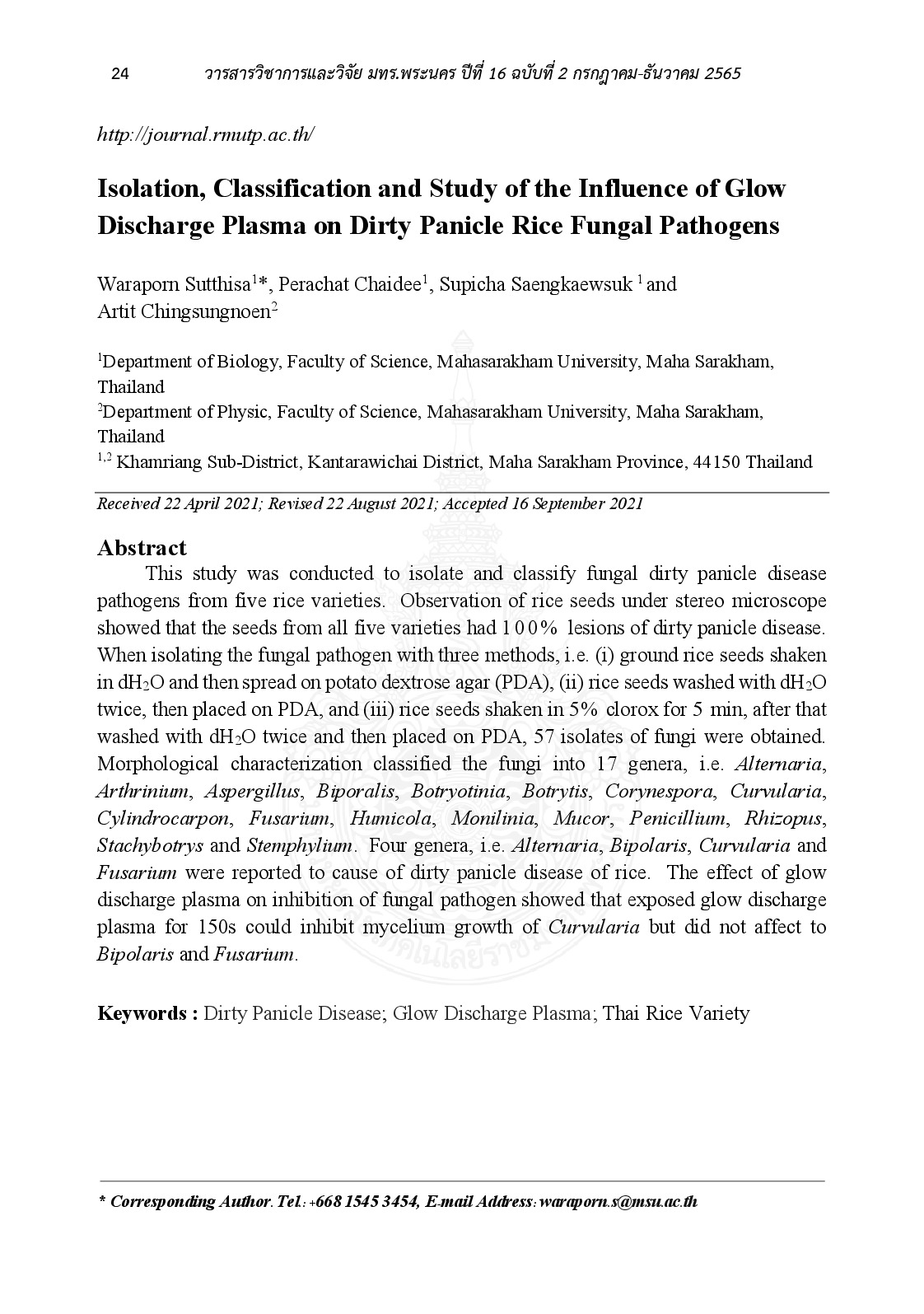
Isolation, classification and study of the influence of glow discharge plasma on dirty panicle rice fungal pathogens
This study was conducted to isolate and classify fungal dirty panicle disease pathogens from five rice varieties. Observation of rice seeds under stereo microscope showed that the seeds from all five varieties had 100% lesions of dirty panicle disease. When isolating the fungal pathogen with three methods i.e. (i) ground rice seeds shaken in dH2O and then spread on potato dextrose agar (PDA) (ii) rice seeds washed with dH2O twice then placed on PDA and (iii) rice seeds shaken in 5% clorox for 5 min after that washed with dH2O twice and then placed on PDA 57 isolates of fungi were obtained. Morphological characterization classified the fungi into 17 genera i.e. Alternaria Arthrinium Aspergillus Biporalis Botryotinia Botrytis Corynespora Curvularia Cylindrocarpon Fusarium Humicola Monilinia Mucor Penicillium Rhizopus Stachybotrys and Stemphylium. Four genera i.e. Alternaria Bipolaris Curvularia and Fusarium were reported to cause of dirty panicle disease of rice. The effect of glow discharge plasma on inhibition of fungal pathogen showed that exposed glow discharge plasma for 150s could inhibit mycelium growth of Curvularia but did not affect to Bipolaris and Fusarium.
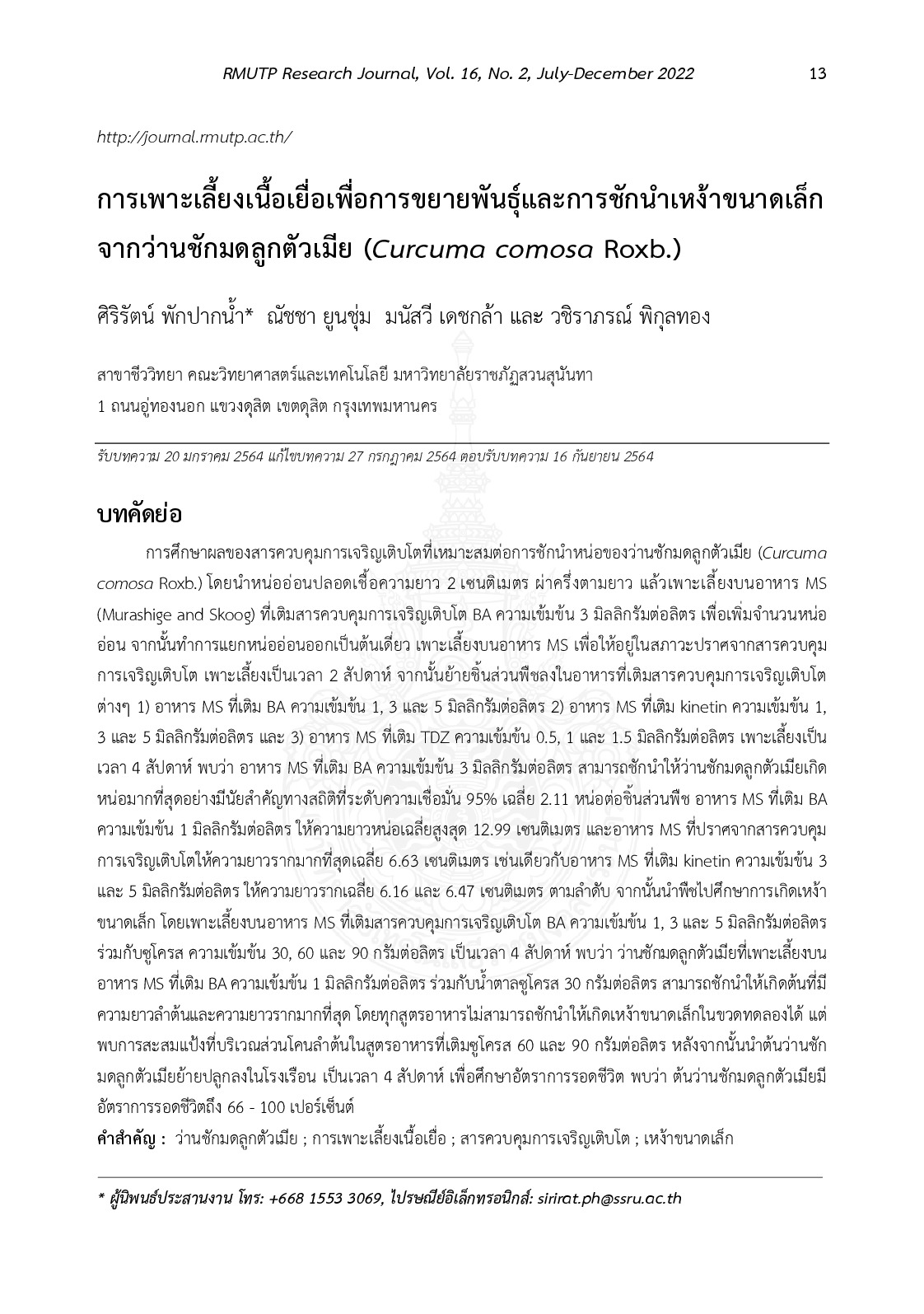
การเพาะเลี้ยงเยื่อเพื่อการขยายพันธุ์และการชักนำเหง้าขนาดเล็กจากว่านชักมดลูกตัวเมีย Curcuma comosa roxb
This study was conducted to determine the effects of plant growth regulators on in vitro propagated plantlets and microrhizome inductions of Curcuma comosa Roxb. for an efficient development of plant regeneration. In vitro sprouted shoots (2 cm length) of C. comosa were incised in longitudinal section and subcultured on MS media supplemented with 3 mg/L BA for shoot multiplication and plant regeneration. Subsequently the regenerated plants were transferred to MS medium with various concentrations of plant growth regulators; BA (1 3 5 mg/L) kinetin (1 3 5 mg/L) and TDZ (0.5 1 1.5 mg/L). The result showed that MS medium supplemented with 3 mg/L BA was the most effective in shoot induction with the significantly maximum average number of 2.11 shoot buds per responding explant. Moreover MS medium supplemented with 1 mg/L BA produced the longest average of shoot bud explants (12.99 cm) while the basal MS medium induced the longest average of root multiplication (6.63 cm). Furthermore microrhizome induction was produced under in vitro conditions derived young shoot buds upon transfer to MS medium containing various combinations of 1 3 and 5 mg/L BA and 30 60 and 90 g/L sucrose concentrations. The optimum combination in the induction of significantly highest average length of both stem (18.32 cm) and root (7.52 cm) multiplication was obtained on MS basal medium supplemented with 1 mg/L BA and 30 g/L sucrose for 4 weeks. Although microrhizome formation was not produced by the different amount of BA and sucrose in induction medium starch accumulation was found at the base of the stem explants cultured on MS medium containing 60 and 90 g/L sucrose concentrations. Additionally in vitro propagated C. comosa plantlets through microrhizome induction were grown under greenhouse conditions for 4 weeks and further developed into normal plants resulting in successfully high survival rates of 66 – 100% in the cultivated C. comosa.