จำนวน Repository ( 2131 )
The satisfaction of students toward the academic service of academic and research affair, faculty of management Technology, Rajamangala University of Technology isan, surin campus
The purpose of this research was to analyze the satisfaction of students towards the academic service of Academic and Research Affair Faculty of Management Technology Rajamangala University of Technology Isan Surin Campus. The processes of this study were divided into three parts: 1.) the procedures of the academic services providing. 2.) The service of academic department officers/staffs. 3.) The facilities feature that classified into gender (sex) and education level (year) of the students. The populations used were 200 students among the first year to the fourth year students who studied in the academic year of 2011. The tool used consisted was the questionnaire and the statistic data were analyzed by frequency percentage average value mean standard deviation T-test and One-Way ANOVA. The findings were concluded as follows: 1.) The students of Management Technology Faculty Rajamangala University of Technology Isan Surin Campus who had the different in gender (sex) and education level (year) were satisfied the procedures of the academic services providing were in the moderate level. While the service of academic department officers/staffs were in high level and lastly the facilities features were also in high level. 2.) The students of Management Technology Faculty Rajamangala University of Technology Isan Surin Campus who had the different gender were satisfied the procedures of the academic services providing the service of academic department officers/staffs the facilities features in the level of indifferent significant. 3.) The students of Management Technology Faculty Rajamangala University of Technology Isan Surin Campus who had the different education level (year) were satisfied the procedures of the academic services providing the service of academic department officers/staffs the facilities features in the different statistical significant level at 0.05
Development of learning achievement by research – based in conjunction with technique SCAMPER
This pre experimental research was one group pretest-post test design. The research aimed to develop the students learning achievement to study learning process by research - base in conjunction with technique SCAMPER and to survey the treatment groupopinions about learning activities. The population consisted of a group of students enrolling in Research Methodology in the second semester in 2012. Before the experiment the learning styles of the treatment group were tested with Kolbs Learning Style Model and we found that the treatment group s learning style was Diverger. The data from testing styles of learning of the students was used to construct a set of activities by research - base in conjunction with technique SCAMPER. Then the students had to take a test with the achievement test constructed by the researcher before and after the experiment. The major research findings were that after the experiment the scores of the treatment group were significantly different at level 0.05 therefore; we concluded that the qualified set of the learning activities by research - base in conjunction with SCAMPER was able to develop the students learning achievement. In the part of learning process the technique SCAMPER was used to promote the students different views and ideas by asking questions which encouraged students to create their thinking systematically. In the students opinions about learning activities most of them strongly agreed with this technique which contributed to the thinking process and the systematic pursuit of knowledge.
Dispersion of copper oxide in water by pH value and ultrasonic method
The objective of this research is to study the dispersion of copper oxide particles in water using as a coolant in heat exchangers. Copper oxide particles were prepared by precipitate method. The parameters affected to dispersion of copper oxide were pH of solution and ultrasonic time. The results showed that an average crystalline size of copper oxide was in nano scale (< 22 nm). At pH value of 13 copper oxide was well dispersion in the water. Appropriate ultrasonic time of dispersion is dependent on particle sizes of copper oxide. The small particle sizes of copper oxide led to decreasing of ultrasonic time. On the other hand an increasing in particles sizes required longer ultrasonic time. Stability of suspension of CuO in the water decreased with an increasing of time. Moreover it was found that CuO particles were well dispersed in the water at pH value of 13 and ultrasonic time of 15 minutes
Evaluation technique for northern corn leaf blight resistance and identification of resistance genes position in maize with dna markers
This study aims to develop a new evaluation technique for Northern Corn Leaf Blight (NCLB) resistance in maize under greenhouse condition. Ki48/Ki47 F2 (160 lines) and 2 commercial verities (Hi-Brix3 and Insee2) were evaluated. For this technique 10-14 day old seedlings (4-5 leaves) were sprayed with ACIL1 spore suspension (104spores/ml.) for infection. The results of this technique correlated with the results from the common technique under field condition which used 21-25 days old seedlings (6-7 leaves) (correlation value = 0.658). This evaluation technique was used to assist in QTL mapping of NCLB resistance. Population of Ki48/Ki47 F2 (160 lines) were analyzed for QTL mapping by using Simple Sequence Repeats (SSR) markers. It was found that major parental polymorphism located on chromosome 5 and chromosome 8. When Single QTL analysis was performed SSR marker UMC1365 could clearly indentified qualitative trait loci on chromosome 5 and SSR markers UMC1095 UMC1268 and UMC2356 could clearly indentified qualitative trait loci on chromosome 8.
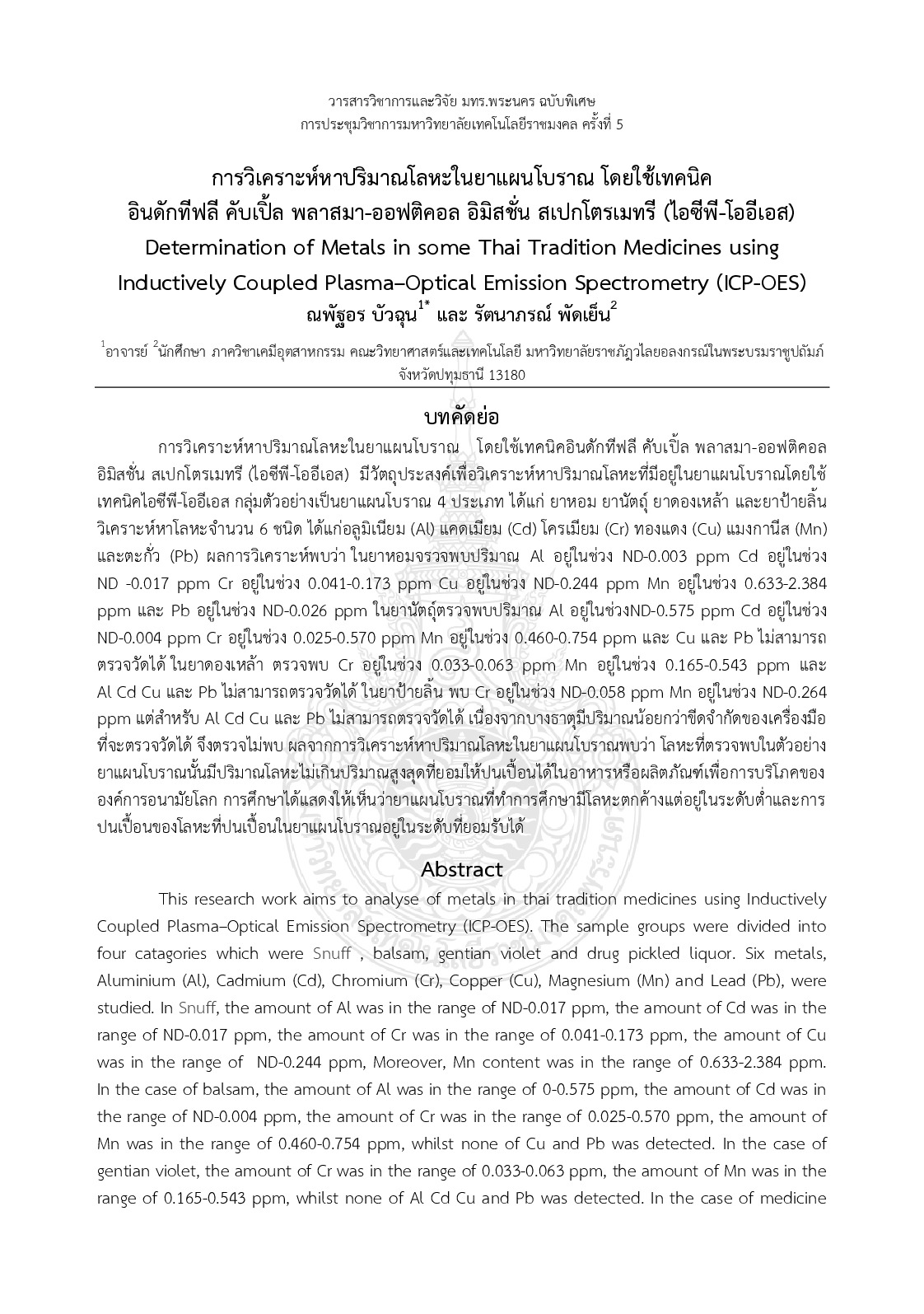
Determination of metals in some thai tradition medicines using inductively coupled plasma–optical emission spectrometry (ICP-OES)
This research work aims to analyse of metals in thai tradition medicines using Inductively Coupled Plasma–Optical Emission Spectrometry (ICP-OES). The sample groups were divided into four catagories which were Snuff balsam gentian violet and drug pickled liquor. Six metals Aluminium (Al) Cadmium (Cd) Chromium (Cr) Copper (Cu) Magnesium (Mn) and Lead (Pb) were studied. In Snuff the amount of Al was in the range of ND-0.017 ppm the amount of Cd was in the range of ND-0.017 ppm the amount of Cr was in the range of 0.041-0.173 ppm the amount of Cu was in the range of ND-0.244 ppm Moreover Mn content was in the range of 0.633-2.384 ppm. In the case of balsam the amount of Al was in the range of 0-0.575 ppm the amount of Cd was in the range of ND-0.004 ppm the amount of Cr was in the range of 0.025-0.570 ppm the amount of Mn was in the range of 0.460-0.754 ppm whilst none of Cu and Pb was detected. In the case of gentian violet the amount of Cr was in the range of 0.033-0.063 ppm the amount of Mn was in the range of 0.165-0.543 ppm whilst none of Al Cd Cu and Pb was detected. In the case of medicine pickled the amount of Cr was in the range of ND-0.058 ppm the amount of Mn was in the range of ND-0.264 ppm the amount of Ni was in the range of 0-0.034 ppm no metals Al Cd Cu and Pb was observed. The detected metals in thai tradition medicines have the contamination value under the optimization scale for consumable under WHO. It show that some metals were retained in thai tradition medicines and the contamination level of metals in were acceptable.