จำนวน Repository ( 136 )

Utilization of sludge from power plant as cement substitution
The feasibility of wastewater treatment sludge from the power plant was studied as cement substituted material. The sludge were used as the air dried sample and the oven dried sludge at 300o C. Their properties then the optimum ratio of cement substituted portion for cement block were determined. In the control set; cement sand and water ratio were 1 2.75 and 0.825 (w/w) respectively while the treatment set sludge replacing were varied at 10 20 and 30 %. The blocks were produced and cured in tap water for 7 14 and 28 days and tested their compressive strength. The leaching ability of heavy metals namely Cd Cr Cu and Pb were determined by Waste Extraction Test or WET (according to the standard from the Notification of Ministry of Industry A.D. 2005) and Toxicity Characteristic Leaching Procedure; TCLP (US EPA method 1311). The results showed that the solution from cement block curing both of control set treatment block had basicidic pH range 11 – 12 and caused reduction of the heavy metal solubility. The solution conductivity range 5 - 7 mS/cm. The 10% dried sludge cement blocks were the suitable ratio compared with the control set which the maximum compressive strength at 28th day was 253.81 Kg/cm2 and 4.73 % moisture. All metal leaching abilities were less than those Notification and US EPA standard. Those optimum ratios 10 % can be applied to produce cement pot.
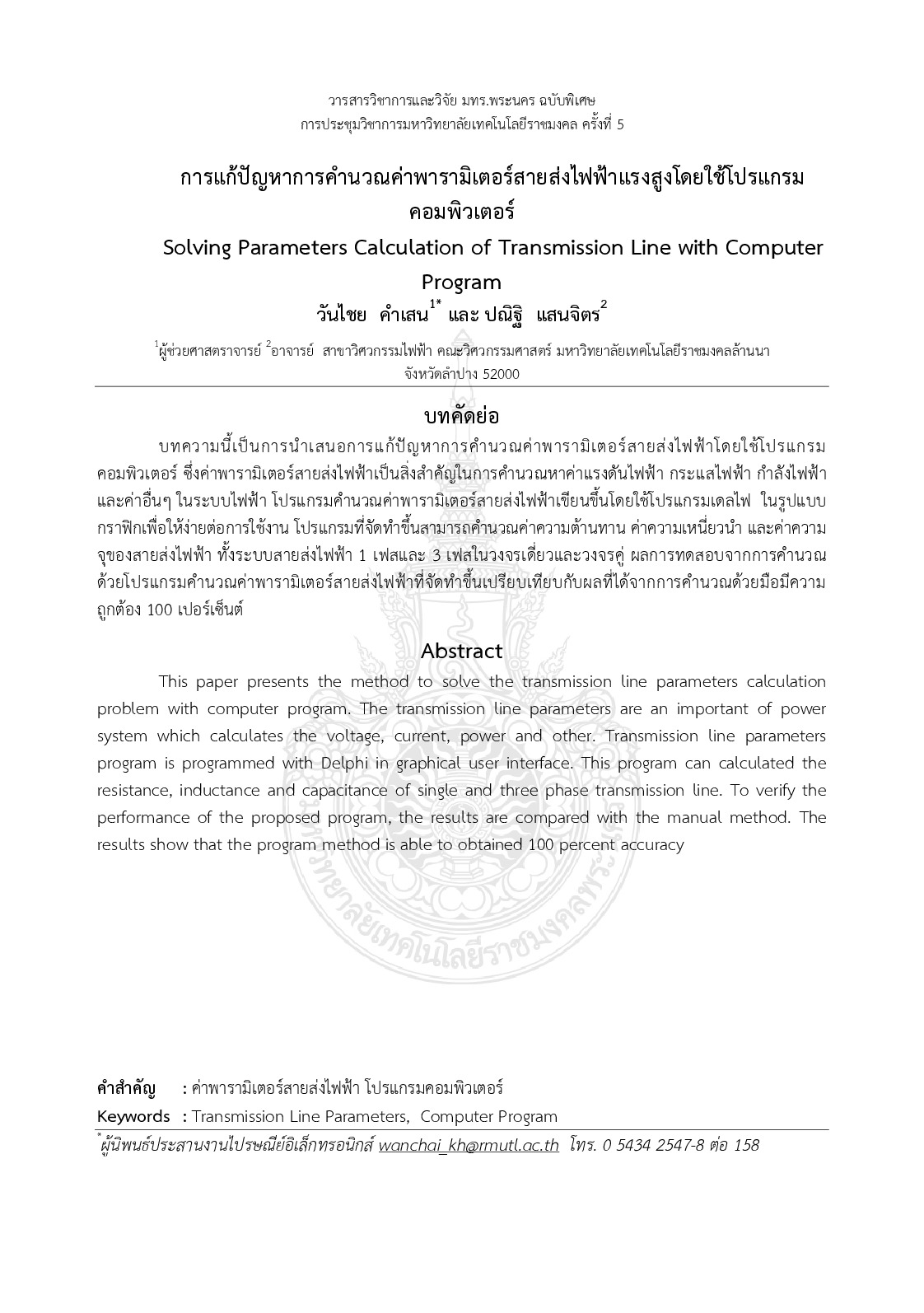
Solving parameters calculation of transmission line with computer program
This paper presents the method to solve the transmission line parameters calculation problem with computer program. The transmission line parameters are an important of power system which calculates the voltage current power and other. Transmission line parameters program is programmed with Delphi in graphical user interface. This program can calculated the resistance inductance and capacitance of single and three phase transmission line. To verify the performance of the proposed program the results are compared with the manual method. The results show that the program method is able to obtained 100 percent accuracy
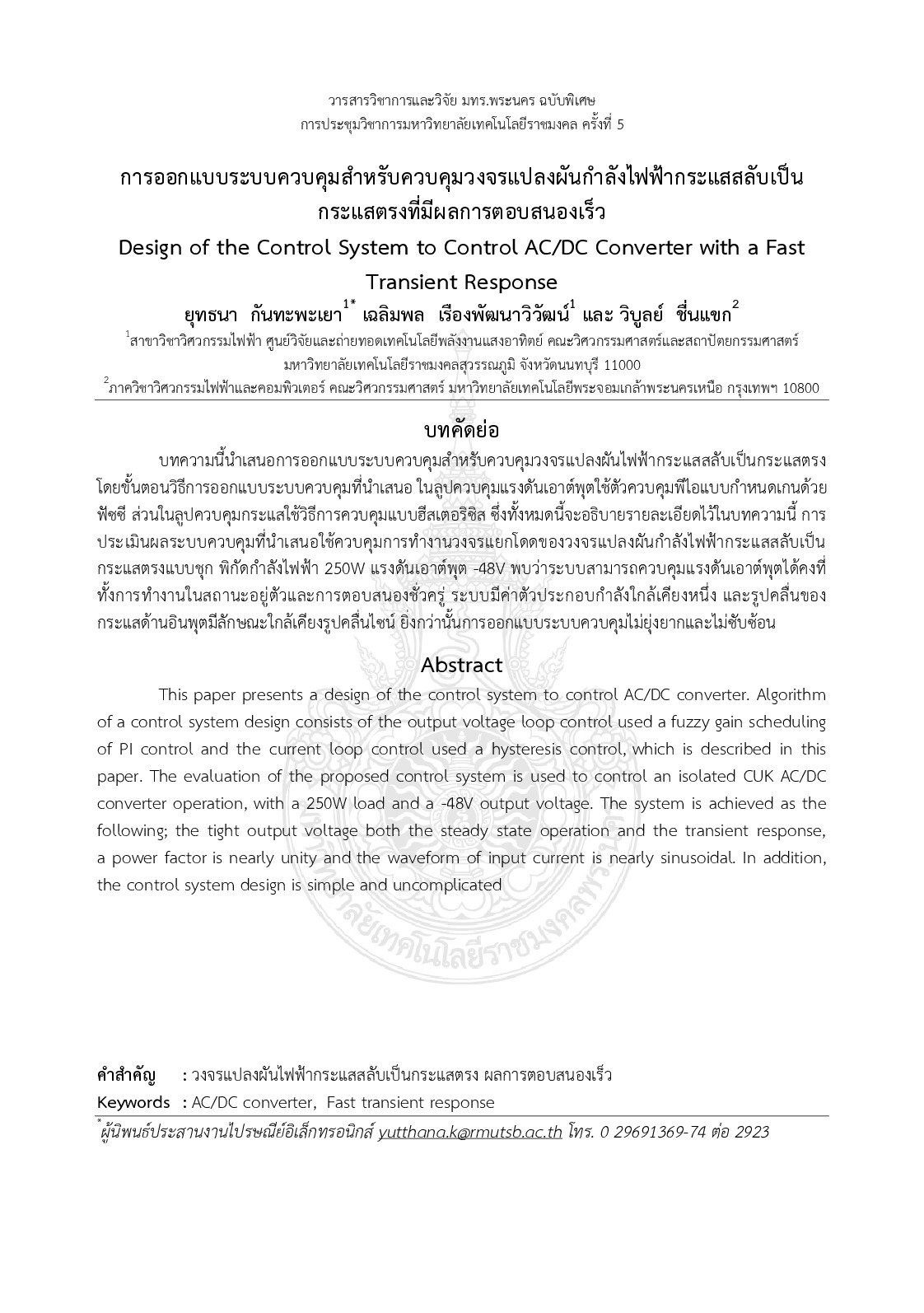
Design of the control system to control AC/DC converter with a fast transient response
This paper presents a design of the control system to control AC/DC converter. Algorithm of a control system design consists of the output voltage loop control used a fuzzy gain scheduling of PI control and the current loop control used a hysteresis control which is described in this paper. The evaluation of the proposed control system is used to control an isolated CUK AC/DC converter operation with a 250W load and a -48V output voltage. The system is achieved as the following; the tight output voltage both the steady state operation and the transient response a power factor is nearly unity and the waveform of input current is nearly sinusoidal. In addition the control system design is simple and uncomplicated
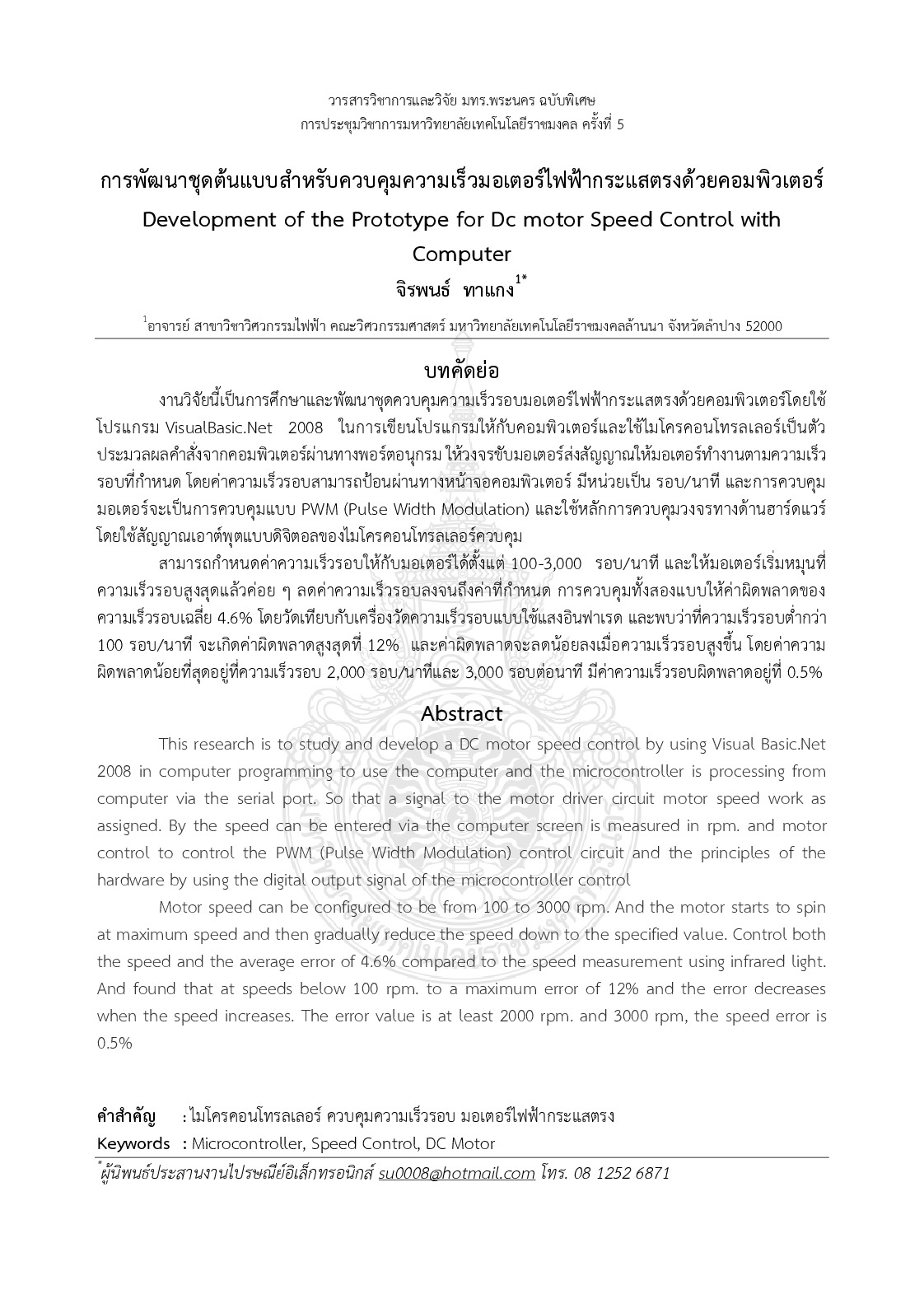
Development of the prototype for dc motor speed control with computer
This research is to study and develop a DC motor speed control by using Visual Basic.Net 2008 in computer programming to use the computer and the microcontroller is processing from computer via the serial port. So that a signal to the motor driver circuit motor speed work as assigned. By the speed can be entered via the computer screen is measured in rpm. and motor control to control the PWM (Pulse Width Modulation) control circuit and the principles of the hardware by using the digital output signal of the microcontroller control Motor speed can be configured to be from 100 to 3000 rpm. And the motor starts to spin at maximum speed and then gradually reduce the speed down to the specified value. Control both the speed and the average error of 4.6% compared to the speed measurement using infrared light. And found that at speeds below 100 rpm. to a maximum error of 12% and the error decreases when the speed increases. The error value is at least 2000 rpm. and 3000 rpm the speed error is 0.5%
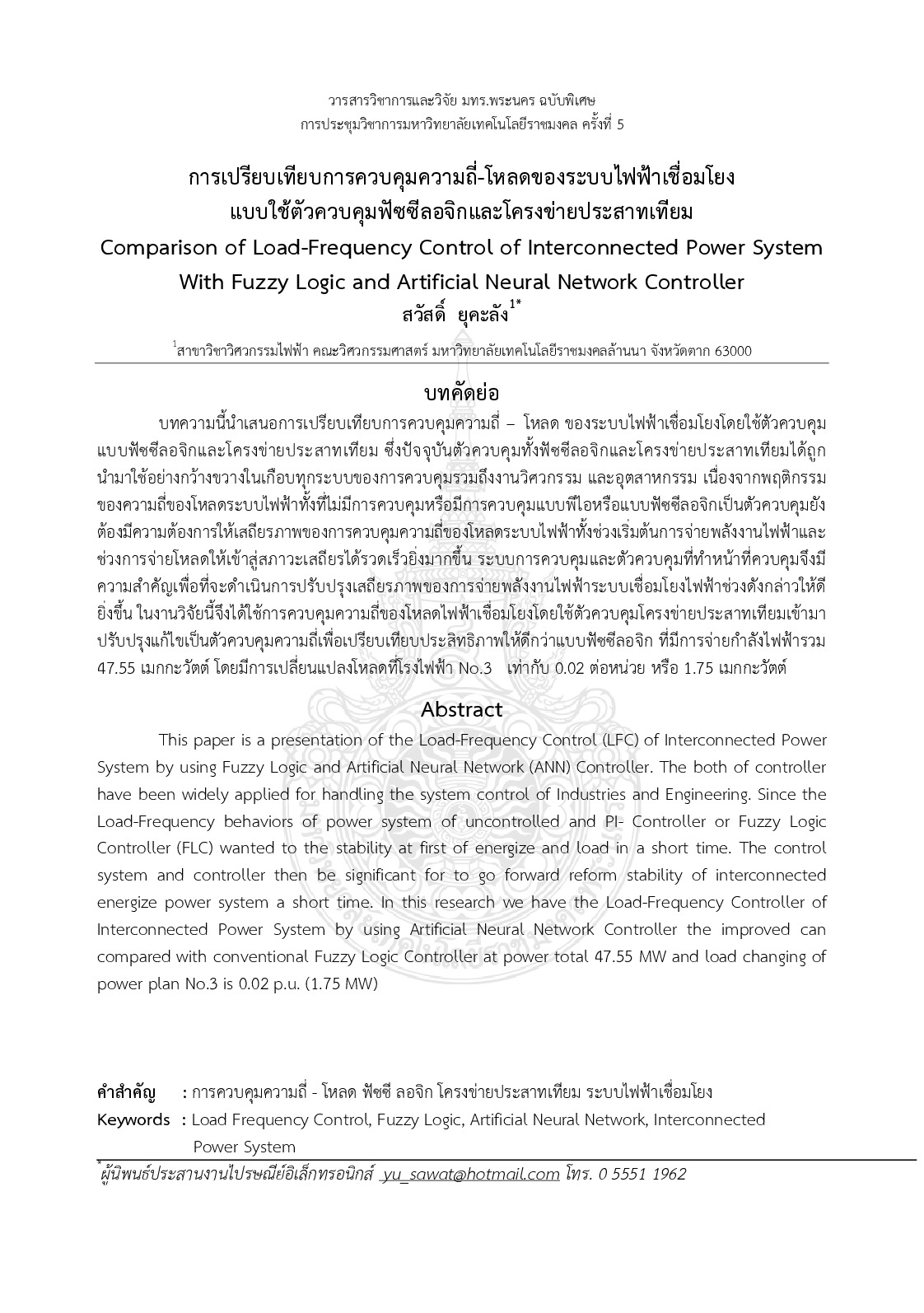
Comparison of load-frequency control of interconnected power system with fuzzy logic and artificial neural Network controller
This paper is a presentation of the Load-Frequency Control (LFC) of Interconnected Power System by using Fuzzy Logic and Artificial Neural Network (ANN) Controller. The both of controller have been widely applied for handling the system control of Industries and Engineering. Since the Load-Frequency behaviors of power system of uncontrolled and PI- Controller or Fuzzy Logic Controller (FLC) wanted to the stability at first of energize and load in a short time. The control system and controller then be significant for to go forward reform stability of interconnected energize power system a short time. In this research we have the Load-Frequency Controller of Interconnected Power System by using Artificial Neural Network Controller the improved can compared with conventional Fuzzy Logic Controller at power total 47.55 MW and load changing of power plan No.3 is 0.02 p.u. (1.75 MW)