จำนวน Repository ( 142 )
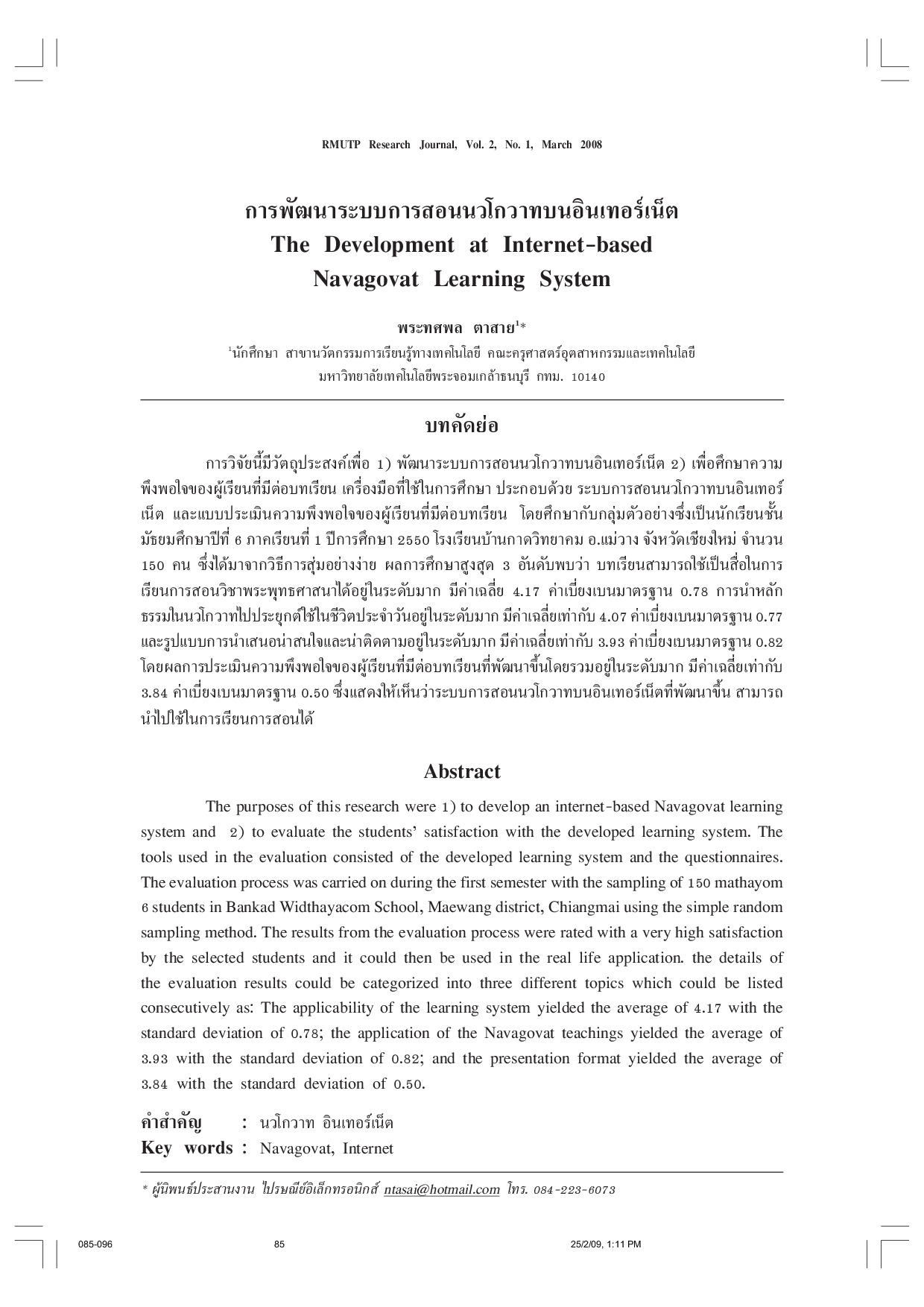
The Development at Internet-based Navagovat Learning System
The purposes of this research were 1) to develop an internet-based Navagovat learning system and 2) to evaluate the students’ satisfaction with the developed learning system. The tools used in the evaluation consisted of the developed learning system and the questionnaires. The evaluation process was carried on during the first semester with the sampling of 150 mathayom 6 students in Bankad Widthayacom School Maewang district Chiangmai using the simple random sampling method. The results from the evaluation process were rated with a very high satisfaction by the selected students and it could then be used in the real life application. the details of the evaluation results could be categorized into three different topics which could be listed consecutively as: The applicability of the learning system yielded the average of 4.17 with the standard deviation of 0.78; the application of the Navagovat teachings yielded the average of 3.93 with the standard deviation of 0.82; and the presentation format yielded the average of 3.84 with the standard deviation of 0.50.
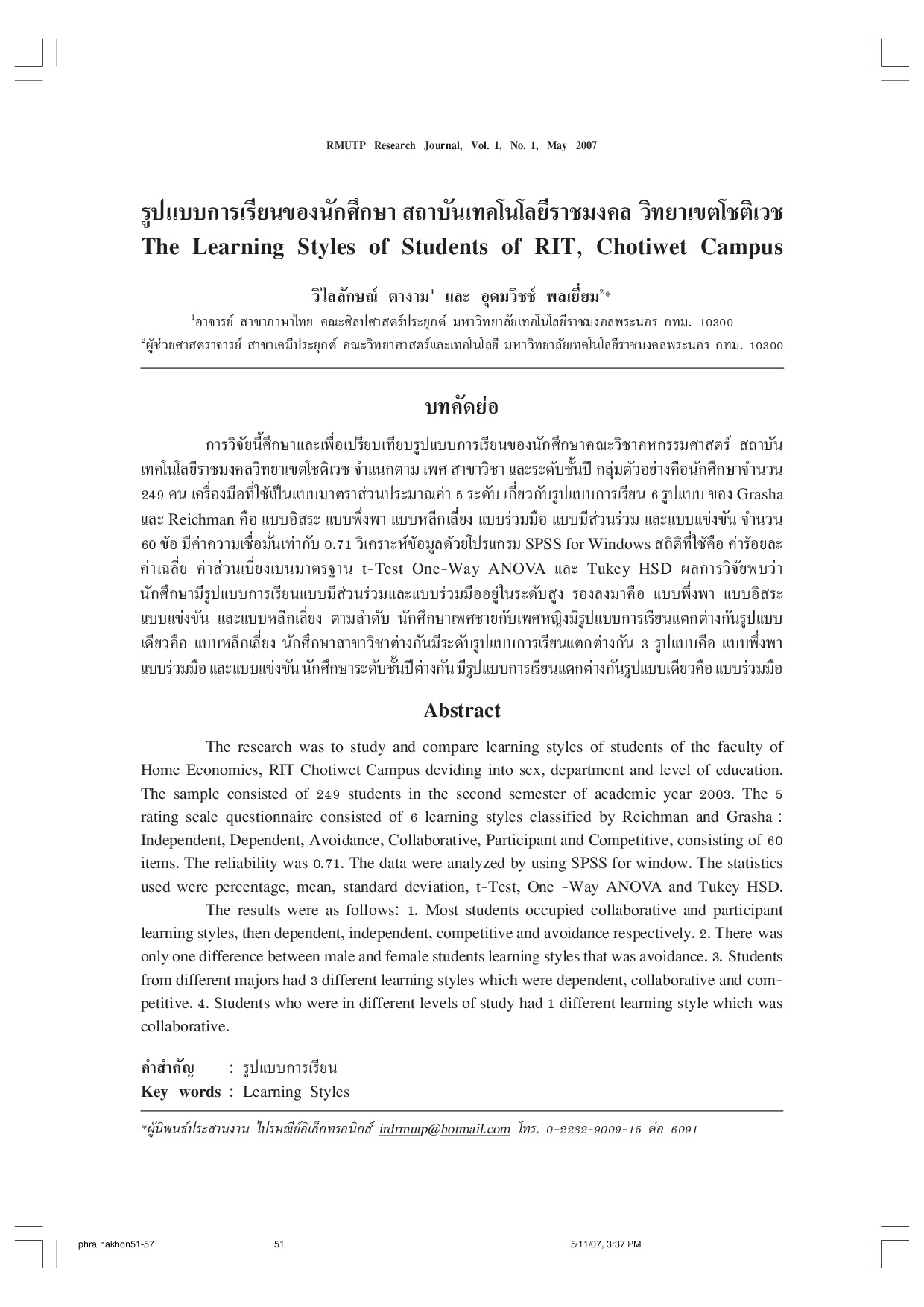
The Learning Styles of Students of RIT, Chotiwet Campus
The research was to study and compare learning styles of students of the faculty of Home Economics RIT Chotiwet Campus deviding into sex department and level of education. The sample consisted of 249 students in the second semester of academic year 2003. The 5 rating scale questionnaire consisted of 6 learning styles classified by Reichman and Grasha : Independent Dependent Avoidance Collaborative Participant and Competitive consisting of 60 items. The reliability was 0.71. The data were analyzed by using SPSS for window. The statistics used were percentage mean standard deviation t-Test One -Way ANOVA and Tukey HSD. The results were as follows: 1. Most students occupied collaborative and participant learning styles then dependent independent competitive and avoidance respectively. 2. There was only one difference between male and female students learning styles that was avoidance. 3. Students from different majors had 3 different learning styles which were dependent collaborative and competitive. 4. Students who were in different levels of study had 1 different learning style which was collaborative.
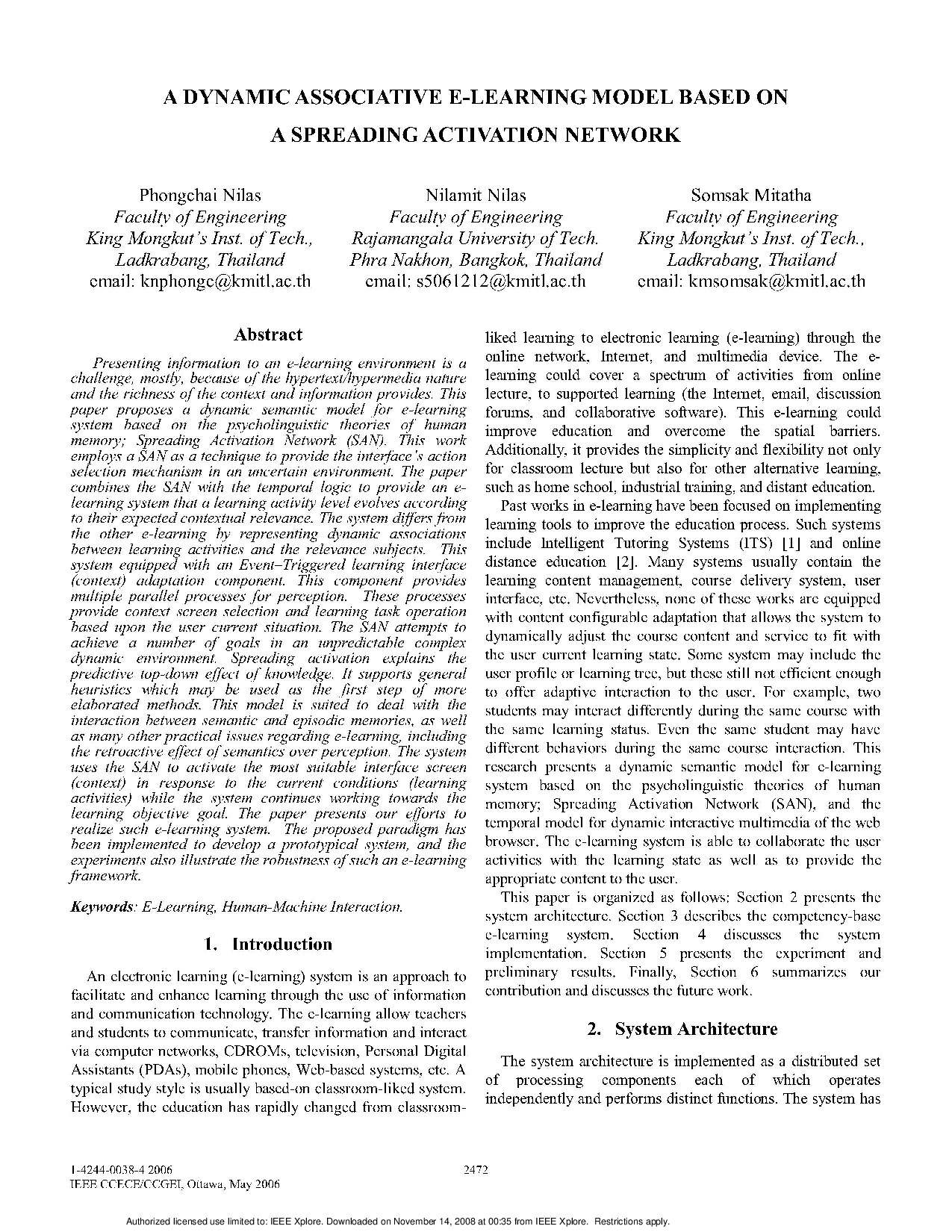
A Dynamic Associative e-learning model based on a spreading activation network
Presenting information to an e-learning environment is a challenge mostly because of the hypertext/hypermedia nature and the richness of the context and information provides. This paper proposes a dynamic semantic model for e-learning system based on the psycholinguistic theories of human memory Spreading Activation Network (SAN). This work employs a SAN as a technique to provide the interfaces action selection mechanism in an uncertain environment. The paper combines the SAN with the temporal logic to provide an e-learning system that a learning activity level evolves according to their expected contextual relevance. The system differs from the other e-learning by representing dynamic associations between learning activities and the relevance subjects. This system equipped with an Event-Triggered learning interface (context) adaptation component. This component provides multiple parallel processes for perception. These processes provide context screen selection and learning task operation based upon the user current situation. The SAN attempts to achieve a number of goals in an unpredictable complex dynamic environment. Spreading activation explains the predictive top-down effect of knowledge. It supports general heuristics which may be used as the first step of more elaborated methods. This model is suited to deal with the interaction between semantic and episodic memories as well as many other practical issues regarding e-learning including the retroactive effect of semantics over perception. The system uses the SAN to activate the most suitable interface screen (context) in response to the current conditions (learning activities) while the system continues working towards the learning objective goal. The paper presents our efforts to realize such e-learning system. The proposed paradigm has been implemented to develop a prototypical system and the experiments also illustrate the robustness of such an e-learning framework.
ความเครียดของนักศึกษาระดับปริญญาตรี ชั้นปีที่ 3 คณะบริหารธุรกิจ มหาวิทยาลัยเทคโนโลยีราชมงคลพระนคร
The objects of this research were (1) to study Third-Year Students’ stress at Faculty of Business Administration Rajamangala University of Technology Phra Nakhon. In Overall and each of four aspects: learning management study skills learning environment and relationship with classmate. (2) To compare stress of Third – Year Students Stress at Faculty of Business Administration. In overall and each aspect classified by gender major group grade point average (GPA) place of birth family economic status the inter personal relationship between student and parents child. The simple consisted of 439 Third – Year Students Stress at Faculty of Business Administration. The statistics used for analysis the data were frequency percentage mean standard deviation t-test one way analysis of variance and LSD. The result of the study revealed that: 1. Male and female students had significant different of stress on relationship with friends at .05 level. 2. Students with different major group had significant different on overall stress at .05 level. 3. Students with different grade point average (GPA) had significant different of stress on relationship with friends at .05 level. 4. Students with different family economic status had no different of stress. 5. Students with different place of birth had no different of stress. 6. Students with different interpersonal relationship patterns had no different of stress. 7. Students whose parents had different child rearing styles had different stress in learning management study skills and learning environment significant at .05 level.
ปัจจัยที่มีอิทธิพลต่อพฤติกรรมการดำเนินชีวิตของนักศึกษามหาวิทยาลัยเทคโนโลยีราชมงคลพระนคร ตามหลักปรัชญาเศรษฐกิจพอเพียง
This research aimed to study the lifestyle behavior of students of Rajamangala University of Technology Phra Nakhon according to the Sufficiency Economy Philosophy. To study the factors influencing the lifestyle behavior of students of Rajamangala University of Technology Phra Nakhon according to the Sufficiency Economy Philosophy. Data collection was conducted between October 2020 and September 2021. It was a survey research using questionnaires. It consists of 4 parts: 1) general information of students which are demographic characteristics 2) knowledge and understanding of the Sufficiency Economy Philosophy 3) lifestyle behavior according to the Sufficiency Economy Philosophy and 4) the students opinions on the adoption of the Sufficiency Economy Philosophy. Sufficiency Economy Philosophy is applied in life. The sample group in the research was students of the University of Technology. The data were analyzed using descriptive statistics for demographic characteristics. The results showed that Demographic data of students of Rajamangala University of Technology Phra Nakhon found that most of them were female aged 20 years studying at the Faculty of Business Administration in the 3rd year. Most of their parents were employed. Family income per month is 20001 – 30000 baht there are expenses per month. (Students only) is 3001 – 6000 baht per month and most students live at home during their studies. in the field of knowledge Understanding of Sufficiency Economy Philosophy Student at Rajamangala University of Technology Phra Nakhon most have knowledge Understanding of Sufficiency Economy Philosophy knowledge level is moderate and when classified according to demographic data show that Students of Rajamangala University of Technology Phra Nakhon with different demographic data knowledge and understanding of sufficiency economy philosophy Life behaviors according to the Sufficiency Economy Philosophy of students of Rajamangala University of Technology Phra Nakhon overall and in each aspect at a high level They can be sorted in descending order of average as follows: Moral conditions reasonableness good immunity moderation and knowledge conditions respectively.