จำนวน Repository ( 1852 )
Psycho-Social Factors Correlated to Instructors’ Behavior as a Principle of the Sufficiency Economy Philosophy
The purposes of this study were to compare interaction and predict power of psychosocial factors affecting instructors’ behavior with biosocial characteristics. The subjects comprised 300 instructors at Rajamangala University of Technology Phra Nakhon during the 2nd semester of 2009 academic year. Questionnaires were used in this research. Data were analyzed and presented by percentage mean standard deviation analysis of variance Scheffe’ Method and Stepwise Multiple Regression Analysis. The results revealed that Instructors with high behavior as a principle of the sufficiency economy philosophy were instructors with high work socialization and achievement motive and with high group of psycho-social factors. Most of them were female instructors. Moreover instructors’ behavior as a principle of the sufficiency economy philosophy were predicted by work socialization self-ability perception according to a principle of the sufficiency economy philosophy and achievement motive
Improving Soil Quality with Gypsum for Agricultural Sustainability
Gypsum is a substance derived from nature and some synthesis. Its structure consists of calcium ion (Ca2+) sulphate ion (SO4 2-) and molecules of H2O. Its formula is CaSO4.2H2O. From this structure gypsum is used in agriculture as soil conditioners especially acid soil and saline soil. The calcium ion will replace aluminium ion (Al3+) in acid soil and sodium ion (Na+) in saline soil. It is effective to reduce acidity salinity compaction in soil and increase friable condition which is suitable for agriculture. Moreover calcium and sulphur are the secondary nutrients for plants. Therefore the application of gypsum as soil conditioners will reduce soil deterioration increase agricultural profits conserve of soil relieve problem of agricultural areas and maintain our agricultural sustainability
Studying and product development of handicraft from elephant dung parer for addings income to community at Changwat Phra Nakhon Si Ayuttha
The research aimed to study and develop handicraft products from elephant dung paper for community income generation in Ayutthaya province and to compare the product satisfaction of the target group for the original style and the new one of elephant dung paper The target group eas from 143 tourists from other provinces and 143 of local tourists. Both of target groups would like to but handicraft products from elephant dung paper and helped generate community income in Ayutthaya province. Research tool eas done by questionnaire and data were analyzed by statistically percentage mean and mode. Questionnaire was used for the product attributes satisfacion avaluation of the target grouq including alternative evaluation process and comparison of product styles evaluation process. Data were analyzed by statistically percentage.mean and t-test dependent sample The results of were foun as follows: 1. The target group chose the third style of handicraft products from elephant dung paper 2. For the product attributs satisfaction of the target group it was found that the new style of hansicraft prosuct was more acceptable than the oniginal one at a significance level of 0.05.
Design and Product Dvevlopment Ceramics using for making wall of Energy conservation building
Ceramics Porduct Develompnet Ceramics
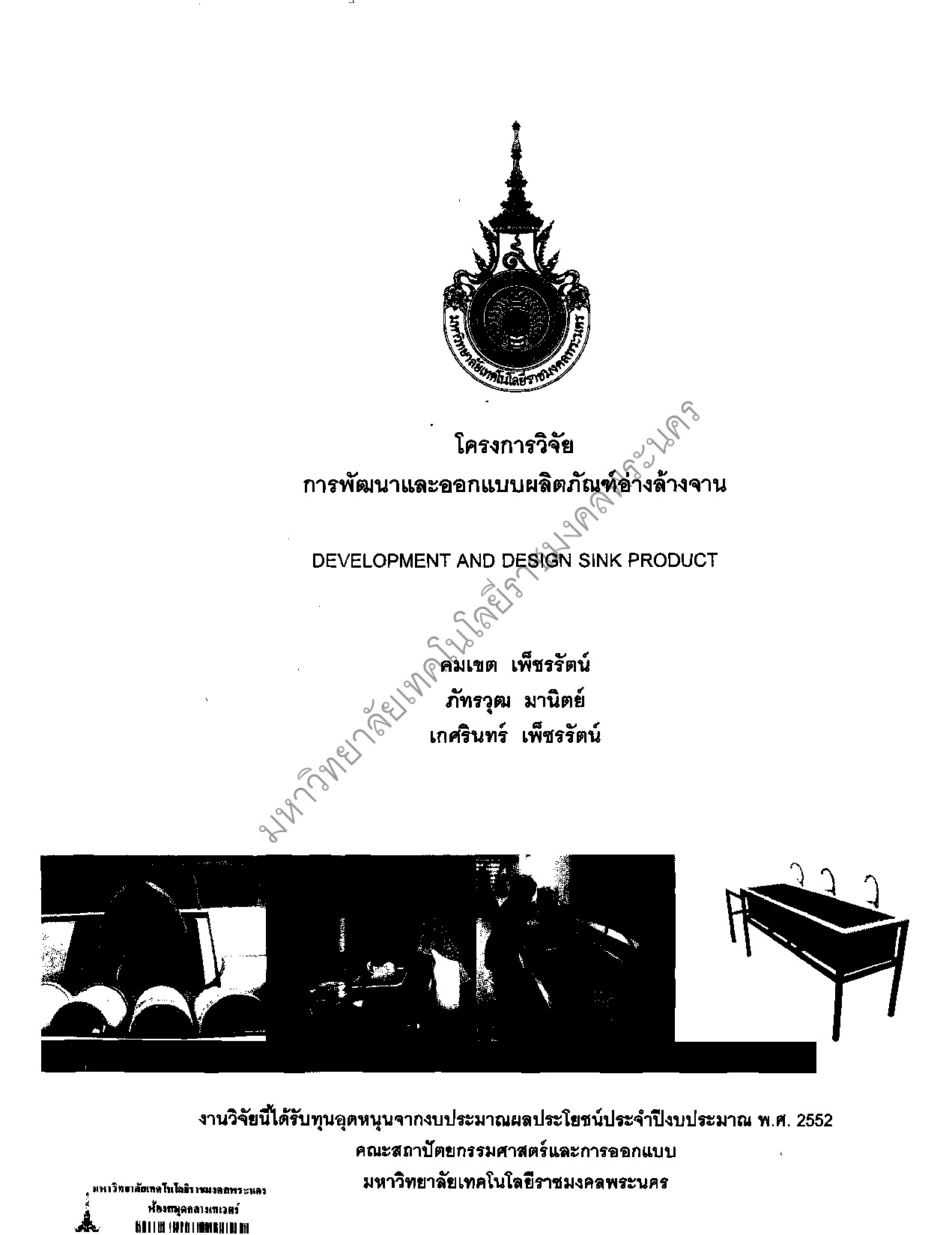
Development and Design Sink Product
The main objective of the study was to explore The relationship of cleaning the container behavior with sink space guide line for sink product. This research an integration of field survey and quasi-experimental techniques were utilized to people who live in condominium in Bangkok and preference assessment of Thai sink product by ninety seven users. This research based on work triangle and evaluation environment for cooking in condominium by experimental. And attitudes expectation of Thai sink product prototype. Variables were used in the framework of this study: size and spatial characteristics of each area understudied for washing in sink. The sizes of areas which could optimally accommodate such activities were derived from eleven cases of experimentation. Other than body size and the extent of disability the study also found that variation in area size was determined by additional factors such as types of activities approach to the area and the individuals skill for that particular activity. Intervening variables such as fatigues after prolonged and repeated tests were found partially affected the results of experiments and attitudes toward the environment and the extent of difficulty to perform each task. The final analysis of the attitude toward the suggested sink product modification was done using data collected from ninety seven users respondents accompanying the disabled. The sink product modification to accommodate all users inclUding the disabled members of the family in accordance with the former environment. The study found however that the extent of intimacy with the disabled significantly determined towards sink product modification. In conclusion the study suggested that conditional application of sink production modification according to the nature of the disabled-in terms of social psychology familial background the extent of disability and the specific needs required by each of the canteen.