จำนวน Repository ( 2131 )
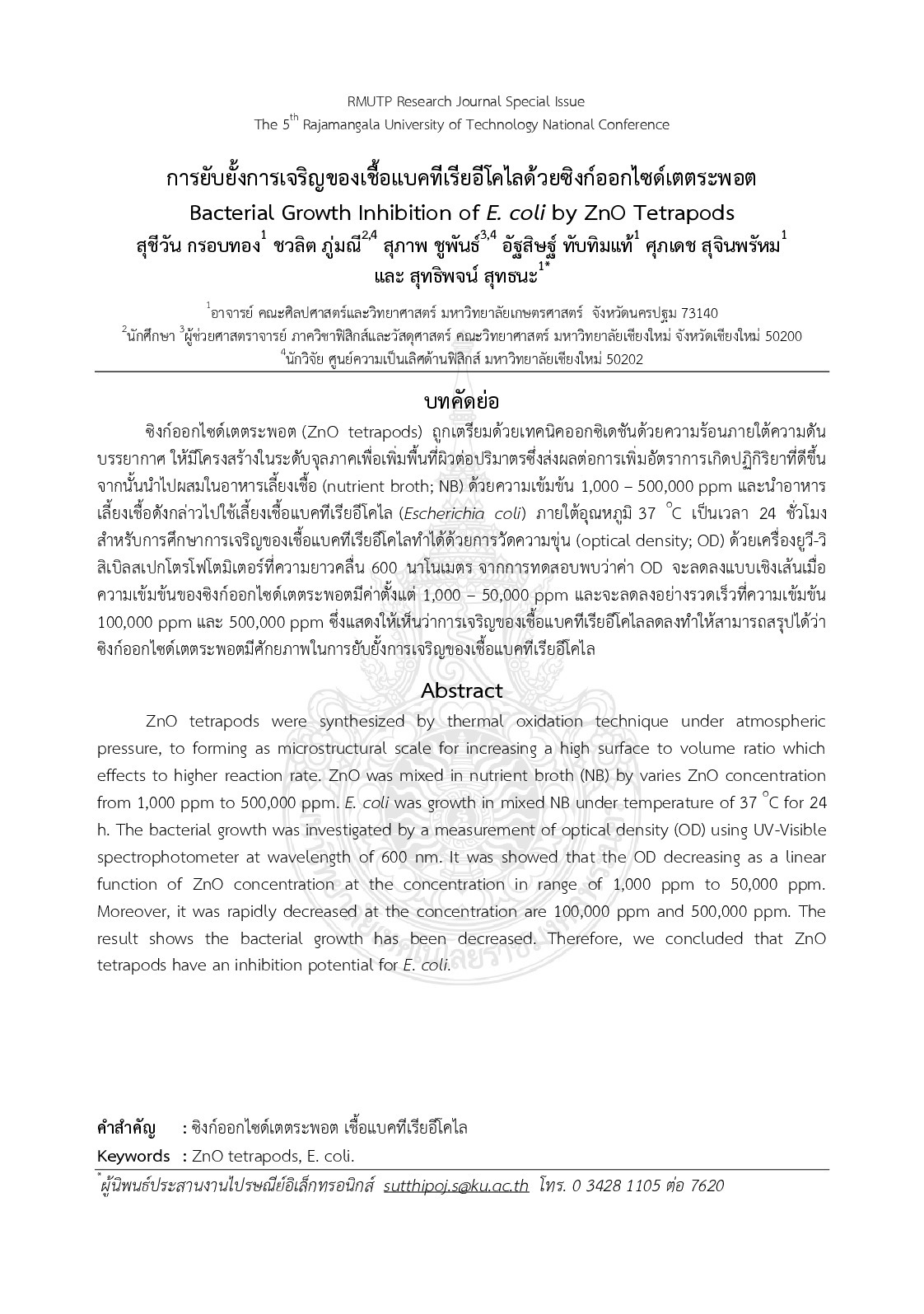
Bacterial growth inhibition of e. coli by zno tetrapods
ZnO tetrapods were synthesized by thermal oxidation technique under atmospheric pressure to forming as microstructural scale for increasing a high surface to volume ratio which effects to higher reaction rate. ZnO was mixed in nutrient broth (NB) by varies ZnO concentration from 1000 ppm to 500000 ppm. E. coli was growth in mixed NB under temperature of 37 oC for 24 h. The bacterial growth was investigated by a measurement of optical density (OD) using UV-Visible spectrophotometer at wavelength of 600 nm. It was showed that the OD decreasing as a linear function of ZnO concentration at the concentration in range of 1000 ppm to 50000 ppm. Moreover it was rapidly decreased at the concentration are 100000 ppm and 500000 ppm. The result shows the bacterial growth has been decreased. Therefore we concluded that ZnO tetrapods have an inhibition potential for E. coli.
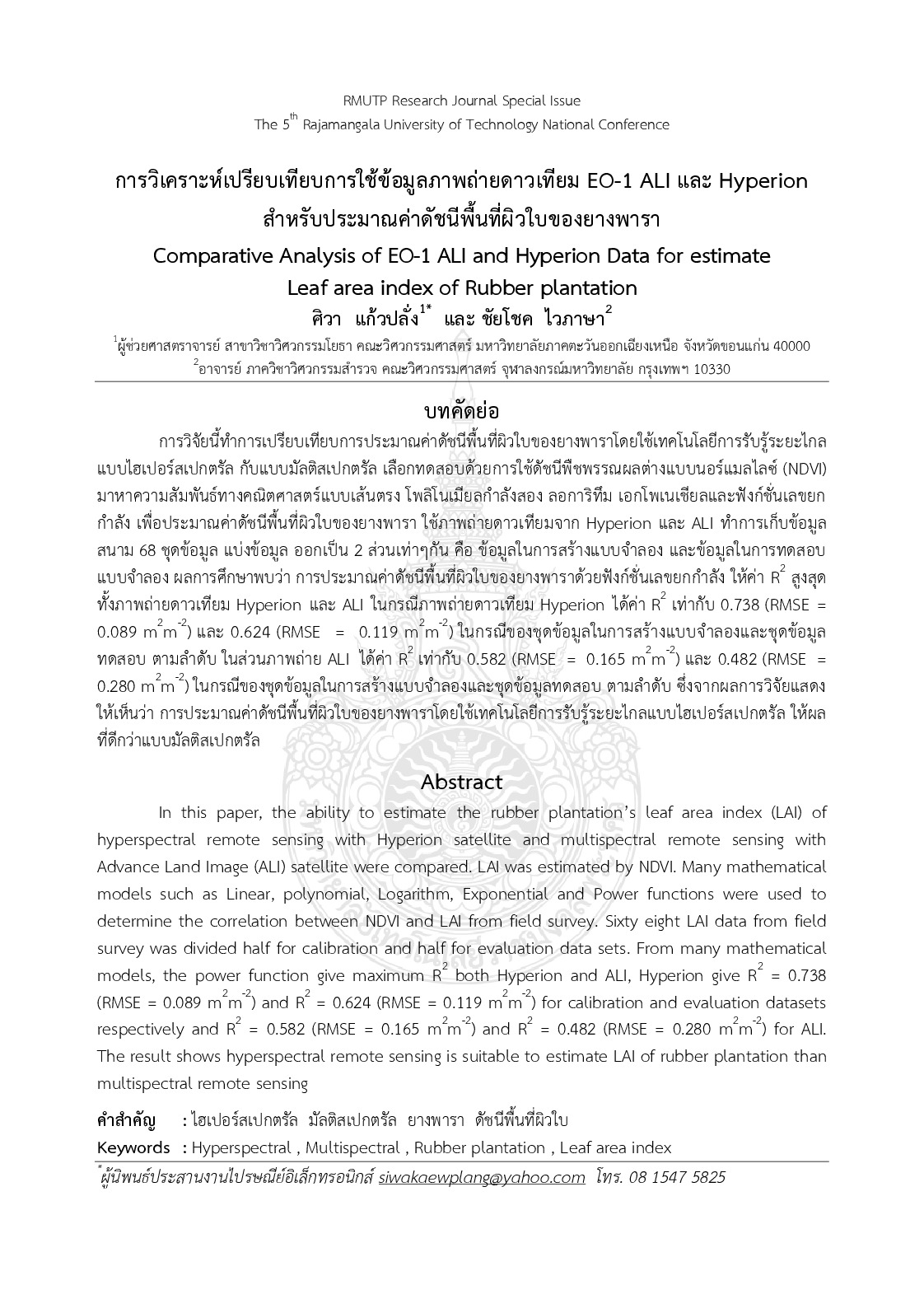
Comparative analysis of EO-1 ALI and Hyperion data for estimate leaf area index of rubber plantation
In this paper the ability to estimate the rubber plantation’s leaf area index (LAI) of hyperspectral remote sensing with Hyperion satellite and multispectral remote sensing with Advance Land Image (ALI) satellite were compared. LAI was estimated by NDVI. Many mathematical models such as Linear polynomial Logarithm Exponential and Power functions were used to determine the correlation between NDVI and LAI from field survey. Sixty eight LAI data from field survey was divided half for calibration and half for evaluation data sets. From many mathematical models the power function give maximum R2 both Hyperion and ALI Hyperion give R2 = 0.738 (RMSE = 0.089 m2m-2) and R2 = 0.624 (RMSE = 0.119 m2m-2) for calibration and evaluation datasets respectively and R2 = 0.582 (RMSE = 0.165 m2m-2) and R2 = 0.482 (RMSE = 0.280 m2m-2) for ALI. The result shows hyperspectral remote sensing is suitable to estimate LAI of rubber plantation than multispectral remote sensing
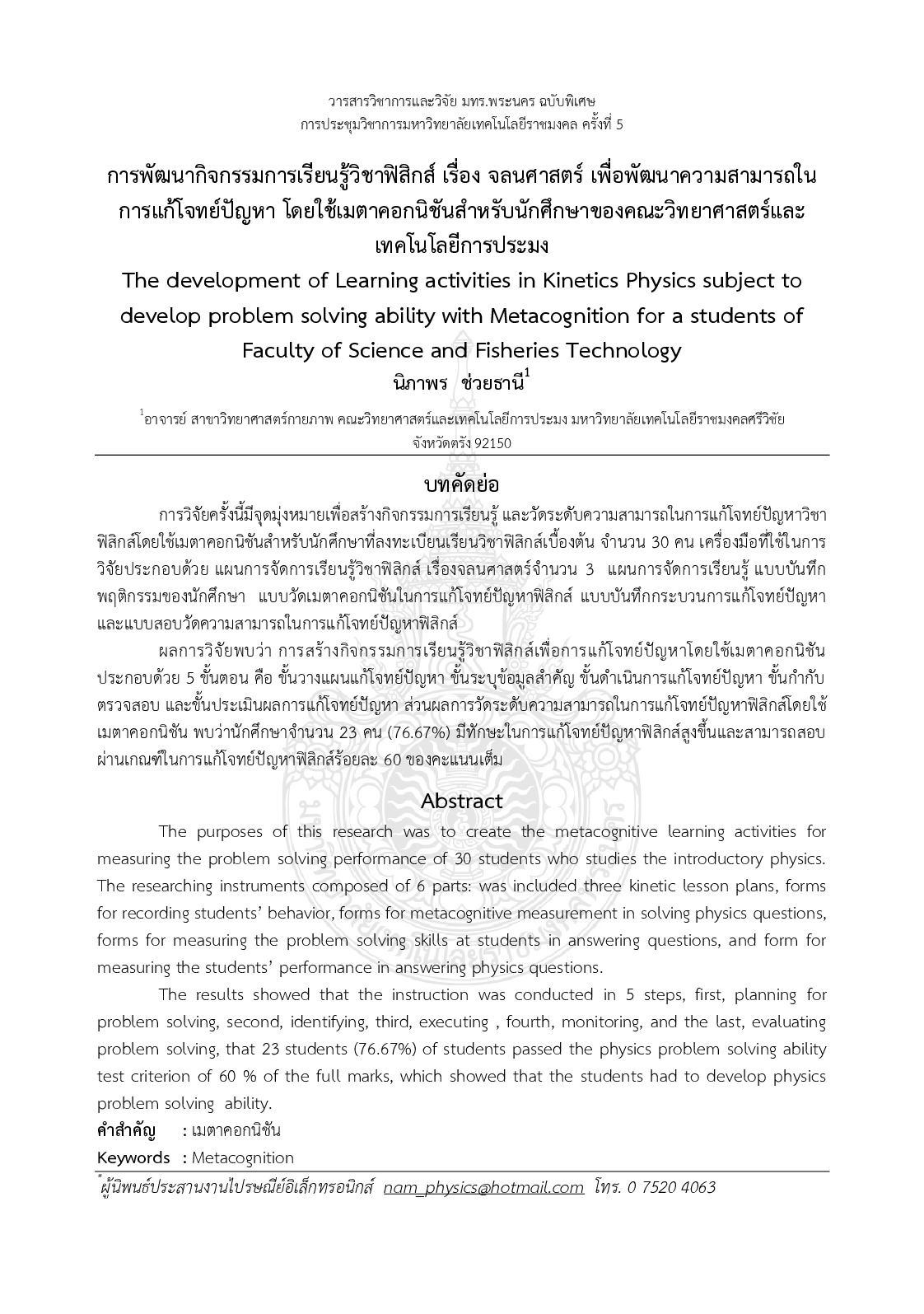
The development of learning activities in kinetics physics subject to develop problem solving ability with metacognition for a students of faculty of science and fisheries technology
The purposes of this research was to create the metacognitive learning activities for measuring the problem solving performance of 30 students who studies the introductory physics. The researching instruments composed of 6 parts: was included three kinetic lesson plans forms for recording students’ behavior forms for metacognitive measurement in solving physics questions forms for measuring the problem solving skills at students in answering questions and form for measuring the students’ performance in answering physics questions. The results showed that the instruction was conducted in 5 steps first planning for problem solving second identifying third executing fourth monitoring and the last evaluating problem solving that 23 students (76.67%) of students passed the physics problem solving ability test criterion of 60 % of the full marks which showed that the students had to develop physics problem solving ability.
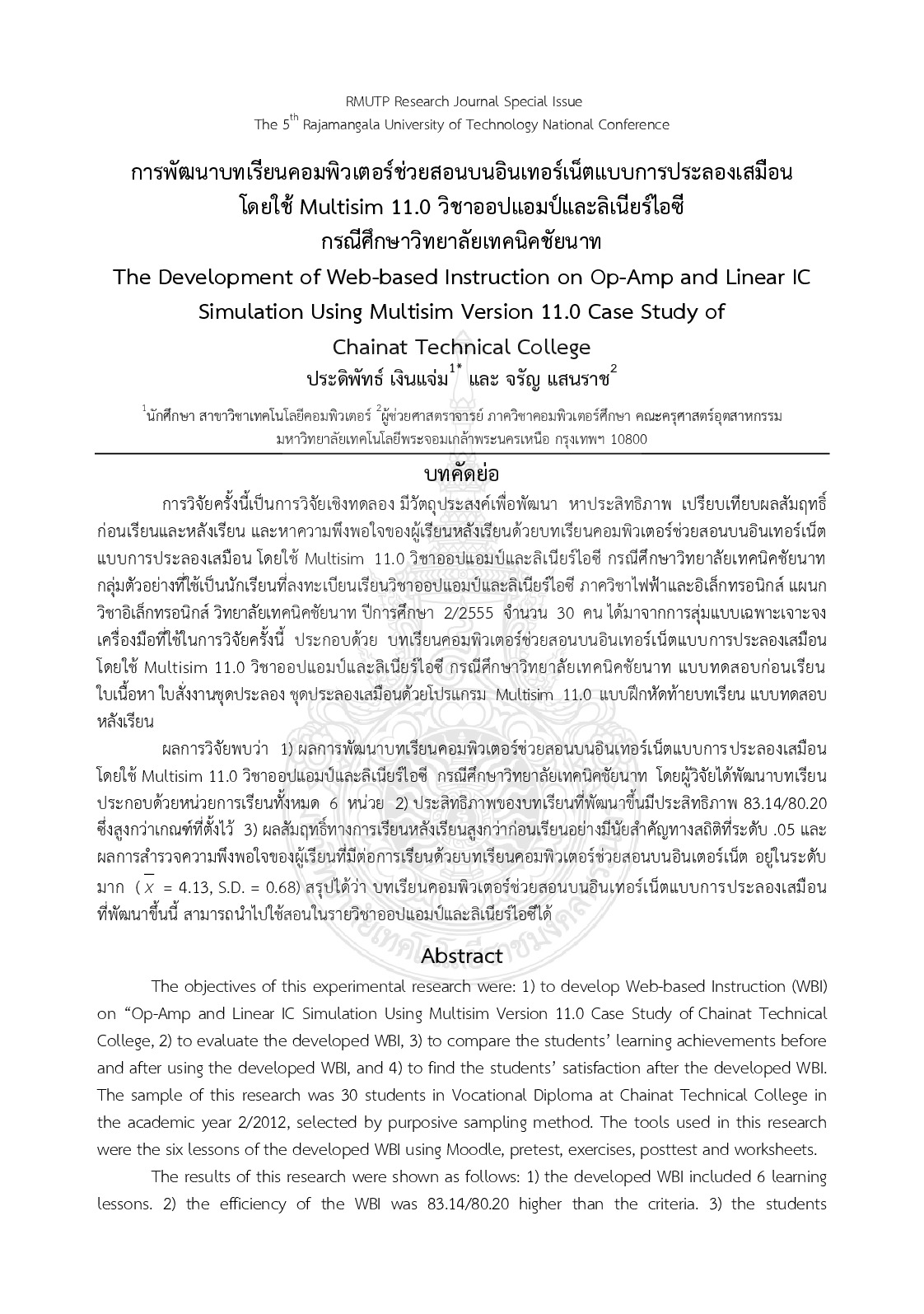
The development of web-based instruction on op-amp and linear IC simulation using multisim version 11.0 case study of chainat technical college
The objectives of this experimental research were: 1) to develop Web-based Instruction (WBI) on “Op-Amp and Linear IC Simulation Using Multisim Version 11.0 Case Study of Chainat Technical College 2) to evaluate the developed WBI 3) to compare the students’ learning achievements before and after using the developed WBI and 4) to find the students’ satisfaction after the developed WBI. The sample of this research was 30 students in Vocational Diploma at Chainat Technical College in the academic year 2/2012 selected by purposive sampling method. The tools used in this research were the six lessons of the developed WBI using Moodle pretest exercises posttest and worksheets. The results of this research were shown as follows: 1) the developed WBI included 6 learning lessons. 2) the efficiency of the WBI was 83.14/80.20 higher than the criteria. 3) the students effectiveness after using the developed WBI was significantly higher than before using it at .05. 4) the students’ satisfaction was at a good level. In conclusion the developed WBI can be used for the target group properly.
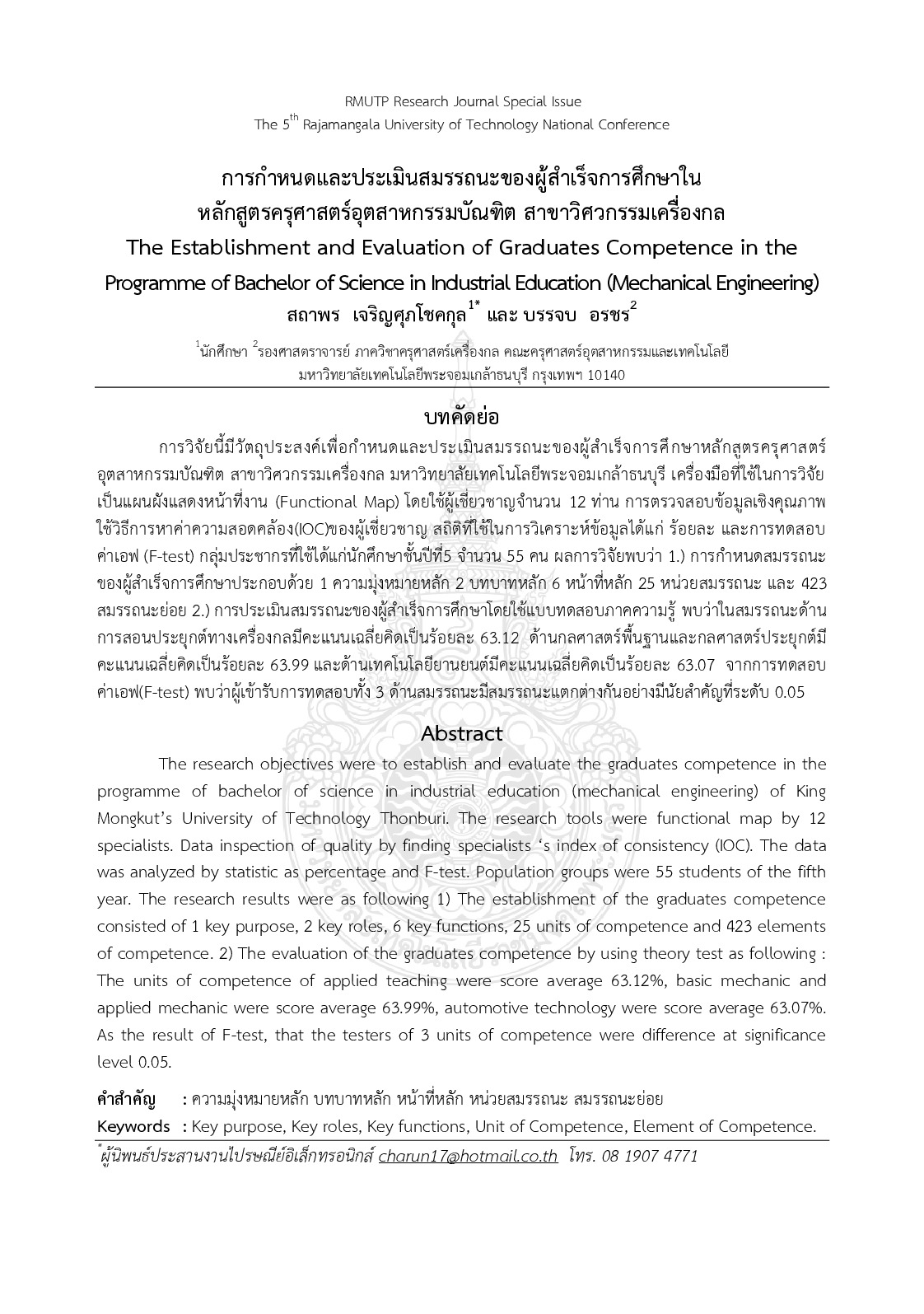
The establishment and evaluation of graduates competence in the programme of bachelor of science in industrial education (mechanical engineering)
The research objectives were to establish and evaluate the graduates competence in the programme of bachelor of science in industrial education (mechanical engineering) of King Mongkut’s University of Technology Thonburi. The research tools were functional map by 12 specialists. Data inspection of quality by finding specialists ‘s index of consistency (IOC). The data was analyzed by statistic as percentage and F-test. Population groups were 55 students of the fifth year. The research results were as following 1) The establishment of the graduates competence consisted of 1 key purpose 2 key roles 6 key functions 25 units of competence and 423 elements of competence. 2) The evaluation of the graduates competence by using theory test as following : The units of competence of applied teaching were score average 63.12% basic mechanic and applied mechanic were score average 63.99% automotive technology were score average 63.07%. As the result of F-test that the testers of 3 units of competence were difference at significance level 0.05.