จำนวน Repository ( 198 )
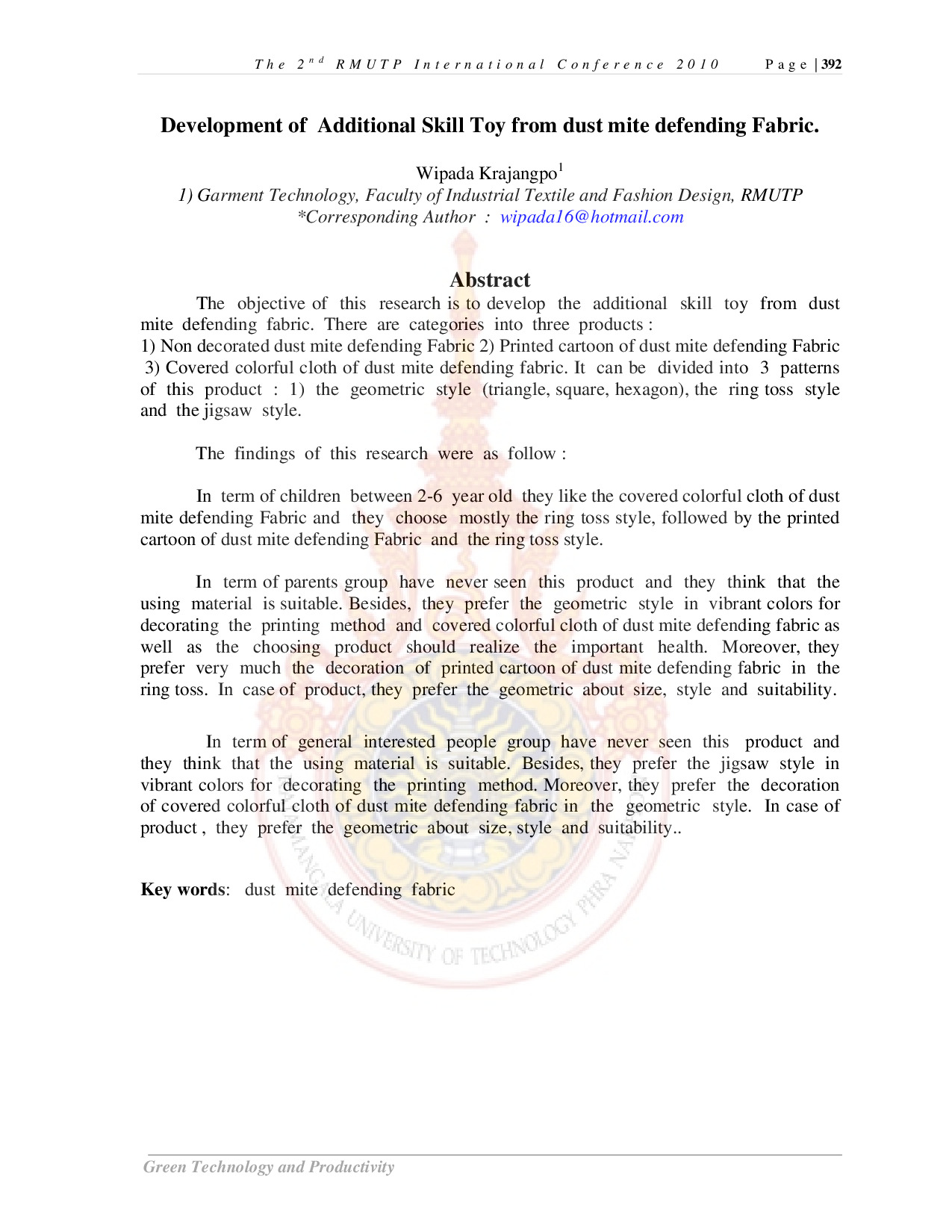
Development of Additional Skill Toy from dust mite defending Fabric.
The objective of this research is to develop the additional skill toy from dust mite defending fabric. There are categories into three products : 1) Non decorated dust mite defending Fabric 2) Printed cartoon of dust mite defending Fabric 3) Covered colorful cloth of dust mite defending fabric. It can be divided into 3 patterns of this product : 1) the geometric style (triangle square hexagon) the ring toss style and the jigsaw style. The findings of this research were as follow : In term of children between 2-6 year old they like the covered colorful cloth of dust mite defending Fabric and they choose mostly the ring toss style followed by the printed cartoon of dust mite defending Fabric and the ring toss style. In term of parents group have never seen this product and they think that the using material is suitable. Besides they prefer the geometric style in vibrant colors for decorating the printing method and covered colorful cloth of dust mite defending fabric as well as the choosing product should realize the important health. Moreover they prefer very much the decoration of printed cartoon of dust mite defending fabric in the ring toss. In case of product they prefer the geometric about size style and suitability. In term of general interested people group have never seen this product and they think that the using material is suitable. Besides they prefer the jigsaw style in vibrant colors for decorating the printing method. Moreover they prefer the decoration of covered colorful cloth of dust mite defending fabric in the geometric style. In case of product they prefer the geometric about size style and suitability..
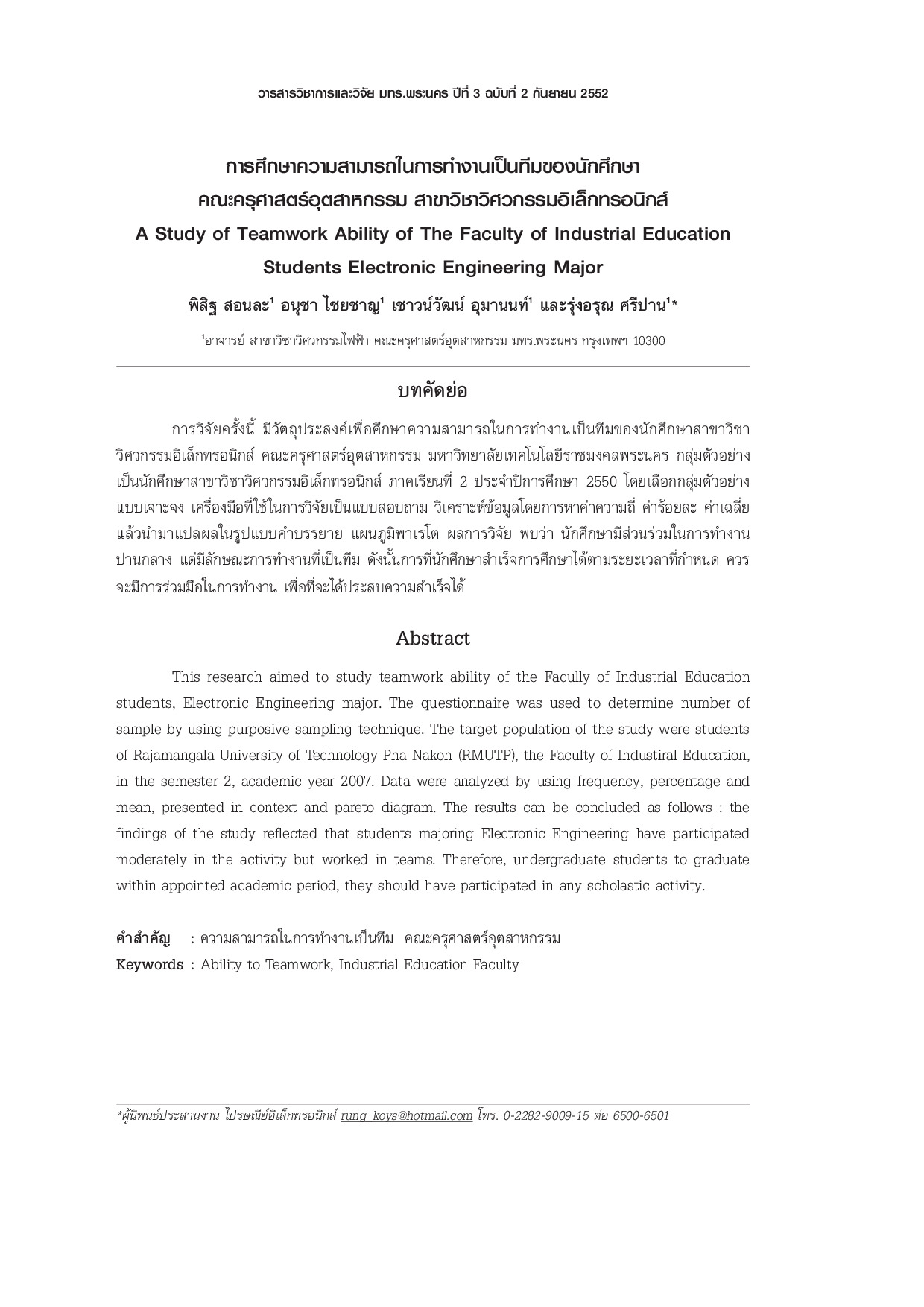
A Study of Teamwork Ability of The Faculty of Industrial Education Students Electronic Engineering Major
This research aimed to study teamwork ability of Facully of Industrial Education students Electronic Engineering major. The questionnaire was used to determine number of sample by using purposive sampling technique. The target population of the study were students of Rajamangala University of Technology Pha Nakon (RMUTP) the Faculty of Industiral Education in the semester 2 academic year 2007. Data were analyzed by using frequency percentage and mean presented in context and pareto diagram. The results can be concluded as follows: the findings of the study reflected that students majoring Electronic Engineering have participated moderately in the activity but worked in teams. Therefore undergraduate students to graduate within appointed academic period they should have participated in any scholastic activity.
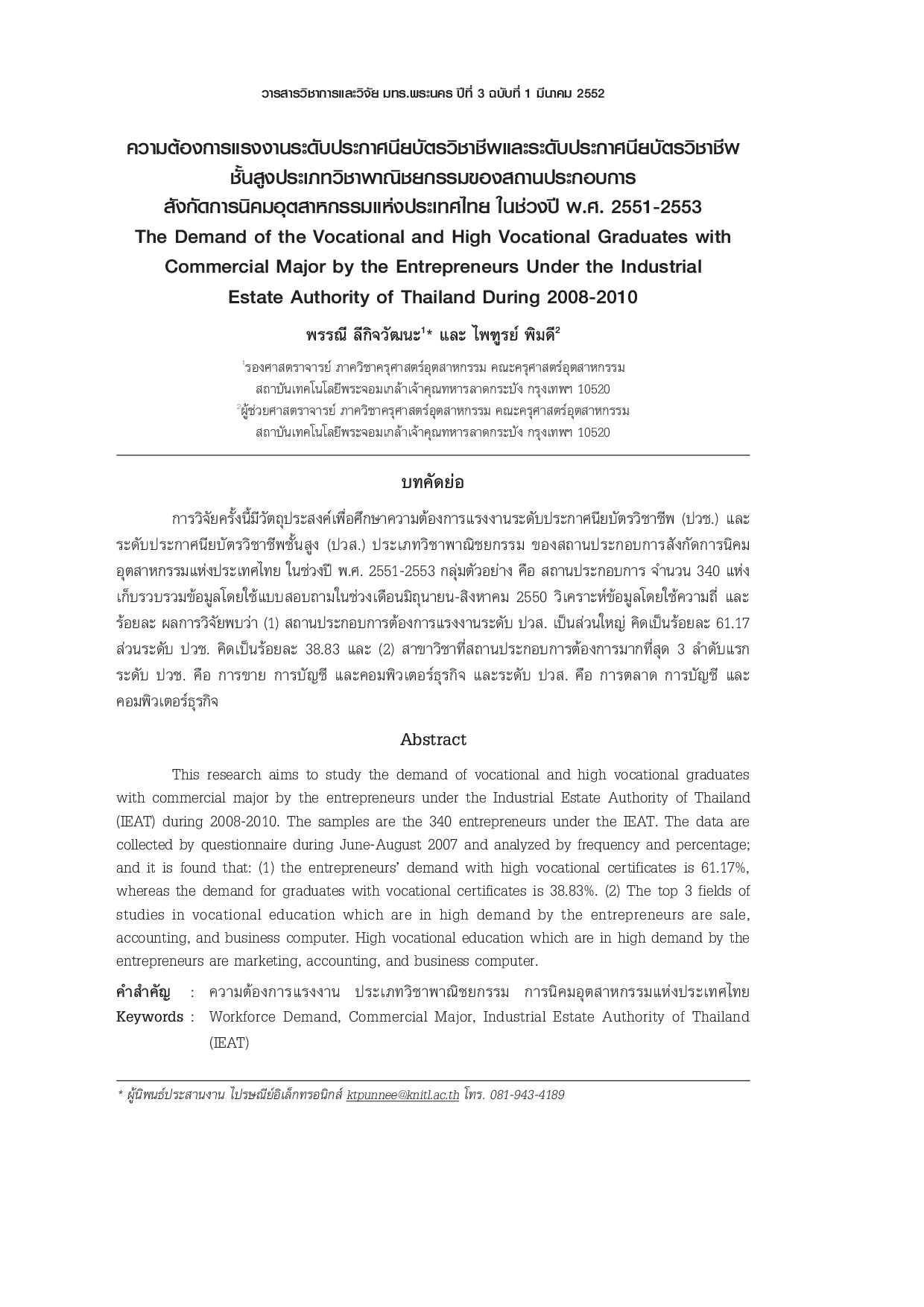
The Demand of the Vocational and High Vocational Graduates with Commercial Major by the Entrepreneurs Under the Industrial Estate Authority of Thailand During 2008-2010
This research aims to study the demand of vocational and high vocational graduates with commercial major by the entrepreneurs under the Industrial Estate Authority of Thailand (IEAT) during 2008-2010. The samples are the 340 entrepreneurs under the IEAT. The data are collected by questionnaire during June-August 2007 and analyzed by frequency and percentage; and it is found that: (1) the entrepreneurs’ demand with high vocational certificates is 61.17% whereas the demand for graduates with vocational certificates is 38.83%. (2) The top 3 fields of studies in vocational education which are in high demand by the entrepreneurs are sale accounting and business computer. High vocational education which are in high demand by the entrepreneurs are marketing accounting and business computer.
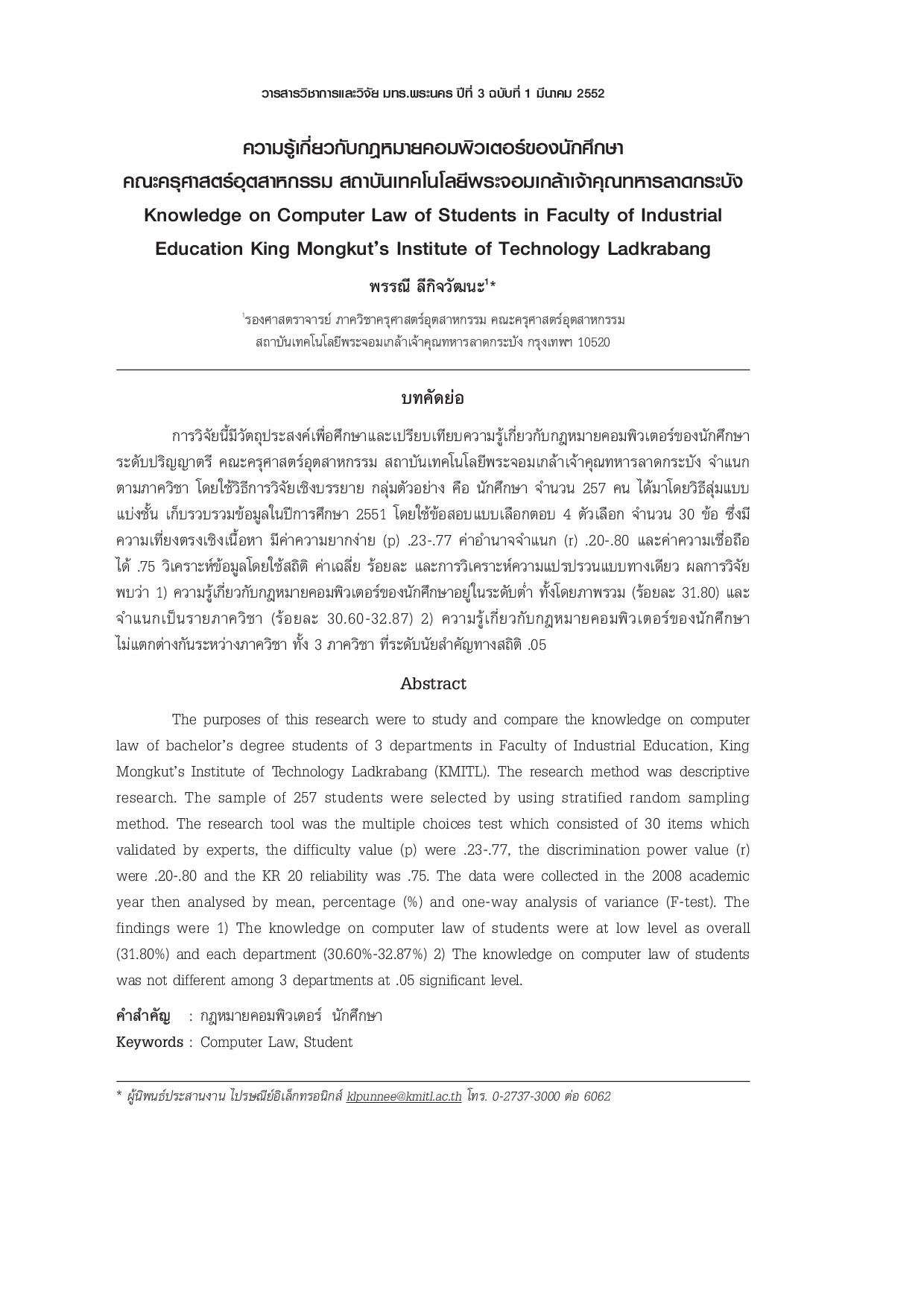
Knowledge on Computer Law of Students in Faculty of Industrial Education King Mongkut’s Institute of Technology Ladkrabang
The purposes of this research were to study and compare the knowledge on computer law of bachelor’s degree students of 3 departments in Faculty of Industrial Education King Mongkut’s Institute of Technology Ladkrabang (KMITL). The research method was descriptive research. The sample of 257 students were selected by using stratified random sampling method. The research tool was the multiple choices test which consisted of 30 items which validated by experts. the difficulty value (p) were 23 - 77 the discrimination power value (r) were 20 - 80 and the KR 20 reliability was .75. The data were collected in the 2008 academic year then analysed by mean percentage (%) and one-way analysis of variance (F-test). The findings were 1) The knowledge on computer law of students were at low level as overall (31.80%) and each department (30.60%-32.87%) 2) The knowledge on computer law of students was not different among 3 departments at .05 significant level.
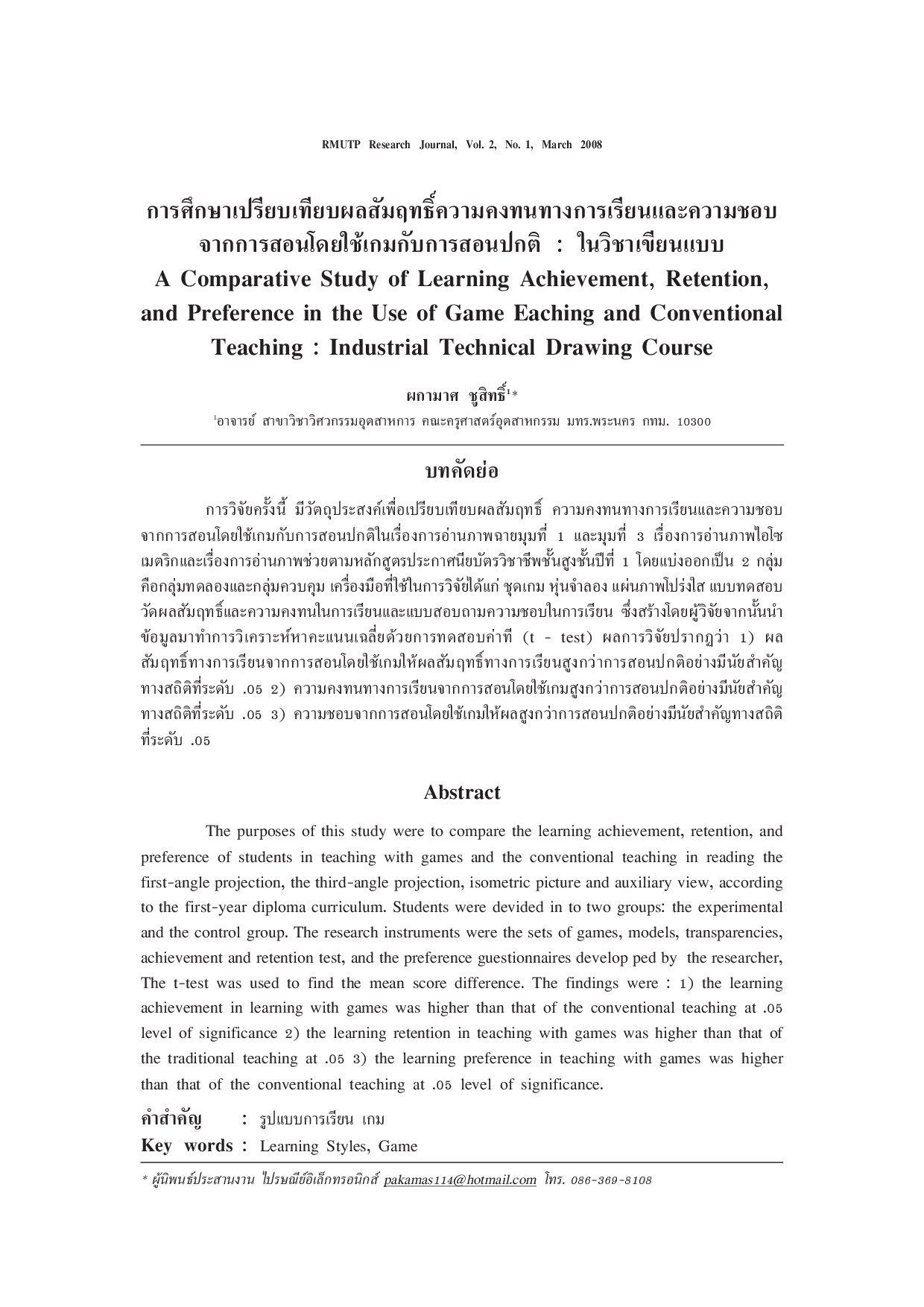
A Comparative Study of Learning Achievement, Retention, and Preference in the Use of Game Eaching and Conventional Teaching : Industrial Technical Drawing Course
The purposes of this study were to compare the learning achievement retention and preference of students in teaching with games and the conventional teaching in reading the first-angle projection the third-angle projection isometric picture and auxiliary view according to the first-year diploma curriculum. Students were devided in to two groups: the experimental and the control group. The research instruments were the sets of games models transparencies achievement and retention test and the preference guestionnaires develop ped by the researcher The t-test was used to find the mean score difference. The findings were : 1) the learning achievement in learning with games was higher than that of the conventional teaching at .05 level of significance 2) the learning retention in teaching with games was higher than that of the traditional teaching at .05 3) the learning preference in teaching with games was higher than that of the conventional teaching at .05 level of significance.