จำนวน Repository ( 167 )

Study on the correlation between the degree of milling on quality of rice
The objectives of this research were to find the correlation between the milling degree and the milling quality of rice which was the basic data to investigate the milling degree equipment. Chainat 1 and KDML 105 rice varieties were milled at difference degree of milling (DOM) which calculated from bran removed. The study revealed that as the DOM increase the milled rice and head rice decreases. Therefore the whiteness transparency and milling degree of milled rice which was measured from Milling Meter also increased. When the DOM increased the whiteness transparency and milling degree also increased. The DOM had highly correlation not only to milled rice and bran but also to milling degree from Milling Meter at R2=0.99 and R2=0.97. So these correlations could be used to investigate the milling degree equipment.
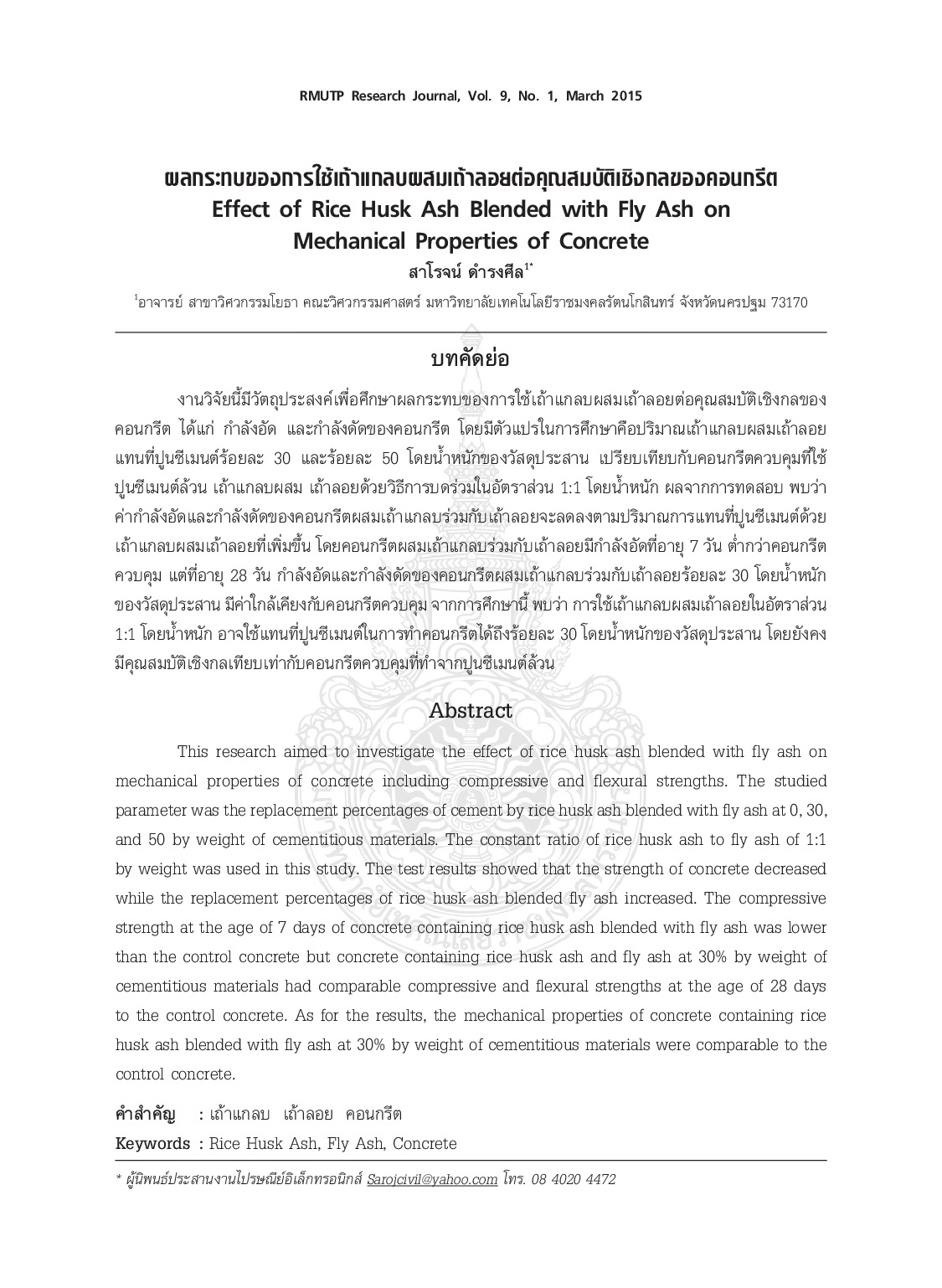
Effect of rice husk ash blended with fly Ash on mechanical properties of concrete
This research aimed to investigate the effect of rice husk ash blended with fly ash on mechanical properties of concrete including compressive and flexural strengths. The studied parameter was the replacement percentages of cement by rice husk ash blended with fly ash at 0 30 and 50 by weight of cementitious materials. The constant ratio of rice husk ash to fly ash of 1:1 by weight was used in this study. The test results showed that the strength of concrete decreased while the replacement percentages of rice husk ash blended fly ash increased. The compressive strength at the age of 7 days of concrete containing rice husk ash blended with fly ash was lower than the control concrete but concrete containing rice husk ash and fly ash at 30% by weight of cementitious materials had comparable compressive and flexural strengths at the age of 28 days to the control concrete. As for the results the mechanical properties of concrete containing rice husk ash blended with fly ash at 30% by weight of cementitious materials were comparable to the control concrete.
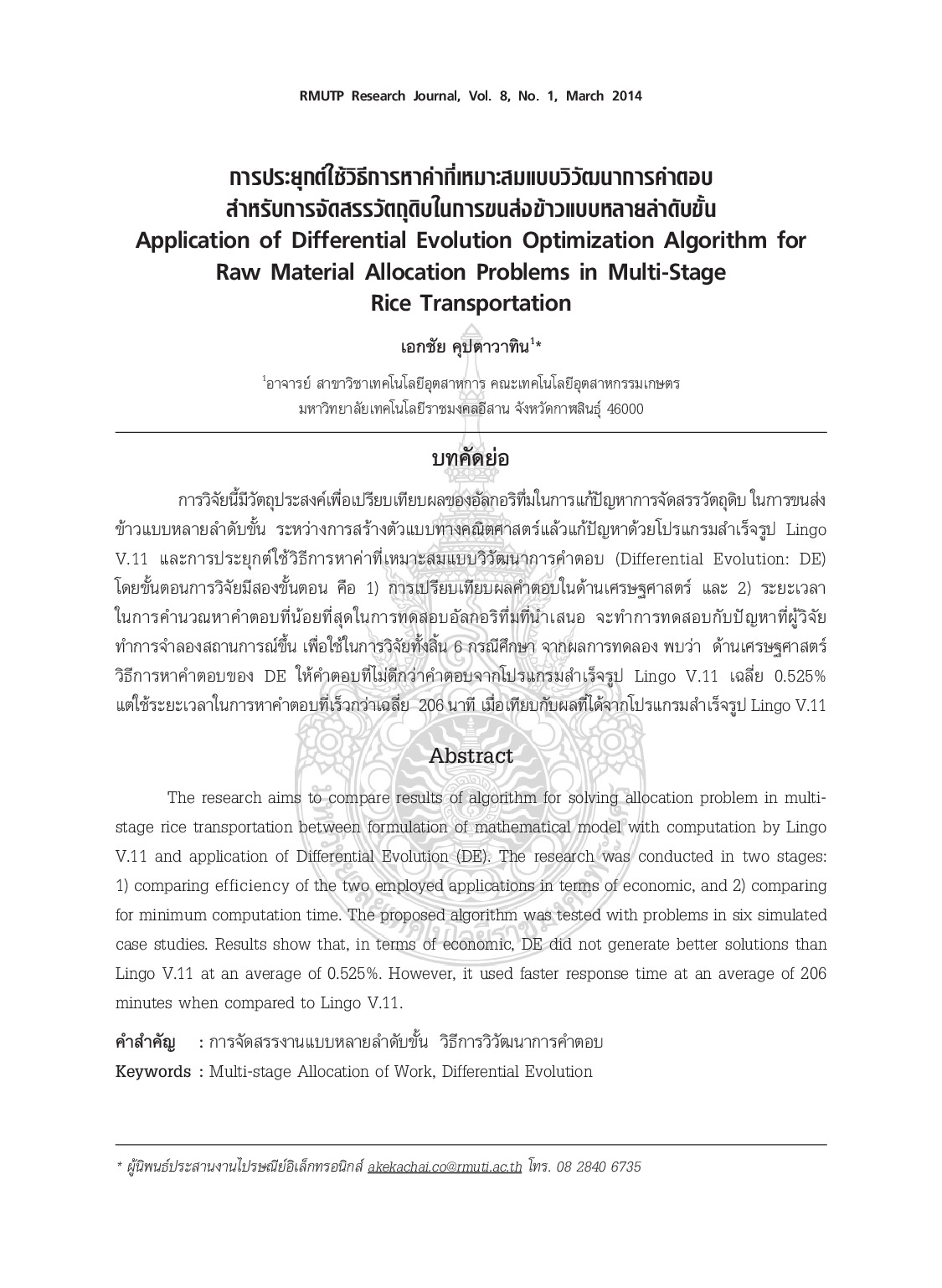
Application of differential evolution optimization algorithm for raw material allocation problems in multi-stage rice transportation
The research aims to compare results of algorithm for solving allocation problem in multi-stage rice transportation between formulation of mathematical model with computation by Lingo V.11 and application of Differential Evolution (DE). The research was conducted in two stages: 1) comparing efficiency of the two employed applications in terms of economic and 2) comparing for minimum computation time. The proposed algorithm was tested with problems in six simulated case studies. Results show that in terms of economic DE did not generate better solutions than Lingo V.11 at an average of 0.525%. However it used faster response time at an average of 206 minutes when compared to Lingo V.11.
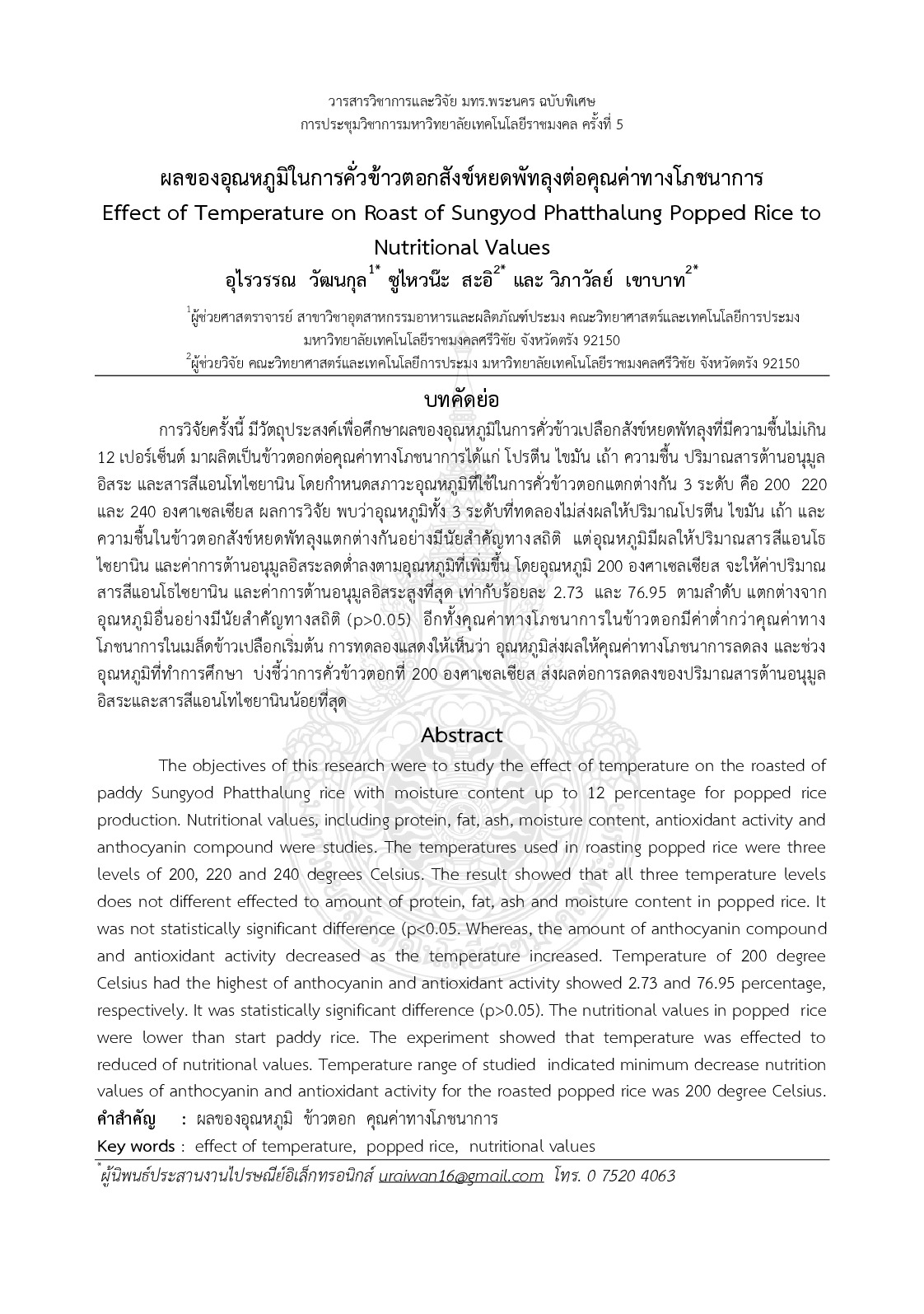
Effect of temperature on roast of sungyod phatthalung popped rice to nutritional values
The objectives of this research were to study the effect of temperature on the roasted of paddy Sungyod Phatthalung rice with moisture content up to 12 percentage for popped rice production. Nutritional values including protein fat ash moisture content antioxidant activity and anthocyanin compound were studies. The temperatures used in roasting popped rice were three levels of 200 220 and 240 degrees Celsius. The result showed that all three temperature levels does not different effected to amount of protein fat ash and moisture content in popped rice. It was not statistically significant difference (p<0.05. Whereas the amount of anthocyanin compound and antioxidant activity decreased as the temperature increased. Temperature of 200 degree Celsius had the highest of anthocyanin and antioxidant activity showed 2.73 and 76.95 percentage respectively. It was statistically significant difference (p>0.05). The nutritional values in popped rice were lower than start paddy rice. The experiment showed that temperature was effected to reduced of nutritional values. Temperature range of studied indicated minimum decrease nutrition values of anthocyanin and antioxidant activity for the roasted popped rice was 200 degree Celsius.
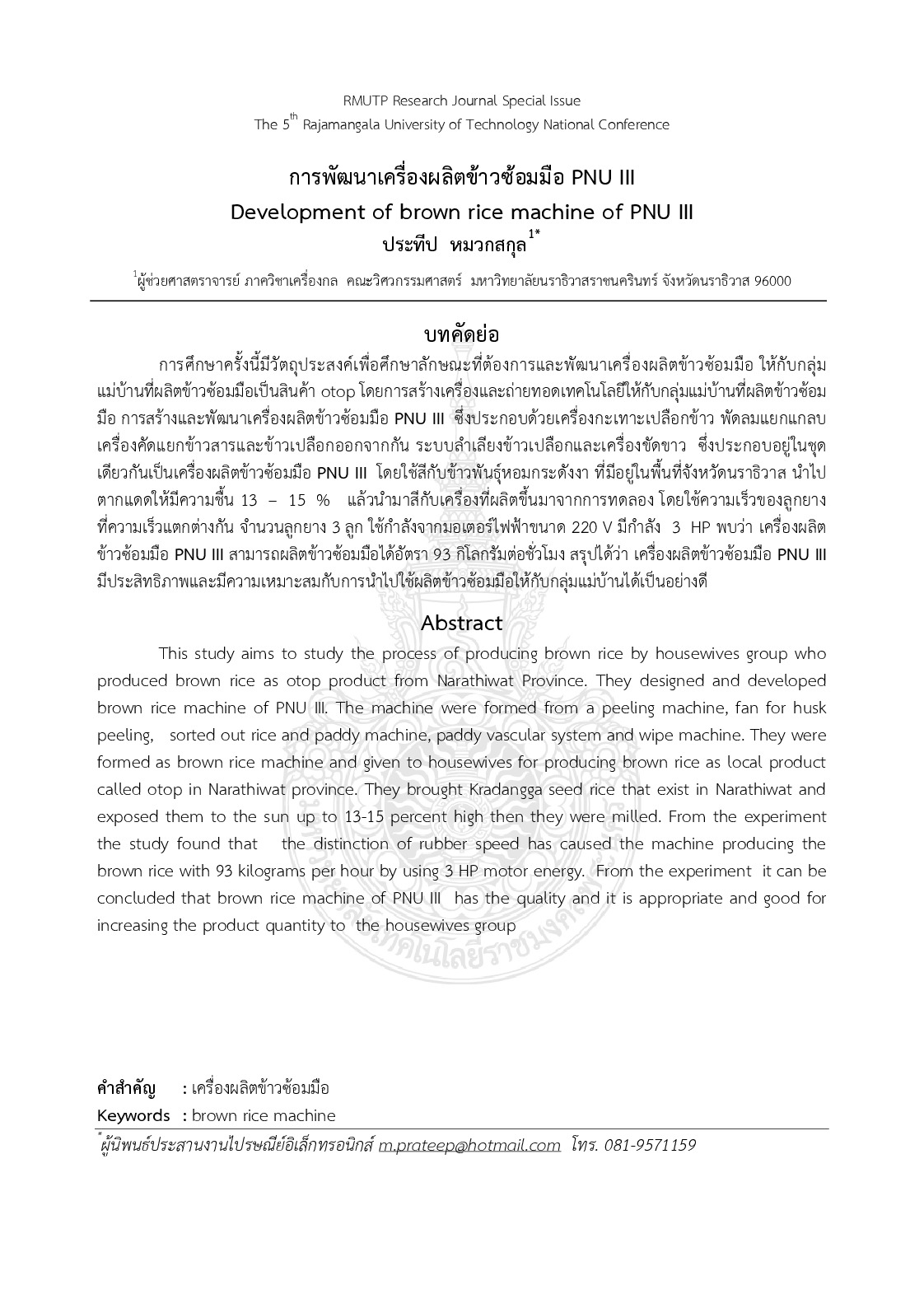
Development of brown rice machine of PNU III
This study aims to study the process of producing brown rice by housewives group who produced brown rice as otop product from Narathiwat Province. They designed and developed brown rice machine of PNU III. The machine were formed from a peeling machine fan for husk peeling sorted out rice and paddy machine paddy vascular system and wipe machine. They were formed as brown rice machine and given to housewives for producing brown rice as local product called otop in Narathiwat province. They brought Kradangga seed rice that exist in Narathiwat and exposed them to the sun up to 13-15 percent high then they were milled. From the experiment the study found that the distinction of rubber speed has caused the machine producing the brown rice with 93 kilograms per hour by using 3 HP motor energy. From the experiment it can be concluded that brown rice machine of PNU III has the quality and it is appropriate and good for increasing the product quantity to the housewives group