จำนวน Repository ( 284 )
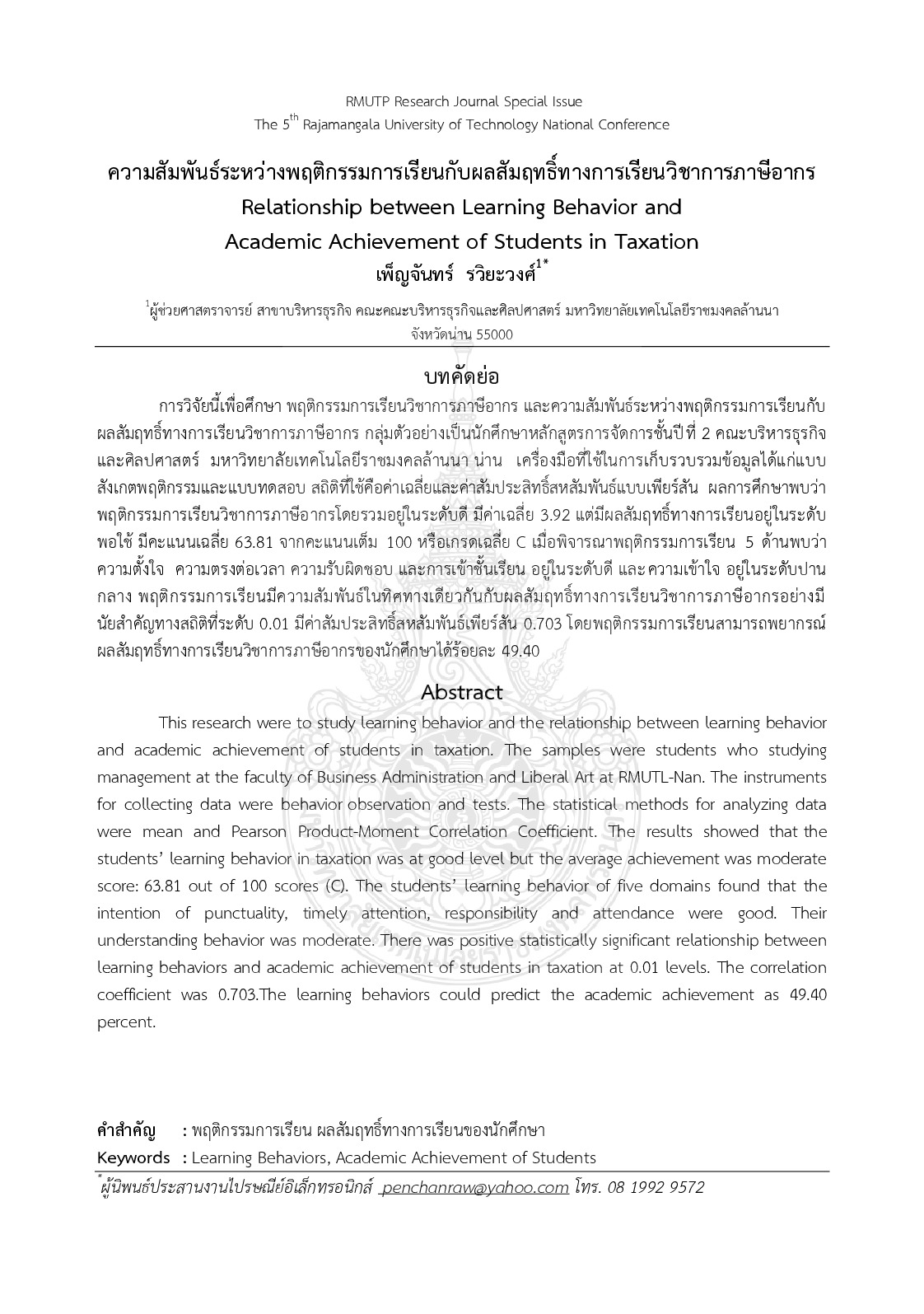
Relationship between learning behavior and academic achievement of students in taxation
This research were to study learning behavior and the relationship between learning behavior and academic achievement of students in taxation. The samples were students who studying management at the faculty of Business Administration and Liberal Art at RMUTL-Nan. The instruments for collecting data were behavior observation and tests. The statistical methods for analyzing data were mean and Pearson Product-Moment Correlation Coefficient. The results showed that the students’ learning behavior in taxation was at good level but the average achievement was moderate score: 63.81 out of 100 scores (C). The students’ learning behavior of five domains found that the intention of punctuality timely attention responsibility and attendance were good. Their understanding behavior was moderate. There was positive statistically significant relationship between learning behaviors and academic achievement of students in taxation at 0.01 levels. The correlation coefficient was 0.703.The learning behaviors could predict the academic achievement as 49.40 percent.
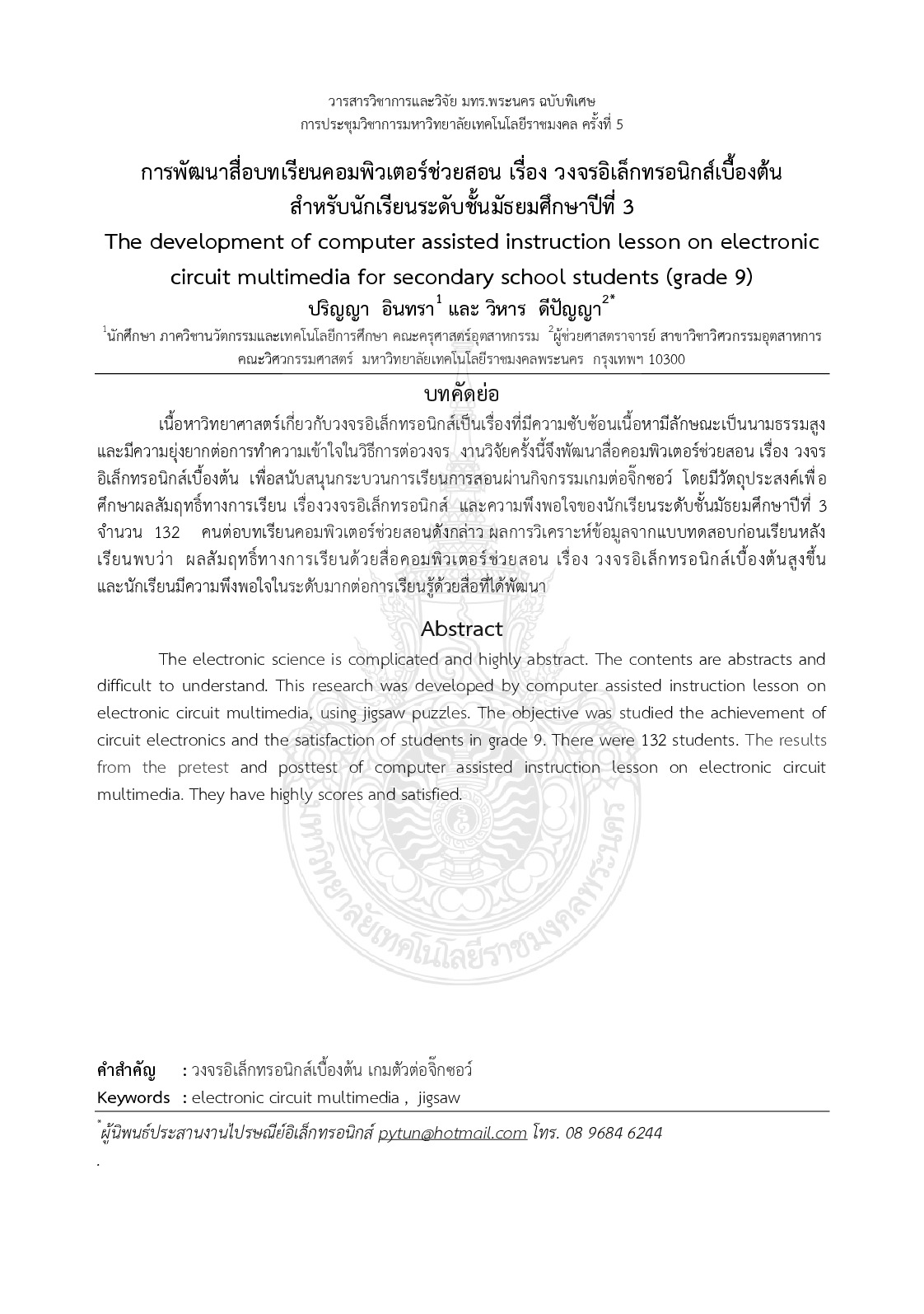
The development of computer assisted instruction lesson on electronic circuit multimedia for secondary school students (grade 9)
The electronic science is complicated and highly abstract. The contents are abstracts and difficult to understand. This research was developed by computer assisted instruction lesson on electronic circuit multimedia using jigsaw puzzles. The objective was studied the achievement of circuit electronics and the satisfaction of students in grade 9. There were 132 students. The results from the pretest and posttest of computer assisted instruction lesson on electronic circuit multimedia. They have highly scores and satisfied.
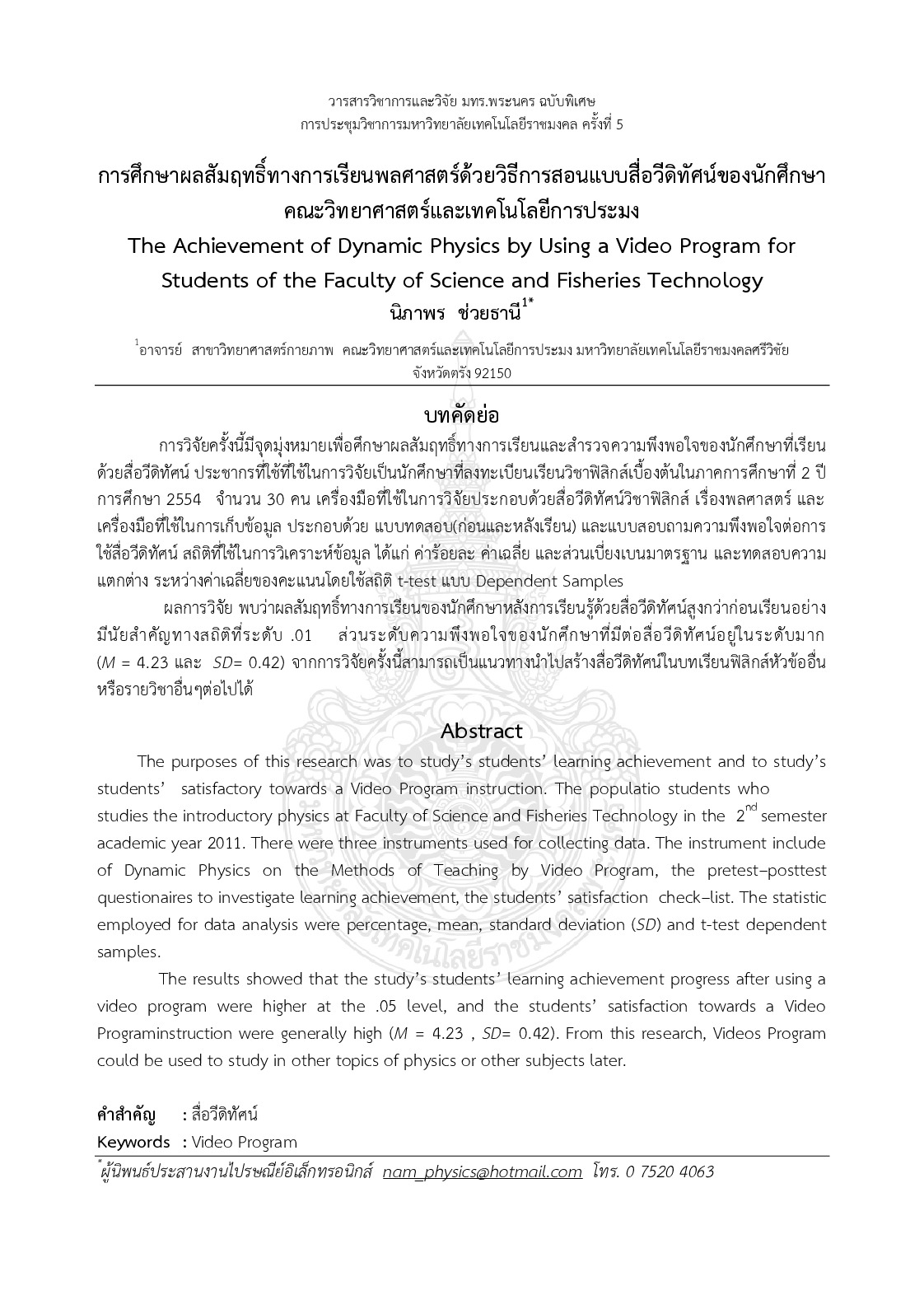
The achievement of dynamic physics by using a video program for students of the faculty of science and fisheries technology
The purposes of this research was to study’s students’ learning achievement and to study’s students’ satisfactory towards a Video Program instruction. The population of 30 students who studies the introductory physics at Faculty of Science and Fisheries Technology in the 2nd semester academic year 2011. There were three instruments used for collecting data. The instrument include of Dynamic Physics on the Methods of Teaching by Video Program the pretest–posttest questionaires to investigate learning achievement the students’ satisfaction check–list. The statistic employed for data analysis were percentage mean standard deviation (SD) and t-test dependent samples. The results showed that the study’s students’ learning achievement progress after using a video program were higher at the .05 level and the students’ satisfaction towards a Video Programinstruction were generally high (M = 4.23 SD= 0.42). From this research Videos Program could be used to study in other topics of physics or other subjects later.
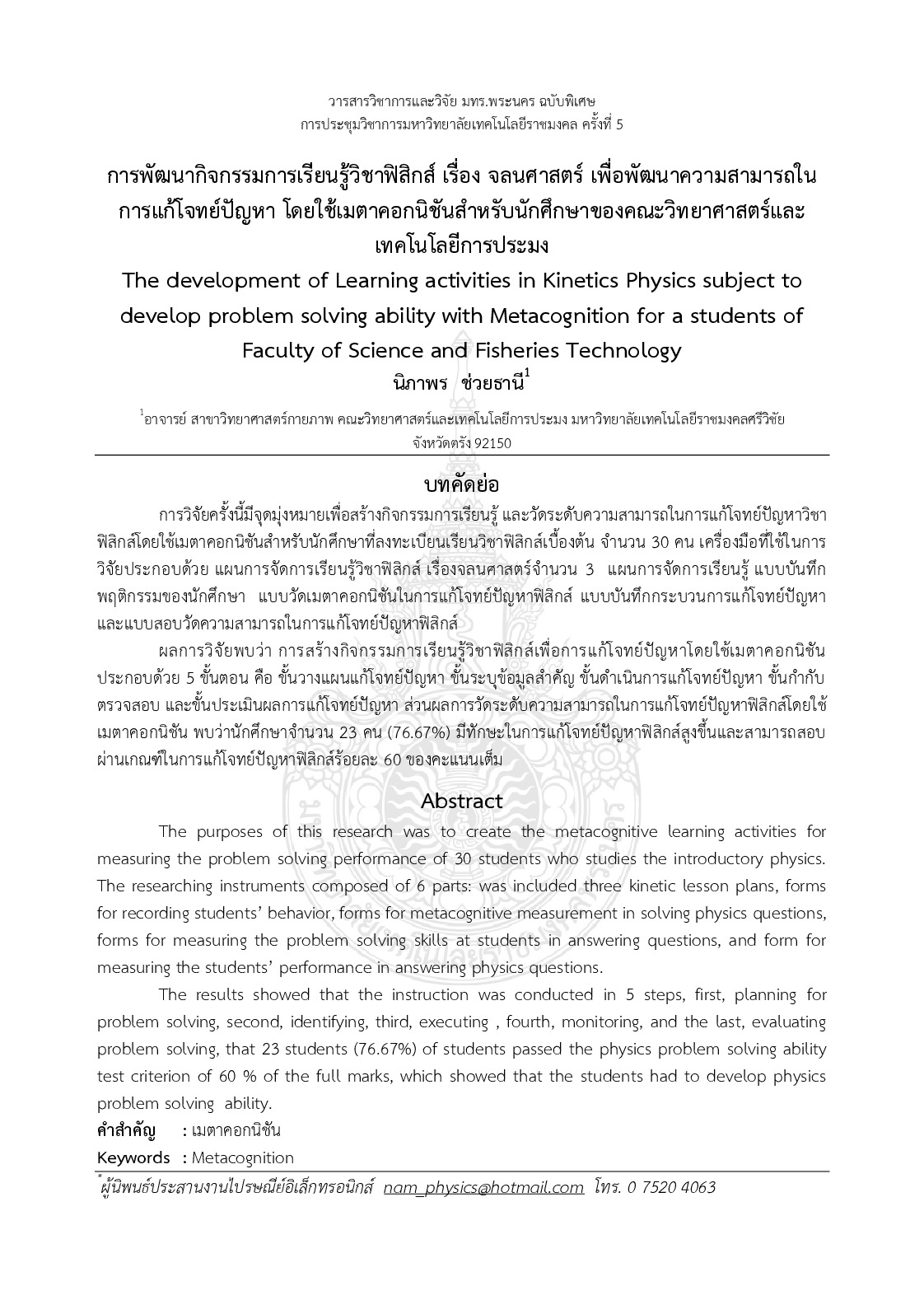
The development of learning activities in kinetics physics subject to develop problem solving ability with metacognition for a students of faculty of science and fisheries technology
The purposes of this research was to create the metacognitive learning activities for measuring the problem solving performance of 30 students who studies the introductory physics. The researching instruments composed of 6 parts: was included three kinetic lesson plans forms for recording students’ behavior forms for metacognitive measurement in solving physics questions forms for measuring the problem solving skills at students in answering questions and form for measuring the students’ performance in answering physics questions. The results showed that the instruction was conducted in 5 steps first planning for problem solving second identifying third executing fourth monitoring and the last evaluating problem solving that 23 students (76.67%) of students passed the physics problem solving ability test criterion of 60 % of the full marks which showed that the students had to develop physics problem solving ability.
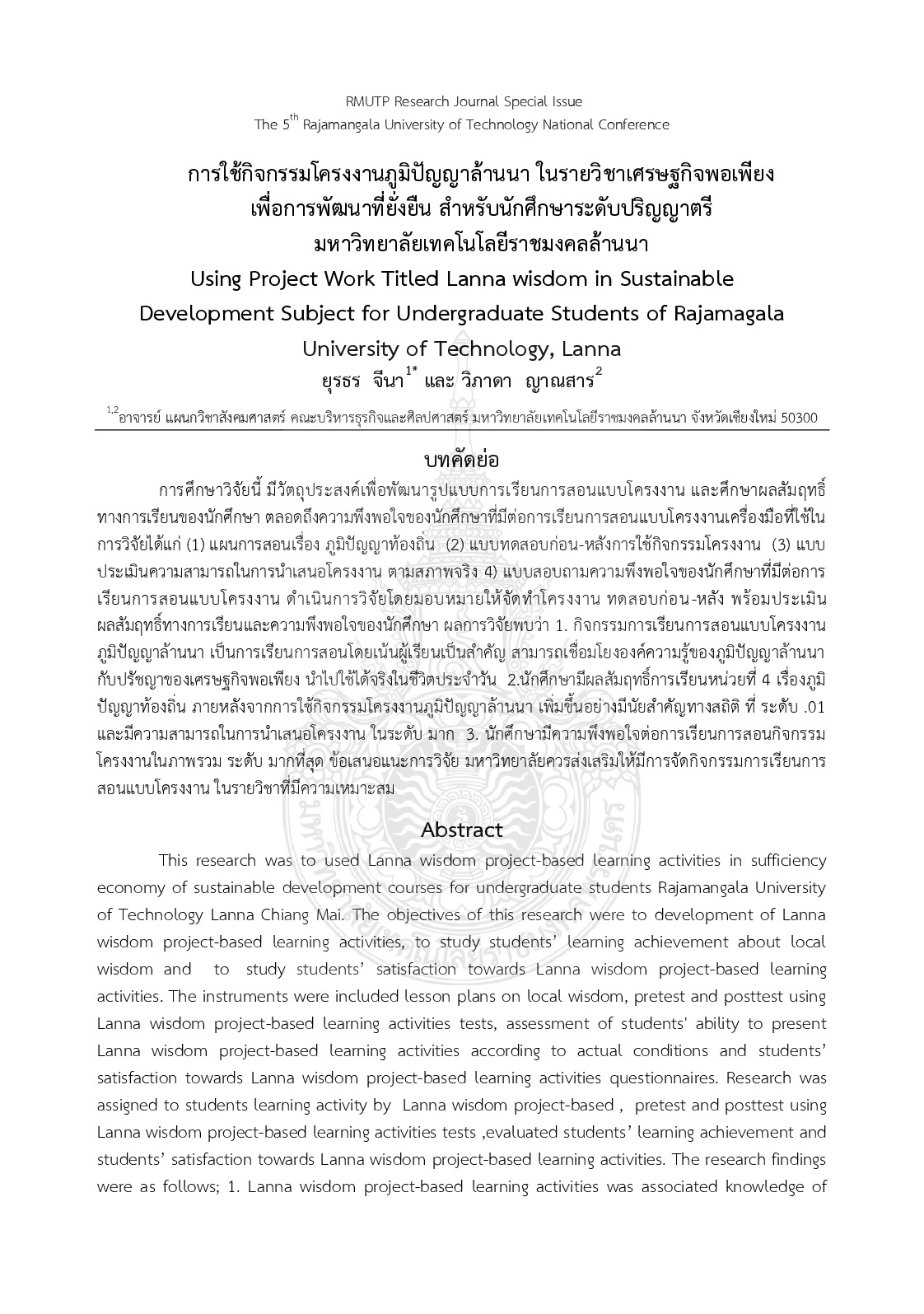
Using project work titled lanna wisdom in sustainable development subject for undergraduate students of Rajamagala University of Technology, lanna
This research was to used Lanna wisdom project-based learning activities in sufficiency economy of sustainable development courses for undergraduate students Rajamangala University of Technology Lanna Chiang Mai. The objectives of this research were to development of Lanna wisdom project-based learning activities to study students’ learning achievement about local wisdom and to study students’ satisfaction towards Lanna wisdom project-based learning activities. The instruments were included lesson plans on local wisdom pretest and posttest using Lanna wisdom project-based learning activities tests assessment of students ability to present Lanna wisdom project-based learning activities according to actual conditions and students’ satisfaction towards Lanna wisdom project-based learning activities questionnaires. Research was assigned to students learning activity by Lanna wisdom project-based pretest and posttest using Lanna wisdom project-based learning activities tests evaluated students’ learning achievement and students’ satisfaction towards Lanna wisdom project-based learning activities. The research findings were as follows; 1. Lanna wisdom project-based learning activities was associated knowledge of Lanna wisdom with sufficiency economy for application in daily life 2. Students’ learning achievement about local wisdom in lesson 4 after using Lanna wisdom project-based learning activities are increase at statistically significant level of 0.01 and capable of Lanna wisdom project-based learning activities presentation at a higher level. 3. Student overalls satisfaction towards Lanna wisdom project-based learning activities at the highest level. The recommendation of research that universities should support of appropriate teaching curriculum by project-based learning activities.