จำนวน Repository ( 2131 )
ผลการจัดการเรียนรู้แบบร่วมมือเชิงบูรณาการ วิชาเทคนิคการจัดดอกไม้ ของนักศึกษา ระดับปริญญาตรี สาขาวิชาการบริหารธุรกิจคหกรรมศาสตร์ มทร.พระนคร
The research studied results of integrated learning management in flower arrangement techniques subject of students from the bachelor’s degree in Home Economics Business Administration program Rajamangala University of Technology Phra Nakhon. The researchers provided the cooperative learning and selected three units of flower arrangement techniques subject consisting of materials and tools for arranging flowers creative flower arrangement and international flower arrangement. The research samples were the second year students of Home Economics Business Administration program. The research methods used in this study were a learning achievement form a satisfaction form and a participant observation form. Results of the study found were: 1. The effects of cooperative learning on students flower arrangement techniques subject achievement was found that there was a statistically significant difference between students pretest and post-test scores at the level .05. 2. The satisfaction of students toward flower arrangement techniques subject was at the highest level ( x = 4.00). It showed that students’ attitudes toward cooperative learning were at good level.
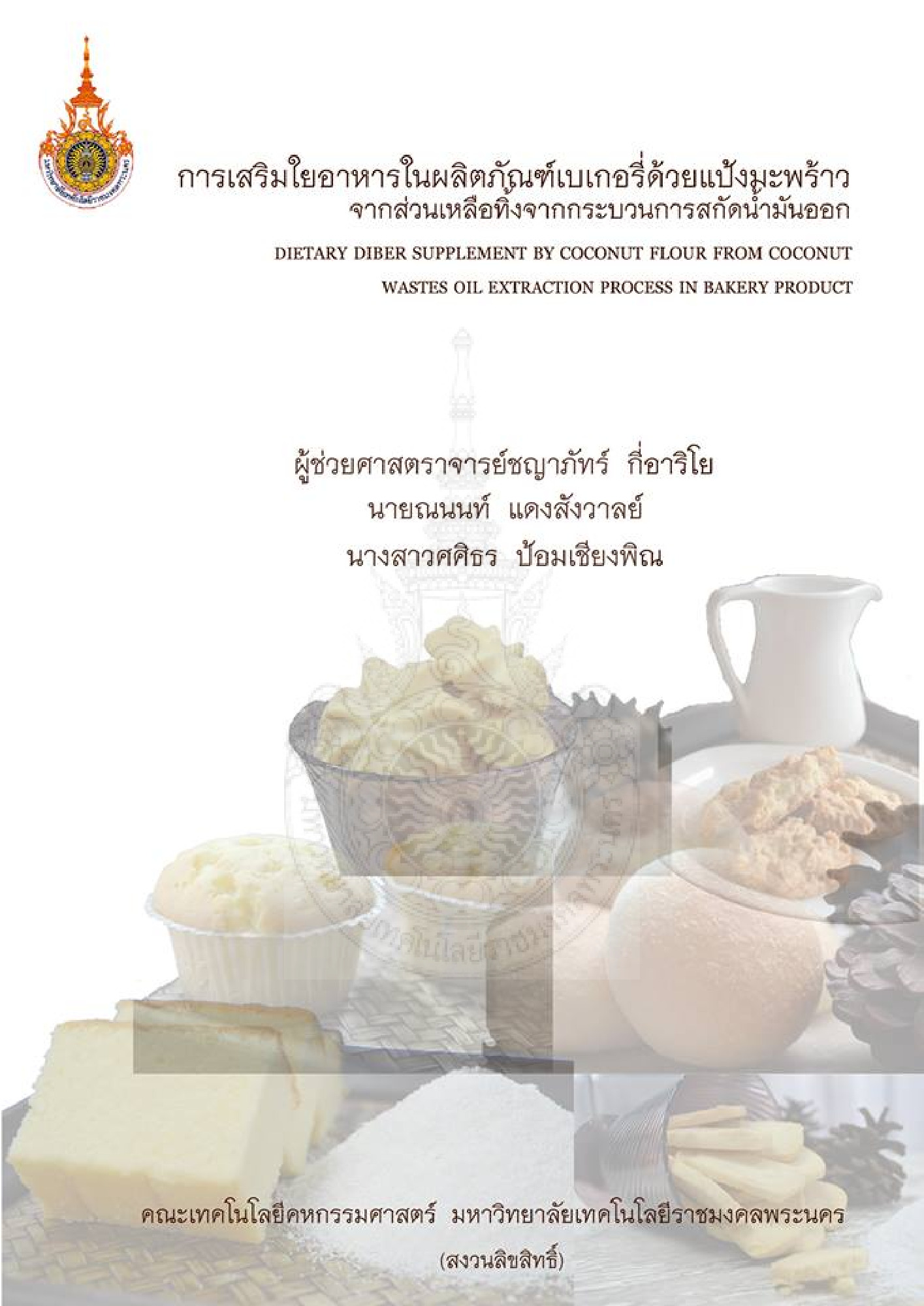
การเสริมใยอาหารในผลิตภัณฑ์เบเกอรี่ด้วยแป้งมะพร้าวจากส่วนเหลือทิ้งจากกระบวนการสกัดน้ำมันออก
The studies of Dietary Fiber Supplement by coconut flour from coconut Wastes Oil Extraction process in Bakery Product was investigated Production of coconut flour from coconut wastes oil extraction drying at 55 ° C for 12 hours and then grinding to powder gave the off-white fine powder. The chemical compositions of coconut flour were 57.70 % carbohydrate 29.4 % fat 6.23 % moisture 5.20 % protein and 1.48 % ash by dye weigh. Butter cake making experiment by substitution of wheat flour with coconut flour at 5 % of wheat flour weigh which has the highest sensory scores comparing butter cake with the control found that increase dietary fiber 1.34 g. /100 g. The majority of the tested consumers (92%) accepted butter cake with 5 % of coconut flour substitution. Muffin making experiment by substitution of wheat flour with coconut flour at 15 % of wheat flour weigh which has the highest sensory scores comparing muffin with the control found that increase dietary fiber 2.34 g /100 g. The majority of the tested consumers (81%) accepted muffin with 15 % of coconut flour substitution. Cornflake cookie making experiment by substitution of wheat flour with coconut flour at 20 % of wheat flour weigh which has the highest sensory scores comparing cornflake cookie with the control found that increase dietary fiber 3.54 g. /100 g. The majority of the tested consumers (94 %) accepted cornflake cookie with 20 % of coconut flour substitution. Butter cookie making experiment by substitution of wheat flour with coconut flour at 10 % of wheat flour weigh which has the highest sensory scorescomparing butter cookie with the control found that increase dietary fiber 3.04 g. /100 g. The majority of the tested consumers (94 %) accepted Butter cookie with 10 % of coconut flour substitution. Frozen cookie making experiment by substitution of wheat flour with coconut flour at 20 % of wheat flour weigh which has the highest sensory scores comparing cookie with the control found that increase dietary fiber 4.02g. /100 g. The majority of the tested consumers (93 %) accepted 20 % of coconut flour substitution. Butter bread making experiment by substitution of wheat flour with coconut flour at 15 % of wheat flour weigh which has the highest sensory scores comparing butter bread with the control found that increase dietary fiber 2.22 g. /100 g. The majority of the tested consumers (75 %) accepted 15% of coconut flour substitution. Whole wheat bread making experiment by substitution of wheat flour with coconut flour at 15 % of wheat flour weigh which has the highest sensory scores comparing whole wheat bread with the control found that increase dietary fiber 2.09 g. /100 g. The majority of the tested consumers (79 %) accepted 15 % of coconut flour substitution. Pie crust making experiment by substitution of wheat flour with coconut flour at 15 % of wheat flour weigh which has the highest sensory scores comparing pie crust with the control found that increase dietary fiber 2.91 g. /100 g. The majority of the tested consumers (82 %) accepted 15 % of coconut flour substitution.
การเสริมใยอาหารในผลิตภัณฑ์มาการองด้วยรำข้าวสังข์หยด
The objective of this research to study the three formula basic of macarons amount of Sangyod Rice Bran usage in macarons product and nutritional composition of macarons product. The sensory evaluate of three formula of macarons the second and the third formula basic macarons non-significant in odor liking ( P< ) . However the three formulas are significant in appearance color liking odor liking taste liking texture liking a nd overall liking ( P> ). When consideration in average score 3rd formula of macarons acceptable that the most one formula. Therefore the third formula used to determine the proper amount of Sangyod Rice Bran to add on macarons in the next step. For the Enhancing of Sangyod Rice Bran in macarons. The three levels as follow; added Sangyod Rice Bran for % % and % of all total weight. The taster remains to accept all sample of Sangyod Rice Bran in macarons. Especially at the % of Sangyod Rice Bran to added in macarons to the highest acceptance . However the resulted of added Sangyod Rice Bran at % to decrease in the appearance and overall liking of macarons .Therefore supplementation of fiber in macarons product with Sangy od Rice Bran is not affectin macarons. Furturemore spicies and amount of other bran for macarons production should be intensive studied.
พฤติกรรมการใช้น้ำ และไฟฟ้า ของนักศึกษาคณะเทคโนโลยีคหกรรมศาสตร์ มหาวิทยาลัยเทคโนโลยีราชมงคลพระนคร
The purposes of this research are to study water and electricity consumption behavior of the students to study understanding of water and electricity saving and to compare the difference of water and electricity consumption behavior classified as personal characteristic of the students Faculty of Home Economics Technology Rajamangala University of Technology Phra Nakhon. This research was descriptive research. The sample group used in the research was the students Faculty of Home Economics Technology Rajamangala University of Technology Phra Nakhon. Size of the sample group was specified to be 325 people by stratified sampling. The tool used in data analysis was questionnaire divided into 3 parts including part 1: questions regarding general details of a respondent part 2: questions regarding knowledge of water and electricity saving consumption the students of Faculty of Home Economics Technology Rajamangala University of Technology Phra Nakhon and part 3: questions regarding water and electricity consumption behavior of the students Faculty of Home Economics Technology Rajamangala University of Technology Phra Nakhon. The statistics used in data analysis consisted of frequency percentage mean standard deviation and hypothesis testing using t-test and ANOVA (Analysis of Variance) for testing parallel difference by LSD method. The research result found that: 1. The level of water and electricity consumption behavior of the students Faculty of Home Economics Technology Rajamangala University of Technology Phra Nakhon was overall in the moderate level. 2. The level of understanding and knowledge regarding water and electricity saving of the students Faculty of Home Economics Technology Rajamangala University of Technology Phra Nakhon was overall in the moderate level. 3. The comparison of different behavior of water and electricity consumption specified according to personal characteristics could be summarized that the students having different gender class and major had identical water consumption behavior and the students having different gender class and major had identical electricity consumption behavior. On the other hand the students having different major had statistical significance in electricity consumption behavior at 0.05
การเสริมใยอาหารในผลิตภัณฑ์มาการองด้วยรำข้าวสังข์หยด
The objective of this research to study the three formula basic of macarons amount of Sangyod Rice Bran usage in macarons product and nutritional composition of macarons product. The sensory evaluate of three formula of macarons the second and the third formula basic macarons non-significant in odor liking (P<). However the three formulas are significant in appearance color liking odor liking taste liking texture liking and overall liking (P>). When consideration in average score 3rd formula of macarons acceptable that the most one formula. Therefore the third formula used to determine the proper amount of Sangyod Rice Bran to add on macarons in the next step. For the Enhancing of Sangyod Rice Bran in macarons. The three levels as follow; added Sangyod Rice Bran for % % and % of all total weight. The taster remains to accept all sample of Sangyod Rice Bran in macarons. Especially at the % of Sangyod Rice Bran to added in macarons to the highest acceptance. However the resulted of added Sangyod Rice Bran at % to decrease in the appearance and overall liking of macarons. Therefore supplementation of fiber in macarons product with Sangyod Rice Bran is not affect in macarons. Furturemore spicies and amount of other bran for macarons production should be intensive studied.