จำนวน Repository ( 145 )

Development of instructional packages of vector quantities
The purposes of this research aimed to 1) develop the instructional packages namely Vector Quantities and 2) compare the achievement scores of the experimental group and the control group. The samples were 60 Computer Science students of Faculty of Science and Technology at Rajamangala University of Technology Phra Nakhon who took Principle of Physics course in semester 1 academic year 2013. They were purposely selected as an experimental group (30 students) and a control group (30 students). They were given two different treatments ; teaching with the instructional packages and the conventional teaching. The research instruments for the experimental group were the instructional packages comprised lesson plans instructional documents and instructional media whereas the control group was taught with only instructional documents. After of the experimental process both of them were given exercises and teacher’s feedback. Then they were tested to see their achievement. The test was 20 multiple choice items which had the degree of difficulty between 0.33-0.77 the degree of discrimination between 0.30-0.77 and the degree of reliability coefficient at 0.73. The analysis of data comprised 2 parts as follows: 1. The development of instructional packages was evaluated by using statistics One – Sample t -test on Vector quantities Demonstration and using statics in terms of mean on the lesson plans instructional documents and instructional media . 2. The achievement scores were evaluated by using t-test at the level of 0.5. The results of this research revealed that : 1. The quality of the instructional packages was excellent. 2. The achievement scores of the students who studied with the instructional packages were higher than those of the control group at the level of .05
Essential elements for learning environment of creative education on social network to develop creative thinking
The purposes of this research were to investigate elements that are essential for the learning environment of creative education on social network to develop creative thinking. The research methodology was documentary research. It was found that there were 3 major elements and 17 sub-elements which were essential for learning environment of creative education on social network to develop creative thinking; namely 1) Creative thinking development or learning process included six steps: (1) problem finding (2) data acquisition (3) analysis (4) solution finding (5) revise/evaluation (6) acceptance finding and (7) convergent thinking; 2) Resources or learning environment included four elements: (1) learning media (2) technology media (3)context and (4)communication; 3) Technologies or online social network in learning environment consisted of six elements: (1) identity network (2) creative network (3) interested network (4) collaboration network (5) gaming/virtual reality and (6) peer to peer communication network.
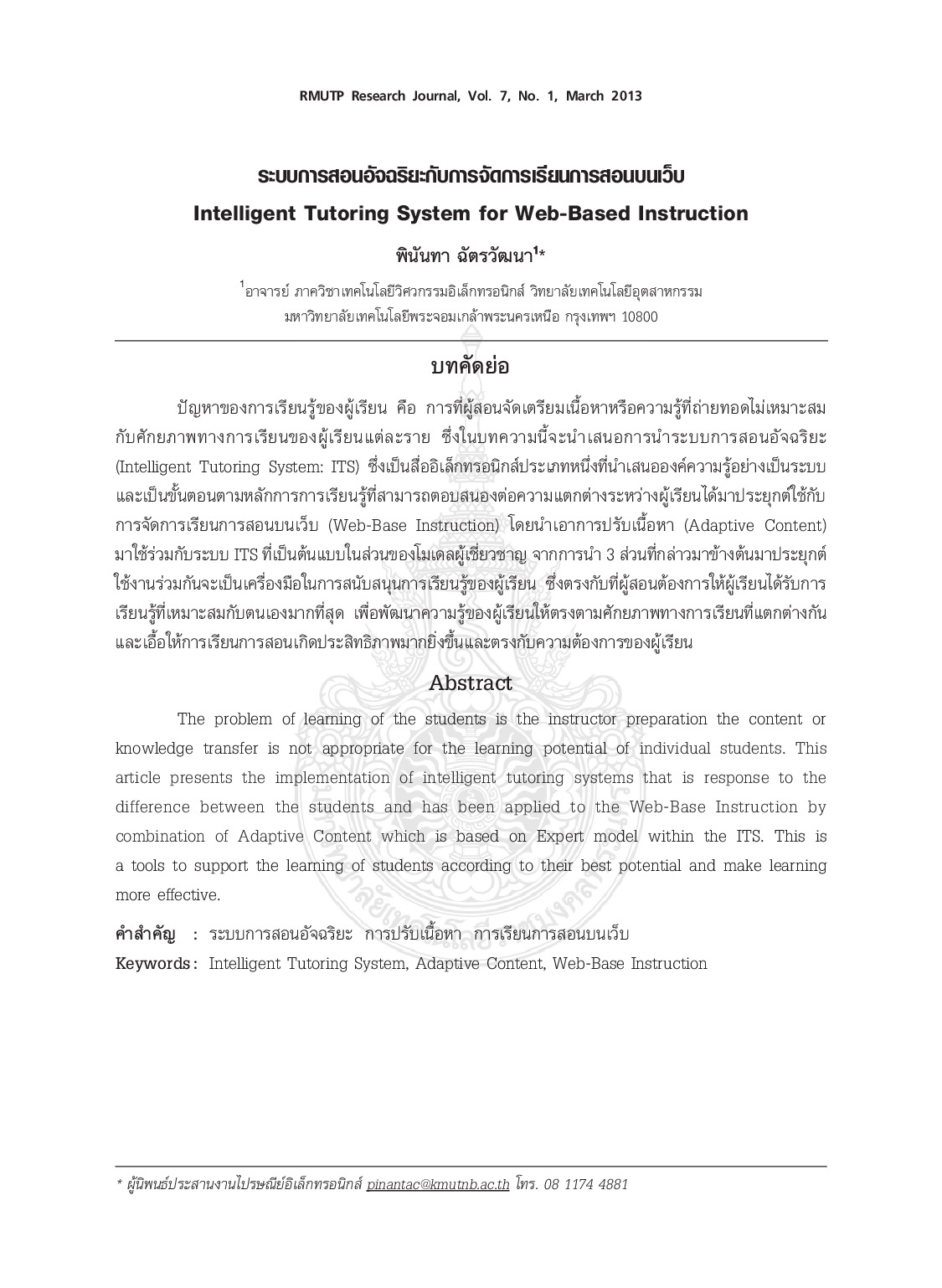
Intelligent tutoring system for web-based instruction
The problem of learning ot the students is the instructor preparation the content or knowiedge transfer is not appropriate for the learning potential of indivedual students. This article presents the implementation of intelligent tutoring systems that is response to the difference between the students and has been applied to the Web-Base Instruction by Combination of Adaptive content which is based on Expert model within the ITS. This is a tools to support the learning of students according to their best potential and make learning more effective.
การเปรียบเทียบความสามารถการแยกแยะเนื้อหาตามระดับความรู้ผู้เรียนของครูที่เรียนรู้ด้วยสื่อ CAI กับการเข้ารับการฝึกอบรมสำหรับการสอนปฏิบัติคอมพิวเตอร์
There are three main purposes of this research. The first is to compare teachers ability in classifying content by students knowledge level before and after learning. The second is to study difference of pretest and posttest score according to students level. The third is to compare ability and determine efficiency in classifying content by duration of teaching experiences. Samples in this study were 30 teachers from Rajamangala University of Technology who leamed through CAI media (15 teachers) and who attended computer training course (15 teachers). The questionnaire was used to measure their ability in classifying content by students knowledge level. Results of the study can be concluded as follows: 1. Teachers ability in classifying content before and after leaming differed significantly at the level of 0.05. Howeverability in classifying content after leaming did not show significant statistical difference. 2. The difference in pretest and posttest scores showed that leaming with CAI could increase level of teachers ability in classifying more than attending training courses. 3. Teachers with different duration of teaching experience showed significant different ability in classifying content by students knowledge level at the level of 0.05. 4. Teachers with more than 7 years of teaching experiences showed the highest efficiency in classifying content.
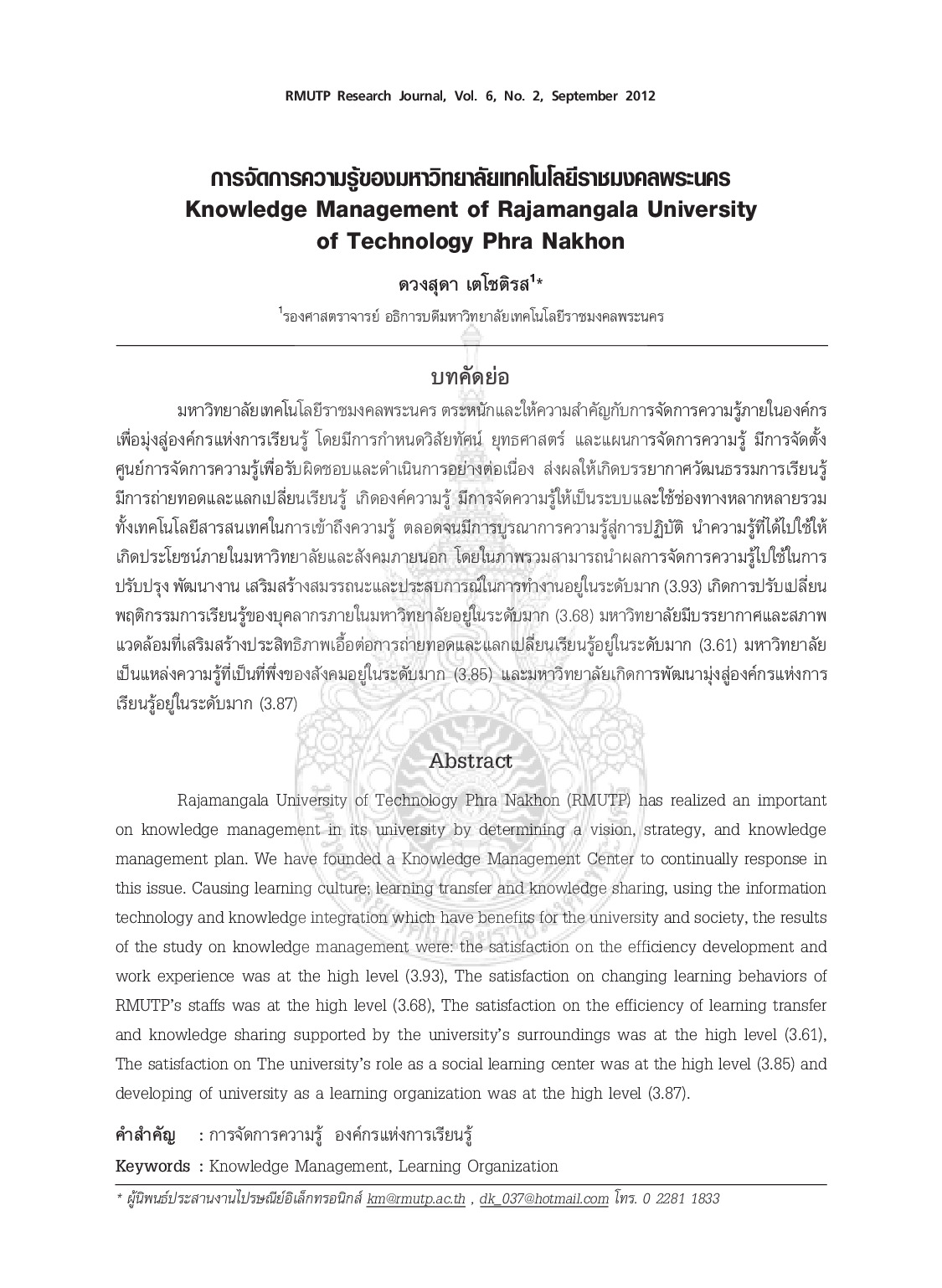
Knowledge Management of Rajamangala University of Technology Phra Nakhon
Rajamangala University of Technology Phra Nakhon (RMUTP) has realized an important on knowledge management in its university by determining a vision strategy and knowledge management plan. We have founded a Knowledge Management Center to continually response in this issue. Causing learning culture; learning transfer and knowledge sharing using the information technology and knowledge integration which have benef its for the university and society the results of the study on knowledge management were: the satisfaction on the eff iciency development and work experience was at the high level (3.93) The satisfaction on changing learning behaviors of RMUTPs staffs was at the high level (3.68) The satisfaction on the eff iciency of learning transfer and knowledge sharing supported by the universitys surroundings was at the high level (3.61) The satisfaction on The universitys role as a social learning center was at the high level (3.85) and developing of university as a learning organization was at the high level (3.87)