จำนวน Repository ( 1852 )
Mechanical Properties of Silica-Based Geopolymer Composites Cured at Ambient Conditions in Accordance with Size-Independent Method
In this paper silica-based geopolymer matrix reinforced composites containing approximately 35 50 or 55 wt.% of carbon (HTS 5631 1600tex 24K TohoTenax) advanced basalt (BCF13-2520tex KV12 Int Basaltex) or electrical grade glass (E-glass: E2400P192 Saint-Gobain Vetrotex) roving fibers respectively were synthesized and fabricated at ambient conditions. The flexural properties of the resulting composites which are high toughness: the shear stress plays here a greater role in compared with other ceramic matrix composites were determined on a universal testing machine under three-point bending mode in accordance with novel size-independent method which based on testing specimens at different scale of sample height (H) to span length (L) ratios; The basic principles of the new size-independent approach are presented as well. Microstructures of composites were analyzed by means of scanning electron microscope (SEM) on perpendicular sections the images show the adhesion between the fibers and geopolymer matrix are very good and micro-cracks on both cross-sections and surfaces of geocomposites are determined as inborn defects of inorganic matrix composites.
Improvement of Efficiency in Biodegradable Packaging Process
This industrial research was studied an improvement of efficiency in natural fiber production plant. The objective was improvement process by using IE techniques which this method was once green technology for industrial problems solving. Now process had build-up in process (WIP) due to unbalance times between trimming station and visual inspection of station. Therefore the research studied work of staffs; time study and data analysis through 5W1H were used for analysis of WIP root cause. The cause of problems founded were the transportation loss of between section had over necessity and loss of visual inspection for repair. Therefore it had bottleneck in process. Consequently the researchers applied ECRS in each working processed by separation of repair station. Repairs of items were isolated from the main flow path of the process. Calculating of work flow rate was used for identified operator for repair station. As a result of the above production improvement Times of visual inspection in a lot was decrease from 283.84 hrs to 160.19 hrs. It was decreased in 43.56%. In addition the effect of separation from the repair process made the total times of all process was decreased from 792.78 hrs/lot to 669.14 hrs/lot. It was decreased in 15.60% and decreased work in process had from 17 lots/day to no work in process.
Investigated on Removal of Residual Dyestuff in Effluent from Dyeing Process: Physical Method
This study was investigated the pretreatment of dye effluent from dyeing process by activated carbon. The study parameters were color strength operating time and types of dyestuff such as direct dye reactive dye acid dye basic dye and disperse dye. The results found the activated carbon was achieved to adsorb the colorant. The pretreatment process used 100 – 200 gram activated carbon to one liter of dye effluent. The contact time was 2 hours at room temperature. The dyeing conditions had an influent for pretreatment process. The acidic condition was favored than neutral and basic condition. In addition the dye removal efficiency was basic dye > acid dye > disperse dye > direct dye > reactive dye.
Development of Civil Engineering Laboratory Professional Program (CivilLabPro)
This research was to develop the computer application program which was called CivilLabPro for civil engineering laboratory. It consists of analytical part and educational part. Both are designed to use database together and they can use either personal computer or internet system. The analytical part is composed of 15 soil mechanics laboratory and 16 materials testing laboratory that it was written by using visual basic language and it could report not only numerical formats but also graphical results. The results of calculation were stored with database system which wrote by using SQL language. The educational part comprises self study and self exam that it was written by using HTML language and SQL language. The effectiveness of this application was evaluated by questionnaire and opinion in items as follows: easiness of usability accuracy of results and rightness of subject matter. From the evaluated results found that most people are satisfied with this application and the results were accuracy. This evaluation was summarized that it was good standard and it was capable to use in electronic teaching and working.
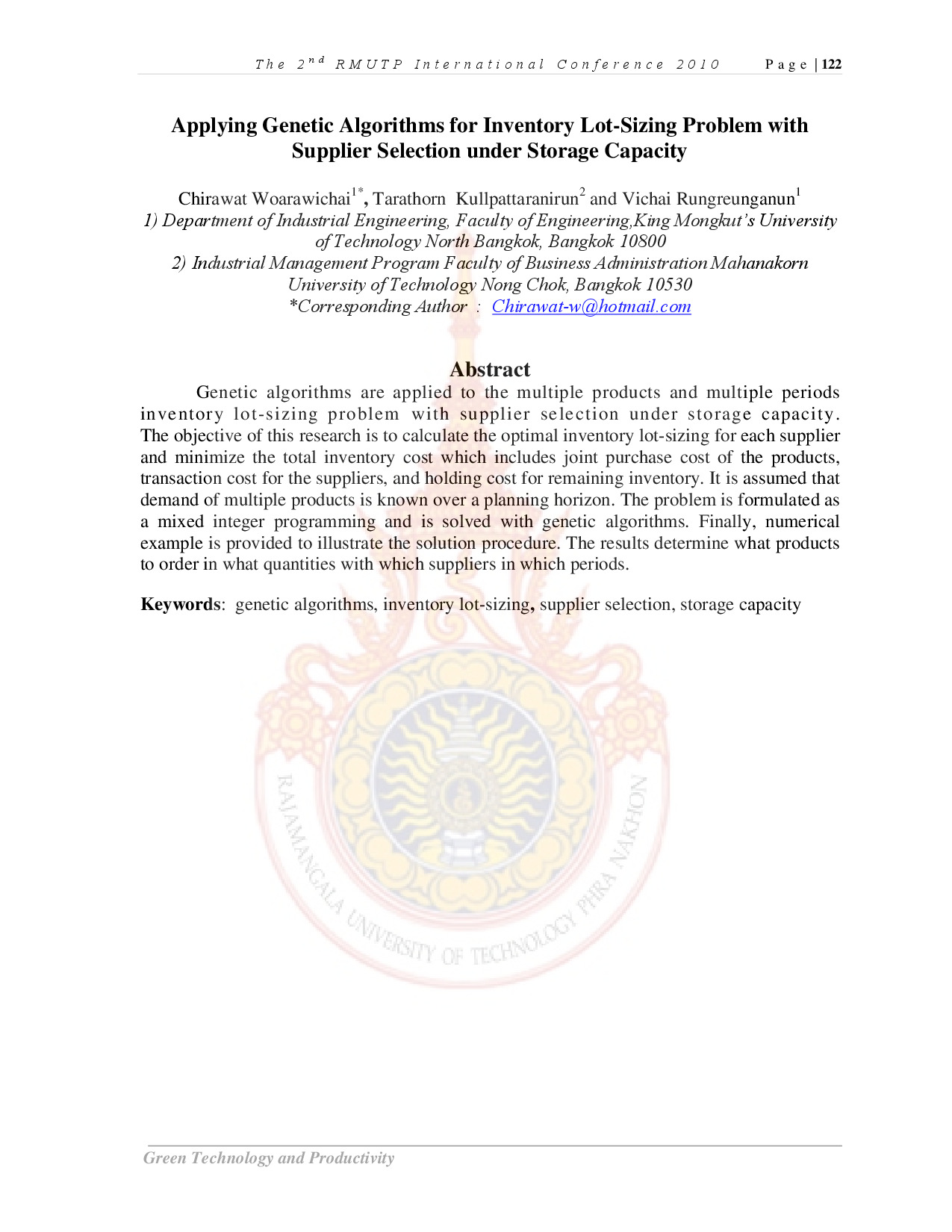
Applying Genetic Algorithms for Inventory Lot-Sizing Problem with Supplier Selection under Storage Capacity
Genetic algorithms are applied to the multiple products and multiple periods inventory lot-sizing problem with supplier selection under storage capacity. The objective of this research is to calculate the optimal inventory lot-sizing for each supplier and minimize the total inventory cost which includes joint purchase cost of the products transaction cost for the suppliers and holding cost for remaining inventory. It is assumed that demand of multiple products is known over a planning horizon. The problem is formulated as a mixed integer programming and is solved with genetic algorithms. Finally numerical example is provided to illustrate the solution procedure. The results determine what products to order in what quantities with which suppliers in which periods.